
censusdis
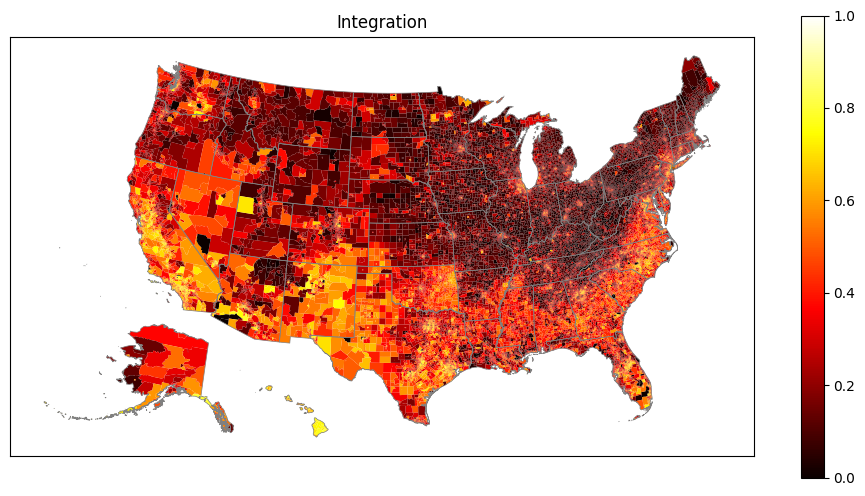










censusdis is a package for discovering, loading, and analyzing U.S. Census data. It is designed
- to support every dataset, every geography, and every year. It's not just about ACS data through the last time the software was updated and released;
- to support all geographies, on and off-spine, not just states, counties, and census tracts;
- to have integrated mapping capabilities that save you time and extra coding;
- to be intuitive, Pythonic, and fast.
Note:
For the full README, please visit the censusdis source repository.
Installation and First Example
censusdis can be installed with pip:
pip install censusdis
Every censusdis query needs four things:
- What data set we want to query.
- What vintage, or year.
- What variables.
- What geographies.
Here is an example of how we can use censusdis to download data once we know those four things.
import censusdis.data as ced
from censusdis.datasets import ACS5
from censusdis import states

df_median_income = ced.download(
    # Data set: American Community Survey 5-Year
    dataset=ACS5,
    # Vintage: 2022
    vintage=2022,
    # Variable: median household income
    download_variables=["NAME", "B19013_001E"],
    # Geography: All counties in New Jersey.
    state=states.NJ,
    county="*",
)
There are many more examples in the tuturial and in the sample notebooks.
Tutorial (A Great Place to Start!)
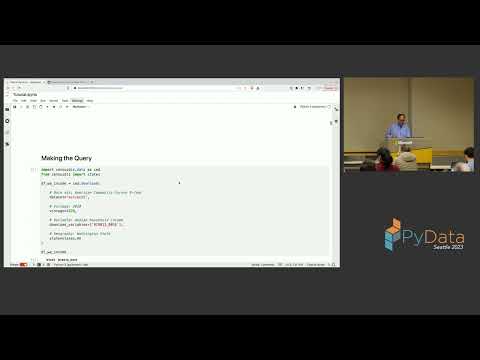
For a tutorial, please see the censusdis-tutorial repository. This tutorial was presented at PyData Seattle 2023. If you want to try it out for yourself, the README.md contains links that let you run the tutorial notebooks live on mybinder.org in your browser without needing to set up a local development environment or download or install any code.
Tutorial Video
A 86 minute video of the tutorial as presented at PyData Seattle 2023 is also available.
More Details
For the full README, lots of maps, demo notebooks, and more, please visit the censusdis source repository.
1 maintainer

Metadata
1 maintainer
Release files for censusdis 1.5.0
For a detailed explanation of source distributions (sdists) and built distributions (wheels), please see the package formats documentation.
Source distribution (sdist)
| File | Size | Uploaded | Provenance | Actions |
|---|---|---|---|---|
| censusdis-1.5.0.tar.gz | 393.5 kB | Without provenance | Details for censusdis-1.5.0.tar.gz |
Built distribution (wheel)
| File | Interpreter | ABI | Platform | Actions Reset |
|---|---|---|---|---|
| censusdis-1.5.0-py3-none-any.whl | Python 3 | none | any | Details for censusdis-1.5.0-py3-none-any.whl |
Total release size: 829.9 kB
Release files / censusdis-1.5.0.tar.gz
| Download URL | censusdis-1.5.0.tar.gz |
|---|---|
| Size | 393.5 kB |
| Tags | Source |
|
SHA-256 checksum How to use checksums |
c5df7b46a1807616b3a722e8dd1e344411630ac7e5074e22f96e0610719c4295
|
|
BLAKE2b-256 checksum How to use checksums |
c945809dc10ee924e7c3799c68b79ea2e82029f8e7e1206bbbb54ce132c70586
|
| Upload date | |
|
Uploaded using Trusted Publishing? What is trusted publishing? |
No |
| Uploaded via |
poetry/2.5.2 CPython/3.11.4 Darwin/24.6.0
|
Release files / censusdis-1.5.0-py3-none-any.whl
| Download URL | censusdis-1.5.0-py3-none-any.whl |
|---|---|
| Size | 436.4 kB |
| Tags | Python 3 |
|
SHA-256 checksum How to use checksums |
a9605bb309ac22492c4c25a365dfb445f14ac89186209101341c275ea1cef255
|
|
BLAKE2b-256 checksum How to use checksums |
1f145474c00fbd2a6f89003737e4613a28029d35cd2dc2ba6025b04c6c541eff
|
| Upload date | |
|
Uploaded using Trusted Publishing? What is trusted publishing? |
No |
| Uploaded via |
poetry/2.5.2 CPython/3.11.4 Darwin/24.6.0
|
Security for censusdis 1.5.0
Provenance
Provenance describes where a file came from. On PyPI, provenance is shared via attestations, which provide a verifiable record of the build or publishing details. View details, limitations and caveats.
No provenance found
None of the files in this release were uploaded with provenance metadata.
A note on package security
PyPI is a repository for distributing packages, not a service for auditing them. While third-party security researchers and our staff do their best to detect and remove malicious packages, PyPI cannot guarantee the quality, security or suitability of any given package.
To learn more about protecting yourself from malicious actors, visit our package security documentation.














