



🧠 Cerebrofy
AI-powered codebase intelligence CLI.
Cerebrofy indexes your repository into a local graph + vector database, then exposes it to AI assistants via MCP — letting them navigate your codebase with surgical precision instead of reading entire files. Zero code uploaded to any server.
cerebrofy init && cerebrofy build
# → Parses, graphs, embeds — one local index, ready for AI tools
cerebrofy validate
# → clean
The Problem: LLM Context Is Expensive
When you ask an AI agent to help with a feature in a real codebase, the naive approach is to dump files into the context window. That approach has three problems:
- Cost: a 20,000 LOC codebase is ~600,000 tokens per query
- Noise: the LLM reads code that is irrelevant to the task
- Hallucination: without structural grounding, the LLM guesses at call relationships and import paths
Cerebrofy solves this by pre-computing a structural + semantic index of your code. Instead of dumping files, it gives the LLM exactly what it needs:
| What the LLM receives | Token count | How it's selected |
|---|---|---|
| 10 matched Neuron signatures | ~500 tokens | KNN cosine similarity search |
| Their depth-2 call graph | ~800 tokens | BFS over the edges table |
| 2–3 pre-written lobe summaries | ~8,000 tokens | Affected lobe .md files |
| Total | ~10,000 tokens | vs. ~600,000 for raw files |
~97% token reduction on a typical mid-size codebase. The LLM gets a precise, grounded, zero-hallucination view of the code it actually needs — not a random 20-file dump.
How Cerebrofy Grounds the LLM
graph TD
    A[Your Codebase<br/>~600,000 tokens] -->|cerebrofy build| B[(cerebrofy.db)]

    B --> N[Neurons<br/>named functions · classes · modules]
    B --> G[Call Graph<br/>LOCAL_CALL · EXTERNAL_CALL · IMPORT]
    B --> V[Vector Embeddings<br/>semantic meaning per Neuron]
    B --> L[Lobe Summaries<br/>pre-written per-module Markdown]

    N & G & V & L -->|user description| H[Hybrid Search<br/>KNN cosine + BFS depth-2]

    H --> P[LLM Prompt<br/>~10,000 tokens<br/>real names · real paths · real call chains]
    P --> S[Grounded Spec]
The call graph answers the question an LLM cannot answer from code alone: "if I change this function, what else breaks?" Cerebrofy computes this once at build time with O(1) edge lookups — no approximation, no guessing.
How It Works
Cerebrofy builds a structural + semantic index of your code in one SQLite file (.cerebrofy/db/cerebrofy.db):
- Parse — Tree-sitter extracts named functions, classes, and modules as Neurons
- Graph — Call relationships become typed edges (
LOCAL_CALL,EXTERNAL_CALL,RUNTIME_BOUNDARY) - Embed — Each Neuron is embedded into a
sqlite-vecvector table for semantic search - Query — Hybrid search (KNN cosine + BFS depth-2) finds affected code units for any description
- Expose — An MCP stdio server lets AI clients trigger builds, run drift checks, and update the index
No cloud index. No code upload. One file, one connection.
Platform Support
Cerebrofy runs on Linux, macOS, and Windows. All commands (init, build, update, validate, viz, mcp) behave identically across platforms with one prerequisite difference:
| Platform | Prerequisites | Notes |
|---|---|---|
| Linux / macOS | Python 3.11+, Git | No extra setup |
| Windows | Python 3.11+, Git for Windows | Required for git hook execution (MSYS bash) |
Windows users: Install Git for Windows before running
cerebrofy init. Git for Windows bundles MSYS bash, which is what runs the installed git hooks. Without it,cerebrofy initsucceeds but the pre-commit / pre-push / post-merge hooks will not fire.
Installation
Recommended: uv tool install
# Base install — includes local embeddings (BAAI/bge-small-en-v1.5, offline)
uv tool install cerebrofy

# With MCP server support (Claude Desktop, Cursor, VS Code, etc.)
uv tool install "cerebrofy[mcp]"
Note: Embeddings are bundled in the base install via
fastembed. No extra required forcerebrofy buildorcerebrofy update. The only optional extra is[mcp].
Alternative installers
pip install cerebrofy
pipx install cerebrofy

# With MCP
pip install "cerebrofy[mcp]"
pipx install "cerebrofy[mcp]"
From source
git clone https://github.com/mm0rsy/cerebrofy
cd cerebrofy
uv sync --group dev
Run tests:
# Unit + integration tests (no MCP)
uv run pytest tests/unit/ tests/integration/test_update_command.py \
  tests/integration/test_validate_command.py tests/integration/test_migrate_command.py

# Full suite including MCP integration tests
uv sync --extra mcp --group dev
uv run pytest
Quick Start
Three commands, then git handles everything automatically:
# Step 1 — one time per repo
cerebrofy init

# Step 2 — one time after init (takes ~30s on a typical codebase)
cerebrofy build

# Step 3 — optional: wire your AI client so it uses the index instead of reading files
cerebrofy init --ai claude      # writes navigation rules to CLAUDE.md
cerebrofy init --ai copilot     # writes rules to .github/copilot-instructions.md
cerebrofy init --ai opencode    # writes rules to .opencode/instructions.md
That's it. From here, cerebrofy update runs automatically on every git commit (via the installed pre-commit hook) and the index is validated before every git push. You never need to run cerebrofy update manually.
your workflow:
  code → git commit  →  index auto-updated  ✓
                ↓
           git push   →  index validated     ✓
First time on a new machine? After cloning a repo that already has cerebrofy:
cerebrofy init   # re-installs hooks
cerebrofy build  # builds your local index from scratch
Once the index is built, AI assistants with MCP configured can call all 27 tools and read MCP resources directly — see MCP Tools and MCP Resources.
Commands
cerebrofy init
Scaffold .cerebrofy/, auto-detect Lobes, install git hooks, and register the MCP server.
cerebrofy init                           # Local MCP registration (default)
cerebrofy init --global                  # Register MCP globally (~/.config/mcp/servers.json)
cerebrofy init --no-mcp                  # Skip MCP registration
cerebrofy init --force                   # Re-initialize, overwrite MCP entry with current binary path
cerebrofy init --ai claude               # Also write AI navigation rules to CLAUDE.md
cerebrofy init --ai copilot              # Also write rules to .github/copilot-instructions.md
cerebrofy init --ai vscode               # Same as --ai copilot
cerebrofy init --ai opencode             # Also write rules to .opencode/instructions.md
What it creates:
.cerebrofy/
├── config.yaml          ← Lobe map, tracked extensions, embed model
├── arch-rules.yaml      ← Architecture drift rules (scaffolded sample)
├── db/                  ← cerebrofy.db lives here (gitignored)
└── queries/             ← Tree-sitter .scm files per language
.cerebrofy-ignore        ← Ignore rules (gitignore syntax)
.gitignore               ← .cerebrofy/db/ appended automatically
.git/hooks/pre-commit    ← Auto-runs cerebrofy update + arch check on every commit
.git/hooks/pre-push      ← Validates index + runs the arch check before push
.git/hooks/post-merge    ← state_hash sync check after git pull
The --ai flag appends a fenced navigation rules block to the target instructions file. The block is idempotent — re-running replaces the existing block rather than appending a second copy. It also writes .github/workflows/cerebrofy-arch.yml so CI runs the architecture check on every pull request (an existing workflow file is kept unless --force).
cerebrofy build
Full atomic re-index of the repository.
cerebrofy build
Writes to cerebrofy.db.tmp, swaps atomically to cerebrofy.db only on success. An interrupted build leaves no corrupted state. Runs 6 steps:
| Step | Action |
|---|---|
| 0 | Create .tmp database, apply schema |
| 1 | Parse all tracked source files → Neurons |
| 2 | Build intra-file call graph (LOCAL_CALL edges) |
| 3 | Resolve cross-module calls (EXTERNAL_CALL, IMPORT, RUNTIME_BOUNDARY edges) |
| 4 | Generate embeddings for all Neurons (BAAI/bge-small-en-v1.5, 384-dim, offline) |
| 5 | Commit file hashes + state_hash, atomic swap |
| 6 | Write per-lobe Markdown docs and cerebrofy_map.md |
cerebrofy update
Partially re-index only changed files — target latency < 2s for a single-file change.
cerebrofy update                        # Auto-detect via git
cerebrofy update src/auth/login.py      # Explicit file list
Detects changes via git diff (falls back to file hash comparison in non-git repos). Uses depth-2 BFS to find and re-index all affected neighbors. All writes are wrapped in a single BEGIN IMMEDIATE transaction — on failure, full rollback.
After a successful update that completes in under 2 seconds, the pre-push git hook is automatically upgraded from warn-only (v1) to hard-block (v2).
cerebrofy validate
Classify drift between the index and current source.
cerebrofy validate
Exit codes:
| Code | Meaning |
|---|---|
| 0 | Index is clean, or minor drift (whitespace/comments only) |
| 1 | Structural drift — function added, removed, renamed, or signature changed |
This command is also invoked automatically by the pre-push git hook.
cerebrofy blast-radius
Compute the blast radius of a function or class — every caller at depth 1 and 2, test coverage gaps, lobe spread, and a risk score.
cerebrofy blast-radius validate_token
cerebrofy blast-radius src/auth/tokens.py::validate_token --depth 3
cerebrofy blast-radius validate_token --format markdown   # PR comment format
cerebrofy context
Build the optimal context window for a coding task within a token budget. Uses KNN + BFS to find relevant Neurons, then greedy-packs them by relevance with tier degradation. JSON output includes a full epistemic confidence payload (overall_confidence, neurons_changed_since_build, unindexed_languages, etc.).
cerebrofy context "add rate limiting to the payments API"
cerebrofy context "refactor auth module" --budget 12000
cerebrofy context "fix token expiry bug" --output claude-xml
cerebrofy epistemic
Show the epistemic confidence score and staleness warnings for the current index.
cerebrofy epistemic
cerebrofy epistemic --json   # machine-readable output for agent consumption
cerebrofy health
Show longitudinal codebase health metrics derived from the call graph, with deltas vs the previous build.
cerebrofy health                      # current snapshot vs last build
cerebrofy health --history 30         # last 30 builds in a table
cerebrofy health --trend coupling     # ASCII sparkline for a metric over time
cerebrofy health --export json        # machine-readable snapshot
cerebrofy health --watch              # live-update: re-renders after each build
cerebrofy arch
Enforce architecture rules as queries over the live call graph — "the API layer must never call the database directly" is checked against real call edges, not imports, so violations that regex- or import-based tools miss are caught here. Rules live in .cerebrofy/arch-rules.yaml (scaffolded by cerebrofy init; four check kinds: no_edge, no_cycles, allowed_callers, max_blast_radius).
cerebrofy arch init                                         # interactive rule builder
cerebrofy arch check                                        # all rules; exit 1 on error-severity violations
cerebrofy arch check --rule no-direct-db-in-api
cerebrofy arch check --since HEAD~1 --format github-annotations
cerebrofy arch check --write-memories                       # record violations as warning memories
cerebrofy arch explain no-direct-db-in-api                  # rule definition + every current violation
cerebrofy arch history                                      # when each rule was first violated
cerebrofy arch watch --interval 2                           # live terminal monitor
While .cerebrofy/arch-rules.yaml exists, the git hooks run the check on every commit and push and the verdict is always blocking. cerebrofy init --ai writes .github/workflows/cerebrofy-arch.yml for the same gate in CI. Results include the index confidence score, warning rules that touch a sprint-priority lobe (.cerebrofy/intent.yaml) escalate to errors for the sprint, and violation counts trend in cerebrofy health --trend arch_violations.
cerebrofy memory
Write and query structured memories attached to neurons and lobes. Memories persist across full rebuilds in a separate memories.db and decay over time using a configurable half-life (default 70 days). Stale memories are surfaced in the epistemic confidence score.
cerebrofy memory add "Clock skew breaks token expiry" \
    --type warning --neuron auth/tokens.py::validate_token --tags "security,jwt"
cerebrofy memory search "JWT expiry edge cases" --lobe auth
cerebrofy memory list --lobe auth --type warning
cerebrofy memory link <from-id> <to-id> --rel motivated
cerebrofy memory export --format markdown > DECISIONS.md
cerebrofy intent
Manage the product intent declaration file (.cerebrofy/intent.yaml) — sprint goals, incidents, architectural direction.
cerebrofy intent init        # scaffold intent.yaml with commented sections
cerebrofy intent show        # display current intent (human-readable)
cerebrofy intent show --json # machine-readable for agent consumption
cerebrofy intent edit        # open in $EDITOR
cerebrofy intent validate    # check YAML + validate lobe names against graph
cerebrofy mcp
Start the MCP stdio server. Used by AI tools (Claude Desktop, Cursor, VS Code, etc.) — not invoked manually.
cerebrofy mcp # requires: uv tool install "cerebrofy[mcp]"
Exposes 27 fully operational tools plus URI-addressable MCP resources. See docs/mcp-integration.md for full setup.
cerebrofy viz
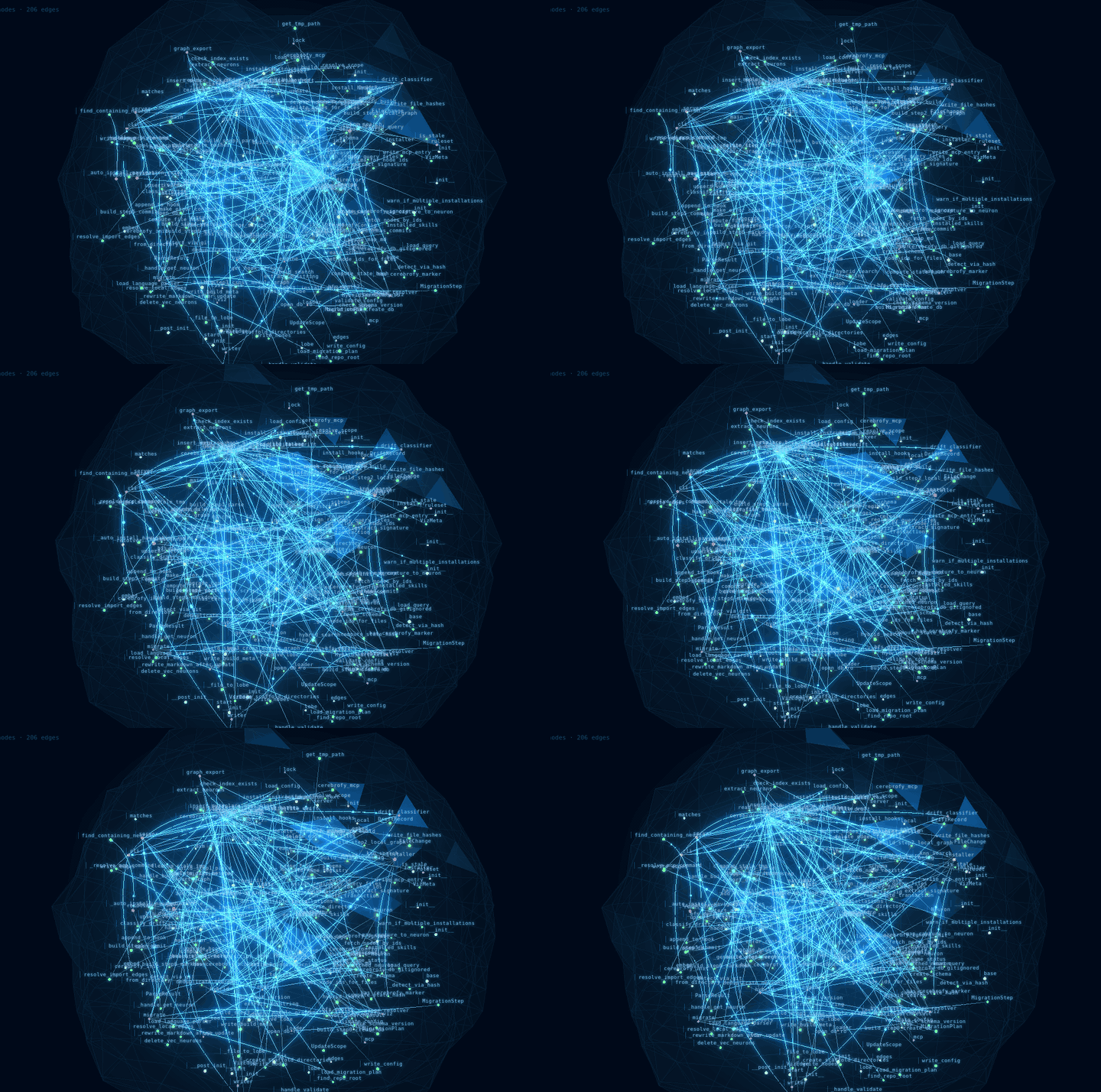
Launch an interactive 3D brain visualization of your codebase's call graph in the browser.
cerebrofy viz
# → Serving at http://localhost:7331
Each node is a function, class, or module. Color encodes its position in the call graph:
| Color | Meaning |
|---|---|
| 🔴 Red | Pure sources — entry points called by nothing (CLI commands, top-level scripts) |
| 🟠 Orange / 🟡 Yellow | Mid-graph — both call and are called |
| 🟢 Green | Pure leaves — utilities called by others, call nothing |
| 🟤 Grey-gold | Isolated — no edges in the filtered graph |
Nodes are distributed throughout the full brain interior using volumetric sphere sampling. Source nodes are placed at the cortex surface. Clicking any node shows its docstring and metadata in a side panel.
Works on any cerebrofy-indexed Python project — no project-specific configuration required.
cerebrofy impact
Predict the full blast radius of a refactor before touching any code. Runs BFS caller traversal, maps test coverage, estimates lines of code affected, and produces a recommended refactoring sequence.
cerebrofy impact auth/tokens.py::validate_token
cerebrofy impact validate_token --depth 3
cerebrofy impact auth/tokens.py:42 --no-sequence
cerebrofy impact auth/tokens.py::validate_token --output json
| Output field | Meaning |
|---|---|
| Callers (Depth 1/2) | Direct and transitive callers via BFS |
| Lobes Crossed | Number of architectural boundaries the change touches |
| Estimated LoC | Lines of code across all affected neurons |
| Complexity Rating | 🟢 LOW / 🟡 MEDIUM / 🔴 HIGH |
| Memory Warnings | warning memories attached to the target from cerebrofy memory |
| Refactoring Sequence | Reverse-topological order — update callers leaf-first to minimise breakage |
cerebrofy plan
Generate a step-by-step, graph-aware refactoring plan from a plain-English description — before touching any code. The planner matches your description against the semantic index, expands the match into a cohesive neuron cluster (>50% internal edges), and sequences a dependency-safe migration: new module skeleton → moves with re-export stubs → caller updates → stub removal + tests.
cerebrofy plan "extract the payment logic into a payments service"
cerebrofy plan "move all database connection code into a db/ module"
cerebrofy plan "extract the auth helpers" --output json       # CI/CD task list
cerebrofy plan "extract the auth helpers" --execute            # + AI execution handoff
The plan is a human-in-the-loop pre-flight checklist. dry_run defaults to true — no files are ever modified by the planner. --execute only prepares an optimized execution-handoff context window for the AI agent that will implement the plan (verified per-step with cerebrofy impact).
| Output | Description |
|---|---|
| cluster | Neurons matched by the description (KNN seeds + graph expansion) |
| proposed_structure | New module name + file mapping (source → target) |
| callers_to_update | Every direct caller outside the cluster (100% list) |
| steps | Ordered migration steps — skeleton first, callees before callers, stubs removed last |
| estimated_hours | Effort estimate from cluster size, caller count, and file count |
| files_affected | Total distinct files touched across cluster, targets, and callers |
Error codes: NO_INDEX (run cerebrofy build first), CLUSTER_TOO_SMALL (< 2 neurons matched — refine the query), CLUSTER_TOO_LARGE (> 200 neurons matched — scope more narrowly).
cerebrofy onboard
Generate a personalized onboarding guide from the cerebrofy index — a topology-derived reading order, entry points, complexity hotspots, and safe zones for any developer joining the project.
cerebrofy onboard                          # generates .cerebrofy/ONBOARDING.md
cerebrofy onboard --name "Alice"           # personalized welcome header
cerebrofy onboard --focus auth             # restrict guide to the auth lobe
cerebrofy onboard --format html            # self-contained interactive HTML
cerebrofy onboard --depth senior           # skip basics, focus on architecture
cerebrofy onboard --output ~/ONBOARDING.md # write to a custom path
The guide includes:
| Section | Source |
|---|---|
| Reading Order | Topological sort of lobes by call-graph dependency |
| Entry Points | Neurons with in_degree == 0 && out_degree > 0 (CLI commands, event handlers) |
| Hotspots | Top-10 functions by blast radius — understand these before touching them |
| Safe Zones | Lobes with low coupling and low blast radius — start contributing here |
| Things to Know | warning and decision memories attached to high-traffic neurons |
Output is written to .cerebrofy/ONBOARDING.md (or .cerebrofy/ONBOARDING.html with --format html). The HTML output is fully self-contained with zero external dependencies.
cerebrofy vuln
Map which of your functions are exposed to a vulnerable package — before patching anything. Finds every call site via the call graph, traces backward to trust boundary entry points, scores exposure, and produces a prioritised remediation sequence.
cerebrofy vuln --package requests
cerebrofy vuln --package requests --function requests.get
cerebrofy vuln --package pyyaml --write-memories
cerebrofy vuln --package requests --depth 3 --output json
| Output field | Meaning |
|---|---|
| Direct Callers | Neurons with a RUNTIME_BOUNDARY edge to the package |
| Critical Exposure | Entry points where external input reaches the vulnerable call (exposure_score 1.0 / 0.6) |
| Low Exposure | Internal callers with no detected external input path (tests, utilities) |
| Pinned Version | Version pinned in pyproject.toml / requirements.txt — compare against CVE advisory manually |
| Remediation Sequence | Patch highest-exposure entry points first, then pin the safe package version |
| Memories Written | Warning memories auto-attached to each affected neuron (with --write-memories) |
cerebrofy silo
Identify knowledge silos — functions with high blast radius owned by few contributors. Overlays git blame authorship on the call graph to compute bus factor risk: a function called by many but written by one is a single point of failure.
cerebrofy silo                              # full report, top 20 silos
cerebrofy silo --top 10 --min-callers 3    # high-traffic functions only
cerebrofy silo --lobe auth                 # restrict to a specific lobe
cerebrofy silo --author alice@company.com  # "if Alice left, what breaks?"
cerebrofy silo --risk high                 # show only HIGH/CRITICAL silos
cerebrofy silo --write-memories            # attach warning memories to HIGH/CRITICAL neurons
cerebrofy silo --output json               # machine-readable output
| Output field | Meaning |
|---|---|
| Silo score | caller_count ÷ unique_authors — higher = more dangerous concentration |
| Primary owner | Author with the most lines in the neuron's line range |
| Own% | Fraction of lines owned by the primary author |
| Unique authors | Number of distinct contributors to this neuron |
| Risk | CRITICAL (≥20) / HIGH (≥8) / MEDIUM (≥3) / LOW (<3) |
| Memories written | Warning memories auto-attached to each HIGH/CRITICAL neuron (with --write-memories) |
cerebrofy coverage-gap
Rank uncovered neurons by blast radius × change velocity to surface functions most likely to cause production bugs. A function that is widely-called, actively changing, and has no tests is the highest-priority coverage gap.
Coverage is sourced from coverage.xml (pytest-cov) when present; otherwise derived from the call graph (any test file with an edge to the neuron). The coverage_source field in every result tells you which was used.
cerebrofy coverage-gap                          # top 20 gaps, 30-day velocity window
cerebrofy coverage-gap --days 14               # tighten velocity to 2 weeks
cerebrofy coverage-gap --min-blast 2           # only functions with meaningful blast radius
cerebrofy coverage-gap --lobe auth             # restrict to a specific lobe
cerebrofy coverage-gap --risk critical         # show only CRITICAL gaps
cerebrofy coverage-gap --write-memories        # attach warning memories to HIGH/CRITICAL neurons
cerebrofy coverage-gap --output json           # machine-readable output
| Output field | Meaning |
|---|---|
| Gap score | risk_score(blast_radius) × velocity — higher = more dangerous gap |
| Callers | Total callers at depth 1+2 from BFS traversal |
| Commits/Nd | Git commits touching the file in the last N days (velocity) |
| Coverage source | coverage_xml (pytest-cov) or graph_topology (call-edge fallback) |
| Risk | CRITICAL (≥100) / HIGH (≥25) / MEDIUM (≥5) / LOW (<5) |
| Memories written | Warning memories auto-attached to each HIGH/CRITICAL neuron (with --write-memories) |
cerebrofy migrate
Run sequential schema migration scripts.
cerebrofy migrate
Scripts live in .cerebrofy/scripts/migrations/. Safe to run multiple times — already-applied migrations are skipped.
cerebrofy session
Record, replay, and audit AI agent sessions — closing the "what did the agent actually do?" gap. Recording is opt-in (record_sessions: true in .cerebrofy/config.yaml) and local-only: every MCP tool call is stored in .cerebrofy/db/sessions.db, which is separate from the index database so it survives rebuilds.
cerebrofy session list                                   # list recorded sessions
cerebrofy session show sess_abc123                       # full replay (latest when omitted)
cerebrofy session diff sess_abc123                       # graph changes the session made
cerebrofy session search "rate limiting"                 # semantic search across session tasks
cerebrofy session export sess_abc123 --format html       # shareable self-contained HTML report
cerebrofy session export --format html --output report.html
A session is started and ended via the MCP tools cerebrofy_session_start / cerebrofy_session_end; every tool call in between is recorded automatically by the SessionMiddleware woven into the MCP dispatcher. cerebrofy session diff answers "what did this session do to the graph?" — which neurons it touched, which disappeared, and whether the blast radius (Idea #01) grew, shrank, or stayed flat.
| Command | Purpose |
|---|---|
list |
Sessions newest-first with outcome and event count |
show |
Full Markdown timeline + graph diff + risk assessment (JSON with --format json) |
diff |
Graph delta (touched / missing / appeared / refreshed) and blast-radius verdict |
search |
Semantic KNN over task text (fallback: task-text match when embeddings are unavailable) |
export |
Self-contained HTML / Markdown / JSON report |
MCP Tools
When configured via cerebrofy init, AI assistants can call these tools directly against your index:
| Tool | Description |
|---|---|
search_code |
Hybrid KNN + BFS semantic search — primary navigation tool. |
get_neuron |
Fetch a specific Neuron by name or file:line. |
list_lobes |
List indexed lobes with summary file paths. |
cerebrofy_context |
Build optimal context window for a task within a token budget. |
cerebrofy_blast_radius |
Compute every caller affected by a changed neuron + risk score. |
cerebrofy_epistemic |
Return index confidence score and staleness warnings. |
cerebrofy_health |
Longitudinal codebase health metrics from the call graph. |
cerebrofy_intent |
Return sprint goals, incidents, and architectural direction. |
cerebrofy_arch_check |
Check .cerebrofy/arch-rules.yaml architecture rules against the call graph; results carry index confidence and sprint-priority escalations. |
cerebrofy_build |
Trigger a full atomic re-index from the AI client. |
cerebrofy_update |
Trigger an incremental re-index. Pass path to target a specific file. |
cerebrofy_validate |
Check for drift. Returns clean, minor_drift, or structural_drift. Zero writes. |
cerebrofy_remember |
Write a structured memory (insight, warning, decision) to the memory store. |
cerebrofy_recall |
Semantic search over stored memories. |
cerebrofy_memories |
List all memories, optionally filtered by lobe or type. |
cerebrofy_link_memories |
Create a directed link between two memories. |
cerebrofy_trace_history |
Trace the ancestry chain of a memory through its linked predecessors. |
cerebrofy_onboard |
Generate a topology-derived onboarding guide: reading order, entry points, hotspots, safe zones, and memory warnings. |
cerebrofy_impact |
Pre-change impact prediction: callers, test coverage, lobe spread, estimated LoC, memory warnings, and refactoring sequence. |
cerebrofy_plan |
Generate a graph-aware, step-by-step refactoring plan from a plain-English description — which neurons to extract, where they move, which callers to update, and in what safe order. Markdown + optional JSON. Never modifies files. |
cerebrofy_vuln |
Vulnerability blast radius: find which of your functions call a vulnerable package, score exposure by trust boundary proximity, and generate a remediation sequence. |
cerebrofy_silo |
Knowledge silo detector: overlay git blame on the call graph to compute bus factor risk per neuron. Filter by lobe, author, or risk level. Pass author to answer "if this person left, what breaks?" |
cerebrofy_coverage_gap |
Test coverage gap predictor: rank uncovered neurons by blast radius × change velocity. Uses coverage.xml when present, falls back to graph topology. Surfaces the functions most likely to cause production bugs if a bug is introduced. |
cerebrofy_session_start |
Start recording an agent session (opt-in via record_sessions: true). Call before a coding task. |
cerebrofy_session_end |
End the active session: records outcome, duration, neurons touched, events, and blast-radius before/after. |
cerebrofy_session_show |
Return a full replay of a session (latest when omitted): timeline, neurons touched, graph diff, blast-radius verdict. |
cerebrofy_list_resources |
Discover every MCP resource URI (static resources + URI templates), optionally filtered by type. |
All data-reading tools automatically include an "epistemic" field with the current confidence score, and an "intent_context" field if .cerebrofy/intent.yaml exists.
Full tool reference: docs/mcp-integration.md
MCP Resources
Beyond tools, the server exposes URI-addressable resources — ambient context an AI client can read (or auto-include) without an explicit tool call:
| Resource | Type | Content |
|---|---|---|
cerebrofy://graph/map |
Markdown | Full codebase map |
cerebrofy://graph/entry-points |
JSON | Entry-point neurons (no non-runtime callers, with outgoing edges) |
cerebrofy://health/current |
JSON | Latest codebase health snapshot |
cerebrofy://lobes/{name} |
Markdown | Per-lobe summary |
cerebrofy://neurons/{neuron_id} |
JSON | Single neuron details — source, signature, direct callers (file::name) |
cerebrofy://neurons/file/{file_path} |
JSON | All neurons defined in a source file |
cerebrofy://neurons/search?q={query} |
JSON | Hybrid semantic search results |
cerebrofy://memories/{neuron_id} |
JSON | Memories attached to a neuron |
cerebrofy://blast-radius/{neuron_id} |
JSON | Callers, risk score, and PR-comment summary |
Discover them with the cerebrofy_list_resources tool (filter: graph, lobes, neurons, health, memories, blast-radius, or all).
Live updates: clients can resources/subscribe to any URI. After cerebrofy update or cerebrofy build changes the index, the server emits notifications/resources/updated for subscribed URIs, so the AI never works with stale graph data.
Lobes
A Lobe is a named module group — typically one top-level directory in your repository. Cerebrofy auto-detects Lobes at cerebrofy init time. Each Lobe gets a Markdown summary at docs/cerebrofy/<name>_lobe.md.
Lobes are configured in .cerebrofy/config.yaml:
lobes:
  auth: src/auth/
  api: src/api/
  db: src/db/
The lobe name surfaces in MCP tool output ("lobe": "auth") and in lobe summary files used as AI context.
Embedding Model
Cerebrofy uses BAAI/bge-small-en-v1.5 via fastembed:
| Property | Value |
|---|---|
| Dimensions | 384 |
| Format | ONNX (no PyTorch) |
| Size | ~130 MB (cached after first cerebrofy build) |
| Offline | Yes — no API key, no network after first download |
| Extra required | None — bundled in base install |
Language Support
Cerebrofy uses Tree-sitter with .scm query files. Supported out of the box:
Python · JavaScript · TypeScript · TSX · JSX · Go · Rust · Java · Ruby · C++ · C
To add a new language, add a .scm query file to .cerebrofy/queries/ and add the extension to tracked_extensions in config.yaml. See docs/architecture.md for details.
Git Hooks
Cerebrofy installs three hooks at cerebrofy init time:
| Hook | Trigger | Behavior |
|---|---|---|
pre-commit |
After every git commit |
Auto-runs cerebrofy update silently, then the architecture check. Index drift never blocks; architecture violations do. |
pre-push |
Before git push |
Validates the index (auto-runs cerebrofy update if drift slipped through) and runs the architecture check with a full report. Blocks if the update fails or rules are violated. |
post-merge |
After git pull / merge |
Compares remote state_hash against local index; warns if out of sync. |
All three hooks are installed by cerebrofy init. You should never need to run cerebrofy update manually — the pre-commit hook does it on every commit. The pre-push hook is a safety net for cases where the pre-commit hook wasn't installed or was bypassed.
The architecture gate is armed by the rules file: the check only runs while .cerebrofy/arch-rules.yaml exists, and when it runs its verdict is always blocking — error-severity violations, including warnings escalated by a sprint-priority lobe, refuse the commit or push. cerebrofy update upgrades existing hooks in place to the current version; it never downgrades them.
Windows
Hooks are written as POSIX sh scripts and executed by the MSYS bash shell that ships with Git for Windows — no extra configuration needed. If hooks don't appear to run after cerebrofy init, confirm that git on your PATH comes from Git for Windows (not WSL or another distribution).
Configuration
Full reference: docs/configuration.md
Quick example .cerebrofy/config.yaml:
lobes:
  auth: src/auth/
  api: src/api/

tracked_extensions:
  - .py
  - .ts
  - .go

embedding_model: local      # local | none
Output Files
| Path | Created by | Description |
|---|---|---|
.cerebrofy/db/cerebrofy.db |
cerebrofy build |
Full index — graph + vectors |
docs/cerebrofy/<name>_lobe.md |
cerebrofy build / update |
Per-lobe Neuron + call table |
docs/cerebrofy/cerebrofy_map.md |
cerebrofy build / update |
Master index with state_hash |
.cerebrofy/arch-rules.yaml |
cerebrofy init / arch init |
Architecture rules — the gate is armed while this file exists |
.cerebrofy/arch-history.jsonl |
cerebrofy arch check |
Append-only check history — feeds health --trend arch_violations |
The lobe .md and map files are committed to git (not gitignored). They form the human-readable index of your codebase and serve as AI context when used with MCP tools.
MCP Integration
Cerebrofy ships an MCP stdio server with 27 fully operational tools and URI-addressable resources (read + subscribe).
# Install with MCP support
uv tool install "cerebrofy[mcp]"

# Initialize — auto-registers the MCP entry with the absolute binary path
cerebrofy init

# Re-register if the binary moved (e.g. after reinstall)
cerebrofy init --force
See docs/mcp-integration.md for client-specific registration, manual setup, and per-tool schemas.
Multi-Developer Workflow
cerebrofy.db is a local artifact — it is not committed to git (.cerebrofy/db/ is gitignored automatically by cerebrofy init). Each developer builds and maintains their own index. Synchronization uses state_hash in cerebrofy_map.md, which is committed.
| Event | What happens |
|---|---|
| First clone | .cerebrofy/ missing → run cerebrofy init && cerebrofy build. Pre-push hook warns but does not block. |
| Daily development | Edit code → cerebrofy update syncs the index in < 2s. Pre-push hook validates automatically. |
git pull / merge |
Post-merge hook compares remote state_hash (from pulled cerebrofy_map.md) against local index. Warns if they differ — run cerebrofy build to resync. |
| Embedding model change | Change embedding_model in config.yaml → run cerebrofy build to rebuild the vector table at the new dimension. |
Performance Targets
Engineering targets validated against real repositories, not guaranteed results.
| Metric | Target |
|---|---|
| Token reduction | ~97% — 20k LOC (~600k tokens) → 10 matched Neurons + lobe context (~15k tokens) |
| Blast radius query | < 10ms — depth-2 BFS on 10,000-node graph via indexed SQLite |
cerebrofy update latency |
< 2s — single-file change, end-to-end including re-embedding |
cerebrofy build |
Linear in codebase size; local embedding model (~130MB, cached after first run) |
Contributing
- Architecture guide — module map, data flow, invariants, database schema
- Adding language support —
.scmquery file authoring - Tests:
uv run pytestafteruv sync --group dev - Lint:
uv run ruff check src/ tests/ - Type check:
uv run mypy src/
License
MIT
1 maintainer

Metadata
1 maintainer
Release files for cerebrofy 3.6.0
For a detailed explanation of source distributions (sdists) and built distributions (wheels), please see the package formats documentation.
Source distribution (sdist)
| File | Size | Uploaded | Provenance | |
|---|---|---|---|---|
| cerebrofy-3.6.0.tar.gz | 7.2 MB | With provenance | Details |
Built distribution (wheel)
| File | Interpreter | ABI | Platform | Reset |
|---|---|---|---|---|
| cerebrofy-3.6.0-py3-none-any.whl | Python 3 | none | any | Details |
Total release size: 8.2 MB
Release files / cerebrofy-3.6.0.tar.gz
| Download URL | cerebrofy-3.6.0.tar.gz |
|---|---|
| Size | 7.2 MB |
| Tags | Source |
|
SHA-256 checksum How to use checksums |
264411211b36ab1cc2247c87b9ffce25bb44fdf5810d42f845618e3b3b39a83a
|
|
BLAKE2b-256 checksum How to use checksums |
7e6e5376b369d4ad75b4267960f5e27005e0824ca5587dbef4a78b7d8aed7233
|
| Upload date | |
|
Uploaded using Trusted Publishing? What is trusted publishing? |
Yes |
| Uploaded via |
twine/7.0.0 CPython/3.13.14
|
Provenance
Provenance describes where a file came from. On PyPI, provenance is shared via attestations, which provide a verifiable record of the build or publishing details. View details, limitations and caveats.


PyPI Publish Attestation
PyPI verified that this artifact, at this checksum, originated from the publisher listed below.
Signed by GitHub Actions, verified by PyPI on Oct 18, 2026.
Transparency logRelease files / cerebrofy-3.6.0-py3-none-any.whl
| Download URL | cerebrofy-3.6.0-py3-none-any.whl |
|---|---|
| Size | 1.0 MB |
| Tags | Python 3 |
|
SHA-256 checksum How to use checksums |
3713d0610445ca292c896e617fa616d411bf7ffbb08df46d2db3e7a9558032f4
|
|
BLAKE2b-256 checksum How to use checksums |
61af9b4c546f920c9c9b006459875812306e220e9fd6a6e74307bd98d63422d5
|
| Upload date | |
|
Uploaded using Trusted Publishing? What is trusted publishing? |
Yes |
| Uploaded via |
twine/7.0.0 CPython/3.13.14
|
Provenance
Provenance describes where a file came from. On PyPI, provenance is shared via attestations, which provide a verifiable record of the build or publishing details. View details, limitations and caveats.
PyPI Publish Attestation
PyPI verified that this artifact, at this checksum, originated from the publisher listed below.
Signed by GitHub Actions, verified by PyPI on Oct 18, 2026.
Transparency logSecurity for cerebrofy 3.6.0
Provenance
Provenance describes where a file came from. On PyPI, provenance is shared via attestations, which provide a verifiable record of the build or publishing details. View details, limitations and caveats.
Full provenance
All 2 files in this release have been uploaded with provenance metadata.
Attestation for cerebrofy-3.6.0.tar.gz
PyPI Publish Attestation
PyPI verified that this artifact, at this checksum, originated from the publisher listed below.
Signed by GitHub Actions, verified by PyPI on Oct 18, 2026.
Transparency logA note on package security
PyPI is a repository for distributing packages, not a service for auditing them. While third-party security researchers and our staff do their best to detect and remove malicious packages, PyPI cannot guarantee the quality, security or suitability of any given package.














