
Cereja is a bundle of useful functions that I don't want to rewrite.

Project description
Cereja 🍒







Cereja was written only with the Standard Python Library, and it was a great way to improve knowledge in the Language also to avoid the rewriting of code.
Getting Started DEV
Don't be shy \0/ ... Clone the repository and submit a function or module you made or use some function you liked.
See CONTRIBUTING 💻
Setup
Installing
Install Cereja Package
python3 -m pip install --user cereja
or for all users
python3 -m pip install cereja
Note: If you're using Windows, you don't need use python3, but make sure your python path settings are correct.
Cereja Example usage
See some of the Cereja tools
Filetools
Have a fun
from cereja import FileIO
# load File
file = FileIO.load('test.json') # return FileIO.json object (has interface for .txt, .csv, .json and more)
print(dir(file))
Corpus
Great training and test separator.
Create from list data
import cereja as cj

X = ['how are you?', 'my name is Joab', 'I like coffee', 'how are you joab?', 'how', 'we are the world']
Y = ['como você está?', 'meu nome é Joab', 'Eu gosto de café', 'Como você está joab?', 'como', 'Nós somos o mundo']

corpus = cj.Corpus(source_data=X, target_data=Y, source_name='en', target_name='pt')
print(corpus) # Corpus(examples: 6 - source_vocab_size: 13 - target_vocab_size:15)
print(corpus.source) # LanguageData(examples: 6 - vocab_size: 13)
print(corpus.target) # LanguageData(examples: 6 - vocab_size: 15)

corpus.source.phrases_freq
# Counter({'how are you': 1, 'my name is joab': 1, 'i like coffee': 1, 'how are you joab': 1, 'how': 1, 'we are the world': 1})

corpus.source.word_freq
# Counter({'how': 3, 'are': 3, 'you': 2, 'joab': 2, 'my': 1, 'name': 1, 'is': 1, 'i': 1, 'like': 1, 'coffee': 1, 'we': 1, 'the': 1, 'world': 1})

corpus.target.phrases_freq
# Counter({'como você está': 1, 'meu nome é joab': 1, 'eu gosto de café': 1, 'como você está joab': 1, 'como': 1, 'nós somos o mundo': 1})

corpus.target.words_freq
# Counter({'como': 3, 'você': 2, 'está': 2, 'joab': 2, 'meu': 1, 'nome': 1, 'é': 1, 'eu': 1, 'gosto': 1, 'de': 1, 'café': 1, 'nós': 1, 'somos': 1, 'o': 1, 'mundo': 1})

# split_data function guarantees test data without data identical to training
# and only with vocabulary that exists in training
train, test = corpus.split_data() # default percent of training is 80%
Read from .csv
import cereja as cj

corpus = cj.Corpus.load_corpus_from_csv('path_to_file.csv', src_col_name='x_data', trg_col_name='y_data', source_name='en', target_name='pt')
# now you have a Corpus instance, have fun! (:
Progress
import cereja as cj
import time

def process_data(i: int):
    # simulates some processing
    time.sleep(cj.rand_n()/max(abs(i), 1))

my_iterable = range(1, 500)
my_progress = cj.Progress("My Progress")

for i in my_progress(my_iterable):
    process_data(i)

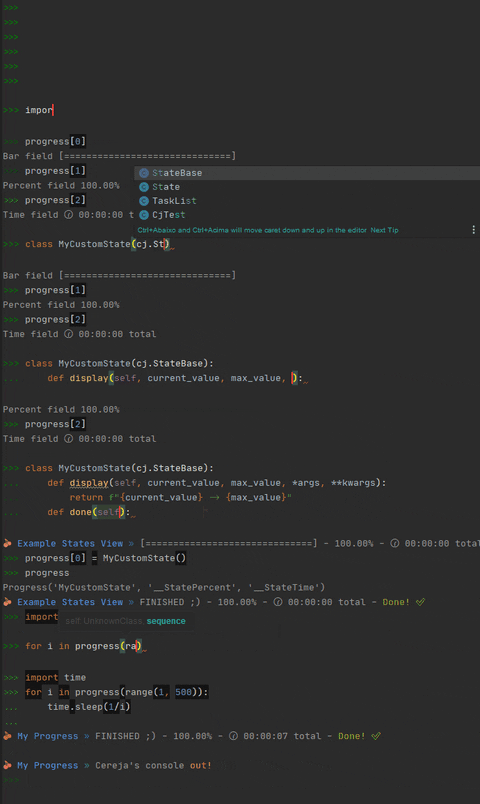
Custom Display
import cereja as cj
import time

progress = cj.Progress("My Progress")
print(progress)

print(progress[0])
print(progress[1])
print(progress[2])

class MyCustomState(cj.StateBase):
    def display(self, current_value, max_value, *args, **kwargs):
        return f'{current_value} -> {max_value}'
    def done(self, *args, **kwargs):
        return f'FINISHED'

progress[0] = MyCustomState

for i in progress(range(1, 500)):
    time.sleep(1/i)
With Statement
import cereja as cj
import time

with cj.Progress("My Progress") as prog:
    time.sleep(5)
    for i in prog(range(1, 500)):
        time.sleep(1/i)

Utils
import cereja.mathtools
import cereja as cj

# Arraytools
data = [[1,2,3],[3,3,3]]
cj.is_iterable(data) # True
cj.is_sequence(data) # True
cj.is_numeric_sequence(data) # True
cj.is_empty(data) # False
cj.get_shape(data) # (2, 3)

data = cj.flatten(data) # [1, 2, 3, 3, 3, 3]
cereja.mathtools.prod(data) # 162
cereja.mathtools.sub(data) # -13
cereja.mathtools.div(data) # 0.006172839506172839

cj.rand_n(0.0, 2.0, n=3) # [0.3001196087729699, 0.639679494102923, 1.060200897124107]
cj.rand_n(1,10) # 5.086403830031244
cj.array_randn((3, 3, 3)) # [[[0.015077210355770374, 0.014298110484612511, 0.030410666810216064], [0.029319083335697604, 0.0072365209507707666, 0.010677361074992], [0.010576754075922935, 0.04146379877648334, 0.02188348813336284]], [[0.0451851551098092, 0.037074906805326824, 0.0032484586475421007], [0.025633380630695347, 0.010312669541918484, 0.0373624007621097], [0.047923908102496145, 0.0027939333359724224, 0.05976224377251878]], [[0.046869510719106486, 0.008325638358172866, 0.0038702998343255893], [0.06475268683502387, 0.0035638592537234623, 0.06551037943638163], [0.043317416824708604, 0.06579372884523939, 0.2477564291871006]]]
cj.group_items_in_batches(items=[1,2,3,4], items_per_batch=3, fill=0) # [[1, 2, 3], [4, 0, 0]]
cj.remove_duplicate_items(['hi', 'hi', 'ih']) # ['hi', 'ih']
cj.get_cols([['line1_col1','line1_col2'],['line2_col1','line2_col2']]) # [['line1_col1', 'line2_col1'], ['line1_col2', 'line2_col2']]
cereja.mathtools.dotproduct([1,2], [1,2]) # 5


a = cj.array_gen((3,3), 1) # [[1, 1, 1], [1, 1, 1], [1, 1, 1]]
b = cj.array_gen((3,3), 1) # [[1, 1, 1], [1, 1, 1], [1, 1, 1]]
cereja.mathtools.dot(a, b) # [[3, 3, 3], [3, 3, 3], [3, 3, 3]]
cereja.mathtools.theta_angle((2,2), (0, -2)) # 135.0
License
This project is licensed under the MIT License - see the LICENSE file for details
Release history Release notifications | RSS feed


Download files
Download the file for your platform. If you're not sure which to choose, learn more about installing packages.
Source Distribution
Built Distribution
Filter files by name, interpreter, ABI, and platform.
If you're not sure about the file name format, learn more about wheel file names.
Copy a direct link to the current filters
File details
Details for the file cereja-1.3.6.tar.gz.
File metadata
- Download URL: cereja-1.3.6.tar.gz
- Upload date:
- Size: 63.4 kB
- Tags: Source
- Uploaded using Trusted Publishing? No
- Uploaded via: twine/3.4.1 importlib_metadata/4.0.1 pkginfo/1.7.0 requests/2.25.1 requests-toolbelt/0.9.1 tqdm/4.60.0 CPython/3.9.4
File hashes
| Algorithm | Hash digest | |
|---|---|---|
| SHA256 |
917ff509ff50c07ff47869417ff2b9fd45902c573028c7a106d92a61b0e14f72
|
|
| MD5 |
15f3d26f545e9306649b294dc0a39690
|
|
| BLAKE2b-256 |
d61b4ac536a70de3f7ebda702761555d866a83cc41e004303c09ba2ceda33069
|
File details
Details for the file cereja-1.3.6-py3-none-any.whl.
File metadata
- Download URL: cereja-1.3.6-py3-none-any.whl
- Upload date:
- Size: 91.1 kB
- Tags: Python 3
- Uploaded using Trusted Publishing? No
- Uploaded via: twine/3.4.1 importlib_metadata/4.0.1 pkginfo/1.7.0 requests/2.25.1 requests-toolbelt/0.9.1 tqdm/4.60.0 CPython/3.9.4
File hashes
| Algorithm | Hash digest | |
|---|---|---|
| SHA256 |
61ce6df753bc90112cb6ce0233a42bf1901b261c0a5af8ef5c4ef8175762a497
|
|
| MD5 |
e577932c4aa8b7ff1b903dc6566edb11
|
|
| BLAKE2b-256 |
2aee53edb03d7ea24396aad46cd4504152b3e61c64132715f025a9cd5e870d92
|






