

PyPI · Documentation · GitHub
Python Changepoint Detection (changepoynt)





changepoynt is a Python library for change point detection / changepoint detection in time series (offline and online). It includes Singular Spectrum Transformation (SST, IKA-SST, ESST), density-ratio change detection (uLSIF, RuLSIF), and matrix-profile segmentation (FLUSS, FLOSS).
Start using it:
pip install changepoynt
or
uv pip install changepoynt
Table of content:
This is the repository hosting the pip-installable python package changepoynt. It implements several change point detection techniques, while focusing mostly on "localized" algorithms, that could be run in an online fashion.
Current algorithms come from the field of:
-
Subspace Estimation (Extracting the characteristic signals)
-
Statistics (Detection of Change in the statistical properties)
-
Time Series Segmentation (Algorithms focused on comparing time series shape)
The package is aimed at execution performance (using JIT compilation and standing on the shoulders of giants like numpy and scipy) while also keeping code readable and maintainable. This includes comments as well as architectural choices.
All of our algorithms are implementations of a base changepoint detection interface and therefore are interchangeable. Currently, we are focused on shifting to the very common and existing sklearn interface of fit and transform. This enables our algorithms to be part of the standard sklearn pipeline for preprocessing.
Quick Start
If you want to start using the package right away, we recommend using one of the singular spectrum transformation algorithms (SST). The first step is to install the package using pip. Then you can use the following example code:
import numpy as np
import matplotlib.pyplot as plt
from changepoynt.algorithms.esst import ESST
from changepoynt.algorithms.sst import SST
from changepoynt.visualization.score_plotting import plot_data_and_score

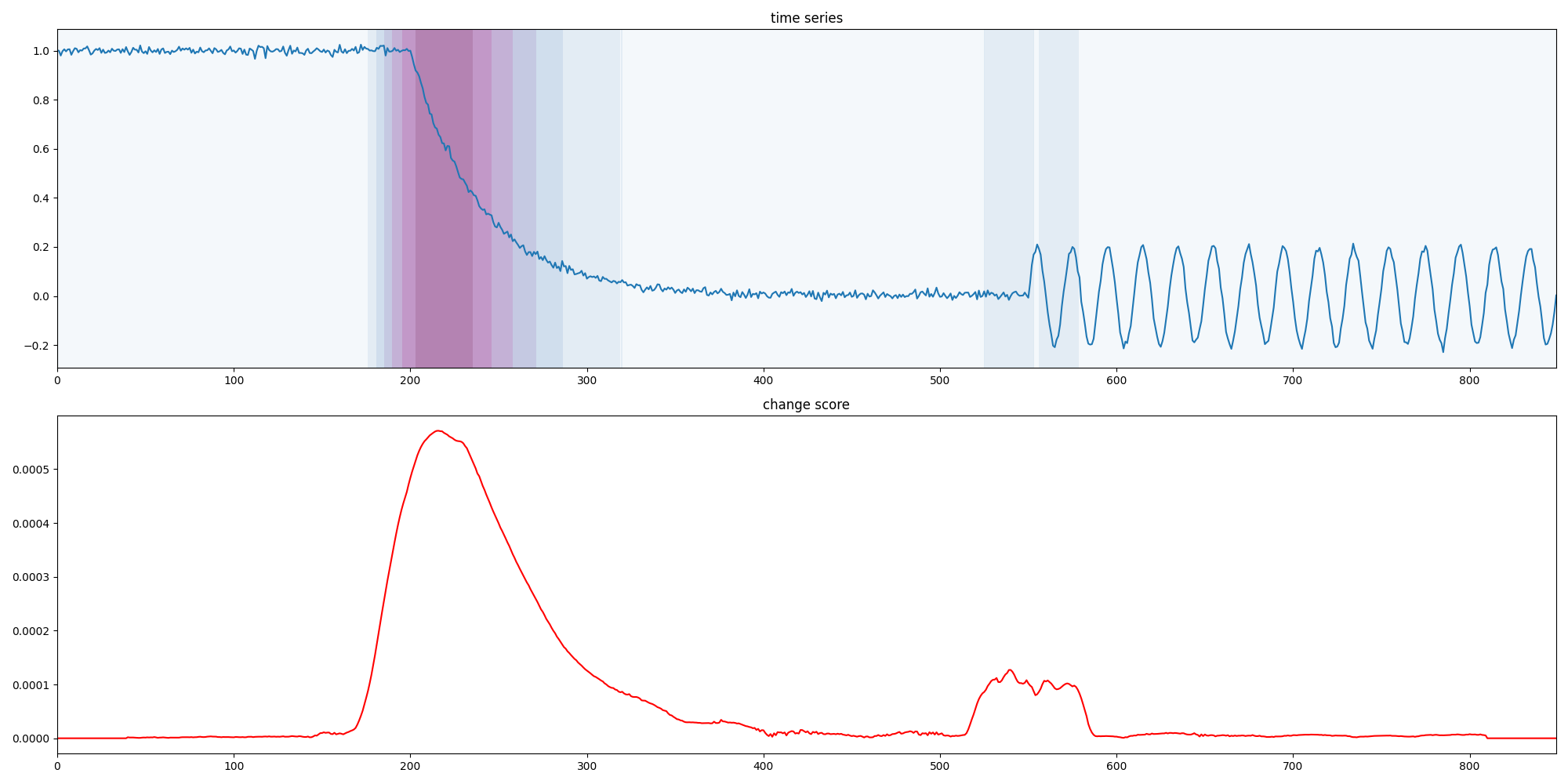
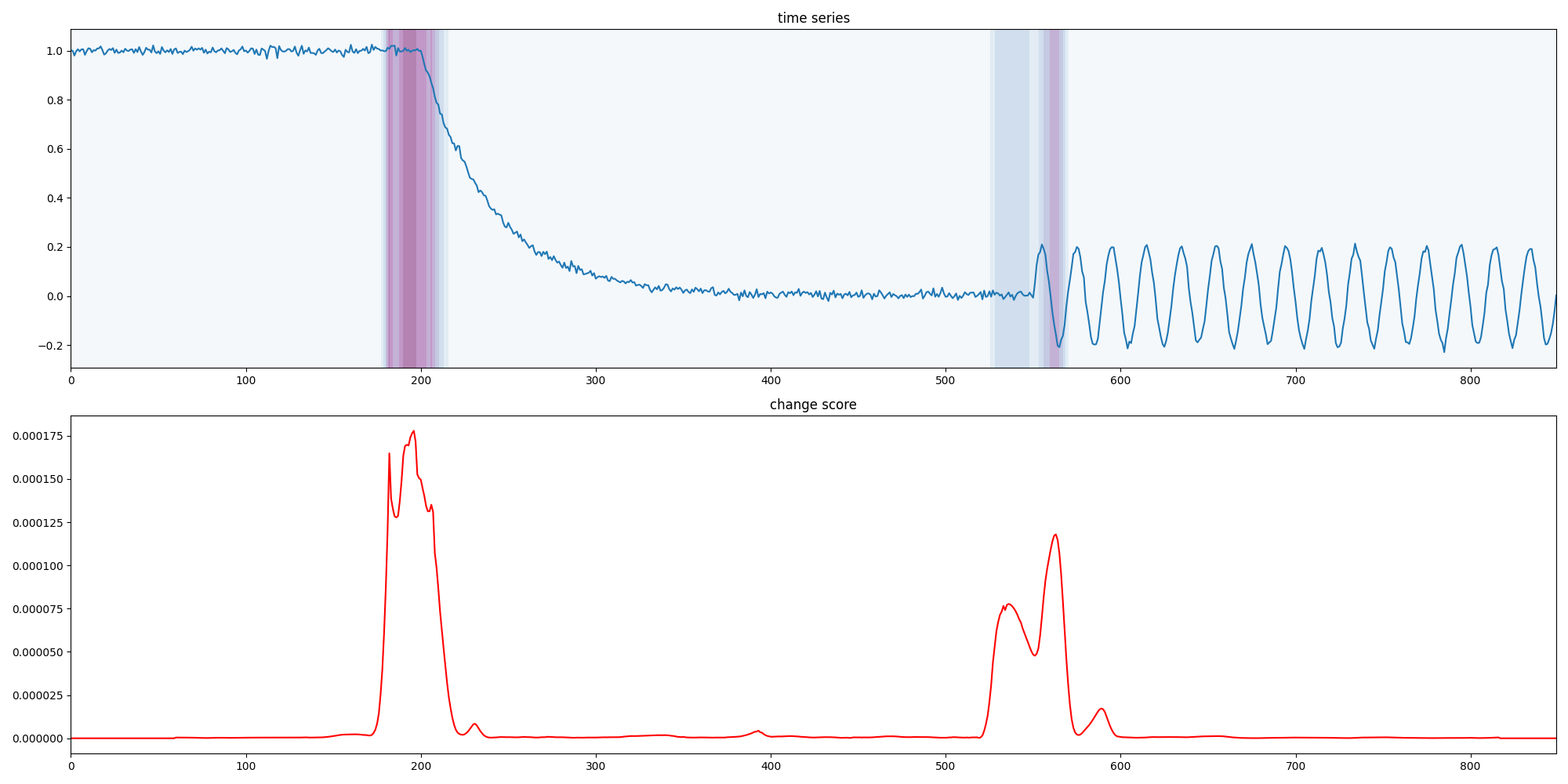
# create a signal that goes from steady to exponential decline into a sine curve
exp_signal = np.exp(-np.linspace(0, 5, 200))
steady_after = np.exp(-5)*np.ones(150)
steady_before = np.ones(200)
sine_after = 0.2*np.sin(np.linspace(0, 3*np.pi*10, 300))

# make the signal
signal = np.concatenate((steady_before, exp_signal, steady_after, sine_after))
signal += 0.01*np.random.randn(signal.shape[0])

# make change point detection
esst_detector = ESST(40)
esst_detection = esst_detector.transform(signal)

# make change point detection
sst_detector = SST(40, method='rsvd', mitigate_offset=True)
sst_detection = sst_detector.transform(signal)

# make the plot
plot_data_and_score(signal, esst_detection)
plt.gcf().tight_layout()
plot_data_and_score(signal, sst_detection)
plt.gcf().tight_layout()
plt.show()
The result looks like this:
ESST:
Examples
You can find example code within the examples folder of this repository. We also wanted to tease the functionality using two different signals in order to show the capabilities of one of our recommended algorithms ESST or SST. If you want to use the algorithms on the contents of a CSV directly, there is a frontend demonstrator currently hosted here (the adress is https://demo.changepoynt.de/, the code for the demonstrator is here).
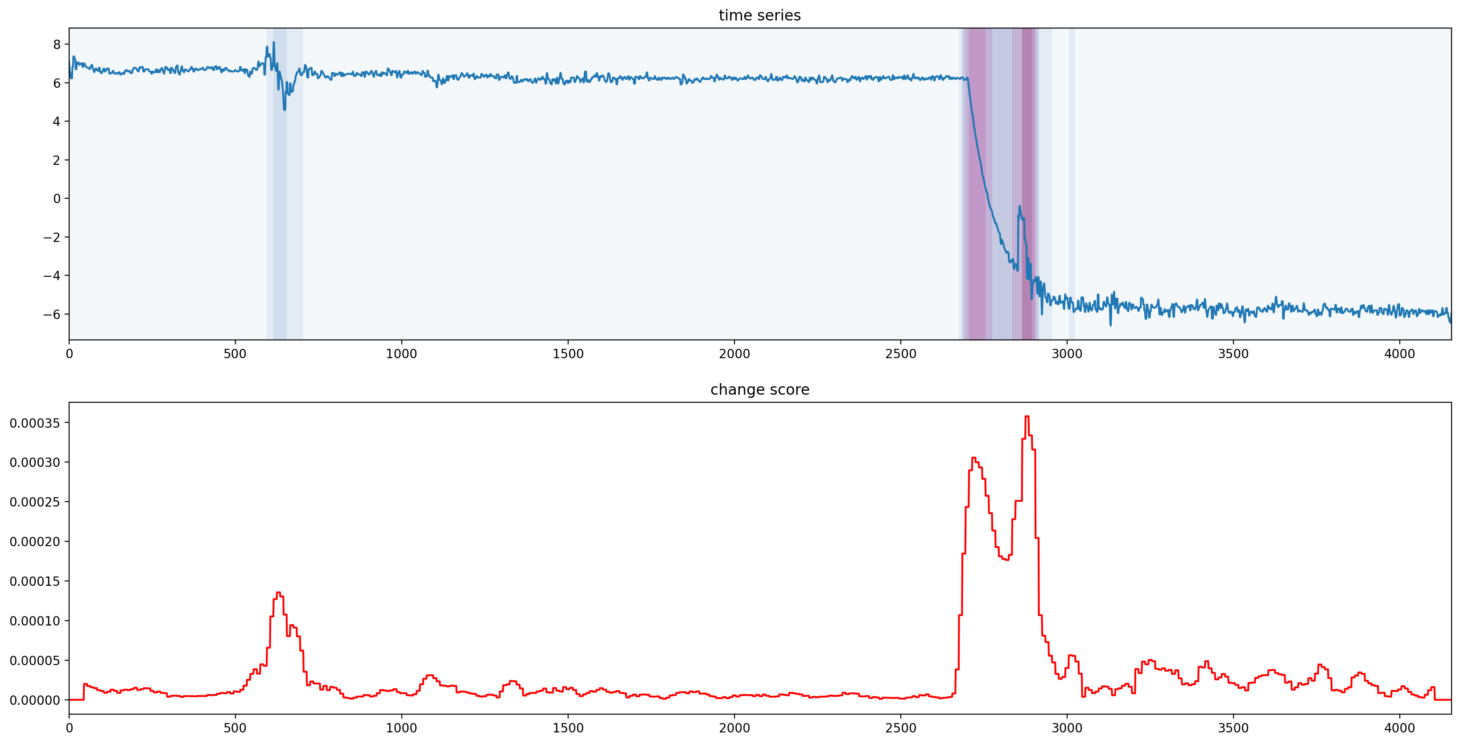
The first application is a simulated temperature of a component in a power plant during shutdown. We artificially added a disturbance at the end of the shutdown, to show the capability of the algorithm to detect a change even in case of another major change.
The other application is for anomaly detection within periodic signals. The example is time series 34 from the Hexagon ML/UCR Time Series Anomaly Detection dataset, where we set the window size for the ESST to three times the estimated period in samples (estimated using maximum of FFT).
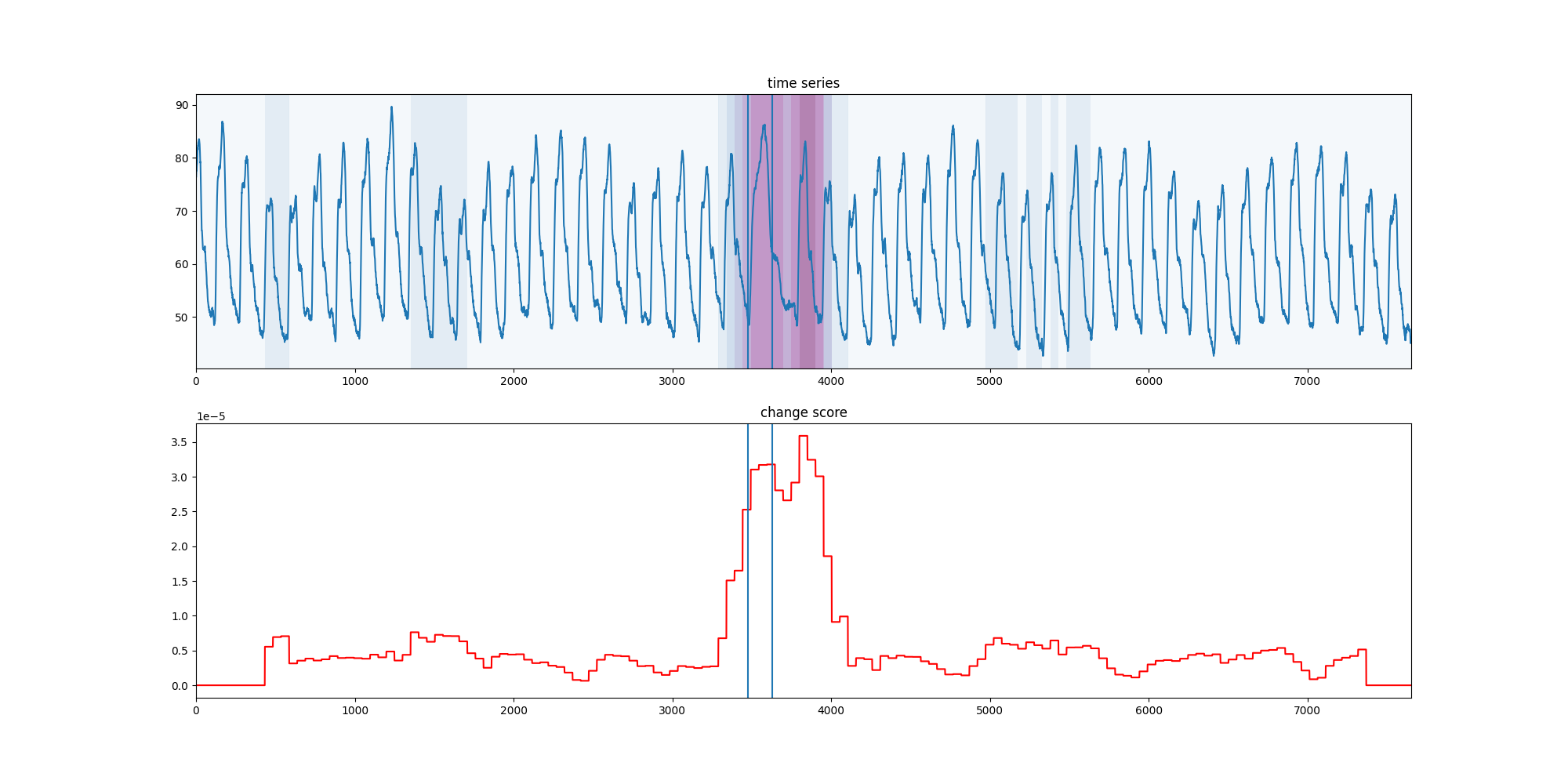
Both plots have been created using changepoynt.algorithms.esst and the plot function from
changepoynt.visualization.score_plotting.
Installation
You can install changepoynt from the common package index PyPi using the
following line with pip:
pip install changepoynt
Please be aware that we are currently in an alpha development phase, as this is part of a research project at the FAU Erlangen together with SIEMENS Energy developed by me. Nevertheless, we aim to be open-source and try our best to guarantee that all the code we use has very permissive licenses.
You can also install the code from source using the following line
pip install git+https://github.com/Lucew/changepoynt.git
Documentation
The complete documentation is available at lucew.github.io/changepoynt.
It includes installation instructions, algorithm references, practical user guides, runtime tuning, visualization, and API documentation.
Frequently Asked Questions (FAQ)
Find the FAQs in the related Markdown document.
Algorithms
We are actively working on the package. Therefore, some algorithms are already available, while others are currently under development. An overview with sources can be seen here:
| Algorithm | Source | Status |
|---|---|---|
| SST | Idé | Stable ✔️ |
| Fast SST | Weber et al. | Stable ✔️ |
| IKA-SST | Idé | Stable ✔️ |
| Fast IKA-SST | Weber et al. | Stable ✔️ |
| Multivariate (IKA-)SST (MSST) | Stable ✔️ | |
| ESST | Boelter & Weber et al. | Stable ✔️ |
| Multivariate ESST (MESST) | Stable ✔️ | |
| RuLSIF | Liu et al. | Stable ✔️ |
| uLSIF | Liu et al. | Stable ✔️ |
| KLIEP | Liu et al. | Planned |
| ClaSP | Ermshaus et al. | Deactivated ❌ |
| FLUSS | Gharghabi et al. | Stable ✔️ |
| FLOSS | Gharghabi et al. | Stable ✔️ |
| BOCPD | Adams et al. | Experimental (mean change) |
| Baseline | Weber | Stable ✔️ |
Contributing
The main way of contributing to this package is by opening an issue or a pull request. We are happy to answer answer any questions you might have in an issue.
We always love to get feedback or new ideas. If you have any of those, feel free to open an issue. We try to get back to you as soon as we can.
If you are an author of a paper in the field or have another algorithmic idea: Feel free to open a pull request.
Known Issues
Division by Zero for SST with IKA
Some of the methods like SST (with method='ika') and (R)uLSIF have issues when running for trivial sections of time series. This includes steady series (e.g., only zero values, just lines with some slope). Intuitively, these methods aim to extract multiple characteristics in these sections but there are none, so they run into issues. Errors you will encounter are: "Matrix is singular" or "division by zero". Unfortunately, the math behind these errors is more complicated and I have not yet found a good way to circumvent these errors.
Fortunately, there is an easy workaround. Just add a small white noise to your signal, e.g. by adding
signal += np.random.normal(0, 1e-4, size=signal.shape[0]). With noise much smaller than you signal you will not
introduce large additional change points and the methods will not fail.
Outlook
We are actively working on the package, and currently have the following steps planned:
- Researching intuitive explanations for SST parametrization
- Setting up a documentation
- Guideline for online deployment of the methods
If you have further ideas, do not hesitate to open a ticket or a pull request!
1 maintainer

Metadata
1 maintainer
Release files for changepoynt 0.2.2
For a detailed explanation of source distributions (sdists) and built distributions (wheels), please see the package formats documentation.
Source distribution (sdist)
| File | Size | Uploaded | |
|---|---|---|---|
| changepoynt-0.2.2.tar.gz | 68.4 kB | Details |
Built distribution (wheel)
| File | Interpreter | ABI | Platform | Reset |
|---|---|---|---|---|
| changepoynt-0.2.2-py3-none-any.whl | Python 3 | none | any | Details |
Total release size: 145.8 kB
Release files / changepoynt-0.2.2.tar.gz
| Download URL | changepoynt-0.2.2.tar.gz |
|---|---|
| Size | 68.4 kB |
| Tags | Source |
|
SHA-256 checksum How to use checksums |
b3d8e6275ccc6dbc8951ec011d662545df5ec1e0a70841abcc98efee39948a20
|
|
BLAKE2b-256 checksum How to use checksums |
93b331bc23c411d9d666c6638c932e88f7b1396b4d0fc49a68afe707f4a01095
|
| Upload date | |
|
Uploaded using Trusted Publishing? What is trusted publishing? |
Yes |
| Uploaded via |
twine/7.0.0 CPython/3.13.14
|
Provenance
Provenance describes where a file came from. On PyPI, provenance is shared via attestations, which provide a verifiable record of the build or publishing details. View details, limitations and caveats.


PyPI Publish Attestation
PyPI verified that this artifact, at this checksum, originated from the publisher listed below.
Signed by GitHub Actions, verified by PyPI on Sep 23, 2026.
Transparency logRelease files / changepoynt-0.2.2-py3-none-any.whl
| Download URL | changepoynt-0.2.2-py3-none-any.whl |
|---|---|
| Size | 77.4 kB |
| Tags | Python 3 |
|
SHA-256 checksum How to use checksums |
8611d24decbd4ee4625ca194c17a7bb93b298a05a05966301a19e71240600d27
|
|
BLAKE2b-256 checksum How to use checksums |
11ea33f231db019ebd51cf984a22b3e747cd2d13d79369bc2f07d449c2b479c7
|
| Upload date | |
|
Uploaded using Trusted Publishing? What is trusted publishing? |
Yes |
| Uploaded via |
twine/7.0.0 CPython/3.13.14
|
Provenance
Provenance describes where a file came from. On PyPI, provenance is shared via attestations, which provide a verifiable record of the build or publishing details. View details, limitations and caveats.
PyPI Publish Attestation
PyPI verified that this artifact, at this checksum, originated from the publisher listed below.
Signed by GitHub Actions, verified by PyPI on Sep 23, 2026.
Transparency log













