
Check Your Advisor




You are choosing a PhD or master's advisor. You have a name, a lab page written by the lab, and no way to check any of it. This reads what PubMed records about that person — or OpenAlex, which covers every field, for an advisor outside biomedicine — and reports it back as facts with denominators.
It does not tell you whether the advisor is good. That judgement stays yours. What it does is replace hearsay with counts that carry the population they were counted over.
python3 scripts/run.py harvest --author "Wang Wei" --orcid 0000-0002-1825-0097 \
    --years-back 10 --output-dir ./record --no-download
python3 scripts/run.py cite    --output-dir ./record
python3 scripts/run.py profile --pi-name "Wang Wei" --output-dir ./record
Three commands, one HTML report — written twice, in English and in Chinese, with the same numbers on both. Nothing to install: the standard library only.
The report opens with a one-page summary: a dozen lines, each a count with its denominator and the section it came from, warnings first. The twenty sections below it define every number and say what it cannot mean.
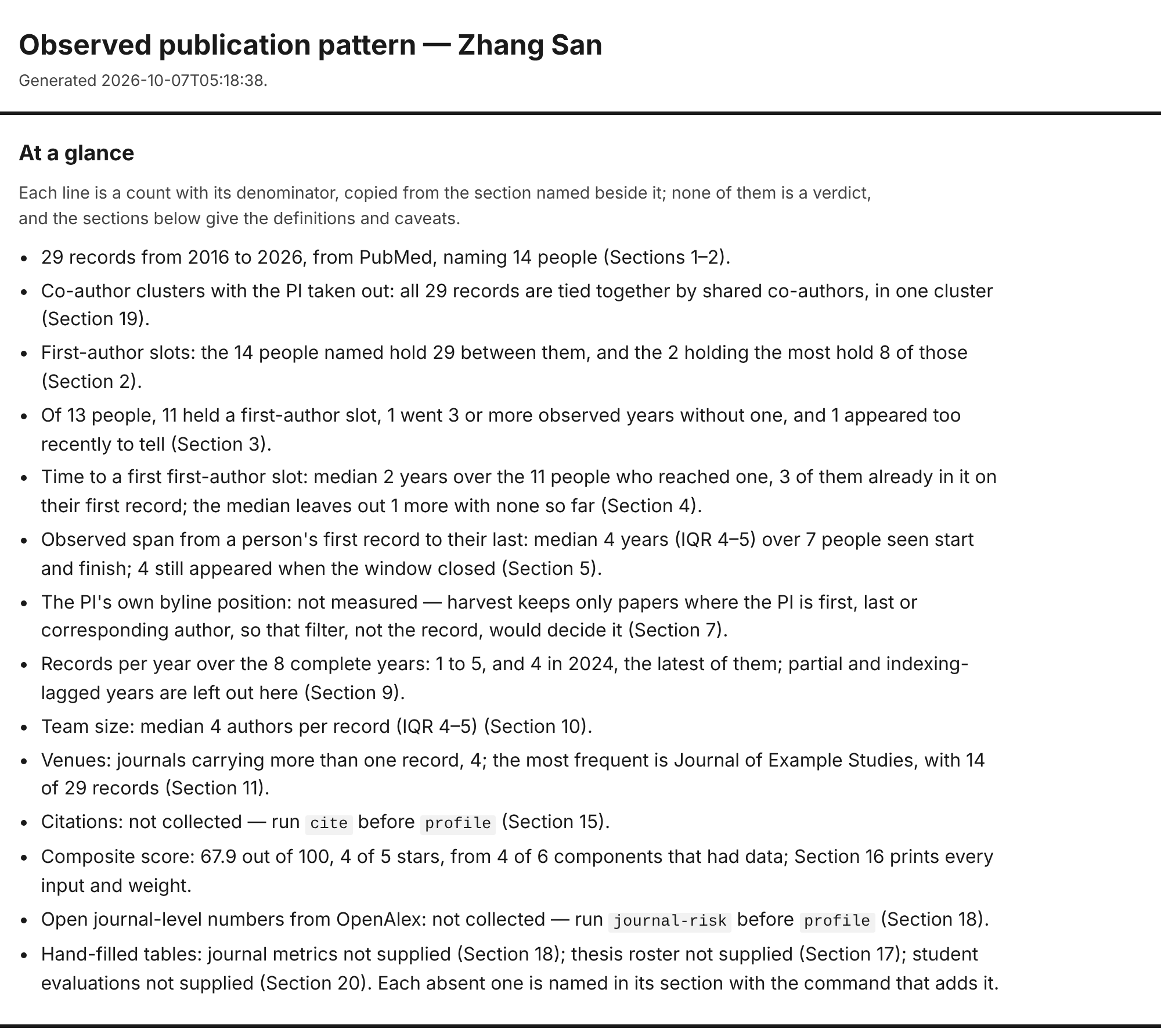
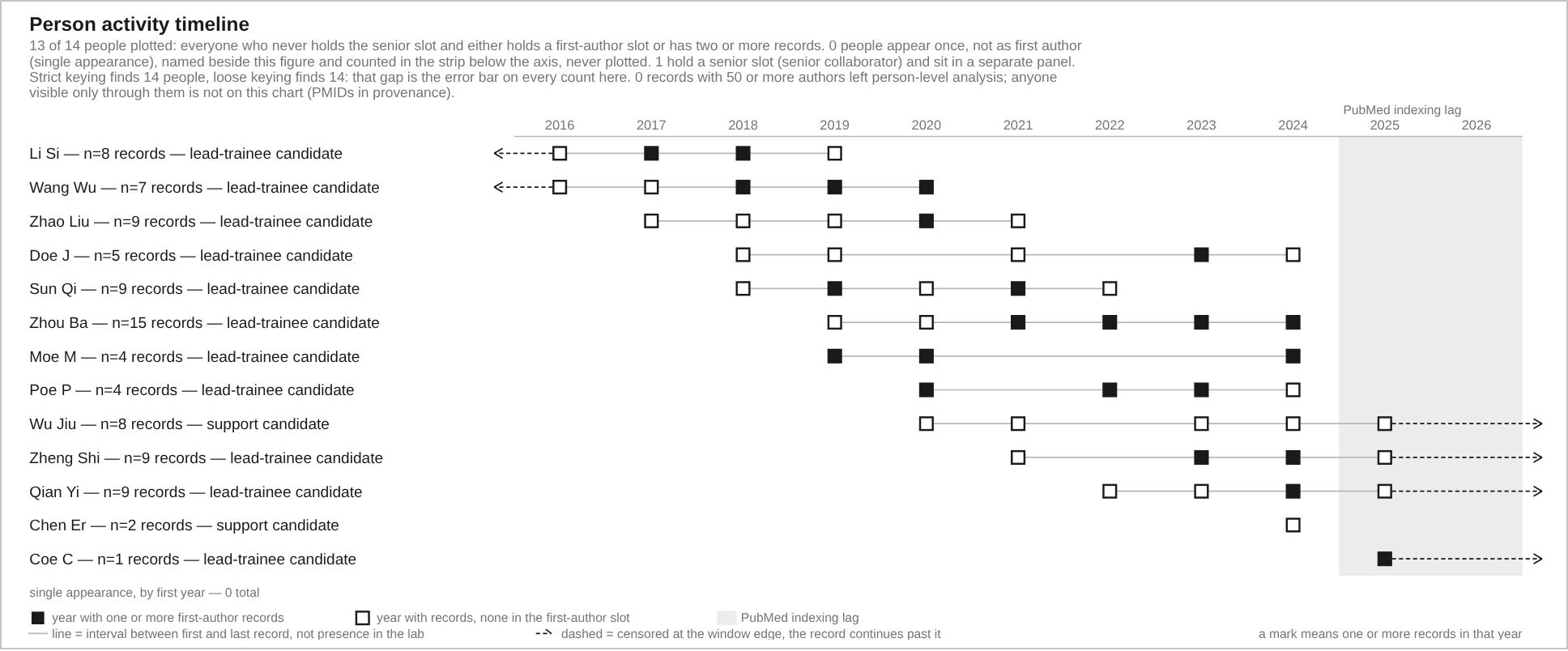
Both images come from a made-up lab. The names, journals and university are placeholders.
What it answers
- who has appeared in this group over the window
- who the first-author slots went to, and how concentrated they are
- how long a newcomer waits before getting one
- how long people stay before they stop appearing
- how much comes out per year, and whether it goes to the same few journals
- citation counts and an h-index, with the coverage they were computed over
- one composite score out of 100, with every component's raw input printed
And, once you supply a table it cannot fetch: what those journals are rated in the edition you looked them up in, and how many people finished a degree here without a single indexed paper — the one group every other number is blind to.
What it refuses, and why the distinction matters
Four different things stand behind "it does not say whether the advisor is good", and the report keeps them apart on the page:
| Examples | Why | |
|---|---|---|
| Computed | citation counts, h-index, composite score, rank, star band, letter band, fitted slope, roster ranking, citation percentile against an external cell | measurements, printed with denominators |
| Refused | a position among the corpora you loaded, a percentile on the composite score, year-over-year percentage change | a decision — see below |
| Waiting on a file | impact factor, JCR quartile, CAS partition, graduate roster | licensed or defended databases; the tool ships schemas, not a crawler |
| Never visible | lab culture, whether the PI is decent, people who left before finishing | in no database at all |
A position among the corpora on one page is not withheld here, it is uncomputable: that set is the one you assembled, so adding or dropping an unrelated corpus moves everybody in it. The composite score has no percentile for the same reason — nothing else in the world computes that score.
A citation count is a different matter, and round four placed it. cite --percentile asks OpenAlex where a count falls among every work sharing that
paper's topic and publication year: a population that is the same whether this
run loaded one corpus or nine, and the same for anyone else running the query.
The definition matters more than it looks. The percentile is the share of works in the cell cited strictly fewer times. In one measured cell, 1399 of 3808 papers had never been cited; under "at or below", every one of those would come back as the 36.7th percentile, printing "nobody cited this" as "ahead of more than a third of the field". Strictly-fewer puts them at 0.0, which is true. The other reading is printed alongside, with the size of the tie, rather than chosen for you.
Papers that could not be placed never come back as low ones. Seven named statuses say which thing did not happen — no citation count, no identifier, topic lookup failed, no topic recorded, no year, distribution unavailable, reference cell too small — and each prints its own sentence in Section 15.
The corpus decides everything
Every number is computed over the papers harvest kept. If papers by a
different person with the same name get in, the roster, the time-to-first-author
and the turnover figures are all wrong — and wrong in a way that looks perfectly
normal on the page.
Give harvest at least one unique identifier. In descending order of
strength:
| Flag | Strength |
|---|---|
--orcid 0000-0002-... |
Strongest. One is worth all the rest |
--author-email wangwei@pku.edu.cn |
The advisor's own address, from the lab page, matched whole. Short of an ORCID the strongest there is: a namesake at the same university does not share it. Repeatable |
--email-domain your-university.edu.cn |
The corresponding author's domain, matched at a label boundary. Repeatable |
--affiliation-keyword "..." |
Weakest. A university name lets every same-name colleague there through; a department narrows it to that department. Defaults to whatever --affiliation says |
--resolve-openalex / --openalex-author-id A... |
OpenAlex's own author clustering. Recorded as OpenAlex's assertion, never as yours |
--resolve-openalex prints every OpenAlex author publishing under this name,
with its id, ORCID, institution history, works count and top research topics —
two people sharing a name at one university are usually told apart fastest by
what they work on. One candidate is
adopted; two or more are listed and none is adopted — picking the most
prolific one would settle an identity question on a proxy and leave no sign in
the report that a choice had been made. Re-run with --openalex-author-id once
you recognise the right one.
No ORCID and no address? harvest then lists the email addresses and
departments the bylines print beside the name — most frequent first, counted
before the identity filter — and Section 1 repeats the list. Different people
sharing the name separate there. Pick the advisor's, then re-run with their
department as --affiliation-keyword and add --require-affiliation: records
are checked against that department, and a namesake in another department stays
out of the corpus rather than in it, marked as a name match. The search still
covers --affiliation. The address alone is not enough, because the university
named by --affiliation stays in the check and lets every namesake there
through; give it with --author-email on top of the department, and a record
printing it counts whatever its department.
If the harvest recorded no evidence at all, the report still renders — with a
warning box at the top of Sections 0, 1 and 19 naming the condition, the numbers
observed and the fix, with Section 14 recording that this used to be a refusal,
and with the process exiting 1. It used to refuse outright; that cost sixteen
sections of computed fact, including Section 19, which is the one section that
would have shown the reader whether the corpus really does hold several people.
Such a corpus also takes no rank on a compare page: it keeps its row and its
score, and holds no position.
The dangerous case raises no warning at all: weak evidence produces a complete, normal-looking report about several people. A real run for one Chinese surgeon, keyed on a province name rather than the full institution, returned 28 records spanning gastrointestinal surgery, analytical chemistry, structural biology, soil microbiology and machine learning — and scored 78.2 out of 100.
Section 19 is the check for that. It removes the PI, who is on every record by construction, and asks which records are still tied together by a shared co-author. One person's output is held together by the people they work with; two people sharing a name have no reason to share anyone else. It applies no threshold — the measurements do not support one, and the README of a tool like this should not pretend otherwise — it prints the clusters and their journals and hands the reading to you. It is usually not subtle.
Outside biomedicine: --source openalex
python3 scripts/run.py harvest --author "Wang Wei" --affiliation "Tsinghua University" \
    --source openalex --years-back 10 --output-dir ./record --no-download
PubMed indexes medicine and the life sciences, so an advisor in engineering,
computer science, physics, chemistry or the social sciences has little or
nothing there — and a search by a common name returns only namesakes.
--source openalex skips PubMed and builds the corpus from OpenAlex, which
covers every field. It looks the author up by name and institution: one
candidate is adopted, several are listed with their institutions and topics and
the run stops, so you can pick one with --openalex-author-id. Section 1 then
says PubMed was not searched and that "PubMed record" elsewhere on the page
means "OpenAlex work". When a PubMed search under the name comes back empty,
harvest says so and points at this flag.
Both sources: --source both
python3 scripts/run.py harvest --author "Wang Wei" \
    --openalex-author-id A5023888391 --source both --output-dir ./record
Pulls the works OpenAlex files under that author id and merges them into the
PubMed corpus, deduplicating on DOI, then PMID, then normalised title plus year.
The PubMed record wins where both hold a paper — its record carries the
affiliation strings and corresponding-author emails every identity check reads,
and OpenAlex's does not. Every record says which source it came from and which
sources hold it, and Section 1 prints both denominators, because a merged corpus
and a PubMed corpus are different numbers. Neither API needs a key. OpenAlex
bills its API against a free daily budget: about $0.10 a day without a key,
enough for several advisors, and ten times that with a free key from
openalex.org/settings/api. Put the key in the environment variable
OPENALEX_API_KEY and every OpenAlex request carries it; nothing else does.
Three tables you fill in by hand
Impact factor, JCR quartile and CAS partition live in licensed products with no free redistributable source. Degree-thesis libraries defend against scraping. Student evaluations sit on forums and review pages that permit automated collection least of all. So this ships the schema, the worklist and the join, and no crawler. (What is fetched, from keyless public APIs whose terms permit it, is citation counts and the journal risk signals in the next section — both into their own dated files, never back into a table you filled in.)
python3 scripts/run.py journal-worklist --output-dir ./record
That writes a CSV holding only the journals this corpus actually uses — typically a couple of dozen, not the twenty thousand in the world — pre-filled with ISSN and paper count, indicator columns blank. Fill it from whichever source you have access to, then:
python3 scripts/run.py profile --output-dir ./record \
    --journal-table ./record/journal_worklist_*.csv \
    --thesis-roster ./record/theses.csv \
    --evaluation-table ./record/evaluations.csv
Before any of that, journal-risk (below) already puts journal-level numbers on
the page with no table at all: OpenAlex's 2-year mean citedness — its open
counterpart of an impact factor — and h-index, per journal, in a table of their
own in Section 18. They are OpenAlex's computations over what it indexes, not
JCR or CAS figures, and never fill those columns.
Two columns are required in the journal table: 版本来源 (which edition —
official, rising-star, folk, or JCR) and 数据获取日期. Without them a
partition number is unfalsifiable two years from now. Where a journal has rows
from two editions, both are shown and neither wins; disagreements are listed.
The graduate roster is the most important of the three. Export the advisor's
supervised theses from a degree library and it produces the number PubMed
structurally cannot: how many graduates have no indexed paper at all. Add a
romanised-name column or the Chinese roster will not match the English bylines.
A file exported straight from CNKI or 万方 carries neither 库来源 nor 导出日期
— they describe the export, not a thesis — so give them once on the command line,
--thesis-source CNKI --thesis-exported 2026-10-07; Section 17 says they came from
there. Bilingual headers such as Author-作者 are read through either half.
Note that people who enrolled and left before finishing are in no library
either — the roster narrows the missing group, it does not close it.
The evaluation table is the one you collect entirely by hand; there is no
worklist command for it, because nothing in a corpus names the places people
talk about an advisor. Required columns: 导师姓名, 评价来源,
数据获取日期, and at least one of 评价内容 or 维度评分. Section 20 prints
how many statements were attributed to this advisor, how many distinct sources
they came from, the span of years they cover, and then every statement in file
order with its source and retrieval date attached. It runs no sentiment
analysis, produces no average or rating, and contributes nothing to the
composite score — these are a handful of statements by people who chose to
write something down, so any number computed over them would measure who
bothered to post. They are reproduced, attributed and dated; the judgement is
yours.
A fourth table: Chinese-language records
The other three hand-filled tables each feed one section. This one is merged into the corpus, so every number in the report moves — which is the point. A PubMed-only harvest of an advisor who publishes in Chinese journals can miss most of their output: 12 indexed papers against 40 in Chinese core journals makes "records per year", the first-author distribution and the turnover figures all statements about a quarter of the work, and the page gives no sign of it.
python3 scripts/run.py profile --output-dir ./record --chinese-records ./record/cnki.csv
Seven required columns; a missing one is named at load time rather than skipped. One of them decides whether the table is usable at all: the romanised author column. A Chinese byline and a romanised advisor name are in different scripts, and without the romanisation the advisor cannot be located in their own byline — the record still counts toward output per year, but holds no byline position. Rows like that are reported line by line, never dropped.
Encodings are tried utf-8-sig then gb18030, in that order deliberately:
gb18030 decodes almost any byte sequence, so trying it first would silently turn
every UTF-8 file into mojibake and report success.
Deduplication has one tier: normalised title plus year. Chinese records usually carry neither DOI nor PMID, so the DOI → PMID → title ladder used for the OpenAlex merge is unavailable. It fails in both directions — two different papers sharing a title and year collapse into one, and one paper indexed under an English title by PubMed and a Chinese title by CNKI never matches itself. So a cross-source hit is reported as suspected, listed pair by pair, and the three denominators are printed separately rather than summed.
Looking again six months later: diff
python3 scripts/run.py diff ./record-2026-03 ./record-2026-09
Older directory first. Reports what is in one corpus and not the other, who appears for the first time, and where the first-author slots went.
Read the window block before any count. If the two harvests asked about different year ranges, "7 more papers" is probably just two extra years of searching — which is the window moving, not the record. So every one-sided count is split three ways: inside the years both harvests asked about (that is growth), inside years only one of them asked about (that is the caliber changing), and undated. When either corpus did not record its window, the command says the two cannot be compared rather than substituting the span the corpus happens to cover.
It reports membership and never a cause. A paper in the older corpus and not the newer one may have been retracted, or the search term may differ, or the identity evidence, or simply what the databases answered on the two days. All four are listed side by side, unordered. The tool cannot tell them apart and does not guess.
Public risk signals — statements, not a rating
Three things about a journal are free to look up, and one command collects them:
python3 scripts/run.py journal-risk --output-dir ./record
DOAJ indexing status, Crossref metadata deposit coverage and OpenAlex's source
record, for every journal in the corpus carrying an ISSN. Keyless public JSON
APIs, one GET each, its own dated file, one fetched_at per record, nothing
written back into the corpus or into the table you filled in. profile picks up
the newest one and Section 18 prints each statement beside the endpoint that
returned it and the day it was read.
Nothing here calls any journal predatory. That is an accusation about a
publisher's conduct; none of these three APIs makes it and neither does this
tool. No count of these signals becomes a grade, a tier, a score, a letter or a
colour, and none of them touches the composite score. You get lines like
未被 DOAJ 收录 and Crossref 元数据缺失 3 项(共查 10 项), with their sources
and dates, and the reading is yours.
Two are misread almost every time, so the report says the opposite beside them: absence from DOAJ is not a finding — DOAJ indexes open-access journals that applied to it, so Journal of Hepatology is absent and always will be, as is most of the subscription literature in medicine. A Crossref coverage field reading zero is not a finding either — it measures what a publisher deposits, and Journal of Hepatology scores 3 of 10 tracked fields at zero.
All three sources are queried every time and none wins. They disagree routinely;
where they do, both lines print with their dates. OpenAlex's Scopus field is
null for a great many real journals, which is a third value and is never
printed as "not indexed".
The 中科院国际期刊预警名单 is not fetched and will not be. It is published once
a year as a login-walled page and a PDF with no machine-readable endpoint, so it
stays in the hand-filled 是否预警 / 预警等级 columns above. A blank there
means nobody checked, and no signal in this block fills it in.
Install
As a command-line tool:
pip install check-your-advisor
check-your-advisor harvest --author "Wang Wei" --orcid 0000-0002-1825-0097
As a Claude Code plugin — the repository is its own marketplace, so two commands inside Claude Code install it:
/plugin marketplace add AschoofAlpha/check-your-advisor
/plugin install check-your-advisor@check-your-advisor
To update later, refresh the marketplace and then the plugin, from a shell, and
start a new session (or run /reload-plugins). The plugin's version is pinned in
plugin.json, so an update arrives with each release rather than each commit:
claude plugin marketplace update check-your-advisor
claude plugin update check-your-advisor@check-your-advisor
Or as a personal skill — clone it where the skill loader looks, so SKILL.md
lands beside the code, and git pull there to update:
git clone https://github.com/AschoofAlpha/check-your-advisor.git \
    ~/.claude/skills/check-your-advisor
Either way the skill finds its own script through ${CLAUDE_SKILL_DIR}, and calls
python3, falling back to python where only that exists.
Or run scripts/run.py straight out of a clone; it is the single entry point
and needs no installation at all.
The pip package declares no dependencies, which is not an oversight: a clean
virtualenv with this installed contains this package, pip and setuptools, and
nothing else. Two extras exist and both have a tested fallback —
pip install "check-your-advisor[pdf]" for PyMuPDF-backed PDF quarantine,
[xlsx] for openpyxl export, [all] for both.
Optional extras
All three degrade with a tested fallback; none is required.
- PyMuPDF (AGPL-3.0, so deliberately not a hard dependency of an MIT
project) lets PDF identity validation quarantine a wrong file. Without it
every download is still checked for the
%PDF-magic. - openpyxl enables the
.xlsxexport. Without it the same data is written as a timestamped CSV. - An HTML-to-PDF converter already on the machine — wkhtmltopdf, Chrome /
Chromium / Edge, weasyprint or LibreOffice — lets
profile --pdfwrite a PDF beside the HTML report. None of them is imported and nothing is downloaded: the tool runs a program that is already installed. With none present,--pdfprints how to install each and the HTML is unchanged, which is the point — the HTML is the deliverable and the PDF is a second copy of it.--pdf-converterpicks one;--pdf-converter-pathnames a binary that is installed but not on PATH, which on Windows is the normal state of both Chrome and LibreOffice.
Tests
python tests/run_all.py
python tests/run_all.py --block-third-party
5335 assertions across 39 files with PyMuPDF installed, 5332 without it,
measured 2026-10-07 by the first command above. That command re-measures
whichever of the two this machine can produce, on every run, and fails if this
sentence has drifted, which is why they are numbers rather than promises. The
second run installs an import hook that
blocks requests, urllib3, pandas, numpy, matplotlib, fitz and
openpyxl inside each test process. It is the only thing that keeps "no install
needed" true rather than merely claimed: exactly three assertions behave
differently without them, and all three are the cases that need a real PDF file.
Known limitations
The report is in English; the command-line logs are in Chinese.Resolved. Every report now comes in both languages, each in one language throughout:profilewritesadvisor_profile_<timestamp>.html/.mdin English andadvisor_profile_<timestamp>.zh-CN.html/.zh-CN.mdin Chinese, from the same built report, so the two pages cannot disagree about a number;comparewritesadvisor_compare_<timestamp>.mdand.zh-CN.md. The JSON record is written once. The command line — logs,--help, errors — follows--lang zh|en, then$CHECK_YOUR_ADVISOR_LANG, then the system locale, and is English on any locale that is not Chinese. Chinese CSV column names (版本来源,数据获取日期, …) stay as they are in both languages, because they are what your file contains.citehas no cache of its own.citeandjournal-risknow cache what each API answered, keyed on which API was asked and what it was asked about, in a second table beside the PDF cache in the same SQLite file. The cache is written on every successful fetch and read only when you pass--max-age-days N— so a default run still asks every source and simply leaves the cache warmer than it found it; the saving arrives on the next run. A hit carries the day the answer was really collected, never the day it was served.- Journal name matching falls back to a token heuristic for corpora harvested before ISSN capture existed. Re-harvest to get the exact join.
- Section 7, where the PI sits in their own bylines, is not measured on a corpus
harvestbuilds. Harvest keeps only the papers where the PI is first, last or corresponding author, so the positions would be the filter's choice rather than the PI's. The section and the summary both say so instead of printing a count.
License
MIT. See LICENSE.
Citation counts come from OpenAlex, Semantic Scholar and Europe PMC, none of which requires a key. Bibliographic records come from NCBI E-utilities. This project ships no licensed data.
1 maintainer

Metadata
1 maintainer
Release files for check-your-advisor 0.4.0
For a detailed explanation of source distributions (sdists) and built distributions (wheels), please see the package formats documentation.
Source distribution (sdist)
| File | Size | Uploaded | |
|---|---|---|---|
| check_your_advisor-0.4.0.tar.gz | 949.8 kB | Details |
Built distribution (wheel)
| File | Interpreter | ABI | Platform | Reset |
|---|---|---|---|---|
| check_your_advisor-0.4.0-py3-none-any.whl | Python 3 | none | any | Details |
Total release size: 1.6 MB
Release files / check_your_advisor-0.4.0.tar.gz
| Download URL | check_your_advisor-0.4.0.tar.gz |
|---|---|
| Size | 949.8 kB |
| Tags | Source |
|
SHA-256 checksum How to use checksums |
b8086e7e8e81eccc9760d6abfda576ababdc4d2c82f94603525b20e7e57f09cf
|
|
BLAKE2b-256 checksum How to use checksums |
a9b6b7ee6a5e971acd07edf2717e9dc550a903a24225eda2f3fb903ba460c33f
|
| Upload date | |
|
Uploaded using Trusted Publishing? What is trusted publishing? |
Yes |
| Uploaded via |
twine/7.0.0 CPython/3.13.14
|
Provenance
Provenance describes where a file came from. On PyPI, provenance is shared via attestations, which provide a verifiable record of the build or publishing details. View details, limitations and caveats.


PyPI Publish Attestation
PyPI verified that this artifact, at this checksum, originated from the publisher listed below.
Signed by GitHub Actions, verified by PyPI on Oct 7, 2026.
Transparency logRelease files / check_your_advisor-0.4.0-py3-none-any.whl
| Download URL | check_your_advisor-0.4.0-py3-none-any.whl |
|---|---|
| Size | 646.3 kB |
| Tags | Python 3 |
|
SHA-256 checksum How to use checksums |
d171e67d095efaf90d0fe192e1c0e15b31930f96c077a4495f2330abaacf2083
|
|
BLAKE2b-256 checksum How to use checksums |
0cee9d7f561757403844e544658630a0b332d1dea0b5fe755ae106568907e0c1
|
| Upload date | |
|
Uploaded using Trusted Publishing? What is trusted publishing? |
Yes |
| Uploaded via |
twine/7.0.0 CPython/3.13.14
|
Provenance
Provenance describes where a file came from. On PyPI, provenance is shared via attestations, which provide a verifiable record of the build or publishing details. View details, limitations and caveats.
PyPI Publish Attestation
PyPI verified that this artifact, at this checksum, originated from the publisher listed below.
Signed by GitHub Actions, verified by PyPI on Oct 7, 2026.
Transparency log













