
Ensures specified environment variables are present during runtime

Project description
checkenv






A modern best-practice is to store your application's configuration in environmental variables. This allows you to keep all config data outside of your repository, and store it in a standard, system-agnostic location. Modern build/deploy/development tools make it easier to manage these variables per-host, but they're still often undocumented, and can lead to bugs when missing.
This module lets you define all the environmental variables your application relies on in an env.json file. It then provides a method to check for these variables at application launch, and print a help screen if any are missing.
Inspired from the popular npm package, checkenv.
Usage
First, define a JSON file called env.json in your project root (see below for the specific structure). Next, install the library using pip connected to the PyPi index:
pip install checkenv
Then, add the following line to the top of your project's entry file:
from checkenv import check
check()
By default, checkenv will print a pretty error message and call sys.exit() if any required variables are missing. It will also print an error message if optional variables are missing, but will not exit the process.
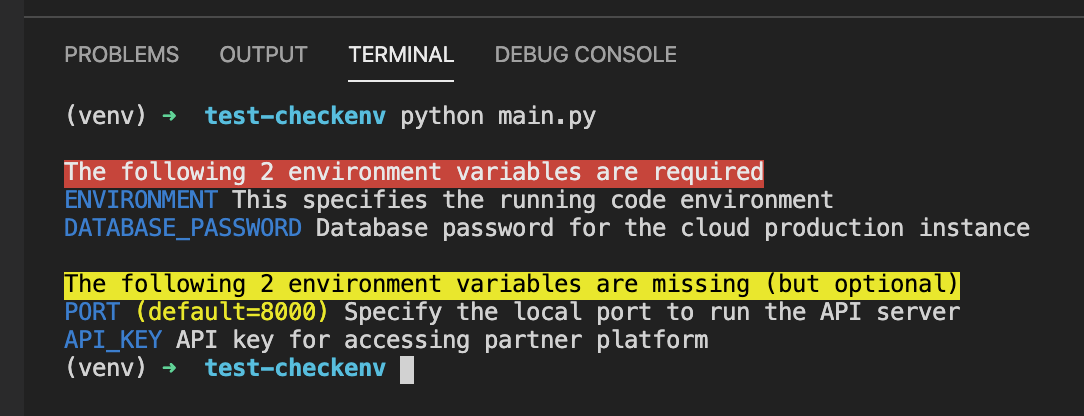
You can specify a filename other than env.json by setting the optional parameter filename. The library will attempt to load this file from the root path of your project. You can also specify an absolute file path.
If you would like to handle errors yourself, check takes an optional raise_exception argument which causes it to raise exceptions instead of exiting the process.
from checkenv import check
try:
  check(raise_exception=True)
except Exception as e:
  # do something with the error 'e' because the process will not exit
An exception can be one of three classes of Exceptions:
checkenv.exceptions.CheckEnvException- thrown if any mandatory environment variables are missing; containsmissingandoptionalproperties that contain a list of environment variable namesjsonschema.exceptions import ValidationError- thrown if the input JSON files is invalidIOError- thrown if the input JSON file cannot be found
You can also silence any output to stdout by setting the optional parameter no_output=True. It is recommended to use this in conjunction with raise_exception=True and handling the error yourself; otherwise, your application can fail silently because you do not realize that something is wrong with your environment variables.
Configuration
Your JSON file should define the environmental variables as keys, and either a boolean (required) as the value, or a configuration object with any of the options below.
JSON
{
  "ENVIRONMENT": {
    "description": "This defines the current environment"
  },
  "PORT": {
    "description": "This is the port the API server will run on",
    "default": 3000
  },
  "PYTHON_PATH": true,
  "DEBUG": {
    "required": false,
    "description": "If set, enables additional debug messages"
  }
}
Object Properties
required- Defines whether or not this variable is required. By default, all variables are required, so you must explicitly set them to optional by setting this tofalse.description- Describes the variable and how it should be used. Useful for new developers setting up the project, and is printed in the error output if present.default- Defines the default value to use if variable is unset. Implicitly setsrequiredtofalseregardless of any specified value.
Change Log
1.2.0
- Added ability for
check()to throw exceptions instead of killing the running process withraise_exception=True - Added ability to silence all output to
stdoutwithno_output=True - Updated documentation with the
filenameparameter feature that allows you to specify an input JSON file with a different name thanenv.json - Updated README.md with usage instructions for these new features
- Increased code coverage to 95%+
1.1.0
- Expanded supported Python interpreter versions -
checkenvnow supports Python versions 2.7, 3.5, 3.6, 3.7, and 3.8. - Refactored the code with classes - although this does not add additional functionality, the code is cleaner, easier to understand, and better documented for future improvements
- Added tests with
pytestandtox - Every pushed branch undergoes automated testing with CircleCI
- Started tracking code coverage percentage and currently hovering around ~50% (to be improved)
1.0.0
- Initial release
Release history Release notifications | RSS feed


Download files
Download the file for your platform. If you're not sure which to choose, learn more about installing packages.
Source Distribution
Built Distribution
Filter files by name, interpreter, ABI, and platform.
If you're not sure about the file name format, learn more about wheel file names.
Copy a direct link to the current filters
File details
Details for the file checkenv-1.2.0.tar.gz.
File metadata
- Download URL: checkenv-1.2.0.tar.gz
- Upload date:
- Size: 7.0 kB
- Tags: Source
- Uploaded using Trusted Publishing? No
- Uploaded via: twine/3.1.1 pkginfo/1.5.0.1 requests/2.23.0 setuptools/46.4.0 requests-toolbelt/0.9.1 tqdm/4.46.0 CPython/3.7.7
File hashes
| Algorithm | Hash digest | |
|---|---|---|
| SHA256 |
a09bfa423430cabb4bf66dc45dd4d6bf99590ecf4abb7a7f4b6333ccf1304c87
|
|
| MD5 |
a652aaa1e1a90053d6db8069896ed567
|
|
| BLAKE2b-256 |
98eb430eb0eff9a331f21e6fd2d0ce7fca9123e3734fdf1b11ab9e88ae9e4e97
|
File details
Details for the file checkenv-1.2.0-py3-none-any.whl.
File metadata
- Download URL: checkenv-1.2.0-py3-none-any.whl
- Upload date:
- Size: 8.2 kB
- Tags: Python 3
- Uploaded using Trusted Publishing? No
- Uploaded via: twine/3.1.1 pkginfo/1.5.0.1 requests/2.23.0 setuptools/46.4.0 requests-toolbelt/0.9.1 tqdm/4.46.0 CPython/3.7.7
File hashes
| Algorithm | Hash digest | |
|---|---|---|
| SHA256 |
efe36de9a5c6fac6a496ea58429a08031ad487e141004434849c581484f55057
|
|
| MD5 |
77f30ccd7e045838ab61aed1a30911d7
|
|
| BLAKE2b-256 |
21cc96dbaa50abe51a92f33c0dba4914309656a3df70c4ba356e9c5282cb60a8
|






