
Chess Analyzer




Review any chess game with an engine on your own machine — a Lichess game, a Chess.com game, a PGN you pasted, or a position you typed. Accuracy, move labels, an eval graph, the engine's best line at every point, and a live mode that follows a game while it is still being played.
The two things it does that the sites do not: it works on both sites from one place, and it tells you why it gave a move the label it gave it.
cd ChessAnalyzer
& "..\.lichess\Scripts\python.exe" -m chess_analyzer.cli serve    # port 8779
Then open http://127.0.0.1:8779.
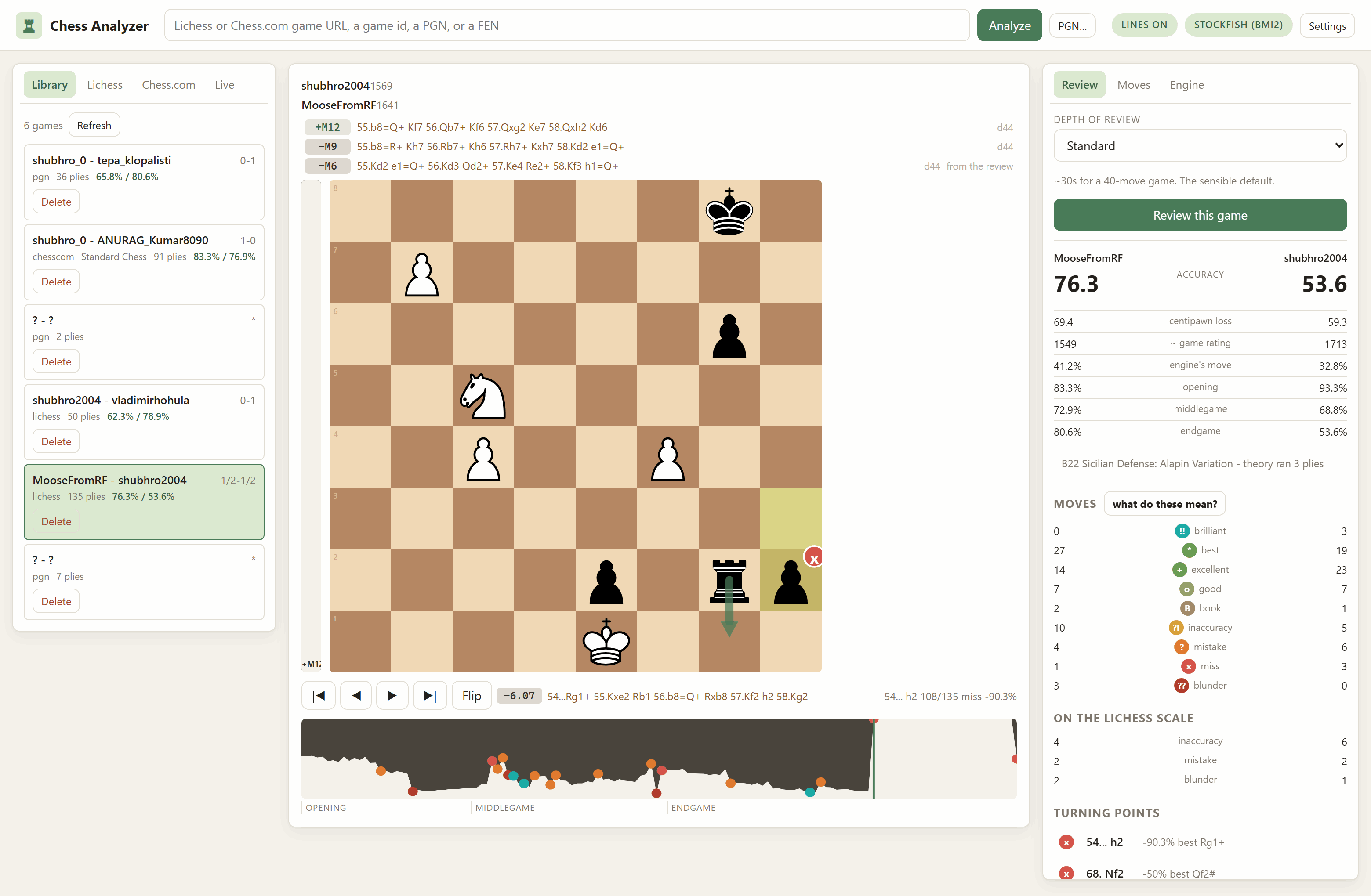
Above: 54... h2, the move this review calls the game's biggest turning point.
The strip over the board says from the review, so those three lines cost
nothing — the review already analysed this position to depth 44.
Install
pip install chess-game-analyzer
chess-analyzer serve
Optional. Lichess cloud-eval fallback: pip install "chess-game-analyzer[cloud]".
Or take all five at once with pip install lichess-essentials. Installed this
way your files live in the usual per-user folder for your platform, and the
app prints the path in its startup banner. To run it from a checkout instead,
see the repository README.
Getting a game in
One box takes all of these — it works out which is which by looking at them, not by asking you:
| Paste this | What happens |
|---|---|
https://lichess.org/Wi8IPxc3 |
Fetched from Lichess. Public API, no token. |
https://www.chess.com/game/live/146864147370 |
Fetched from Chess.com, including a game still in progress. |
| A PGN, from anywhere | Read as-is. A Site tag saying lichess.org does not make it a link. |
| A FEN | Becomes a position you can analyse and play from. |
| A bare game id | 8 characters is Lichess, a long number is Chess.com. |
Or use the sidebar: type a username on the Lichess or Chess.com tab and get their recent games with the PGN already attached, so opening one costs no second request.
The review
Pick a depth and press the button. Four presets, from ~10 seconds to a fixed depth 22; a 90-ply game takes about 10 seconds on Quick and half a minute on Standard.
 |
 |
| The report. Two scales side by side, per-phase accuracy, and the turning points ranked by what they cost. | The move list. Every move wears its label, and the evaluation beside it is the one the review computed. |
You get two scales side by side, on purpose:
The Lichess scale — inaccuracy, mistake, blunder at 10, 20 and 30 winning-chance points lost. Lichess publishes both these thresholds and the accuracy formula, so the arithmetic here is theirs rather than an approximation of it.
Checked against a game Lichess had already analysed (Wi8IPxc3), at the Deep preset:
| this app | lichess.org | |
|---|---|---|
| White accuracy | 76.3% | 76% |
| Black accuracy | 53.6% | 60% |
| White blunders | 2 | 6 |
Accuracy lands where it should. The blunder counts do not, and will not —
those depend on what the engine actually saw, and a different engine at a
different depth disagrees about which moves were losing. Treat the counts as
this engine's opinion, and the accuracy as comparable. Both apps agree about
the move that mattered: the app independently flagged 68. Nf2 as throwing
away a forced mate, which is what Lichess says about it too.
The Chess.com-style ladder — brilliant, great, best, book, excellent, good, inaccuracy, mistake, miss, blunder. Chess.com has never published its criteria, so this cannot be a reimplementation and does not pretend to be. What it is: the same idea, built from rules that are written down and shown in the app — click what do these mean? in the review panel. When a label surprises you, you can read why it fired instead of guessing.

The rules that took the most tuning:
- Brilliant — the engine's top move, which gives up at least 1.8 pawns of material that the engine's own line never wins back, and still leaves you at 45% or better. Material is read off the engine's principal variation four plies deep rather than from a hand-rolled exchange evaluator: if the engine's best play leaves you a piece down and still says you are fine, you sacrificed and it worked.
- Great — the top move, where the second-best is at least 15 points worse.
- Neither is ever given for a recapture, or once the game is decided past 92%. Taking back the piece that was just taken beats the alternatives for reasons that are not to your credit; without that rule, a third of every game comes out "great".
- Book moves are excluded from accuracy and centipawn loss entirely, so preparation is not scored as skill.
Also in the report: per-phase accuracy (opening / middlegame / endgame, with the boundaries found from the position rather than a fixed move number), average centipawn loss, how often you found the engine's move, the turning points ranked by what they cost, and a rough ACPL-implied rating shown with its formula attached — it is a fit, not a measurement, and it moves 200 points on one blunder.
Reading it
-
The engine's ranked lines sit above the board, in small text, and stay there while the Lines pill in the top bar is lit — they follow whatever position you are looking at rather than waiting to be asked. How many lines and how long the engine gets are on the Engine tab. Click one to play it.
On a game you have reviewed these cost nothing: the review already analysed every position several variations deep, so scrolling through it shows those lines instantly, at the review's depth, and the strip says from the review so you know which they are. Only the final position, which the review has no row for, falls back to a live engine call.
-
The engine's preferred continuation sits beside the board controls, as a score chip and the line. On a reviewed move it is deliberately retrospective — the line you could have played instead — because that is the question you are asking while reading a review. Anywhere else it is the best line from here.
-
Scroll the mouse wheel over the board to step through the game — down goes forward, up goes back. Every position is already in the browser, so this is instant; it is the reason the board is drawn client-side rather than fetched as an image. Trackpads work too: deltas are accumulated to a threshold, so a flick is one move rather than ten. (The two sibling apps now do this as well.)
-
Arrow keys do the same;
fflips;Home/Endjump to the ends. -
Click the eval graph to jump to that moment.
-
Each move wears its label as a badge on the destination square, and when you did not play the engine's move, an arrow shows what it wanted.
-
Play any move on the board to explore. The game itself is never touched: your move becomes a variation, shown in the move list in brackets and a lighter colour right after the move it replaces, the way Lichess and Chess.com do it —
5...O-O (5...d5 6.Bb5 Bg4). Keep playing and it extends; go back and try something else and you get a second variation beside the first; try something inside a variation and it nests in its own brackets. The engine follows you into them, so an exploratory move gets its own evaluation. Back to the game returns to the mainline, Clear variations throws them all away, and the review's labels and stored lines stay attached to the moves that were actually played.
Live games
Five ways in, because the five situations are genuinely different.
| Mode | How it works |
|---|---|
| Lichess | A real push stream. /api/stream/game/{id} is public and sends a line per move — any game, yours or anyone's. Give it a game URL, an id, or just a username. |
| Chess.com | Polling chess.com/callback/live/game/{id} every two seconds and decoding the move list. Undocumented — see below. |
| Follow along | You click the moves as they are played. No network at all, so it works for a Chess.com blitz game, a stream you are watching, or a board in front of you. |
| Arrange the board | There is no URL and no PGN, only a position. Put the pieces where they are, say who is to move, and the engine evaluates it. See below. |
| Paste PGN | Paste, and re-paste as the game grows. Only ever moves forward: a short or scrambled paste cannot rewind the game. |
In every mode the eval bar and the engine's ranked lines keep up with the current position, you can scroll back through the game without losing your place when the players move, and Save & review freezes the game into the library so you can run a full review on it.
Arranging a position
Pick Arrange the board and the board becomes an editor, outlined in green so it is obvious that clicking it no longer plays moves. Choose a piece from the palette and click squares; clicking the piece that is already there removes it, and right-clicking any square clears it. From the board copies whatever position you are already looking at, which beats building from empty when you only need to move two pieces.
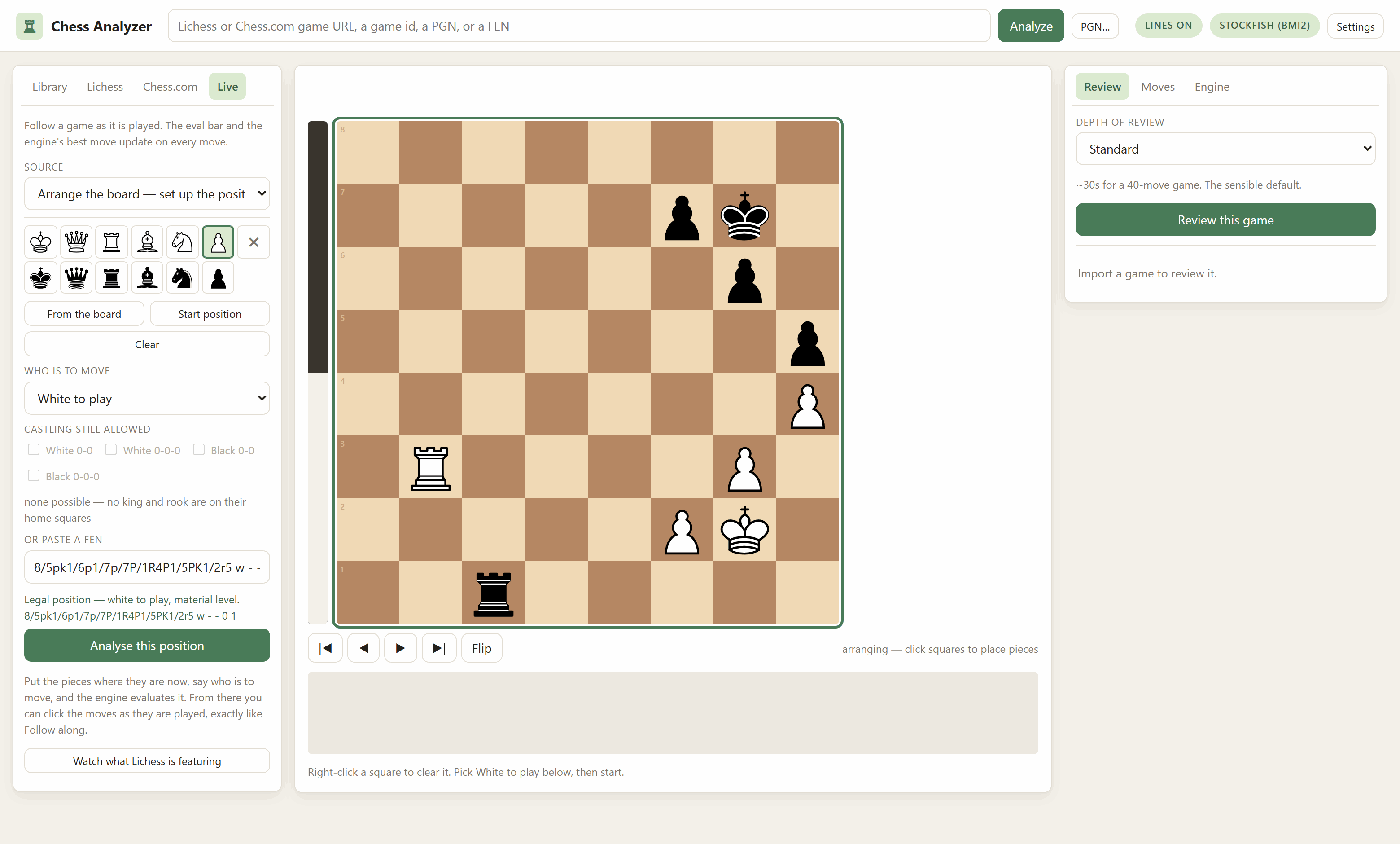
The castling row in that shot reads none possible on its own — no king and rook are on their home squares in this position, so there is nothing to offer and nothing left over from a previous arrangement to pass to the engine.
Then say White to play or Black to play, and press Analyse this position. From that point it behaves exactly like Follow along: the eval bar and the engine's lines are live, and you click the moves as they happen. Save & review turns it into a game in your library, with the arranged position kept as the PGN's starting position.
Every click is validated, because most arrangements of pieces are not positions. Two white kings, a pawn on the first rank, or Black in check while White is to move cannot occur in a game, and an engine handed one either refuses to start or produces a confident number about nothing. The editor says which of those is wrong, in a sentence, before you can start.
Two details it fills in rather than asking about:
- Castling rights are offered only for a king and rook still on their home squares — and a tick left over from a previous arrangement is dropped rather than passed to the engine.
- En passant is offered only where a double pawn push could really just
have happened and the capture would be legal. (python-chess's
has_legal_en_passantis not enough on its own here: it asks whether a pawn could capture onto the square and will say yes when there is no pawn there to take.statusis what checks a double push could have produced it. The editor needs both, or it would offer you a square its own validator then rejects.)
The honest part about Chess.com live games
Chess.com's documented public API cannot see a live game. /pub/player/{u}/games
is documented as "games in progress" and returns daily/correspondence games
only — a blitz game you are playing right now is not in it, and no documented
endpoint has it.
chess.com/callback/live/game/{id} does have it. It is undocumented, which
means it is not covered by Chess.com's API terms and can change or vanish
without notice. This app therefore treats it as optional: if it stops
answering, the session keeps the moves it already has and tells you to switch
to Paste PGN, which always works.
That endpoint returns moves in TCN, Chess.com's own two-characters-per-ply
encoding, which nothing in python-chess speaks. The decoder in
tcn.py is verified against 40 real games that
Chess.com shipped as both TCN and PGN — every move and every final position
matches, promotions and en passant included. The fixture is in the repository
so the check runs with no network.
Also: Chess.com sits behind Cloudflare and returns a 403 challenge page to
any request without a User-Agent header. Not a rate limit and not a ban —
just a missing header, which is a confusing hour to spend if you do not know.
Engines
The app uses whatever Stockfish it can find first — including the one in the
sibling app's Lichess-Study-to-PDF/engine/ folder, so following this
repository's setup instructions means never being asked to download a second
copy.
Click the engine pill to see the picker. It reads each project's own GitHub releases, so a new Stockfish appears the day it ships:

- Stockfish, any recent version (~77 MB).
- Lc0 (~24 MB) plus a network file. The Maia networks are the interesting ones: they predict what a human of a given rating actually plays rather than what is best. Use one to ask whether a move was findable — never to judge one.
You can set the review engine and the analysis engine separately.
About CPU builds. Stockfish publishes one binary per instruction set —
bmi2, avx2, avx512, down to a plain x86-64 — and running one your
processor cannot execute does not fail politely, it dies on an illegal
instruction. There is no portable way to read CPU feature flags from Python on
Windows, so the app does not guess: it downloads a build, runs it, waits
for it to answer uci, and on failure walks down to the next-safest build
automatically. What worked is remembered, so it happens at most once.
What is kept on disk
ChessAnalyzer/games/ holds one JSON file per imported game — the record, the
PGN and the finished review — plus positions.json, a shared cache of analysed
positions keyed by position and engine settings. That cache is why
re-reviewing a game at the same settings is instant, and why a 0.1-second
answer never masquerades as a depth-22 one.
ChessAnalyzer/data/openings.json is the opening index, built once from
Lichess's own openings dataset (3,810 named positions, no token needed). It is
indexed by position rather than by move order, so a transposition into a named
line is still recognised.
Downloaded engines go in ChessAnalyzer/engines/. All three directories are
gitignored.
A Lichess API token is accepted in Settings and is never written to disk — it lives in the process and dies with it. Nothing here needs one; every endpoint the app uses is public. It only raises the rate limit for bulk imports.
Command line
python -m chess_analyzer.cli serve                     # the browser interface
python -m chess_analyzer.cli review <url|id|pgn>       # review and print it
python -m chess_analyzer.cli review <url> --preset deep --depth 20
python -m chess_analyzer.cli engines                   # what is here, what is available
python -m chess_analyzer.cli engines --install stockfish:sf_18
python -m chess_analyzer.cli import <url>              # add to the library
python -m chess_analyzer.cli library                   # list saved games
Tests
python -m pytest ChessAnalyzer/tests -q          # 51 tests
node ChessAnalyzer/tests/test_variations.js      # 10 more, if you have node
python ChessAnalyzer/tests/test_layout.py        # 21 in a real browser
No network and no engine required — a suite that needs both is a suite nobody runs.
The second file covers the variation tree, which is browser code. Rather than
duplicating the logic, it lifts the functions out of the shipped app.js by
name and runs them against a state it controls; a copy would keep passing
after app.js changed underneath it, which is the one thing a test must not
do. (Checked by deliberately reintroducing the old behaviour, which failed
three of them.)
The third drives a real headless browser over the DevTools protocol, against a
server you have already started. It needs no new dependency — Edge or Chrome is
already on the machine and websockets came in with uvicorn[standard] — and
it skips if neither is there.
It exists because the app's worst bug could not be found by reading. The board and the scrolling panel were resizing each other several times a second, so the whole page shook; the stylesheet looked perfectly reasonable. One measurement found it. It now checks that the board, the controls and the graph fit at seven window sizes, that the board's size settles rather than drifting, that an arriving evaluation does not move it, that trying a move leaves the game's notation alone, and that a wheel notch and a trackpad flick each move exactly one move.
Things worth knowing if you change this
A warm engine stops the process from exiting. python-chess runs each
engine's event loop on a non-daemon thread, and CPython joins non-daemon
threads before it runs atexit handlers. So a program that leaves an engine
open prints its last line and then blocks for ever, with no output and no
traceback to explain it. An atexit hook does not fix this — it runs too late.
Every entry point must call engines.close(); the server does it in its
shutdown handler and the CLI in a finally.
Lichess's single-game export is not under /api. It is
https://lichess.org/game/export/{id}, while everything else this app uses is
https://lichess.org/api/.... Getting it wrong returns a 404 HTML page.
The opening explorer needs a token; the openings dataset does not.
explorer.lichess.org now requires an authenticated request, which is why book
detection here uses the downloadable dataset instead — it never changes, so a
380 KB download once beats an authenticated request per position.
Scores are White's point of view everywhere, matching PovScore.white()
and the sibling app's Eval. Only classify.py flips, and it does so once, at
the boundary. A 30-point drop in White's winning chances is a gain for Black,
and there is a test that keeps that sign honest.
Hosting it for free
Same profile as
the other two apps —
FastAPI/Uvicorn needing a real container, not a serverless host. Unlike
Repertoire-Creator, this app doesn't actually import the sibling package
anywhere in its code despite the cloud extra in pyproject.toml (that's an
unused hook for later), so Dockerfile is self-contained in
this folder — no repo-root build context needed.
It installs Stockfish via apt-get rather than letting the app's own
GitHub-releases downloader (chess_analyzer/engines.py) fetch one at
runtime — simpler, and apt already picks the build matching the container's
actual CPU. engines.py checks $STOCKFISH_PATH directly
(engines.py:214), which the Dockerfile
sets, so it shows up in the engine picker as "Engine from $STOCKFISH_PATH"
with nothing else to configure. Lc0/Maia are left out — they're optional, and
downloadable from the same picker at runtime if you want them.
What does not persist on a free host
games/, data/openings.json and engines/ are already gitignored locally
because they're regenerated on demand (see "What is kept on disk", above) —
but on a free container they also get wiped by every redeploy, and possibly
every wake from sleep. Unlike Repertoire-Creator, there is no git-autosave
here to fix that. In practice that means: the openings index rebuilds itself
on first use, Stockfish is already baked into the image so there's nothing to
re-download for the main engine, and your reviewed-game library does not
survive a restart. Treat a hosted instance as a live analysis tool, not a
permanent archive — export or note anything from games/ you want to keep,
or do that curation against a local run instead.
Render
- Push this repo to GitHub.
- New Web Service → connect the repo → Root Directory:
ChessAnalyzer→ Render auto-detects the Dockerfile → Free instance. - Optional environment variables, marked secret:
ANALYZER_AUTH_USER/ANALYZER_AUTH_PASS— see "Locking it behind a password" below. - Deploy. You get a URL like
https://<name>.onrender.com.
Hugging Face Spaces
Spaces are their own separate git repo, so:
- New Space → SDK: Docker → Hardware: CPU basic (free).
- Clone the Space's repo locally, then copy this folder's contents
(
Dockerfile,requirements.txt,chess_analyzer/, etc.) into its root — not theChessAnalyzerfolder itself, what's inside it. - Add this to the top of the Space's
README.md:--- title: Chess Analyzer sdk: docker app_port: 7860 ---
- Settings → Repository secrets:
ANALYZER_AUTH_USER/ANALYZER_AUTH_PASS, if you want the password gate below. - Commit and push (a Hugging Face access token as the git password).
Locking it behind a password
server.py already has an HTTP Basic Auth gate
that only activates when both ANALYZER_AUTH_USER and ANALYZER_AUTH_PASS
are set — leave them unset and local chess-analyzer serve is unaffected.
Set both as secrets on whichever host you use and every route, API included,
asks for that username and password first. It's one shared credential pair,
not per-user accounts, sent over the HTTPS both Render and Hugging Face
Spaces terminate by default.
One less thing to worry about here
This app never asks for a Lichess token via an environment variable at all —
the token field in Settings lives in memory only and every endpoint it calls
is public (see "What is kept on disk", above). The public-token caveat that
applies to the other two apps' LICHESS_TOKEN doesn't apply here.
Licence
MIT — see LICENSE.
1 maintainer

Download files
Download the file for your platform. If you're not sure which to choose, learn more about installing packages.
Source Distribution
Built Distribution
Filter files by name, interpreter, ABI, and platform.
If you're not sure about the file name format, learn more about wheel file names.
Copy a direct link to the current filters
File details
Details for the file chess_game_analyzer-0.1.0.tar.gz.
File metadata
- Download URL: chess_game_analyzer-0.1.0.tar.gz
- Upload date:
- Size: 127.0 kB
- Tags: Source
- Uploaded using Trusted Publishing? No
- Uploaded via:
twine/7.0.0 CPython/3.14.4
File hashes
| Algorithm | Hash digest | |
|---|---|---|
| SHA256 |
c17ee06f4d0e8edad0ec09f22ca43cb759f2e02bfdca241dcd643dd472333e13
|
|
| MD5 |
849323c9e237f768965223490a08d696
|
|
| BLAKE2b-256 |
d44c2cdac8de4199bfa2cb0628a753d272590c02c0179cf78750422645cbc53d
|
File details
Details for the file chess_game_analyzer-0.1.0-py3-none-any.whl.
File metadata
- Download URL: chess_game_analyzer-0.1.0-py3-none-any.whl
- Upload date:
- Size: 117.4 kB
- Tags: Python 3
- Uploaded using Trusted Publishing? No
- Uploaded via:
twine/7.0.0 CPython/3.14.4
File hashes
| Algorithm | Hash digest | |
|---|---|---|
| SHA256 |
d3378e2c191e64c1e944e70577d4981cf159eb1a607668303b2db4f737153689
|
|
| MD5 |
025c541b228aedda6b1aad109e0b212e
|
|
| BLAKE2b-256 |
abec66ba83fc23328a7ec81d4dbcc9eb869d2f1e9c927609b8abff04b1f15ecf
|













