
ChessAI - Chinese Chess Game Analyzer
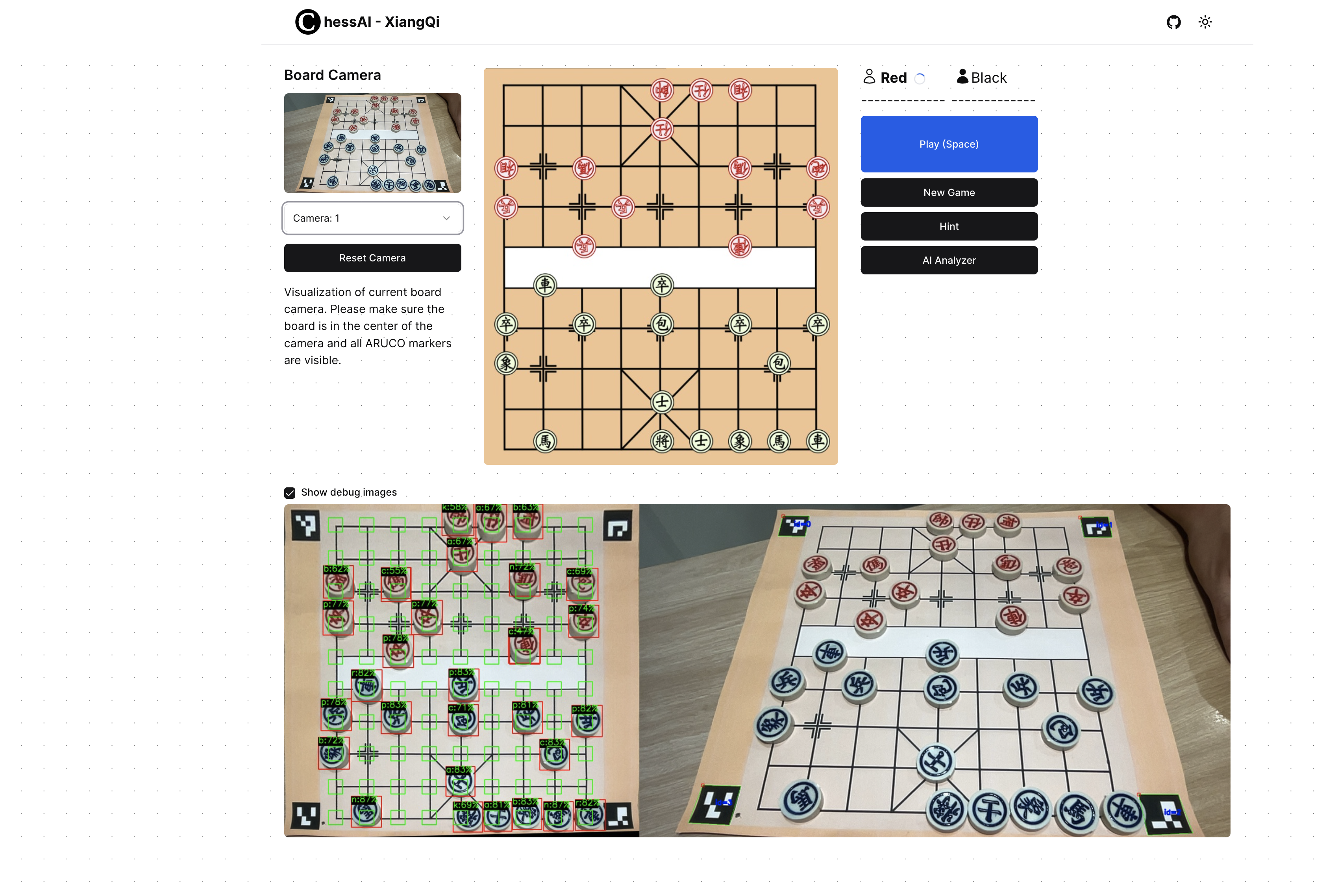
ChessAI is a groundbreaking tool that brings together computer vision, chess algorithms, and advanced analytics to revolutionize the Chinese Chess analytics landscape. With ChessAI, you don't need expensive electronic boards to analyze your games. Simply use your regular board, set up a camera to capture the position, and let ChessAI do the rest.
- Main source code:
chesssai. - Deep Learning / Data Preparation:
dnn_models/data_preparation- Currenly only support for Chinese Chess (XiangQi), contact me for the license and the source code of the data preparation tool. - Deep Learning / Training:
dnn_models/training.
Roadmap
- Chess position detection.
- Chess engine integration.
- Move suggestion.
- Deep learning model for chess board detection (No need to use ARUCO markers).
Environment setup
- Requirements: Python 3.9, Conda, Node.js 18+.
- Clone this repository.
git clone https://github.com/vietanhdev/chessai --recursive
- Create a new conda environment and the required packages.
conda create -n chessai python=3.9
conda activate chessai
pip install -e .
- Install Node.js packages and build the frontend.
cd chessai/frontend
npm install
cd ..
bash build_frontend.sh
Build chess engine
cd godogpaw
go build
- Copy the executable file (
godogpaw*) to the ./data/engines folder.
Run the app
ENGINE_PATH="data/engines/godogpaw-macos-arm" python -m chessai.app --run_app
Replace ENGINE_PATH with the path to the chess engine executable file.
Data preparation & Training
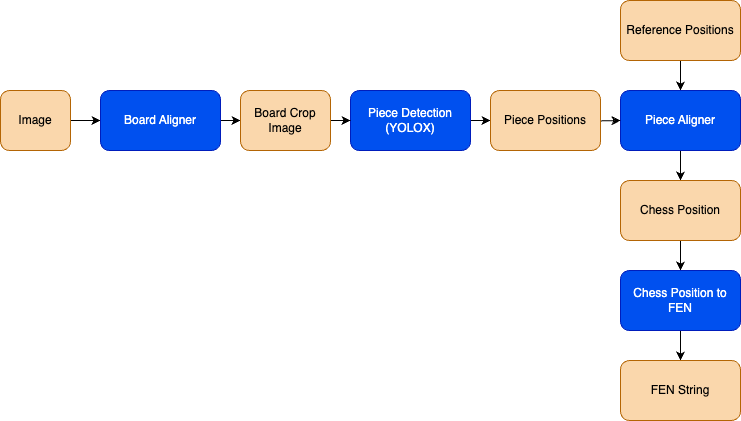
This project uses computer vision and deep learning to detect chess pieces and chess board position.
AI flow for chess position detection:
- Go to dnn_models folder and follow the instructions in the
README.mdfile to prepare the data and train the model.
References
- This project was initially built for Hackster's OpenCV AI Competition 2023. Hackster Project: ChessAI - Chinese Chess Game Analyzer.
- Object detection model (for chess pieces) is based on YOLOX - License: Apache 2.0.
- Chess engine: godogpaw - License: MIT.
- UI components: shadcn-ui - License: MIT.
1 maintainer

Metadata
1 maintainer
Release files for chessai-python 0.0.2
For a detailed explanation of source distributions (sdists) and built distributions (wheels), please see the package formats documentation.
Source distribution (sdist)
| File | Size | Uploaded | Provenance | Actions |
|---|---|---|---|---|
| chessai-python-0.0.2.tar.gz | 22.3 kB | Without provenance | Details for chessai-python-0.0.2.tar.gz |
Built distribution (wheel)
| File | Interpreter | ABI | Platform | Actions Reset |
|---|---|---|---|---|
| chessai_python-0.0.2-py3-none-any.whl | Python 3 | none | any | Details for chessai_python-0.0.2-py3-none-any.whl |
Total release size: 50.7 kB
Release files / chessai-python-0.0.2.tar.gz
| Download URL | chessai-python-0.0.2.tar.gz |
|---|---|
| Size | 22.3 kB |
| Tags | Source |
|
SHA-256 checksum How to use checksums |
22ecbcc7877262029641b20319476d6a782cfb9b958a256f334a3023ade5e528
|
|
BLAKE2b-256 checksum How to use checksums |
785eea50b4cbddfaf96ed5fa74e41089466873ac3f5a8095d4fa7165cc79dd1d
|
| Upload date | |
|
Uploaded using Trusted Publishing? What is trusted publishing? |
No |
| Uploaded via |
twine/4.0.2 CPython/3.9.18
|
Release files / chessai_python-0.0.2-py3-none-any.whl
| Download URL | chessai_python-0.0.2-py3-none-any.whl |
|---|---|
| Size | 28.4 kB |
| Tags | Python 3 |
|
SHA-256 checksum How to use checksums |
4e02f15319ce7b65dfc47cccd6b9004d8a2e41ca7d0fa41bd7d294eb7c6e0820
|
|
BLAKE2b-256 checksum How to use checksums |
7881d9fb9df8fa92dc446ecbbf3431e03038a9ca383c97766a80d561f1b8c4eb
|
| Upload date | |
|
Uploaded using Trusted Publishing? What is trusted publishing? |
No |
| Uploaded via |
twine/4.0.2 CPython/3.9.18
|
Security for chessai-python 0.0.2
Provenance
Provenance describes where a file came from. On PyPI, provenance is shared via attestations, which provide a verifiable record of the build or publishing details. View details, limitations and caveats.
No provenance found
None of the files in this release were uploaded with provenance metadata.
A note on package security
PyPI is a repository for distributing packages, not a service for auditing them. While third-party security researchers and our staff do their best to detect and remove malicious packages, PyPI cannot guarantee the quality, security or suitability of any given package.
To learn more about protecting yourself from malicious actors, visit our package security documentation.













