
chessformer_lens
A toolkit + visualizer library for mechanistic interpretability of transformer based chess models.
Download a chessformer engine then pip install chessformer_lens

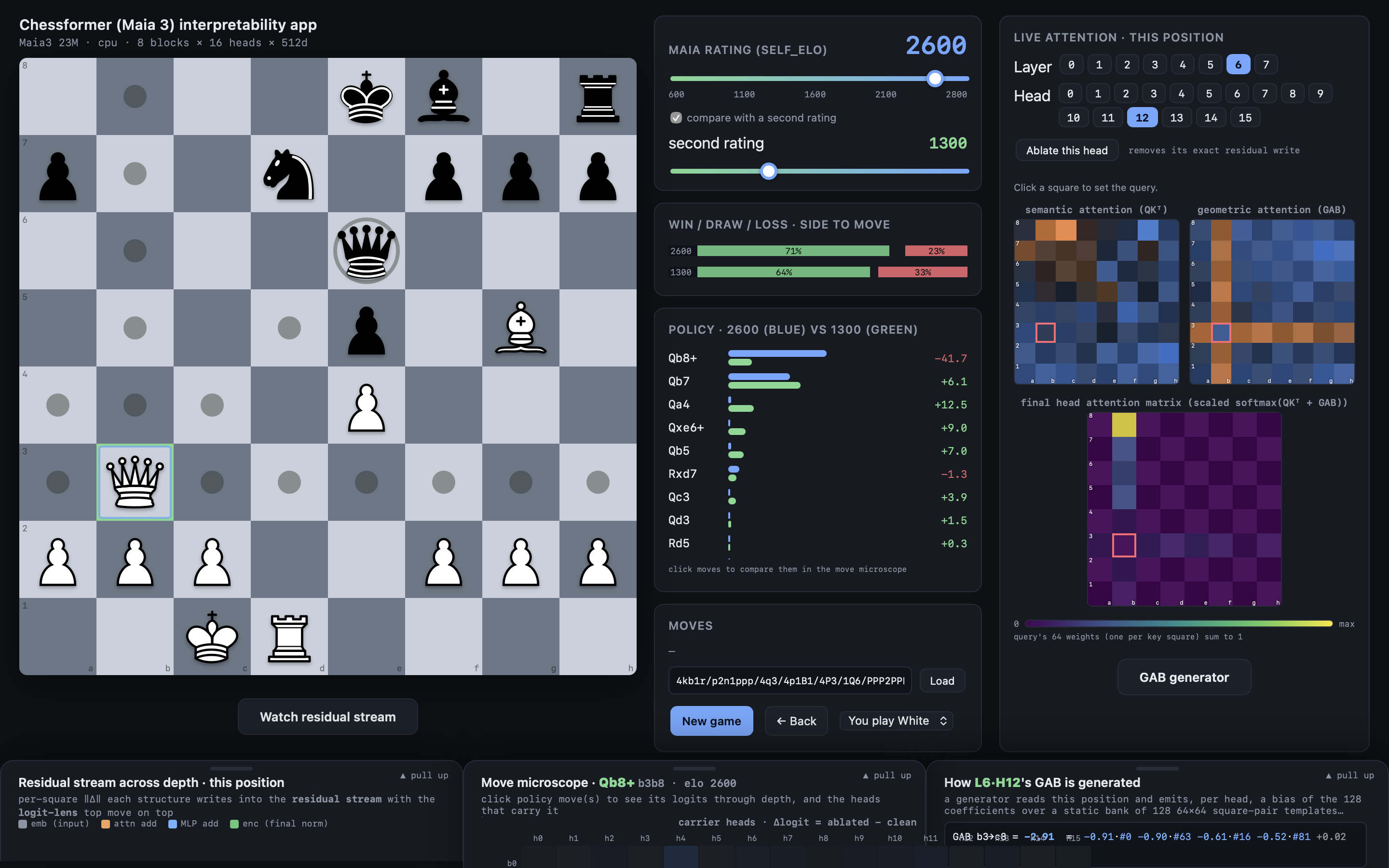
Case study: Knight Fork Carrier Head
Download chessformer_lens locally:
Pip install:
python3 -m venv .venv && source .venv/bin/activate
pip install git+https://github.com/CSSLab/maia3
pip install chessformer_lens
Clone install:
git clone https://github.com/chessformer-lens/chessformer_lens
cd chessformer_lens
pip install -r requirements.txt
Quick interpretability demo (n=10): attention layer 5 head 5 seems to be the carrier head for knight forks
In python:
# Gather ten positions with knights forking King and Queen, then ablate every
# head in the model to see which one is most causally linked to the output.
import chess
import matplotlib.pyplot as plt
from chessformer_lens import MaiaEngine
import chessformer_lens.interp_plot as ip

eng = MaiaEngine()

knight_forks = [
{"fen": '1r2k3/3qn3/3p4/p2P1Pp1/PpP3Np/1P3Q1P/3K1PP1/7R w - - 0 37', "move":'g4f6'},
{"fen": '5b2/6p1/3p2k1/2p3pn/7r/8/P2NKPQ1/R6R b - - 2 25', "move":'h5f4'},
{"fen": '6k1/5p1p/p3p1p1/1p2n3/1P1q4/P2p2P1/3Q1N1P/6K1 b - - 2 37', "move":'e5f3'},
{"fen": 'rn1q1knr/pb2p1b1/6p1/5pN1/1pPP3p/1P6/P1B2PPP/1RQ2RK1 w - - 2 20', "move":'g5e6'},
{"fen": '5r1k/3nrBp1/b1pp1n1p/p3q2P/Pp2PN2/3PB1Q1/1PP3P1/2KR3R w - - 1 22', "move":'f4g6'},
{"fen": '6k1/1pq2ppp/p7/3p4/1P1Nn3/P2QPP2/1B4Pb/7K b - - 1 26', "move":'e4f2'},
{"fen": '4r1k1/6b1/3p2pp/3Pnp2/4N2Q/6P1/P1q2P1P/4R1K1 b - - 0 26',"move": 'e5f3'},
{"fen": '5rk1/pp5p/2p1p1p1/6N1/3PQBP1/2q4P/P7/3n3K b - - 1 25', "move":'d1f2'},
{"fen": 'r2q1rk1/ppp3p1/3ppn1B/2b1p3/3nP3/3P2QN/PPP2PPP/RN3RK1 b - - 2 11',"move": 'd4e2'},
{"fen": 'r1b2rk1/1pp2p1p/4p1p1/2PqP3/p1nPN2B/P1PQ4/6PP/R4RK1 w - - 2 21',"move": 'e4f6'}]

for pos in knight_forks:
    ip.plot_move_report(eng, chess.Board(pos["fen"]), 2400, pos["move"])
    plt.show()
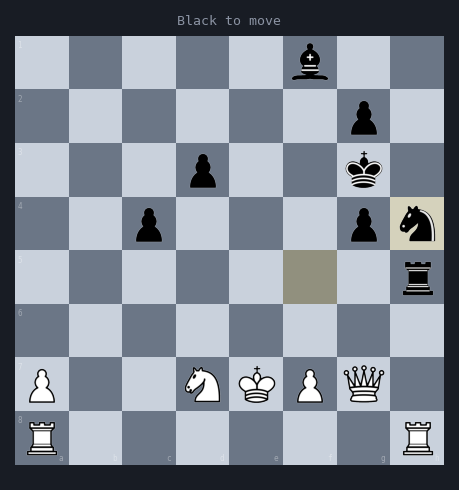
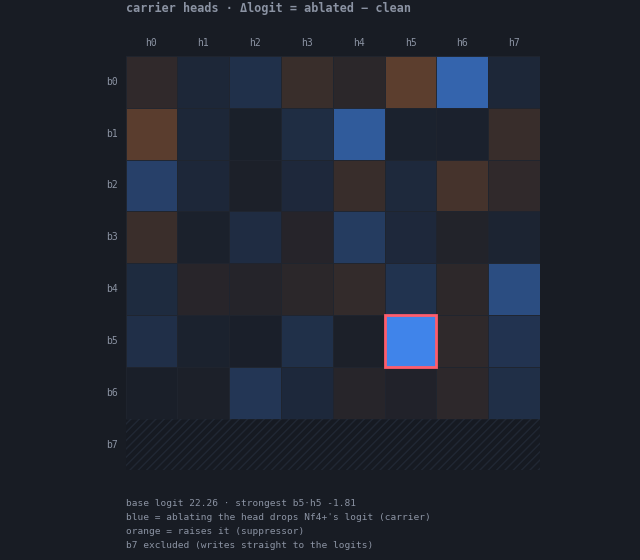
There is wonderful prior chess-interp work, for instance: McGrath et al. on AlphaZero concepts, Jenner et al. on lookahead in Leela, Karvonen on chess-GPT—but there is no general infrastructure for rigorous interpretability work or interactive visualization for these models.
Chessformer_lens is built to do both, especially inspired by Neel Nanda's transformer_lens library.
Chess is unusually suited for AI interpretability because it requires complex and structured reasoning in a compact domain, and it has a hierarchy of human concepts (squares -> threats -> tactics -> strategy) which can provide deep insight into how AI carves features.
Transformer based chess models ("chessformer") are a good lens for studying LLMs because outputs have a clear ground source for the evaluation of a move and so avoid the vagueness of language, because attention functions with clearly interpretable roles on a chess board, and because informative chessformer results are straightforward to scale and investigate in LLMs.
This repo's core is one engine with three frontends:
engine.py is the interp core (model + hooks + logit lens + head ablation + list of values through depth). It does all of the analysis for:
app.pyinterp_plot.pyinterp_widget.py
Users are encouraged to read the user guides for each of these modules which can be found at the top of the respective scripts.
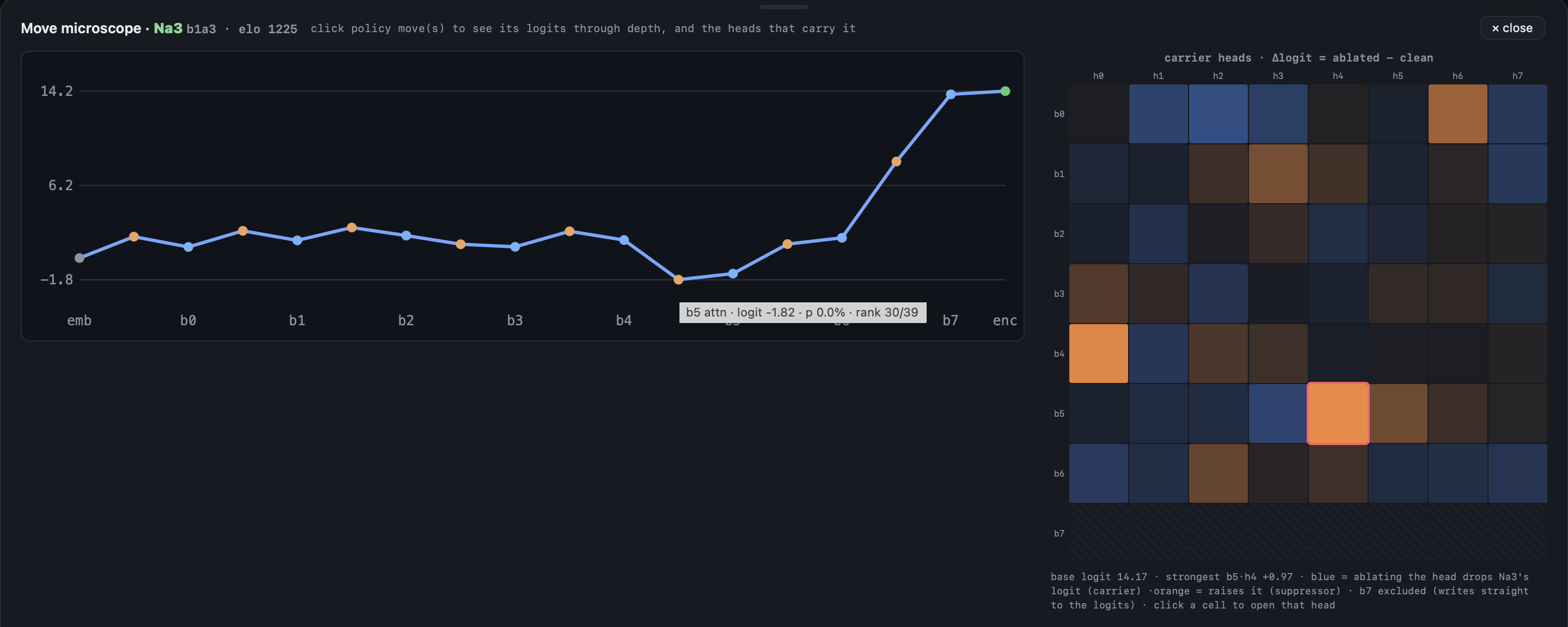
Quickstart in colab or notebook:
Recall that FEN is the modern notation for a chess position
!pip install -q git+https://github.com/CSSLab/maia3 --quiet
!pip install -q chessformer_lens

import chess
from chessformer_lens import MaiaEngine
import chessformer_lens.interp_widget as iw

eng = MaiaEngine()
# Opera Game FEN right at legendary queen sacrifice
fen = "4kb1r/p2n1ppp/4q3/4p1B1/4P3/1Q6/PPP2PPP/2KR4 w k - 0 16"
# [or insert another FEN string]

try:
    board = chess.Board(fen)
except ValueError as e:
    print(f"Invalid FEN: {e}")

#Interact with the attention widget
#click between different layers and heads in the widget
iw.attention_widget(eng, board, 1500,layer=4,head=3)
The app
To me, the app is the pièce de résistance and usage should be rather intuitive, nonetheless, a detailed guide can be found in app_README.md.
Play a transformer-based chess bot ("chessformer") and watch its move policy, its attention (both semantic QKᵀ and unique geometric GAB), and its residual stream evolve with model depth. The model loads on a background thread so the window opens instantly.
#Various ways to launch, note that higher parameter models have 16 and 32 heads per layer, and 512 and 1024 dim of the model (d_model):
chessformer_lens
chessformer_lens 23m
chessformer_lens --model maia3-79m
MAIA3_ALIAS=5m chessformer_lens
Code layout: all found within the chessformer_lens package
__init__.py— the package surface:MaiaEngine,build_cfg,pick_device,attention_widget,gab_widget,__version__.engine.py—MaiaEngine: the interp core (model + hooks + logit lens + head ablation + list of values through depth). No UI deps; imports cleanly in a notebook.interp_plot.py— matplotlib figures that the app usesinterp_widget.py— the app's two interactive panels as a self-contained notebook cell or standalone HTML pagepiece_art.py— drawspieces.py's cburnett pieces in matplotlib from PNGsbridge.py— the game state + the JSON API the UI calls.ui.py— the whole interface (HTML/CSS/JS) as one string including guide to change template.pieces.py— SVG piece set as data URIs.app.py— app launcher (native window via pywebview); thechessformer_lenscommand is itsmain().
Notes
Maia-3 comes from: Chessformer / Maia-3 (Monroe et al., ICLR 2026). Model weights: https://huggingface.co/UofTCSSLab/Maia3-5M
The Maia-3 model interpreter is completed; Leela will be completed soon. Both of these treat each square as a token—which allows for beautiful board readable attention patterns. Eventually other tokenization schemes will be tackled.
Please don't hesitate to give me feedback or thoughts by email or at davidlitman.com. I hope for this to be a useful and intuitive tool for the community!
Citing
If chessformer_lens contributes to published work, a citation is very appreciated and helps others find it! Use GitHub's "Cite this repository" button, or DOI 10.5281/zenodo.21877655.
1 maintainer

Metadata
1 maintainer
Release files for chessformer-lens 0.3.0
For a detailed explanation of source distributions (sdists) and built distributions (wheels), please see the package formats documentation.
Source distribution (sdist)
| File | Size | Uploaded | |
|---|---|---|---|
| chessformer_lens-0.3.0.tar.gz | 181.3 kB | Details |
Built distribution (wheel)
| File | Interpreter | ABI | Platform | Reset |
|---|---|---|---|---|
| chessformer_lens-0.3.0-py3-none-any.whl | Python 3 | none | any | Details |
Total release size: 361.6 kB
Release files / chessformer_lens-0.3.0.tar.gz
| Download URL | chessformer_lens-0.3.0.tar.gz |
|---|---|
| Size | 181.3 kB |
| Tags | Source |
|
SHA-256 checksum How to use checksums |
ffe52265fbcaa73029166f51ec245143d56bdbca398dc206abd83e7ebee4d5c9
|
|
BLAKE2b-256 checksum How to use checksums |
787e64bb69a05ddcf473960e79578da1dd56c5aee998924ac3210eb382f27ac1
|
| Upload date | |
|
Uploaded using Trusted Publishing? What is trusted publishing? |
No |
| Uploaded via |
twine/7.0.0 CPython/3.10.6
|
Release files / chessformer_lens-0.3.0-py3-none-any.whl
| Download URL | chessformer_lens-0.3.0-py3-none-any.whl |
|---|---|
| Size | 180.3 kB |
| Tags | Python 3 |
|
SHA-256 checksum How to use checksums |
e249203d02f51dd08461a5f86f21ef2976cbc2e4a08cd7afb5b5af605202ddd5
|
|
BLAKE2b-256 checksum How to use checksums |
fc8e2a4ea57679b8bb093a1009e4cc980743082aa20c5fc34c29d24cee1df605
|
| Upload date | |
|
Uploaded using Trusted Publishing? What is trusted publishing? |
No |
| Uploaded via |
twine/7.0.0 CPython/3.10.6
|














