

CHIA: An open-source framework for principled, agentic AI-driven hardware/software co-design research
Documentation • Paper • Website
What is CHIA?
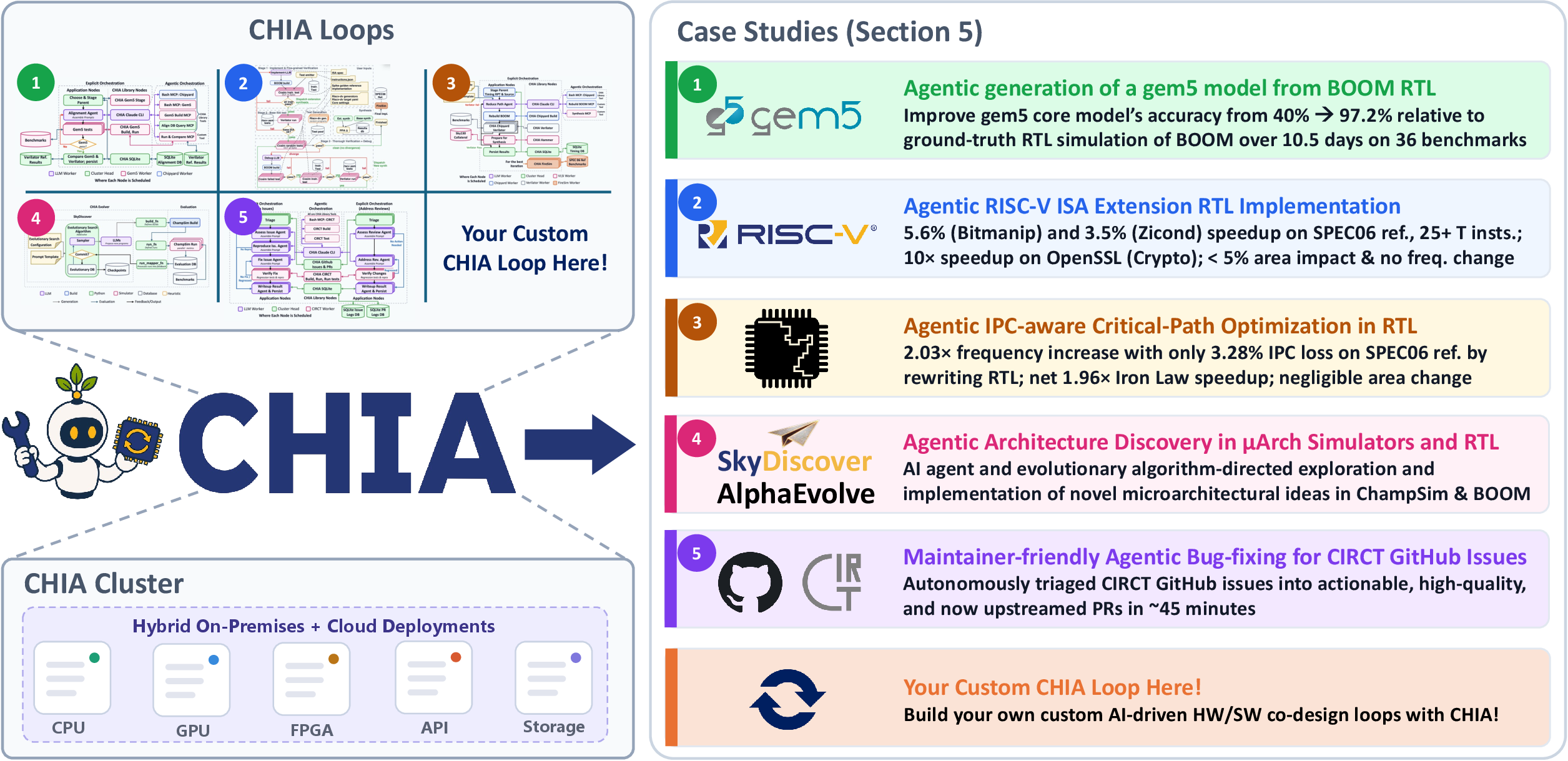
CHIA is an open-source framework for agile and principled hardware/software co-design research. Even though many of the steps of the hardware/software co-design process can be accelerated by AI, existing research using AI in these contexts has been limited to small studies on isolated examples because it is still too hard to assemble more complex experiments. CHIA solves this problem by enabling users to express the whole co-design workflow in an agile way with all of the tools you already use. CHIA abstracts workflows as graphs, and provides an efficient, feature rich runtime system to execute these workflows.
See the documentation to run your first flow!
Installation
CHIA requires Python 3.10.19 (matching the Python in the Docker images). With conda:
conda create -n chia_env python=3.10.19
conda activate chia_env
pip install chialoops
If you are actively developing CHIA, install from a clone in editable mode instead:
git clone https://github.com/ucb-bar/chia.git
pip install -e ./chia
See the installation guide for optional extras.
Learn more about CHIA
- CHIA Basics — the core ideas, start here.
- Architecture Overview — how CHIA works under the hood.
User guides:
- ChiaFunction
- ChiaTool
- Cluster Configuration Reference
- Building a CHIA-compatible Docker image
- Caching and Bypass
- Profiling
Overview of CHIA and Early Case Studies
Integrations & Ecosystem
CHIA workflows compose the tools you already use across the hardware/software co-design stack:

















Powered by Ray:

Attribution
If you use CHIA in your research, please cite our paper:
@misc{cui2026chiaopensourceframeworkprincipled,
      title={CHIA: An open-source framework for principled, agentic AI-driven hardware/software co-design research},
      author={Angela Cui and Ferran Hermida-Rivera and Jack Toubes and Raghav Gupta and Jim Fang and Chengyi Lux Zhang and Ella Schwarz and Junha Kim and Yakun Sophia Shao and Borivoje Nikolic and Christopher W. Fletcher and Sagar Karandikar},
      year={2026},
      eprint={2606.27350},
      archivePrefix={arXiv},
      primaryClass={cs.AR},
      url={https://arxiv.org/abs/2606.27350},
}
1 maintainer

Metadata
1 maintainer
Release files for chialoops 2.0.1
For a detailed explanation of source distributions (sdists) and built distributions (wheels), please see the package formats documentation.
Source distribution (sdist)
| File | Size | Uploaded | |
|---|---|---|---|
| chialoops-2.0.1.tar.gz | 724.8 kB | Details |
Built distribution (wheel)
| File | Interpreter | ABI | Platform | Reset |
|---|---|---|---|---|
| chialoops-2.0.1-py3-none-any.whl | Python 3 | none | any | Details |
Total release size: 1.6 MB
Release files / chialoops-2.0.1.tar.gz
| Download URL | chialoops-2.0.1.tar.gz |
|---|---|
| Size | 724.8 kB |
| Tags | Source |
|
SHA-256 checksum How to use checksums |
4855291d6c20269ea3f3137baf31282fab51b939dbff1d1b2c3b9270b00c6f61
|
|
BLAKE2b-256 checksum How to use checksums |
b0ffc9ee6015e90ef5c05a67348efbbe406cd871a3fae687ddbde358b8ad2f92
|
| Upload date | |
|
Uploaded using Trusted Publishing? What is trusted publishing? |
Yes |
| Uploaded via |
twine/7.0.0 CPython/3.13.14
|
Provenance
Provenance describes where a file came from. On PyPI, provenance is shared via attestations, which provide a verifiable record of the build or publishing details. View details, limitations and caveats.


PyPI Publish Attestation
PyPI verified that this artifact, at this checksum, originated from the publisher listed below.
Signed by GitHub Actions, verified by PyPI on Oct 19, 2026.
Transparency logRelease files / chialoops-2.0.1-py3-none-any.whl
| Download URL | chialoops-2.0.1-py3-none-any.whl |
|---|---|
| Size | 861.6 kB |
| Tags | Python 3 |
|
SHA-256 checksum How to use checksums |
fbd1587522a65203108cbcd28cf7240ee3b887768f8f575a97e0432975726b6c
|
|
BLAKE2b-256 checksum How to use checksums |
0ed2a44d5b63db504aea2d6f0aa6580e8ae783c91b116135519d4825189c2294
|
| Upload date | |
|
Uploaded using Trusted Publishing? What is trusted publishing? |
Yes |
| Uploaded via |
twine/7.0.0 CPython/3.13.14
|
Provenance
Provenance describes where a file came from. On PyPI, provenance is shared via attestations, which provide a verifiable record of the build or publishing details. View details, limitations and caveats.
PyPI Publish Attestation
PyPI verified that this artifact, at this checksum, originated from the publisher listed below.
Signed by GitHub Actions, verified by PyPI on Oct 19, 2026.
Transparency log













