
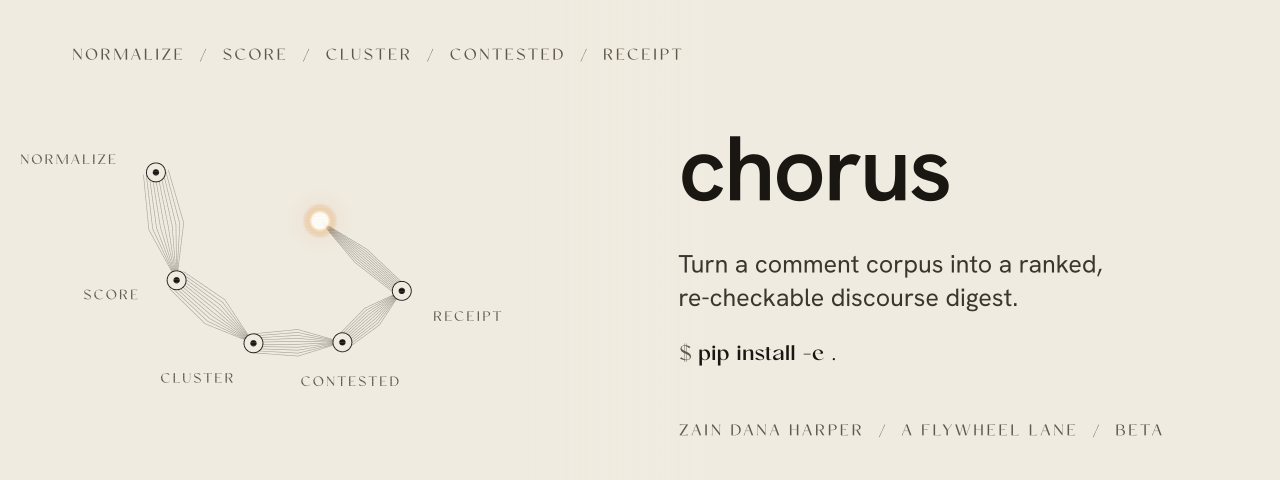
Chorus
Chorus reads a comment section and tells you what the crowd says, how strongly, and where it disagrees, with a receipt anyone can re-run.
Give it a set of comments and it returns a digest: the themes people raise, ranked by engagement and strength of feeling, the loudest voice that disagrees with each theme's majority, and the topics the crowd is split on. The same input always gives the same digest, and a stranger can check that the digest follows from the comments. It runs on your machine with Python alone, with no model, no service key and no network call.
It is for journalists, researchers, moderators and product teams who read large comment threads and need a summary they can show their working for.
Install and first run
Python 3.10 or newer. Chorus has no third-party dependencies.
python -m pip install chorus-discourse
curl -LO https://raw.githubusercontent.com/HarperZ9/chorus/main/examples/discourse-sample.json
chorus run discourse-sample.json --verify
The sample holds twelve comments on a phone review. The digest is JSON; trimmed, it reads:
"themes":    "display / screen / bright", "drains / battery", "phone / life / battery",
             "camera / photos / average", "awful / dead / disappointing"
"contested": "life" (0.5531, 3 mentions), "battery" (0.5386, 5 mentions)
"verified":  true
To see the receipt refuse an edited digest, run this from the same folder:
import dataclasses, json
from chorus.item import normalize
from chorus.sentiment import score
from chorus.synthesize import synthesize
from chorus.receipt import verify

scored = score(normalize(json.load(open("discourse-sample.json"))))
digest = synthesize(scored)
print(verify(digest, scored))   # True

theme = dataclasses.replace(digest.themes[0], weighted_score=999.0)
edited = dataclasses.replace(digest, themes=(theme,) + tuple(digest.themes[1:]))
print(verify(edited, scored))   # False
Your own input is a JSON list of rows such as
{"kind": "comment", "id": "c01", "ref": "video-1", "text": "...", "meta": {"like_count": 340}},
or a corpus folder written by Gather.
Rows of kind comment, post, reply and feed-entry count as discourse.
like_count or score in meta sets engagement; a row without either is
recorded as having no signal, never as zero.
How it compares
- VADER scores the sentiment of one text from a lexicon and rules. Chorus uses a smaller lexicon of the same kind, then groups comments into themes, weights them by engagement and reports split topics across the whole thread.
- BERTopic and other embedding topic models find themes by meaning, so they group paraphrases that Chorus misses. They need a model download, and their output is not re-derivable byte for byte. Chorus clusters by shared words and writes a receipt that reproduces every number.
- Polis clusters participants by how they vote on each other's statements in a live deliberation it hosts. Chorus works after the fact, on comments already posted somewhere else.
- Asking a language model to summarise the thread gives fluent prose that
cannot be checked against the comments. Chorus can pass its least certain
comments to a model you name with
--model, and it keeps that opinion outside the receipt.
Limits
- Sentiment comes from a 30-word English lexicon. It reads text literally, so it misses sarcasm, irony and other languages.
- Clustering is lexical. Two comments that make one point in different words can land in different themes.
- A verified receipt shows the digest follows from the input. It does not show the input is complete, representative or free of coordinated accounts.
- The test suite is small, and Chorus has not yet been studied on real comment sections. Treat its themes as a starting point for your own reading.

See it work, step by step
The animated explainer walks through the bundled twelve-comment sample: lexicon scores, engagement weights, five themes, the contested battery topic, and a digest receipt that rejects a doctored weight even with its hash recomputed. Every value on it is output from this repository. Its source is docs/explainer/index.html.
What you get
- Themes, ranked. Comments cluster into themes by what they say; each theme carries a corpus-salience label, label-support metadata, its size, an engagement-and-sentiment weight, a sentiment split, a controversy score (how divided and how strongly felt), and the single highest-weight voice that disagrees with the majority. The digest marks singleton and weak-support labels, so a narrow label never passes for a broad crowd theme. Theme item IDs stay in the output so callers can resolve labels back to the source links and provenance in their corpus.
- The contested topics, named. A separate lens reports the aspects the corpus is split on, measured across every comment that mentions a topic. It is immune to the lexical clustering that would otherwise file "the battery is amazing" and "the battery is terrible" under different themes and hide the fight. One-sided praise and neutral chatter are excluded; only real two-sided disagreement is surfaced.
- A receipt for every digest.
--verifyre-derives the whole digest from the inputs and confirms it. A tampered digest fails even if its own hash was recomputed to match. Sentiment is a weight, never a verdict. - Honest nulls. A missing engagement signal is recorded as absent, never counted as a zero. A too-thin corpus says so. The lexicon's limits (English-only, literal, no sarcasm) are stated in the digest itself.
- A daemon. Point it at a watchlist and it re-synthesizes only when a corpus changes, storing each receipted digest by its own hash.
- A source-change review gate. Compare a current gather corpus against a
reference corpus before reusing a prior synthesis or release note. The result
reports added, removed, changed, unchanged, digest verification, a local digest
outline, and typed source failure states. The optional public projection is
safe by default as hashes and counts. Human-readable public ids, source names,
refs, and URLs require a
--public-policysidecar you write; raw source row metadata cannot authorize public output. The projection omits raw source text, author names, local paths, private session content, and bulk comments. Source URLs appear there only through that public-policy sidecar. - An MCP surface. Drive it from any MCP host:
chorus.run,chorus.corpora,chorus.digests,chorus.decision,chorus.status,chorus.doctor.
Release notes
CHANGELOG.md lists
every release. Version 0.3.1 reads Gather feed entries as discourse. Version
0.3.0 added chorus decision, a review gate that reports whether the sources
behind an earlier digest changed; it does not judge whether a source claim is
true. Version 0.2.0 added theme-label support metadata to receipts, and
chorus-lens/2 receipts from earlier versions still verify.
Run it
python -m pip install chorus-discourse   # or, from a checkout: python -m pip install -e .

chorus run examples/discourse-sample.json --verify   # try it on the bundled sample
chorus run <corpus> --verify        # a corpus -> a verified discourse digest
chorus decision <current> --reference <reference> --task "Check whether sources changed"
chorus decision <current> --reference <reference> --public --public-policy public-policy.json
chorus corpora <root>               # discover gather corpora as discourse sources
chorus watch add <corpus>           # add a corpus to the daemon watchlist
chorus daemon --interval 300        # poll the watchlist, synthesize on change
chorus digests <store>              # what the daemon has synthesized
chorus mcp                          # the MCP stdio server
<corpus> is a gather corpus directory (a folder holding catalog.jsonl) or a
JSON list of rows. Add --model "<command>" to run to overlay a model's read on
the comments the lexicon is least sure about; the overlay is provenance-tagged and
never enters the re-checkable core.
No service key or provider account is needed for the deterministic path. The bundled sample is the quickest local check:
chorus run examples/discourse-sample.json --verify
python -m pytest
If chorus is not on PATH, reinstall with python -m pip install chorus-discourse
and open a new shell. chorus.status and
chorus.doctor are MCP tools exposed through chorus mcp; they are not separate
CLI subcommands. Public source-change projections need a --public-policy
sidecar you write before source names, ids, refs, or URLs appear.

The receipt
The digest's receipt binds the inputs, the method, and the result. verify
first checks that the submitted digest body still matches its own receipt, then
re-runs the deterministic pipeline (score, cluster, weight) from the same corpus
through the method-version verifier recorded in the receipt. Current runs write
chorus-lens/3; historical chorus-lens/2 receipts remain checkable through
their legacy label body. Unsupported method versions fail closed. Any model
overlay is listed separately with its own provenance and is excluded from that
check: the parts a stranger can re-derive and the parts that are model opinion
are kept distinct, on the record.

Design
The design and its two exposed defects-caught-in-review live in docs/superpowers/specs. Sentiment is coarse by construction and the digest says so; clustering is lexical, not semantic. chorus tells you what it did and hands you the means to check it.
License
Chorus is free software under the GNU Affero General Public License, version 3 only (AGPL-3.0-only). See LICENSE and NOTICE.
Anyone may use, study, change and share it. If you distribute a changed copy, or run one as a service that people use over a network, you must offer them its source under the same licence.
Releases up to 0.3.1 were published under FSL-1.1-MIT. They keep those terms, and each converts to MIT two years after its release.
Built by Zain Dana Harper in Seattle: evidence-first tools that leave a re-checkable artifact behind. Other tools by the same author are listed at harperz9.github.io.
1 maintainer

Metadata
1 maintainer
Release files for chorus-discourse 0.3.2
For a detailed explanation of source distributions (sdists) and built distributions (wheels), please see the package formats documentation.
Source distribution (sdist)
| File | Size | Uploaded | Provenance | |
|---|---|---|---|---|
| chorus_discourse-0.3.2.tar.gz | 70.5 kB | With provenance | Details |
Built distribution (wheel)
| File | Interpreter | ABI | Platform | Reset |
|---|---|---|---|---|
| chorus_discourse-0.3.2-py3-none-any.whl | Python 3 | none | any | Details |
Total release size: 120.6 kB
Release files / chorus_discourse-0.3.2.tar.gz
| Download URL | chorus_discourse-0.3.2.tar.gz |
|---|---|
| Size | 70.5 kB |
| Tags | Source |
|
SHA-256 checksum How to use checksums |
b978192ddb43ca8d60a2132075ac12f47398c85213f186aeba1a8b5388060873
|
|
BLAKE2b-256 checksum How to use checksums |
ce67944392573a20c7c78a1e578dea946539ca5593b5519c89b4ba2bb9771fff
|
| Upload date | |
|
Uploaded using Trusted Publishing? What is trusted publishing? |
Yes |
| Uploaded via |
twine/7.0.0 CPython/3.13.14
|
Provenance
Provenance describes where a file came from. On PyPI, provenance is shared via attestations, which provide a verifiable record of the build or publishing details. View details, limitations and caveats.


PyPI Publish Attestation
PyPI verified that this artifact, at this checksum, originated from the publisher listed below.
Signed by GitHub Actions, verified by PyPI on Oct 23, 2026.
Transparency logRelease files / chorus_discourse-0.3.2-py3-none-any.whl
| Download URL | chorus_discourse-0.3.2-py3-none-any.whl |
|---|---|
| Size | 50.0 kB |
| Tags | Python 3 |
|
SHA-256 checksum How to use checksums |
daa48004a18b811f25c4bc17be1a8255086e896c428333d101409d874e8f6018
|
|
BLAKE2b-256 checksum How to use checksums |
8915760f190f0ed928c61e5f300eab3c06411a6118185e7084872dd92f9ff158
|
| Upload date | |
|
Uploaded using Trusted Publishing? What is trusted publishing? |
Yes |
| Uploaded via |
twine/7.0.0 CPython/3.13.14
|
Provenance
Provenance describes where a file came from. On PyPI, provenance is shared via attestations, which provide a verifiable record of the build or publishing details. View details, limitations and caveats.
PyPI Publish Attestation
PyPI verified that this artifact, at this checksum, originated from the publisher listed below.
Signed by GitHub Actions, verified by PyPI on Oct 23, 2026.
Transparency logSecurity for chorus-discourse 0.3.2
Provenance
Provenance describes where a file came from. On PyPI, provenance is shared via attestations, which provide a verifiable record of the build or publishing details. View details, limitations and caveats.
Full provenance
All 2 files in this release have been uploaded with provenance metadata.
Attestation for chorus_discourse-0.3.2.tar.gz
PyPI Publish Attestation
PyPI verified that this artifact, at this checksum, originated from the publisher listed below.
Signed by GitHub Actions, verified by PyPI on Oct 23, 2026.
Transparency logA note on package security
PyPI is a repository for distributing packages, not a service for auditing them. While third-party security researchers and our staff do their best to detect and remove malicious packages, PyPI cannot guarantee the quality, security or suitability of any given package.














