
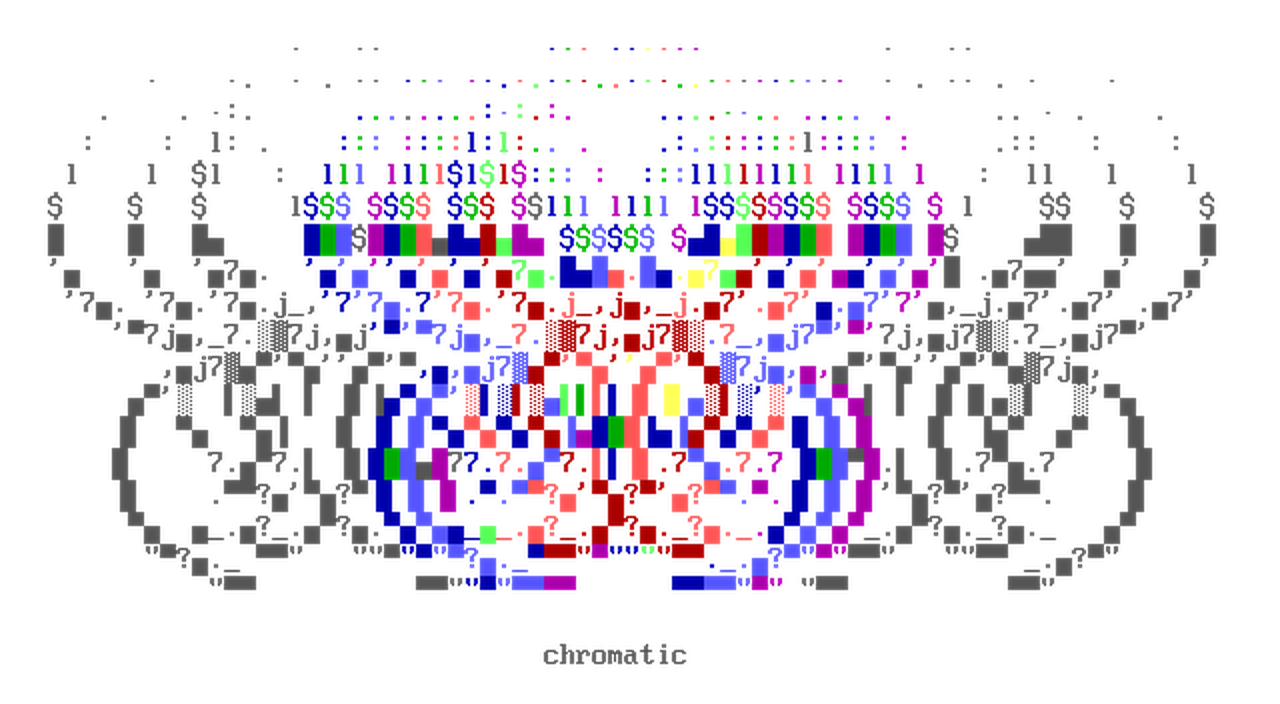


Chromatic is a library for ANSI art image processing and colored terminal text.
It offers a collection of algorithms and types for a variety of use cases:
- Image-to-ASCII / Image-to-ANSI conversions.
- ANSI art rendering, with support for user-defined fonts.
- A
ColorStrtype for low-level control over ANSI SGR strings. - colorama-style wrappers (
Fore,Back,Style). - Conversion between 16-color, 256-color, and true-color (RGB) ANSI colorspace via the
colorbytestype. - Et Cetera 😲
Usage
ColorStr
from chromatic import ColorStr

cs = ColorStr("hello world", fg=0xFF0000, ansi_type="8b")

assert cs.base_str == "hello world"
assert len(cs) == len("hello world")

head, tail = cs.split()

assert head.fg == tail.fg == cs.fg
assert all(c.fg == cs.fg for c in cs)
ColorStr is a str subclass that carries SGR state as metadata.
Its str methods delegate to the base string and return ColorStr instances that retain the SGR state.
assert str(cs) == "\x1b[38;5;196mhello world\x1b[0m"
assert cs.ansi == b"\x1b[38;5;196m"
The SGR sequence materializes when the ColorStr is converted back to a Python str.
color_chain
from chromatic import color_chain

cc = color_chain(
    [ColorStr("hello", fg=0xFF0000), ColorStr(" world", fg=0x00FF00)], ansi_type="8b"
)

sgr, s = cc[0]

assert sgr.fg == (0xFF, 0, 0)
assert s == "hello"
A color_chain is a sequence of colored-text fragments that round-trips with a structured NumPy array.
Each fragment is an (sgr, text) pair of the SGR state and the run of text it applies to.
cc2 = color_chain("\x1b[38;5;196mhello\x1b[38;5;46m world")

assert cc == cc2
The constructor also parses a raw SGR string.
It infers the color depth from the sequence, so cc2 needs no ansi_type.
arr = cc.term_array()

assert arr.dtype == [("char", "<U1"), ("sgr", "<u8"), ("rgb", "u1", (2, 4))]
assert str(color_chain.fromarray(arr)) == str(cc)
term_array exposes the structured ndarray behind the chain, and fromarray reverses it.
fromarray accepts any ndarray of that dtype, so an array built by other means converts to a printable color_chain.
img2ansi
from chromatic import img2ansi

cc = img2ansi("input.png")
img2ansi reads an image and returns a color_chain.
arr = img2ansi("input.png", outarray=True)

assert color_chain.fromarray(arr) == cc
outarray=True returns the underlying ndarray instead.
ansi2img
from chromatic import ansi2img

img = ansi2img(cc)
img.show()
ansi2img renders a color_chain back to an image.
It also accepts a dtype-matching array.
ansify
from chromatic import ansify

img = ansify("input.png")
arr = img.info["ansi_array"]
ansify runs both directions in one call, returning the rendered image with the array it rendered from on Image.info.
Animated images
frames = img2ansi("input.gif")

assert isinstance(frames, list)
assert all(isinstance(f, color_chain) for f in frames)
An animated image renders to a list[color_chain], one per frame.
chromatic image ansify input.gif --stdout
The CLI renders and plays one straight to the terminal.
Installation
Install the package using pip:
pip install chromatic-python
Credits
Banner artwork: main rules by Crasher (2002)
1 maintainer

Metadata
1 maintainer
Release files for chromatic-python 0.9.3
For a detailed explanation of source distributions (sdists) and built distributions (wheels), please see the package formats documentation.
Source distribution (sdist)
| File | Size | Uploaded | Provenance | Actions |
|---|---|---|---|---|
| chromatic_python-0.9.3.tar.gz | 342.5 kB | With provenance | Details for chromatic_python-0.9.3.tar.gz |
Built distribution (wheel)
| File | Interpreter | ABI | Platform | Actions Reset |
|---|---|---|---|---|
| chromatic_python-0.9.3-py3-none-any.whl | Python 3 | none | any | Details for chromatic_python-0.9.3-py3-none-any.whl |
Total release size: 427.1 kB
Release files / chromatic_python-0.9.3.tar.gz
| Download URL | chromatic_python-0.9.3.tar.gz |
|---|---|
| Size | 342.5 kB |
| Tags | Source |
|
SHA-256 checksum How to use checksums |
4f556a12a2d3af4ee89e8557c69367d582ce8b0647a18efc4bf4a1b5137eeaa5
|
|
BLAKE2b-256 checksum How to use checksums |
e0d5fbd4537292a4ff8a1a5a3754c7a7ccccd7e29b343f1cc0db14504c08d0ac
|
| Upload date | |
|
Uploaded using Trusted Publishing? What is trusted publishing? |
Yes |
| Uploaded via |
twine/7.0.0 CPython/3.13.14
|
Provenance
Provenance describes where a file came from. On PyPI, provenance is shared via attestations, which provide a verifiable record of the build or publishing details. View details, limitations and caveats.


PyPI Publish Attestation
PyPI verified that this artifact, at this checksum, originated from the publisher listed below.
Signed by GitHub Actions, verified by PyPI on Oct 1, 2026.
Transparency logRelease files / chromatic_python-0.9.3-py3-none-any.whl
| Download URL | chromatic_python-0.9.3-py3-none-any.whl |
|---|---|
| Size | 84.6 kB |
| Tags | Python 3 |
|
SHA-256 checksum How to use checksums |
b3b7361ba861a63cc4026fa1f2c2204ff6aa3c5a23c036daf5c14be1eaf15d22
|
|
BLAKE2b-256 checksum How to use checksums |
deb3e035c2ef7b285fc5f3e3d267fc898aa24fc2c8c6e87c88c22a1e313cd65b
|
| Upload date | |
|
Uploaded using Trusted Publishing? What is trusted publishing? |
Yes |
| Uploaded via |
twine/7.0.0 CPython/3.13.14
|
Provenance
Provenance describes where a file came from. On PyPI, provenance is shared via attestations, which provide a verifiable record of the build or publishing details. View details, limitations and caveats.
PyPI Publish Attestation
PyPI verified that this artifact, at this checksum, originated from the publisher listed below.
Signed by GitHub Actions, verified by PyPI on Oct 1, 2026.
Transparency logSecurity for chromatic-python 0.9.3
Provenance
Provenance describes where a file came from. On PyPI, provenance is shared via attestations, which provide a verifiable record of the build or publishing details. View details, limitations and caveats.
Full provenance
All 2 files in this release have been uploaded with provenance metadata.
Attestation for chromatic_python-0.9.3.tar.gz
PyPI Publish Attestation
PyPI verified that this artifact, at this checksum, originated from the publisher listed below.
Signed by GitHub Actions, verified by PyPI on Oct 1, 2026.
Transparency logA note on package security
PyPI is a repository for distributing packages, not a service for auditing them. While third-party security researchers and our staff do their best to detect and remove malicious packages, PyPI cannot guarantee the quality, security or suitability of any given package.
To learn more about protecting yourself from malicious actors, visit our package security documentation.














