
chronoise
Synthetic noise-driven time series with controllable structure for ML benchmarks.
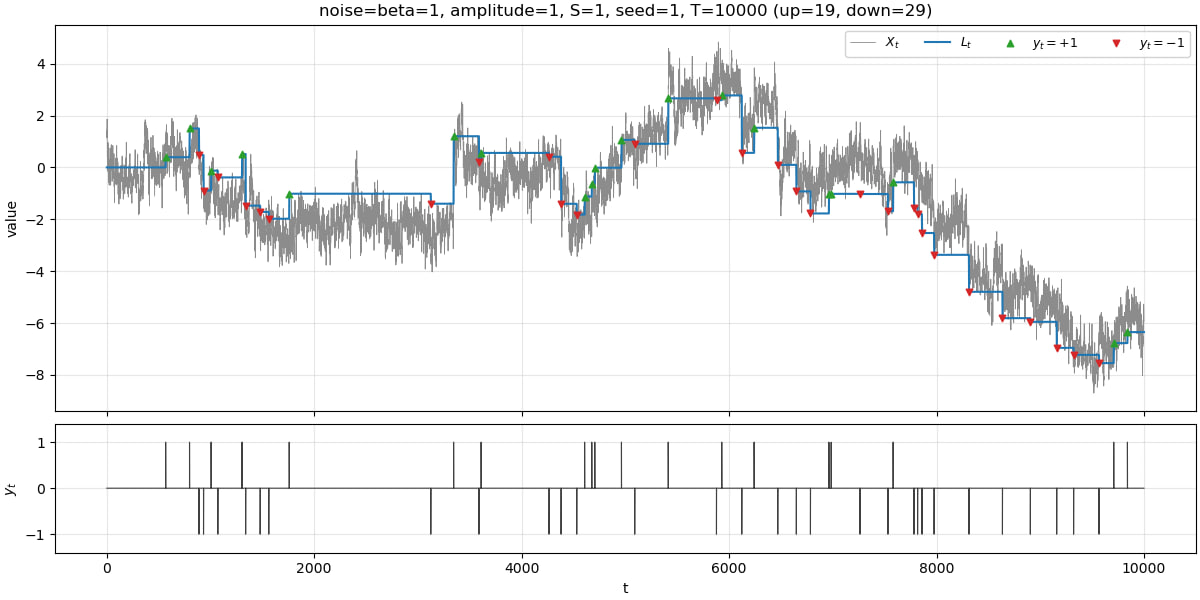
Each series is generated as
X_t = L_t + a * N(t)
where L_t is a piecewise-constant level with stochastic step lengths and an
optional seasonal sign bias, and N(t) is one of six configurable noise styles
(five 1/f^beta colored noises and one El-Nino-style noise). The canonical
dataset is a 6 x 3 x 2 x 10 = 360-element grid.
Install
pip install chronoise
Requires Python >=3.10, numpy>=1.23, torch>=2.0.
Usage
from chronoise import (
    GeneratorConfig, NoiseKind, NoiseSpec,
    generate_series, NoiseSeriesDataset,
)

cfg = GeneratorConfig()

# Single realization.
r = generate_series(
    cfg,
    noise=NoiseSpec(NoiseKind.BETA, beta=1.0),
    amplitude=1.0,
    structural_mode=1,
    seed=0,
)
# r.X        : (T,) float64 observed series
# r.y        : (T,) int8 signed direction labels in {-1, 0, +1}
# r.y_binary : (T,) int8 binary bifurcation labels in {0, 1}
# r.L, r.N   : level and standardized noise components

# Full canonical dataset (360 series in memory).
ds = NoiseSeriesDataset(cfg)                  # default: signed labels {-1, 0, +1}
ds.save("dataset.npz")
ds = NoiseSeriesDataset.load("dataset.npz")

x, y = ds[0]  # torch tensors

# Switch to binary bifurcation labels for the break-vs-no-break task:
ds_bin = NoiseSeriesDataset(cfg, label_mode="binary")
x, y = ds_bin[0]                              # y in {0, 1}

# Both encodings are always stored — access either without rebuilding:
y_signed = ds.labels(0, mode="signed")
y_binary = ds.labels(0, mode="binary")
For a runnable example see examples/quickstart.py.
CLI
chronoise-build dataset.npz --T 8192 --n-seeds 10
Add --keep-components to also store the level (L) and noise (N)
components in the archive. Add --label-mode {signed,binary} to choose the
default label encoding (both arrays are always persisted; this flag only
selects what __getitem__ returns):
chronoise-build dataset.npz --label-mode binary
Configuration
All knobs live on GeneratorConfig (chronoise/config.py): series length,
level statistics (sigma_L, gamma, T0, segment-length geometric
parameters), colored-noise frequency grid (K, f_low, f_high),
El-Nino-style noise (T1, T2, phi_ar), and the canonical product axes
(betas, amplitudes, structural_modes, n_seeds).
Series with the same seed share the same level trace across noise types,
which is convenient for paired comparisons.
Example
License
This project is licensed under the MIT License.
1 maintainer

Metadata
1 maintainer
Release files for chronoise 0.3.0
For a detailed explanation of source distributions (sdists) and built distributions (wheels), please see the package formats documentation.
Source distribution (sdist)
| File | Size | Uploaded | Provenance | Actions |
|---|---|---|---|---|
| chronoise-0.3.0.tar.gz | 20.3 kB | Without provenance | Details for chronoise-0.3.0.tar.gz |
Built distribution (wheel)
| File | Interpreter | ABI | Platform | Actions Reset |
|---|---|---|---|---|
| chronoise-0.3.0-py3-none-any.whl | Python 3 | none | any | Details for chronoise-0.3.0-py3-none-any.whl |
Total release size: 37.3 kB
Release files / chronoise-0.3.0.tar.gz
| Download URL | chronoise-0.3.0.tar.gz |
|---|---|
| Size | 20.3 kB |
| Tags | Source |
|
SHA-256 checksum How to use checksums |
effb37dbaeb12fd3b72bbe04177ec2336c370f1c8d3025e782bae5069d54e655
|
|
BLAKE2b-256 checksum How to use checksums |
79bfa4ec5c49ac2e7d7c63e1789ab32e81096109bae940c3b6f88974571faf75
|
| Upload date | |
|
Uploaded using Trusted Publishing? What is trusted publishing? |
No |
| Uploaded via |
twine/6.2.0 CPython/3.12.13
|
Release files / chronoise-0.3.0-py3-none-any.whl
| Download URL | chronoise-0.3.0-py3-none-any.whl |
|---|---|
| Size | 17.1 kB |
| Tags | Python 3 |
|
SHA-256 checksum How to use checksums |
9a254d0cf0538664220a90b737b7916c996b2f298930648d09387b264c74b5f6
|
|
BLAKE2b-256 checksum How to use checksums |
a4e6528ed389573c3adfce4efa87a00e93cf48fee194c8fffa8f051d9ca7221f
|
| Upload date | |
|
Uploaded using Trusted Publishing? What is trusted publishing? |
No |
| Uploaded via |
twine/6.2.0 CPython/3.12.13
|
Security for chronoise 0.3.0
Provenance
Provenance describes where a file came from. On PyPI, provenance is shared via attestations, which provide a verifiable record of the build or publishing details. View details, limitations and caveats.
No provenance found
None of the files in this release were uploaded with provenance metadata.
A note on package security
PyPI is a repository for distributing packages, not a service for auditing them. While third-party security researchers and our staff do their best to detect and remove malicious packages, PyPI cannot guarantee the quality, security or suitability of any given package.
To learn more about protecting yourself from malicious actors, visit our package security documentation.














