
PNG corruption analyzer and repair helper.

Project description

Chunklate
Chunklate is a work-in-progress PNG repair tool. It inspects broken PNG files,
tries known repair routes, saves each candidate in a Folder_* output folder,
and writes a readable summary of what happened.
It is useful for CTF-style PNG damage, partial image salvage, and guided brute force searches. It is not magic: when image data is missing or the file is structurally valid but visually wrong, Chunklate needs a strong checksum, reference image, ROI, or user validation to know what the original image should look like.
Quick Start
Install the runtime dependencies:
./scripts/bootstrap_dev.sh
. .venv/bin/activate
On Windows:
py scripts\bootstrap_dev.py
.venv\Scripts\activate
Run Chunklate:
python Chunklate.py -f path/to/file.png
Or, after installing the package entry point:
chunklate -f path/to/file.png
For long brute force runs:
python Chunklate.py -f bad.png -workers normal
For optional OpenGL acceleration when supported:
python Chunklate.py -f bad.png -gpu -workers normal
Optional GPU dependency:
python -m pip install -e ".[gpu]"
or:
python -m pip install "moderngl>=5.10"
PyPI Package
Install from PyPI:
python -m pip install chunklate
Install the optional GPU extra:
python -m pip install "chunklate[gpu]"
Update an installed package:
python -m pip install --upgrade chunklate
Chunklate checks PyPI at startup by default. If a newer package exists, it prints
the update command and asks whether to continue with the installed version. Use
--no-update-check only when you need a fully offline or deterministic run.
Build the package locally:
python -m build
python -m twine check dist/*
Before publishing, bump the version in both pyproject.toml and
chunklate/__init__.py, run the test suite, then upload:
python -m twine upload dist/*
Arguments
usage: Chunklate.py [-h] [-f FILE] [-c] [-p] [-d] [-df] [-dp] [-ep] [-sp]
                    [-stfu] [-a] [--no-color] [--no-update-check]
                    [--output-dir DIR] [--max-saves N]
                    [-workers min|normal|max|N] [-gpu]
                    [-ddll N] [--ddl-crc-forge auto|off|force]
                    [--ddl-forge-bytes N] [--ddl-forge-window START:END]
                    [--ddl-deflate-mitm auto|off|force]
                    [-ulfr exact|similar PATH] [-ulfroi-edit] [-ulfsp]
                    [-ulfgl N] [-ulfmc FLOAT]
General options:
| Argument | What it does |
|---|---|
-f FILE |
PNG file to inspect or repair. |
-a |
Auto-choose safe/default answers when possible. |
-stfu |
Minimal terminal output. Prompts that matter can still appear. |
-c |
Clear the terminal after saves. |
-p |
Pause after saves. |
-sp |
Pause at dialogue messages. |
-ep |
Pause at errors. |
-d |
Print debug output in the terminal. |
-df |
Add debug output and terminal transcript context to the summary file. |
-dp |
Pause at debug messages. |
--no-color |
Disable terminal colors. |
--output-dir DIR |
Write Folder_* outputs under this directory. |
--max-saves N |
Stop after writing N repaired files. |
--no-update-check |
Skip the default startup check against PyPI. |
Performance and brute force:
| Argument | What it does |
|---|---|
-workers 0 or -workers 1 |
Serial mode. |
-workers min |
Use about CPU / 4 workers. |
-workers normal |
Use about CPU / 2 workers. |
-workers max |
Use about CPU - 1 workers. |
-workers N |
Use exactly N CPU workers. |
-gpu |
Allow GPU acceleration when a compatible engine supports the current pass. CPU remains the fallback. |
DaedalusForce options:
| Argument | What it does |
|---|---|
-ddll N |
Start DaedalusForce at brute-force level N; useful to jump straight to level 2 for 4-byte Hermes windows after lower levels are already exhausted. |
--ddl-crc-forge auto |
Let HermesProbe try targeted IDAT CRC repairs before broad DaedalusForce. This is the default. |
--ddl-crc-forge off |
Skip HermesProbe CRC repair and go to the normal DaedalusForce path. |
--ddl-crc-forge force |
Let HermesProbe use wider targeted repair budgets. This can still be slow. |
--ddl-forge-bytes N |
Limit HermesProbe to one suspected byte count. |
--ddl-forge-window START:END |
Limit HermesProbe to one or more IDAT byte windows. This is useful when you already know the damaged area. |
--ddl-deflate-mitm auto |
Let HermesProbe use the deflate meet-in-the-middle V2 solver for longer IDAT edits. This is the default. |
--ddl-deflate-mitm off |
Disable the V2 deflate solver while keeping the other HermesProbe passes. |
--ddl-deflate-mitm force |
Use larger V2 solver budgets. Prefer this only with a tight byte window. |
Ultimate line-feed options:
| Argument | What it does |
|---|---|
-ulfr exact PATH |
Use a reference PNG for exact candidate scoring. |
-ulfr similar PATH |
Use a related/similar PNG for ROI or patch scoring. |
-ulfroi-edit |
Open the ROI editor before Ultimate scoring. |
-ulfsp |
Open live Ultimate candidate previews. |
-ulfgl N |
Keep up to N saved visual candidates. |
-ulfmc FLOAT |
Minimum visual gallery scanline coverage, from 0 to 1. |
Output Files
Chunklate writes repairs and artifacts next to the input by default:
Folder_bad/
  bad.0_Fixed.png
  Summary_Of_bad
  Bruteforce_Previews/
  Debug_Payloads/
  _SBB.progress.json
  _ULF.progress.json
Important distinction:
*_Fixed.pngshould mean a repair candidate passed the current write gate.Bruteforce_Previews/contains visual candidates, blackfill fallbacks, and unproven brute force artifacts.Debug_Payloads/contains payloads useful for debugging, not final repairs._SBB.progress.jsonis the DaedalusForce resume checkpoint. The filename is kept for compatibility with existing runs._ULF.progress.jsonis the Ultimate resume checkpoint.
Tkinter Visual Helpers
Some repair routes need human visual judgement. When Chunklate cannot prove the right pixels from PNG structure alone, it can open small Tkinter tools instead of forcing a blind automatic choice.
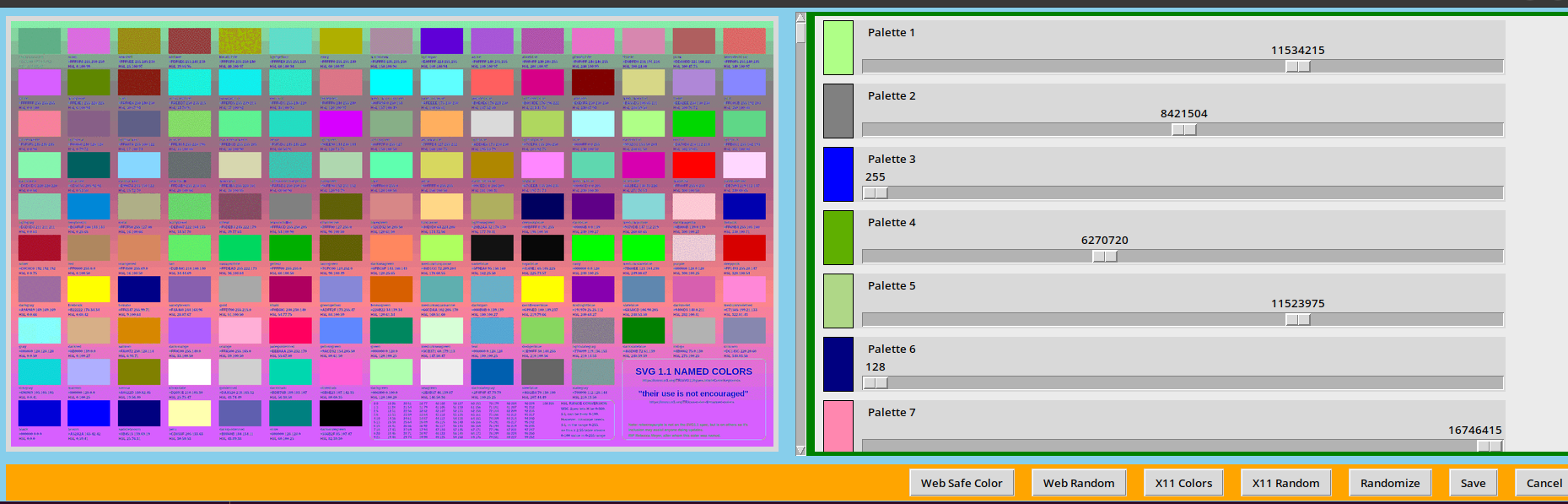
PLTE Palette Editor
When an indexed PNG has a missing, malformed, empty, or suspicious PLTE,
Chunklate may build a grayscale emergency palette first. If the preview is not
good enough, answer no at the palette prompt to open the Tkinter palette
editor. The editor lets you try preset palettes, randomize entries, adjust
individual palette sliders, then save the selected PLTE back through the
normal clone/checkpoint path.
Ultimate Reference ROI Editor
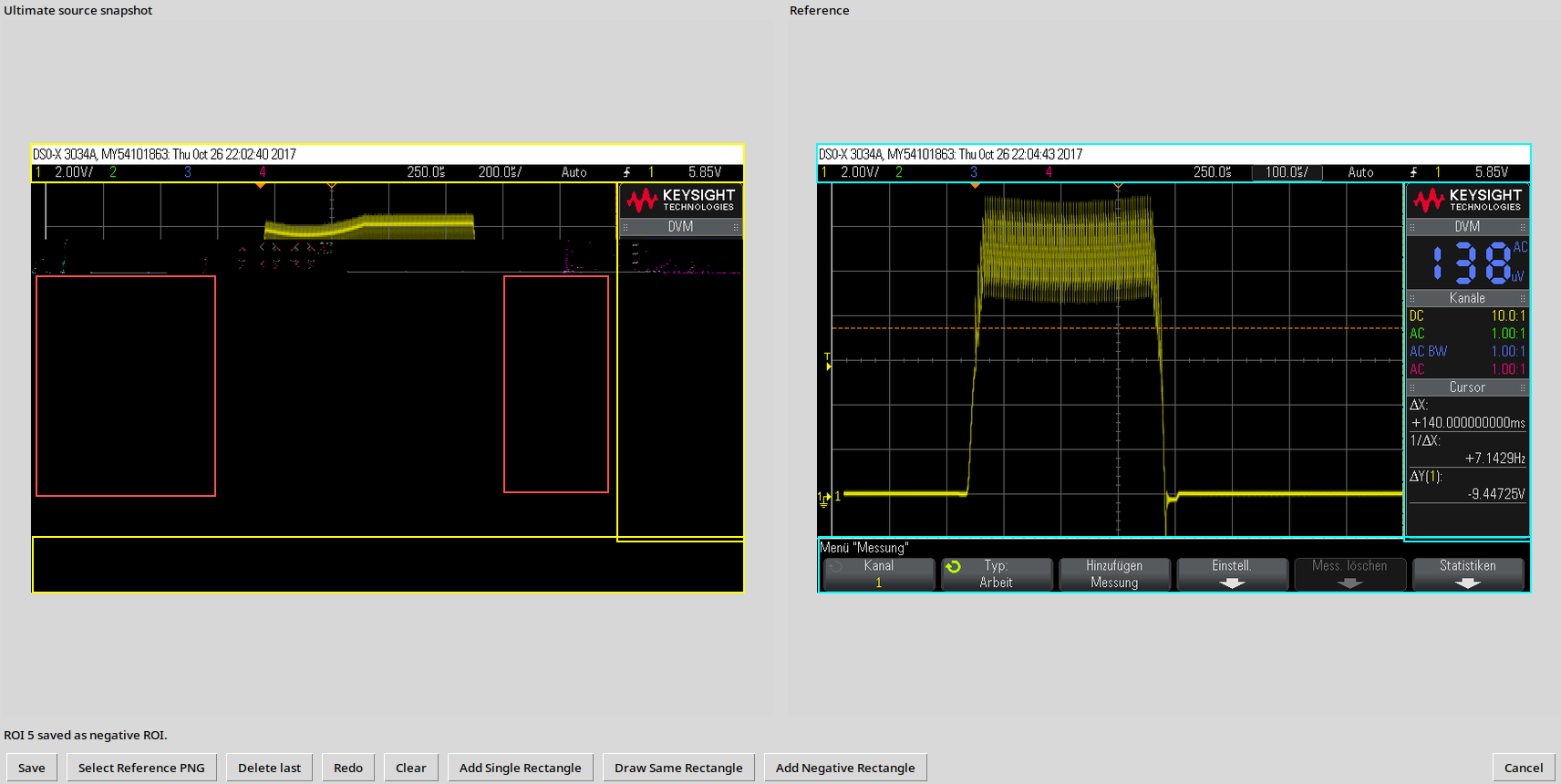
For visually guided IDAT recovery, especially UltimateMegaSuperLineFeedBruteForce,
Chunklate can use a reference PNG. With -ulfr similar PATH -ulfroi-edit, the
Tkinter ROI editor lets you mark source/reference regions, same-position
regions, search regions, or negative regions. Those saved ROI mappings help the
visual scorer prefer candidates that look coherent instead of merely producing
more decompressed bytes.
What Chunklate Repairs
Chunklate currently handles many structural PNG problems:
- Missing, shifted, or embedded PNG signatures.
- Wrong chunk length, chunk type/name, and chunk CRC.
- Missing
IEND, trailing garbage, and some broken end-of-file cases. - Broken
IHDRvalues when CRC evidence or IDAT scanline math is strong enough. - Empty, missing, undersized, oversized, or malformed indexed
PLTEchunks. - Duplicate singleton chunks such as
IHDR,PLTE,gAMA,sRGB,iCCP,pHYs,sBIT,bKGD,tRNS,hIST,sTER,oFFs, andeXIf. - Selected misplaced chunks, including ancillary chunks interrupting consecutive
IDATchunks. - Known ancillary payload issues in chunks such as
bKGD,cHRM,gAMA,gIFg,hIST,iTXt,oFFs,pHYs,sBIT,sCAL,sRGB,sTER,tIME,tRNS,tEXt,zTXt, and related metadata. - Unsafe unknown/private critical chunks when removing or renaming them can make the PNG structurally valid.
- Known bad sRGB/iCCP profile chunks and zero-value
gAMA. - Some text metadata damage, including
tEXtnull bytes,iTXtfield damage, andzTXtcompression method or zlib data-format byte errors. - Periodic byte corruption in PNG/IDAT-shaped files when a bounded periodic transform can be reversed and the whole PNG validates afterward.
IDAT Salvage And Brute Force
IDAT is the compressed image data. This is the hard part.
Chunklate has four main IDAT paths:
partial-idat-blackfill: salvage complete decompressed scanlines, fill the missing area with black/transparent bytes, rebuild a valid PNG. This is a fallback, not proof that the original pixels were recovered.DaedalusForce: brute force IDAT byte edits. It includesHermesProbefor targeted byte-window passes andHephaestusForgefor heavier campaigns.UltimateMegaSuperLineFeedBruteForce: deeper line-feed conversion recovery with checkpoints, visual candidate galleries, optional reference scoring, and optional CPU workers.periodic_tail_xor_counter: despite the compatibility name, this is now a bounded periodic byte repair campaign. It tests XOR, add/sub counter families, little/big-endian counters, pair swaps, bit-not, nibble swaps, and one-bit rotations over likely periods/phases.
Periodic repair is intentionally conservative. It is triggered by periodic
damage symptoms such as IDAT CRC failure, No NextChunk, corrupt deflate, or
BadCodeLengthHuffmanTree, but it only accepts a candidate when the repaired
file has valid PNG structure, rebuilt CRC consistency, and a complete IDAT
decode. It does not use file names, challenge side files, or external container
context as proof.
GroundHogDay still tries the cheaper LF/CR and bounded SuperLineFeed probes, but it does not launch MiniUltimate/UltimateLineFeed automatically from that loop. Ultimate remains a separate heavier route with explicit checkpoints/options.
HermesProbe runs before broad DaedalusForce when the stored original IDAT CRC is useful.
For small edits it can solve the CRC directly. For larger edits it now also has
a deflate meet-in-the-middle V2 path: it reads the compressed stream structure
around the suspected area, keeps only deflate/Huffman shapes that can make sense,
then uses the CRC as a final constraint. That does not make 20-byte damage
trivial, but it avoids jumping straight to a blind full brute force when a
targeted structural search is still realistic.
If HermesProbe cannot prove a full PNG repair, Chunklate explains the handoff before broad DaedalusForce. In interactive mode you can trust the detected DaedalusForce level, choose a custom level/byte scope, go back to retry targeted repair, or accept a blackfill fallback when one exists.
For brute force, Chunklate tries to keep the parent process responsible for all visible effects: prompts, previews, final files, summaries, and checkpoint writes. CPU workers and GPU kernels only test candidates and return possible hits. The parent still validates the candidate PNG before accepting it.
GPU Status
-gpu is a permission flag. It does not force GPU use.
Current status:
- OpenGL compute support is experimental.
- DaedalusForce/HermesProbe can use GPU CRC filtering for supported direct IDAT byte-window passes, including tiled rank spaces that go beyond 32-bit candidate counts.
- Ultimate has an OpenGL preflight that can suggest CR/LF and Adler-trailer offsets before the normal CPU search.
- CPU validation remains mandatory for every GPU hit.
- If OpenGL,
moderngl, the driver, or the current candidate plan is not usable, Chunklate reports the reason and keeps using CPU workers.
What It Does Not Repair Yet
Chunklate cannot reliably repair everything:
- If a PNG has no usable
IDAT, there are no source pixels to recover. - If the PNG is structurally valid but visually wrong, Chunklate usually needs a reference image, ROI, checksum, or human validation. It cannot guess the intended picture from structure alone.
- Missing decompressed bytes are not the same thing as missing compressed bytes. A tiny deflate error can make a large part of the image disappear.
- Large IDAT brute force spaces can still take hours, days, months, or worse.
- HermesProbe is targeted, not omniscient. If the suspected window is wrong or the corruption spans several IDAT chunks at once, it may still need another pass or a broader fallback.
- GPU acceleration is still being expanded. HermesProbe has the broadest GPU coverage; HephaestusForge and Ultimate still fall back to CPU for many passes.
- Blackfill output is a valid salvage image, not an exact original recovery.
TODO
- Expand GPU coverage for HephaestusForge passes that can be represented as deterministic IDAT byte windows.
- Add stronger GPU/CPU parity tests for deeper byte-window levels.
- Improve ETA handling so Chunklate asks only before genuinely expensive passes.
- Keep improving HermesProbe deflate reverse parsing for harder 10+ byte IDAT corruptions.
- Improve visual scoring for structurally valid but visually suspicious PNGs.
- Keep growing the repair matrix for real corrupt PNG families.
- Continue preparing Ultimate for heavier GPU acceleration after the DaedalusForce GPU path is stable.
- Evaluate native C/Rust acceleration for mutation, CRC/Adler, and zlib hot paths.
Development
Install or refresh dependencies:
./scripts/bootstrap_dev.sh
Run the full local validation:
./scripts/check.sh
Run pytest directly:
.venv/bin/python -m pytest
Useful docs:
docs/architecture.md
docs/repair_matrix.md
The readable repair matrix lives in docs/repair_matrix.md. The strict
regression source of truth is tests/repair_matrix.py, plus focused unit and
runtime tests.
Png_Errors_handled_by_Chunklate_So_Far/periodic_you_*.png contains corruption fixtures .
They cover the new periodic families: legacy counter XOR, counter add/sub, endian counter
variants, pair swap, bit-not, nibble swap, one-bit rotations, and a four-byte
periodic counter case. Each fixture is expected to repair back to the original
bytes through the periodic route.
In Memory Of Glenn Randers-Pehrson
(April 30, 1941 - October 2018)


Download files
Download the file for your platform. If you're not sure which to choose, learn more about installing packages.
Source Distribution
Built Distribution
Filter files by name, interpreter, ABI, and platform.
If you're not sure about the file name format, learn more about wheel file names.
Copy a direct link to the current filters
File details
Details for the file chunklate-0.1.0.tar.gz.
File metadata
- Download URL: chunklate-0.1.0.tar.gz
- Upload date:
- Size: 893.8 kB
- Tags: Source
- Uploaded using Trusted Publishing? No
- Uploaded via: twine/6.2.0 CPython/3.13.7
File hashes
| Algorithm | Hash digest | |
|---|---|---|
| SHA256 |
095563439b26f5d9dbe50ada6cb24a5dccf25701e9acf81c5aa8cd845f87515f
|
|
| MD5 |
938b76d93b8118756ca6ff4b3893e002
|
|
| BLAKE2b-256 |
3e8d9b6b2e3092d62000e81b1bb705e2fc9244dce7faa2ba2584b3b05e548bd2
|
File details
Details for the file chunklate-0.1.0-py3-none-any.whl.
File metadata
- Download URL: chunklate-0.1.0-py3-none-any.whl
- Upload date:
- Size: 573.6 kB
- Tags: Python 3
- Uploaded using Trusted Publishing? No
- Uploaded via: twine/6.2.0 CPython/3.13.7
File hashes
| Algorithm | Hash digest | |
|---|---|---|
| SHA256 |
b557b5e5a43befc163de57a670a8f695cfb00059c03171de0f6d5446ad52af6d
|
|
| MD5 |
d3752bd843fa0183d731591ba6122aa0
|
|
| BLAKE2b-256 |
c44a9367f978f46bc4ac7cc0a72696d736efbaa883c3b50468ee9e614e8b6c7b
|






