
Cinematlas
Ask a question. Get the second in the video that answers it.
pip install "cinematlas[video,whisper]"
cinematlas doctor
cinematlas ingest "https://www.youtube.com/watch?v=5NhYvbMdbBU"
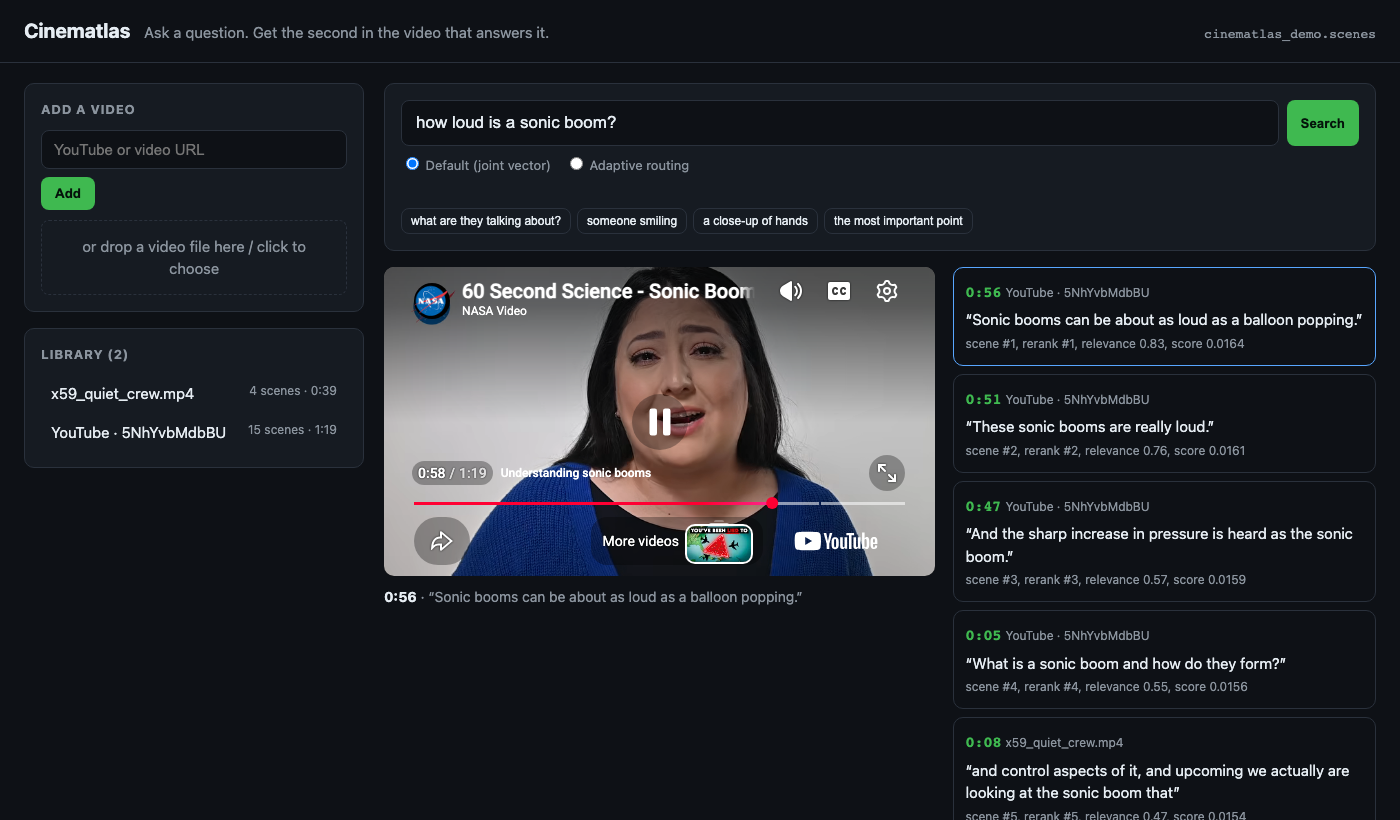
cinematlas search "how loud is a sonic boom?"
 1. 5NhYvbMdbBU#11 @    0:56  Sonic booms can be about as loud as a balloon popping.
    https://www.youtube.com/watch?v=5NhYvbMdbBU&t=56s
 2. 5NhYvbMdbBU#10 @    0:51  These sonic booms are really loud.
    https://www.youtube.com/watch?v=5NhYvbMdbBU&t=51s
Or try it in the browser: pip install "cinematlas[demo,whisper]" and cinematlas demo. Add a video
by URL or upload, ask a question, and the player jumps to the second that answers it.
The finding: fuse within a unit, chunk across units
A record carries several signals about the same thing: a scene's picture and speech, a photo and its caption. The standard design gives each signal its own index and merges the ranked lists. That loses: on any question about one signal, the lists disagree, and merging averages the right answer away.
Fuse. Embed a record's signals together, into one vector.
| Hit@1 | Video | Held-out video | NASA photos | Met artworks |
|---|---|---|---|---|
| merged rankings, as usually built | 0.65 | 0.21 | 0.62 | 0.62 |
| best merge we found (incl. learned weights) | 0.72 | 0.50 | 0.78 | 0.81 |
| one joint vector per record | 0.83 | 0.62 | 0.93 | 0.95 |
It wins on data nobody tuned on (240 questions written blind by an AI agent, on space footage, space photography and museum art), isn't reading burned-in subtitles, wins even when a record's parts describe different things (0.70 vs 0.11), and holds on the kind of queries people really type: terse and from memory (0.80 vs 0.70 against the strongest merge) or full of typos (0.84 vs 0.61).
Chunk. One vector per record breaks when a part is long. Bury each photo's description among 31 others and the joint vector falls below chunked late fusion; the long text even drowns out the photo. Embed the photo together with each chunk instead:
| Hit@1, answer is 1/32 of the text | |
|---|---|
| one joint vector per record | 0.54 |
| chunked late fusion (ideal chunk boundaries) | 0.81 |
| the photo fused into each chunk (ideal boundaries) | 0.94 |
| Ideal boundaries aren't needed. Strip the paragraph breaks so a chunker has to find the topics itself, | |
and Semantic (cut where adjacent sentences stop being similar) scores 0.90 against 0.93 for ideal |
|
| boundaries, statistically indistinguishable; fixed-size chunks score 0.82–0.85 and one vector per record | |
| 0.59 (8 descriptions per record). |
Both come with paired significance tests and fourteen predictions written down before each run, four of which failed. TL;DR · Paper · every table · the story · review · what's new
In the library: video search() ranks scenes with the joint vector and uses a reranker only to pick
the exact second (.adaptive() leans ahead on speech questions, at twice the latency).
cinematlas.core applies both halves to any records: Text("title") + Image("photo") to fuse,
Text("body", chunk=…) to chunk.
Quickstart
export MONGODB_URI="mongodb+srv://…"     # MDB_URI also works
export VOYAGE_API_KEY="pa-…"
from cinematlas import Cinematlas

engine = Cinematlas()
engine.ensure_indexes()                                  # once; idempotent

engine.ingest("https://www.youtube.com/watch?v=5NhYvbMdbBU")   # NASA: 60 Second Science, Sonic Booms
engine.ingest("lecture.mov")                             # or a URL, bytes, file object, web upload

results = engine.search("how loud is a sonic boom?")     # lazy; runs on first read
results.top.link                                         # 'https://www.youtube.com/watch?v=5NhYvbMdbBU&t=56s'
results.top.text                                         # 'Sonic booms can be about as loud as a balloon popping.'
results.top.explain()                                    # rank per source, relevance, score

engine.search("an airplane in the sky").only("scene")   # the joint vector alone: scenes only, ~100 ms
Narrow any search by video or by your own metadata. Declare the filter fields once, and they're built into every search index, so filtering happens before ranking:
engine = Cinematlas(filters=("genre", "course"))
engine.ensure_indexes()
engine.ingest("lecture.mov", metadata={"genre": "lecture", "course": "cs101"})

engine.search("when is the exam?").where(course="cs101").limit(3)
engine.search("the rocket launch").video("5NhYvbMdbBU", "abc123").where(genre=["science", "news"])
Plain pip install cinematlas is search-only (pymongo + voyageai), so it can serve queries from a
backend. Ingesting video needs cinematlas[video] (OpenCV, PySceneDetect, yt-dlp), and speech-to-text
needs whisper (or an OPENAI_API_KEY).
Cinematlas doesn't pick an LLM for you; results.to_context() gives you numbered, citable excerpts to
pass to one.
Every Voyage call is metered. result.usage is what one ingest sent (per model: calls, inputs,
tokens, image pixels), engine.usage is the running total, and engine.usage.cost(prices) turns it
into dollars at the prices you pass. Rate limits (429) back
off longer than other errors, with jitter. A notebook version of this lives in
docs/quickstart.ipynb.
In an async server, await any query. It runs the same ranking code in a worker thread, so the event loop never blocks and concurrent searches overlap:
@app.get("/search")
async def search(q: str):
    return [{"at": h.timestamp, "text": h.text, "link": h.link} for h in await engine.search(q).limit(5)]
Results are dicts underneath: every field you stored comes back, and json.dumps works. On top of
that, every hit has rank, score, moment ({text, start, end, relevance}), text and explain().
Video hits (SearchHit) add video_id, scene_id, timestamp, link and per-source ranks.
Observability. With cinematlas[otel], each ingest is an OpenTelemetry span with one child per
stage (fetch, scenes, speech, embed, store), and each search is a span. Both carry the Voyage calls and
tokens they used. cinematlas[progress] draws a progress bar for cinematlas ingest.
Beyond video: cinematlas.core
The finding isn't about video. Any records whose signals describe the same thing (product photos and
titles, slides and their text, diagrams and captions) search better with one joint vector than with
separate indexes merged afterwards. cinematlas.core is that idea as a small library:
from cinematlas.core import Atlas, Text, Image

photos = Atlas().collection("nasa.photos",
    embed=Text("title") + Image("image"),      # parts compose into ONE joint vector
    moment="description",                      # the reranker picks the best sentence
    filters=["center"], key="nasa_id")         # filterable fields; re-adding a key replaces it
photos.setup()                                 # the vector index; idempotent, updates in place
photos.add(records)                            # any iterable of dicts, or a loader
photos.wait_until_searchable()

photos.search("astronaut fixing a telescope in space").top.title   # 'Making Room for Hubble's New Camera'
photos.search(Image("mars.jpg")).where(center="JPL")               # query by picture, filtered
That output is real: examples/photos.py indexes about 200 NASA photos and runs it.
Video and records share one connection. atlas.videos(...) is a video collection on the same cluster,
with the same Voyage client, the same usage meter, the same retries, and the same query builder
(.where, .limit, .rerank, .candidates):
from cinematlas.core import Atlas, Slides

atlas = Atlas()
talks = atlas.videos("media.talks", filters=("course",))       # everything Cinematlas does, shared connection
slides = atlas.collection("media.slides", like=Slides)

talks.search("when is the exam?").where(course="cs101").top.link
slides.search("the exam schedule").where(deck="week1").top.text
print(atlas.usage)                                              # both, on one meter
Long text? Chunk it, fused. Text("body", chunk=800) splits long text into its paragraphs (up to 800
characters each) and embeds each piece together with the record's other parts; search keeps each
record's best piece and returns it as the moment. For text without paragraphs (transcripts, OCR, scraped
pages) use chunk=Semantic(800), which cuts where the topic changes:
manuals = atlas.collection("manuals", embed=Text("title") + Text("body", chunk=800) + Image("cover"),
                           key="id", moment="body")
manuals.search("how do I reset the pressure valve?").top.text   # the passage that answers
Built in. Parts: Text (labels, nested or computed fields, truncation, chunk=) and Image (PIL,
bytes, path or URL, downscaled to Voyage's limits). Loaders, each with a suggested setup you can borrow with
atlas.collection("decks", like=Slides):
| Loader | One record per | Install |
|---|---|---|
Slides("deck.pptx", pdf="deck.pdf") |
slide: title, body, speaker notes, and the rendered slide from its PDF export | cinematlas[slides] |
Screenshots("shots/") |
screenshot, with its on-screen text read by OCR line by line | cinematlas[ocr] |
PDFPages("paper.pdf") |
page: its image and text | cinematlas[pdf] |
ImageFolder("photos/") |
image, with a caption from a same-named .txt |
|
JSONLines("rows.jsonl") |
line |
decks = atlas.collection("decks", like=Slides)
decks.add(Slides("q3-review.pptx", pdf="q3-review.pdf"))
decks.search("the slide where we showed Q3 churn").top.text    # the speaker-note sentence about churn

shots = atlas.collection("shots", like=Screenshots)
shots.add(Screenshots("qa-run-42/"))
shots.search("the screen with the red error banner").top.text  # 'Payment failed: card declined'
Check it on your own data. Every vector library says its approach wins; this one lets you check.
Create the collection with late=True (it also stores one vector per part), label 30–50 questions, and
evaluate() runs the joint vector against merged per-part rankings with the same paired test:
photos = atlas.collection("photos", embed=Text("title") + Image("image"), key="id", late=True)
...
print(photos.evaluate([{"q": "astronaut fixing a telescope", "relevant": ["sts082-717-029"]}, ...]))
                  Hit@1  Hit@10    MRR
joint vector       0.93    0.99   0.95
merged rankings    0.62    0.90   0.71

The joint vector wins on your data: joint 0.93 vs merged 0.62 Hit@1 on 80 questions (25 vs 1 disputed, p = < 0.001).
The default challenger is Reciprocal Rank Fusion (what Atlas $rankFusion does); fusion="sum" tests
against the strongest merge we found. To see the merged ranking for a single question, use
photos.search(q).merged("sum").
Extend it. A part is anything that turns a record into text or images for the vector; a loader is anything that yields records:
from cinematlas.core import Part, Loader, Collection

class Price(Part):                                   # numbers become words the model understands
    def inputs(self, record):
        return [f"costs ${record[self.field]:.0f}"] if record.get(self.field) else []

class Tickets(Loader):                               # records from anywhere
    key, moment = "id", "body"
    embed = Text("subject") + Text("body")
    def __iter__(self):
        yield from my_helpdesk_api.tickets()

@Collection.extend                                   # add methods to every collection, jQuery-style
def newest(self, k=5):
    return list(self.mongo.find({}, {"embedding": 0}).sort("_id", -1).limit(k))
Ship a plugin as a package with a cinematlas.plugins entry point, and cinematlas.core.plugins()
lists it next to the built-ins.
Examples
Five runnable scripts in examples/.
They need only MONGODB_URI and VOYAGE_API_KEY in .env. The first two search a demo corpus of six
NASA interviews, the next two index your own video, and the last one searches photos.
uv run python examples/search.py "a little girl standing on hay bales"
uv run python examples/search.py --adaptive "what did he say about his first flight?"
uv run python examples/ask.py "What first got these people interested in aviation?"
uv run python examples/index_and_search.py lecture.mp4 "when is the exam?"
uv run python examples/photos.py "a rover's tracks on red sand" --center JPL
| Example | What it does |
|---|---|
search.py |
The scene and the second for any question, with why each hit ranked. --adaptive shows routing reading a question as said or shown |
ask.py |
A cited answer from a local LLM (Ollama, no API key), each citation a link to the exact second |
index_and_search.py |
Index any URL, YouTube link or file with live progress, then search it |
api.py |
A FastAPI service: POST /videos to upload, an async GET /search for deep links |
photos.py |
cinematlas.core on about 200 NASA photos: search by text or by picture, filter by center |
How it works
 ingest(video)
   ├─ scenes ── PySceneDetect cuts, ≤30 s each
   ├─ said ──── faster-whisper → timestamped sentences, aligned to scenes
   ├─ shown ─── the middle keyframe of each scene
   └─ Voyage ── one joint keyframe+transcript vector per scene (plus keyframe-only and transcript vectors)
                → one MongoDB Atlas document per scene

 search(question)
   ├─ joint-vector search over scenes                                        one query, ranks scenes
   └─ $rerank over those scenes' sentences                                   picks the second

 search(question).adaptive()
   ├─ $rankFusion over scene, keyframe, transcript and BM25 retrieval        one query
   └─ weights set per question by the reranker's confidence                  said vs shown
| Need | Call |
|---|---|
| The scene and the exact second (default) | search(q) |
| Mostly questions about speech | search(q).adaptive() |
| The scene, fastest | search(q).only("scene") |
| Speech only | search(q).using("transcript", "text") |
| Your own blend | search(q).weights(scene=2, transcript=1, rerank=1) |
| One source | .only("transcript") · .only("text") · .only("visual") · .only("scene") |
Each one chains with .video(...), .where(...), .limit(k) and .rerank(False). Each call returns
a new query, so a base query can be shared and refined safely. Every hit carries moment
({start, end, text}), moment_link (YouTube ?t=431s, files #t=431), ranks, relevance and the
scene's fields.
ingest() accepts:
| Source | Fetched with |
|---|---|
s3://bucket/key, gs://bucket/object |
the cloud SDK and your ambient credentials (cinematlas[s3], cinematlas[gcs]) |
| a direct video link, including presigned S3 / GCS / Azure URLs | a streaming download, every redirect SSRF-checked |
| a page such as YouTube | yt-dlp |
a path, bytes, a file object, a FastAPI UploadFile / Flask FileStorage |
streamed to disk |
Remote URLs are treated as untrusted: private addresses are refused, downloads are capped at
max_download_mb (cloud objects are checked before downloading), and signed-URL credentials are stripped
before storage. Re-ingesting a video replaces it without a gap.
CLI
cinematlas doctor                        # checks the deployment and prints the exact fix for each problem
cinematlas setup [--update]              # create indexes; --update upgrades them in place
cinematlas ingest <url|path|-> [--meta course=cs101]    # progress on stderr, JSON on stdout
cinematlas search "<question>" [-k 5] [--where course=cs101] [--video-id ID]
                  [--by hybrid|adaptive|scene|transcript|visual|text] [--format table|json|context]
cinematlas demo [--port 8765]            # local web app: add videos, search, jump to the second
Global options: --uri, --db, --collection, --transcript-mode, --filter FIELD, -v. A field
used in --where is declared as a filter automatically. Before the first search on a new field,
declare it and run cinematlas --filter course setup --update so the indexes can filter on it.
Atlas features used
Atlas Vector Search for the joint vectors, $rerank (8.3+) for in-database sentence reranking,
$rankFusion (8.0+) for adaptive routing's one-query fusion, Automated Embedding for transcripts,
Atlas Search for BM25, scalar quantization and BSON float32 vectors. Each has an equivalent fallback, and
cinematlas doctor tells you which path is in use.
Development
cinematlas/
  engine.py        Cinematlas: the facade (configuration + public API)
  media.py         download, uploads, audio, scene cuts, keyframes, S3
  urlsafety.py     remote URLs are untrusted input (SSRF guard)
  transcribe.py    speech to timestamped sentences (OpenAI Whisper or faster-whisper)
  embed.py         keyframe, joint, transcript and query vectors
  ingest.py        the pipeline and its gapless replace
  search.py        single sources, fusion, reranking, routing
  query.py         the lazy query builder shared by video and records (Search, RecordSearch)
  results.py       Hit / Hits: plain dicts with typed accessors
  usage.py         Voyage usage metering, cost estimates, the one retry path
  tracing.py       optional OpenTelemetry spans
  capabilities.py  native-stage fallbacks and routing calibration
  doctor.py        what's wrong and how to fix it
  demo/            cinematlas demo: FastAPI server + a one-file web page
  core/            joint-vector search for any records: parts, chunkers, loaders, evaluate()
uv sync
uv run pytest -m "not integration and not media"    # unit, offline (~9 s)
uv run pytest -m media                               # real ffmpeg / Whisper on a committed NASA fixture
uv run pytest -m integration                         # live Atlas + Docker Atlas Local (reads .env)
uv run python bench/ingest.py                        # benchmark corpora, once: interviews,
uv run python bench/ingest.py --no-captions          #   caption ablation,
uv run python bench/ingest.py --station              #   held-out video,
uv run python bench/photos.py --ingest               #   photos (aligned and misaligned)
uv run python bench/met.py --ingest                  #   Met artworks
uv run python bench/boundary.py --ingest             #   boundary tests (see paper.md for the full list)
uv run python bench/run.py                           # every table and paired test → bench/RESULTS.md
MIT license. Test and benchmark media: NASA, public domain.
1 maintainer

Metadata
1 maintainer
Release files for cinematlas 0.16.2
For a detailed explanation of source distributions (sdists) and built distributions (wheels), please see the package formats documentation.
Source distribution (sdist)
| File | Size | Uploaded | |
|---|---|---|---|
| cinematlas-0.16.2.tar.gz | 999.7 kB | Details |
Built distribution (wheel)
| File | Interpreter | ABI | Platform | Reset |
|---|---|---|---|---|
| cinematlas-0.16.2-py3-none-any.whl | Python 3 | none | any | Details |
Total release size: 1.1 MB
Release files / cinematlas-0.16.2.tar.gz
| Download URL | cinematlas-0.16.2.tar.gz |
|---|---|
| Size | 999.7 kB |
| Tags | Source |
|
SHA-256 checksum How to use checksums |
ae1acdcc0463ed62392605598477d3bb0b47ea02d2c5f9b79c8e5263a78a6004
|
|
BLAKE2b-256 checksum How to use checksums |
71ca682f9780aefe5949af9bf7e3d20cb5ca48a6b2d5c271de535f091da95e4f
|
| Upload date | |
|
Uploaded using Trusted Publishing? What is trusted publishing? |
No |
| Uploaded via |
uv/0.11.24 {"installer":{"name":"uv","version":"0.11.24","subcommand":["publish"]},"python":null,"implementation":{"name":null,"version":null},"distro":{"name":"macOS","version":null,"id":null,"libc":null},"system":{"name":null,"release":null},"cpu":null,"openssl_version":null,"setuptools_version":null,"rustc_version":null,"ci":null}
|
Release files / cinematlas-0.16.2-py3-none-any.whl
| Download URL | cinematlas-0.16.2-py3-none-any.whl |
|---|---|
| Size | 101.3 kB |
| Tags | Python 3 |
|
SHA-256 checksum How to use checksums |
0e5ce13a60b5130e5bc5a2bb960c8933277bdc54e219e07476992b97953314b3
|
|
BLAKE2b-256 checksum How to use checksums |
69188e8107c8e2c2e49622e3d851366b7ae027018a118371f8b8a7672c05e8fb
|
| Upload date | |
|
Uploaded using Trusted Publishing? What is trusted publishing? |
No |
| Uploaded via |
uv/0.11.24 {"installer":{"name":"uv","version":"0.11.24","subcommand":["publish"]},"python":null,"implementation":{"name":null,"version":null},"distro":{"name":"macOS","version":null,"id":null,"libc":null},"system":{"name":null,"release":null},"cpu":null,"openssl_version":null,"setuptools_version":null,"rustc_version":null,"ci":null}
|














