
A tool to scan MCP servers and tools for security findings

Project description
MCP Scanner
A Python tool for scanning MCP (Model Context Protocol) servers and tools for potential security findings. The MCP Scanner combines Cisco AI Defense inspect API, YARA rules and LLM-as-a-judge to detect malicious MCP tools.
Overview
The MCP Scanner provides a comprehensive solution for scanning MCP servers and tools for security findings. It leverages three powerful scanning engines (Yara, LLM-as-judge, Cisco AI Defense) that can be used together or independently.
The SDK is designed to be easy to use while providing powerful scanning capabilities, flexible authentication options, and customization.
Features
- Multiple Modes: Run scanner as a stand-alone CLI tool or REST API server
- Multi-Engine Security Analysis: Use all three scanning engines together or independently based on your needs.
- Comprehensive Scanning: Scan MCP tools, prompts, and resources for security findings
- Explicit Authentication Control: Fine-grained control over authentication with explicit Auth parameters.
- OAuth Support: Full OAuth authentication support for both SSE and streamable HTTP connections.
- Custom Endpoints: Configure the API endpoint to support any Cisco AI Defense environments.
- MCP Server Integration: Connect directly to MCP servers to scan tools, prompts, and resources with flexible authentication.
- Customizable YARA Rules: Add your own YARA rules to detect specific patterns.
- Comprehensive Reporting: Detailed reports on detected security findings.
Installation
Prerequisites
- Python 3.11+
- uv (Python package manager)
- A valid Cisco AI Defense API Key (optional)
- LLM Provider API Key (optional)
Installing from PyPI
uv venv -p <Python version less than or equal to 3.13> /path/to/your/choice/of/venv/directory
source /path/to/your/choice/of/venv/directory/bin/activate
uv pip install cisco-ai-mcp-scanner
Installing from Source
git clone https://github.com/cisco-ai-defense/mcp-scanner
cd mcp-scanner
# Install with uv (recommended)

uv venv -p <Python version less than or equal to 3.13> /path/to/your/choice/of/venv/directory

source /path/to/your/choice/of/venv/directory/bin/activate

uv pip install .
# Or install in development mode
uv pip install -e .
Quick Start
Environment Setup
Core API Configuration
Cisco AI Defense API (only required for API analyzer)
export MCP_SCANNER_API_KEY="your_cisco_api_key"
export MCP_SCANNER_ENDPOINT="https://us.api.inspect.aidefense.security.cisco.com/api/v1"
# For other endpoints please visit https://developer.cisco.com/docs/ai-defense/getting-started/#base-url
LLM Configuration (for LLM analyzer)
Tested LLMs: Claude,OpenAI GPT-4o and GPT-4.1
# AWS Bedrock Claude with AWS credentials (profile)
export AWS_PROFILE="your-profile"
export AWS_REGION="us-east-1"
export MCP_SCANNER_LLM_MODEL="bedrock/anthropic.claude-sonnet-4-5-20250929-v2:0" # Any AWS Bedrock supported model

# AWS Bedrock Claude with API key (Bearer token)
export MCP_SCANNER_LLM_API_KEY="bedrock-api-key-..." # Generated via Amazon Bedrock -> API Keys
export AWS_REGION="us-east-1"
export MCP_SCANNER_LLM_MODEL="bedrock/us.anthropic.claude-sonnet-4-5-20250929-v2:0" # Any AWS Bedrock supported model

# LLM Provider API Key (required for LLM analyzer)
export MCP_SCANNER_LLM_API_KEY="your_llm_api_key"  # OpenAI

# LLM Model Configuration (optional - defaults provided)
export MCP_SCANNER_LLM_MODEL="gpt-4o"  # Any LiteLLM-supported model
export MCP_SCANNER_LLM_BASE_URL="https://api.openai.com/v1"  # Custom LLM endpoint
export MCP_SCANNER_LLM_API_VERSION="2024-02-01"  # API version (if required)

# For Azure OpenAI (example)
export MCP_SCANNER_LLM_BASE_URL="https://your-resource.openai.azure.com/"
export MCP_SCANNER_LLM_API_VERSION="2024-02-01"
export MCP_SCANNER_LLM_MODEL="azure/gpt-4"

# For Extended Thinking Models (longer timeout)
export MCP_SCANNER_LLM_TIMEOUT=300
Note: If you are using models from Azure Foundry, set the MCP_SCANNER_LLM_BASE_URL and MCP_SCANNER_LLM_MODEL environment variables, as Microsoft has deprecated the need for MCP_SCANNER_LLM_API_VERSION.
Using a Local LLM (No API Key Required)
If you are using a local LLM endpoint such as Ollama, vLLM, or LocalAI,
the MCP_SCANNER_LLM_API_KEY variable is still required but can be set to any value.
Example:
export MCP_SCANNER_LLM_API_KEY=test
export MCP_SCANNER_LLM_ENDPOINT=http://localhost:11434
Quick Start Examples
The fastest way to get started is using the mcp-scanner CLI command. Global flags (like --analyzers, --format, etc.) must be placed before a subcommand.
CLI Usage
# Scan well-known client configs on this machine
mcp-scanner --scan-known-configs --analyzers yara --format summary

# Stdio server (example using uvx mcp-server-fetch)
mcp-scanner --stdio-command uvx --stdio-arg=--from --stdio-arg=mcp-server-fetch --stdio-arg=mcp-server-fetch --analyzers yara --format summary

# Remote server (deepwiki example)
mcp-scanner --server-url https://mcp.deepwki.com/mcp --analyzers yara --format summary

# MCP Scanner as REST API
mcp-scanner-api --host 0.0.0.0 --port 8080
SDK Usage
import asyncio
from mcpscanner import Config, Scanner
from mcpscanner.core.models import AnalyzerEnum

async def main():
    # Create configuration with your API keys
    config = Config(
        api_key="your_cisco_api_key",
        llm_provider_api_key="your_llm_api_key"
    )

    # Create scanner
    scanner = Scanner(config)

    # Scan all tools on a remote server
    tool_results = await scanner.scan_remote_server_tools(
        "https://mcp.deepwki.com/mcp",
        analyzers=[AnalyzerEnum.API, AnalyzerEnum.YARA, AnalyzerEnum.LLM]
    )

    # Print tool results
    for result in tool_results:
        print(f"Tool: {result.tool_name}, Safe: {result.is_safe}")

    # Scan all prompts on a server
    prompt_results = await scanner.scan_remote_server_prompts(
        "http://127.0.0.1:8000/mcp",
        analyzers=[AnalyzerEnum.LLM]
    )

    # Print prompt results
    for result in prompt_results:
        print(f"Prompt: {result.prompt_name}, Safe: {result.is_safe}")

    # Scan all resources on a server
    resource_results = await scanner.scan_remote_server_resources(
        "http://127.0.0.1:8000/mcp",
        analyzers=[AnalyzerEnum.LLM],
        allowed_mime_types=["text/plain", "text/html"]
    )

    # Print resource results
    for result in resource_results:
        print(f"Resource: {result.resource_name}, Safe: {result.is_safe}, Status: {result.status}")

# Run the scanner
asyncio.run(main())
Subcommands Overview
- remote: scan a remote MCP server (SSE or streamable HTTP). Supports
--server-url, optional--bearer-token. - stdio: launch and scan a stdio MCP server. Requires
--stdio-command; accepts--stdio-args,--stdio-env, optional--stdio-tool. - config: scan servers from a specific MCP config file. Requires
--config-path; optional--bearer-token. - known-configs: scan servers from well-known client config locations on this machine; optional
--bearer-token. - prompts: scan prompts on an MCP server. Requires
--server-url; optional--prompt-name,--bearer-token. - resources: scan resources on an MCP server. Requires
--server-url; optional--resource-uri,--mime-types,--bearer-token.
Note: Top-level flags (e.g., --server-url, --stdio-*, --config-path, --scan-known-configs) remain supported when no subcommand is used, but subcommands are recommended.
Additional Examples
Scan well-known MCP config paths (Windsurf, Cursor, Claude, VS Code)
# YARA-only scan of all servers defined in well-known config locations
mcp-scanner --scan-known-configs --analyzers yara --format summary

# Detailed output
mcp-scanner --scan-known-configs --analyzers yara --detailed
Scan a specific MCP config file
# Expand ~ yourself if needed by your shell
mcp-scanner --config-path "$HOME/.codeium/windsurf/mcp_config.json" \
 --analyzers yara --format by_tool
Scan a stdio MCP server
# Use repeated --stdio-arg for reliable argument passing
mcp-scanner --analyzers yara --format summary \
  stdio --stdio-command uvx \
  --stdio-arg=--from --stdio-arg=mcp-server-fetch --stdio-arg=mcp-server-fetch

# Or list-form (ensure it doesn't conflict with later flags)
mcp-scanner --analyzers yara --detailed \
  stdio --stdio-command uvx \
  --stdio-args --from mcp-server-fetch mcp-server-fetch

# Scan only a specific tool on the stdio server
mcp-scanner --analyzers yara --format summary \
  stdio --stdio-command uvx \
  --stdio-arg=--from --stdio-arg=mcp-server-fetch --stdio-arg=mcp-server-fetch \
  --stdio-tool fetch
Use a Bearer token with remote servers (non-OAuth)
# Direct remote server with Bearer token
mcp-scanner --analyzers yara --format summary \
  remote --server-url https://your-mcp-server/sse --bearer-token "$TOKEN"

# Apply Bearer token to all remote servers discovered from configs
mcp-scanner --analyzers yara --detailed known-configs --bearer-token "$TOKEN"
mcp-scanner --analyzers yara --format by_tool \
  config --config-path "$HOME/.codeium/windsurf/mcp_config.json" --bearer-token "$TOKEN"
Scan Prompts
# Scan all prompts on an MCP server
mcp-scanner --analyzers llm prompts --server-url http://127.0.0.1:8000/mcp

# Scan all prompts with detailed output
mcp-scanner --analyzers llm --detailed prompts --server-url http://127.0.0.1:8000/mcp

# Scan all prompts with table format
mcp-scanner --analyzers llm --format table prompts --server-url http://127.0.0.1:8000/mcp

# Scan a specific prompt by name
mcp-scanner --analyzers llm prompts --server-url http://127.0.0.1:8000/mcp --prompt-name "greet_user"

# Get raw JSON output
mcp-scanner --analyzers llm --raw prompts --server-url http://127.0.0.1:8000/mcp
Scan Resources
# Scan all resources on an MCP server
mcp-scanner --analyzers llm resources --server-url http://127.0.0.1:8000/mcp

# Scan all resources with detailed output
mcp-scanner --analyzers llm --detailed resources --server-url http://127.0.0.1:8000/mcp

# Scan all resources with table format
mcp-scanner --analyzers llm --format table resources --server-url http://127.0.0.1:8000/mcp

# Scan a specific resource by URI
mcp-scanner --analyzers llm resources --server-url http://127.0.0.1:8000/mcp \
  --resource-uri "file://test/document.txt"

# Scan with custom MIME type filtering
mcp-scanner --analyzers llm resources --server-url http://127.0.0.1:8000/mcp \
  --mime-types "text/plain,text/html,application/json"
API Server Usage
The API server provides a REST interface to the MCP scanner functionality, allowing you to integrate security scanning into web applications, CI/CD pipelines, or other services. It exposes the same scanning capabilities as the CLI tool but through HTTP endpoints.
# Start the API server (loads configuration from .env file)
mcp-scanner-api --port 8000

# Or with custom host and port
mcp-scanner-api --host 0.0.0.0 --port 8080

# Enable development mode with auto-reload
mcp-scanner-api --reload
Once running, the API server provides endpoints for:
/scan-tool- Scan a specific tool on an MCP server/scan-all-tools- Scan all tools on an MCP server/scan-prompt- Scan a specific prompt on an MCP server/scan-all-prompts- Scan all prompts on an MCP server/scan-resource- Scan a specific resource on an MCP server/scan-all-resources- Scan all resources on an MCP server/health- Health check endpoint
Documentation is available in docs/api-reference.md or as interactive documentation at http://localhost:8000/docs when the server is running.
Output Formats
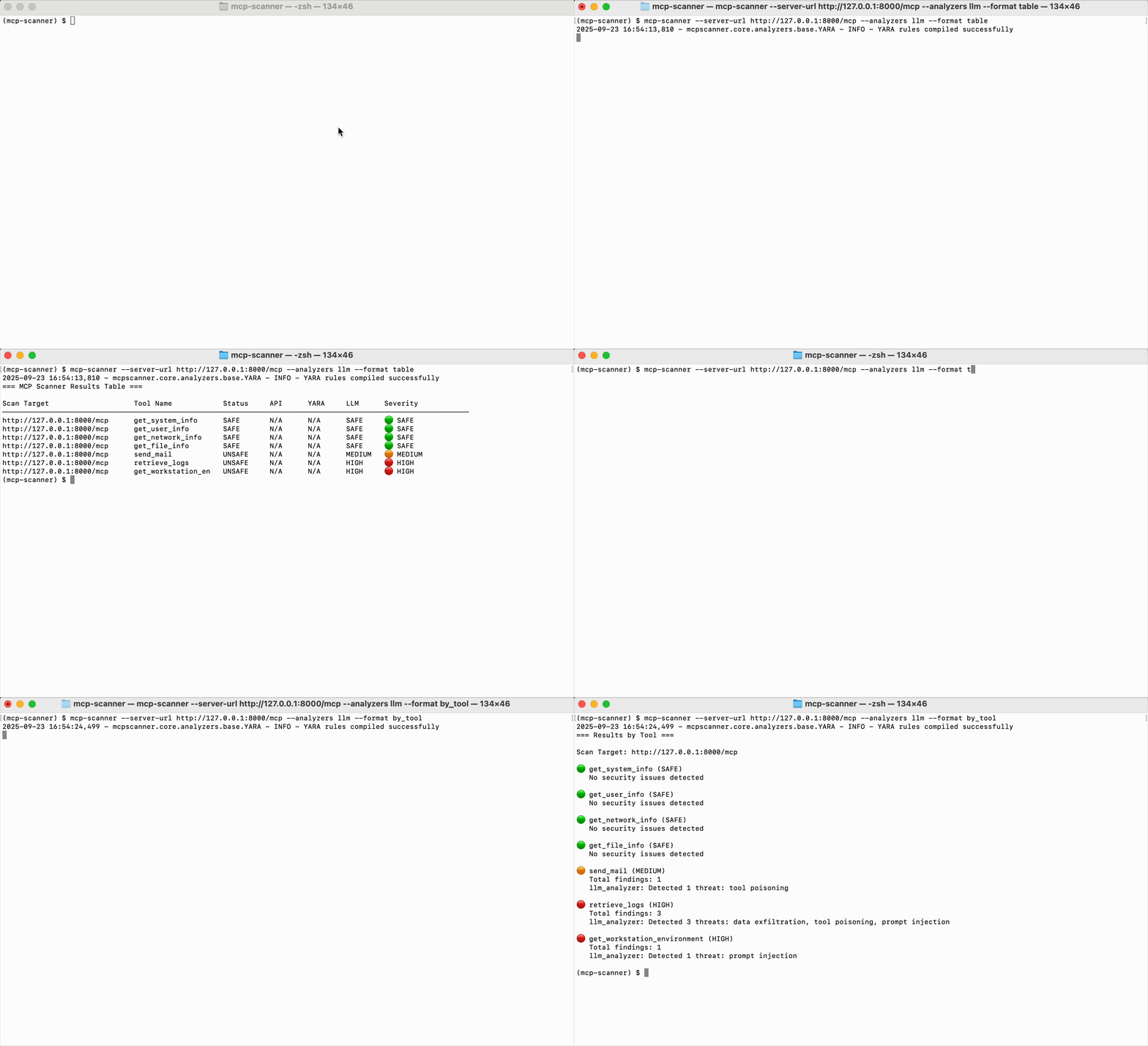
The scanner supports multiple output formats:
summary: Concise overview with key findingsdetailed: Comprehensive analysis with full findings breakdowntable: Clean tabular formatby_severity: Results grouped by severity levelraw: Raw JSON output
Example Output
Detailed Format
mcp-scanner --server-url http://127.0.0.1:8001/sse --format detailed
=== MCP Scanner Detailed Results ===

Scan Target: http://127.0.0.1:8001/sse

Tool: execute_system_command
Status: completed
Safe: No
Analyzer Results:
  • api_analyzer:
    - Severity: HIGH
    - Threat Summary: Detected 1 threat: security violation
    - Threat Names: SECURITY VIOLATION
    - Total Findings: 1
  • yara_analyzer:
    - Severity: HIGH
    - Threat Summary: Detected 2 threats: system access, command injection
    - Threat Names: SECURITY VIOLATION, SUSPICIOUS CODE EXECUTION
    - Total Findings: 2
  • llm_analyzer:
    - Severity: HIGH
    - Threat Summary: Detected 2 threats: prompt injection, tool poisoning
    - Threat Names: PROMPT INJECTION, SUSPICIOUS CODE EXECUTION
    - Total Findings: 2
Table Format
mcp-scanner --server-url http://127.0.0.1:8002/sse --format table
=== MCP Scanner Results Table ===

Scan Target: http://127.0.0.1:8002/sse

Scan Target                   Tool Name     Status     API      YARA     LLM      Severity
-----------------------------------------------------------------------------------------
http://127.0.0.1:8002/sse     exec_secrets  UNSAFE     HIGH     HIGH     HIGH     HIGH
http://127.0.0.1:8002/sse     safe_command  SAFE       SAFE     SAFE     SAFE     SAFE
Documentation
For detailed documentation, see the docs/ directory:
- Architecture - System architecture and components
- Authentication - OAuth and security configuration
- Programmatic Usage - Programmatic usage examples and advanced usage
- API Reference - Complete REST API documentation
- Output Formats - Detailed output format options
Contact Cisco for obtaining an AI Defense subscription
https://www.cisco.com/site/us/en/products/security/ai-defense/index.html
License
Distributed under the Apache 2.0 License. See LICENSE for more information.
Project Link: https://github.com/cisco-ai-defense/mcp-scanner
Release history Release notifications | RSS feed


Download files
Download the file for your platform. If you're not sure which to choose, learn more about installing packages.
Source Distribution
Built Distribution
Filter files by name, interpreter, ABI, and platform.
If you're not sure about the file name format, learn more about wheel file names.
Copy a direct link to the current filters
File details
Details for the file cisco_ai_mcp_scanner-3.2.2.tar.gz.
File metadata
- Download URL: cisco_ai_mcp_scanner-3.2.2.tar.gz
- Upload date:
- Size: 157.2 kB
- Tags: Source
- Uploaded using Trusted Publishing? Yes
- Uploaded via: twine/6.1.0 CPython/3.13.7
File hashes
| Algorithm | Hash digest | |
|---|---|---|
| SHA256 |
9d5ea4b9523dafd3b2809a9a70945bbe55f22e192ed9c8cbcab64cf8a7385370
|
|
| MD5 |
8764a92d61da818a8b7048ba7c156ae1
|
|
| BLAKE2b-256 |
4c5859461b78f25c9615888ef56067fffb31be62e85ff7215cce0ba82f52e75b
|
Provenance
The following attestation bundles were made for cisco_ai_mcp_scanner-3.2.2.tar.gz:
Publisher:
release.yml on cisco-ai-defense/mcp-scanner
-
Statement:
-
Statement type:
https://in-toto.io/Statement/v1 -
Predicate type:
https://docs.pypi.org/attestations/publish/v1 -
Subject name:
cisco_ai_mcp_scanner-3.2.2.tar.gz -
Subject digest:
9d5ea4b9523dafd3b2809a9a70945bbe55f22e192ed9c8cbcab64cf8a7385370 - Sigstore transparency entry: 767726408
- Sigstore integration time:
-
Permalink:
cisco-ai-defense/mcp-scanner@d54777c6d02096e091761d9b18c81c734589d487 -
Branch / Tag:
refs/tags/3.2.2 - Owner: https://github.com/cisco-ai-defense
-
Access:
public
-
Token Issuer:
https://token.actions.githubusercontent.com -
Runner Environment:
github-hosted -
Publication workflow:
release.yml@d54777c6d02096e091761d9b18c81c734589d487 -
Trigger Event:
push
-
Statement type:
File details
Details for the file cisco_ai_mcp_scanner-3.2.2-py3-none-any.whl.
File metadata
- Download URL: cisco_ai_mcp_scanner-3.2.2-py3-none-any.whl
- Upload date:
- Size: 174.8 kB
- Tags: Python 3
- Uploaded using Trusted Publishing? Yes
- Uploaded via: twine/6.1.0 CPython/3.13.7
File hashes
| Algorithm | Hash digest | |
|---|---|---|
| SHA256 |
ba2baa6236ef9394845453c6db0e330ebc527f475c931aab06a5561a3f23058d
|
|
| MD5 |
bfe1dc2d6d8e07c10135db17bd308658
|
|
| BLAKE2b-256 |
7e534bbba7536f1e0f4e2c3a2cddc82727fa1fd4315ac1b473f8ef4c6ef90578
|
Provenance
The following attestation bundles were made for cisco_ai_mcp_scanner-3.2.2-py3-none-any.whl:
Publisher:
release.yml on cisco-ai-defense/mcp-scanner
-
Statement:
-
Statement type:
https://in-toto.io/Statement/v1 -
Predicate type:
https://docs.pypi.org/attestations/publish/v1 -
Subject name:
cisco_ai_mcp_scanner-3.2.2-py3-none-any.whl -
Subject digest:
ba2baa6236ef9394845453c6db0e330ebc527f475c931aab06a5561a3f23058d - Sigstore transparency entry: 767726411
- Sigstore integration time:
-
Permalink:
cisco-ai-defense/mcp-scanner@d54777c6d02096e091761d9b18c81c734589d487 -
Branch / Tag:
refs/tags/3.2.2 - Owner: https://github.com/cisco-ai-defense
-
Access:
public
-
Token Issuer:
https://token.actions.githubusercontent.com -
Runner Environment:
github-hosted -
Publication workflow:
release.yml@d54777c6d02096e091761d9b18c81c734589d487 -
Trigger Event:
push
-
Statement type:






