
Cisco Time Series Model is a pretrained Multi-resolution time series forecasting model.


Project description
Cisco Time Series Model 1.0



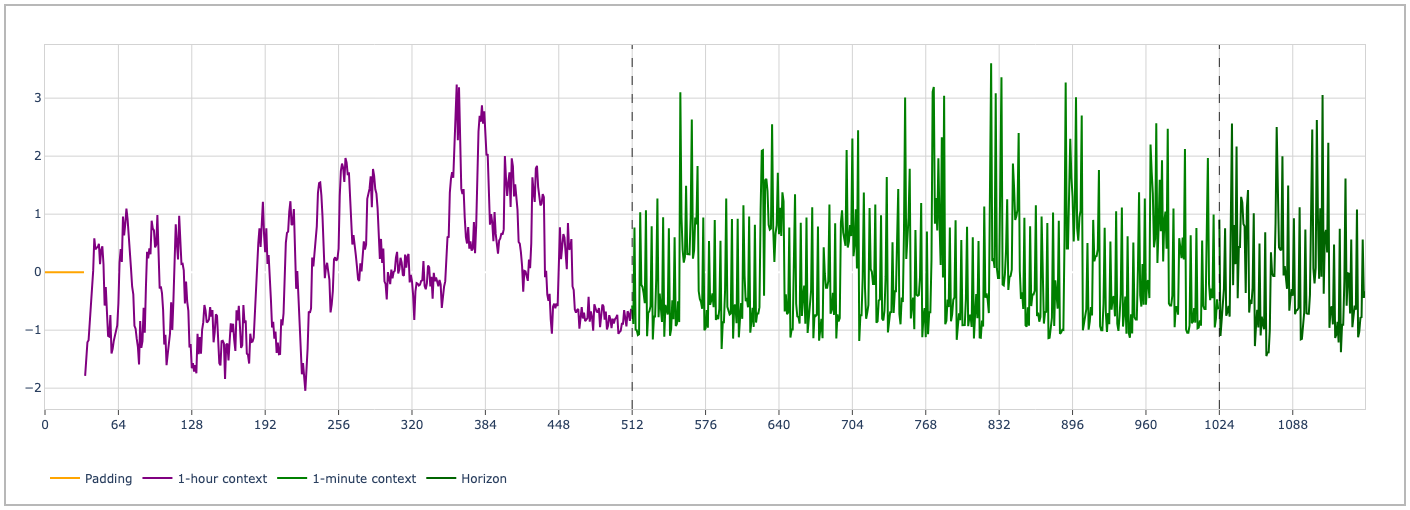
The Cisco Time Series Model is a foundation model trained to perform univariate zero-shot forecasting. Its core is a sequence of decoder-only transformer layers. It is architecturally inspired by the TimesFM2.0 model, with multiresolution modifications aimed at efficient use of long context. It expects a multiresolution context (xc, xf), where the resolution (i.e., space between data points) of xc is 60 times the resolution of xf. Both xc and xf can have length up to 512. The input contexts should be aligned “on the right,” e.g., if xf consists of the 512 minutes terminating at 11:00AM on November 11, then xc should consist of the 512 hours terminating at the same time. The output is a forecast of 128 points, which should be interpreted at the finer resolution; and corresponding quantiles for these points.
For convenience, we also provide utilities for preparing a multiresolution context from a single resolution context (with length up to 512 x 60 = 30,720) directly.
Latest Release (250M) - CTSM 1.0
Results and Improvements:
- Achieves state-of-the-art performance in the Observability (O11y) domain compared to leading models.
- 1-minute resolution: Outperforms the second-best benchmarked model by 16.12% in MASE score.
- 5-minute resolution: Outperforms the second-best benchmarked model by 12.42% in MASE score.
- Improves GIFT-EVAL (public) Benchmark MASE score by 8.57% compared to our previous release.
Key improvements over our November 2025 release (cisco-time-series-model-1.0-preview):
- Trained from scratch (NO continued pretraining (CPT) from TimesFM weights).
- Uses 2× more internal observability (O11y) data in the training mixture.
- Reduces size from ~500M → ~250M parameters.
- Adds Short-Context Training, Bidirectional Coarse Attention, and RoPE for better robustness overall.
Model Architecture and Training Details
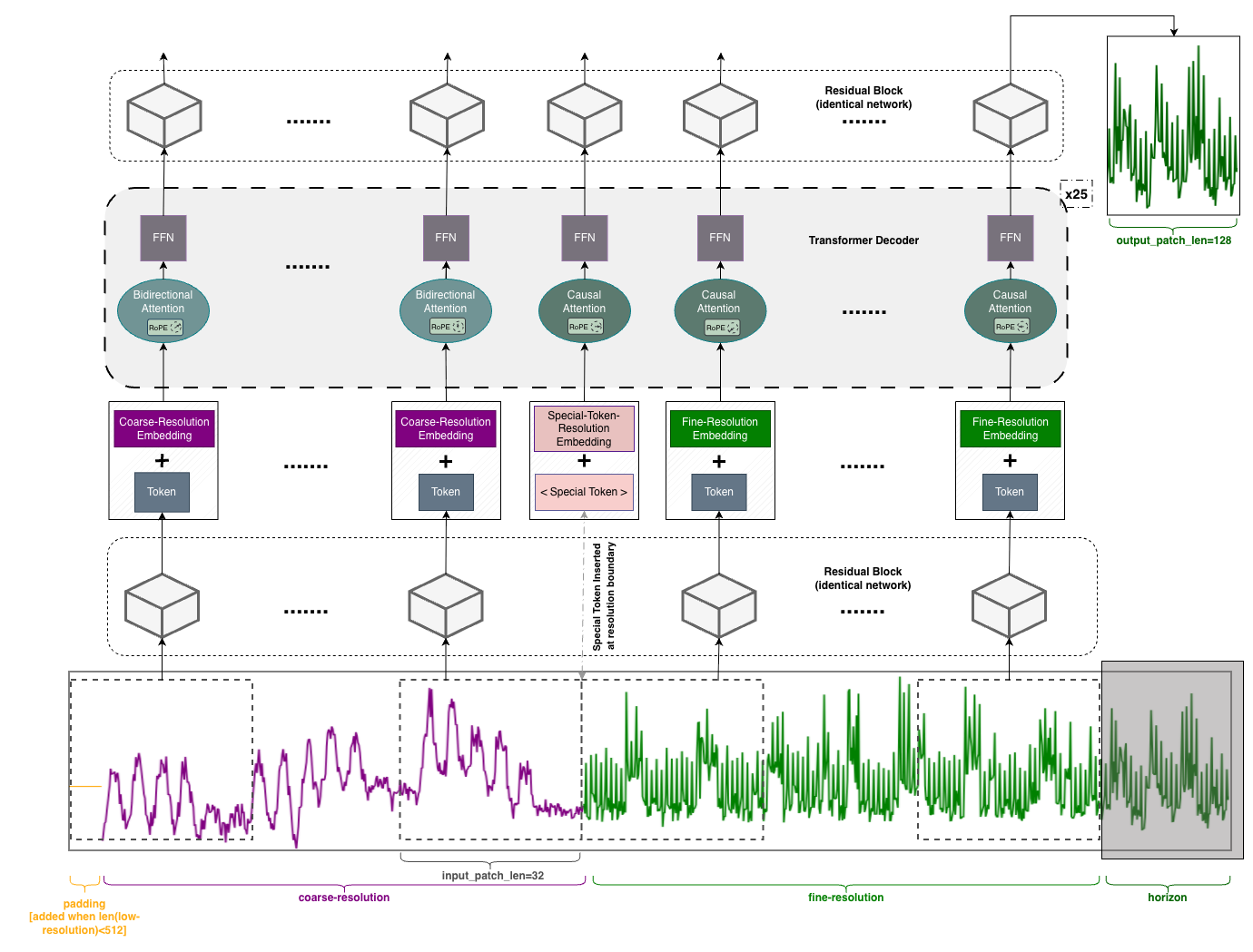
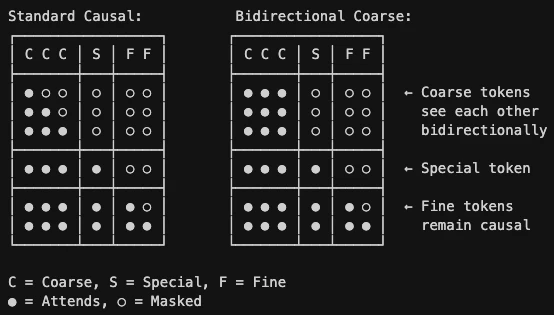
Our latest Cisco Time Series Model 1.0 is a 250M parameter model that is trained from scratch and uses 25 transformer layers (vs 50 in 1.0-preview). This checkpoint leverages the architectural changes of expanded quantiles (15 quantile outputs, 0.01-0.99), rotary positional embeddings (RoPE), special token, separate resolution embeddings for each of coarse context / fine context / special token, and bidirectional attention over the coarse-resolution context.
Standard Causal Attention vs Bidirectional Coarse Attention (Ours):
Example Visualization of Multiresolution Time Series Input to the Model
Training Datasets
The distribution of the training corpus is as follows:
- Internal Splunk Observability Cloud metric time series (upweighted ~2× vs the previous release) datasets:
- (1-hour, 1-minute) resolution: 46.2%
- (5-hour, 5-minute) resolution: 21.8%
- Public datasets:
- Synthetic dataset: 9.5%
Technical Report
NOTE: The report focuses on our November 2025 release (1.0-preview), so some training details differ from our latest release. An updated technical report with details on the latest release will be made available in the near future.
Benchmark Results
> Observability Data
With reference to the training and validation sets, these time series are both out-of-domain and in-the-future. We apply curation rules similar to those described in Section 3 (of the technical report) to ensure a diverse and high-quality benchmark.
We report metrics (models sorted by MASE scores, lower is better) on both 1-minute and 5-minute resolution data (with coarse contexts at 1-hour and 5-hour resolution, respectively). For observability data, error metrics are computed per horizon, then all horizons are aggregated via arithmetic mean. This quantity is normalized by a similar computation using a naive baseline which simply forecasts the final value in the context for all time steps in the horizon (as no natural seasonality is available).
An input context of 1024 length is used with a forecast horizon of 128 length for all models. Metrics of MSIS and CRPS are both computed using 9 quantiles (0.1, 0.2, 0.3, 0.4, 0.5, 0.6, 0.7, 0.8, 0.9) to keep them consistent with the GIFT-EVAL Benchmark.
1. 1-minute Resolution data
| MODEL | MSE | MAE | MASE | sMAPE | MSIS | CRPS |
|---|---|---|---|---|---|---|
CTSM-1.0 (Ours) |
0.196 |
0.366 |
0.562 |
0.923 |
0.164 |
0.295 |
Toto_Open_Base_1.0 |
0.270 |
0.436 |
0.670 |
0.967 |
0.303 |
0.357 |
TimesFM-2.5 |
0.250 |
0.441 |
0.671 |
0.980 |
0.186 |
0.361 |
Chronos-2 |
0.242 |
0.421 |
0.674 |
0.955 |
0.192 |
0.341 |
TimesFM-2.0 |
0.338 |
0.547 |
0.762 |
1.030 |
0.214 |
0.443 |
Chronos-bolt-base |
0.439 |
0.617 |
0.810 |
1.137 |
0.321 |
0.524 |
2. 5-minute Resolution data
| MODEL | MSE | MAE | MASE | sMAPE | MSIS | CRPS |
|---|---|---|---|---|---|---|
CTSM-1.0 (Ours) |
0.232 |
0.425 |
0.543 |
1.005 |
0.195 |
0.340 |
Chronos-2 |
0.282 |
0.475 |
0.620 |
1.040 |
0.176 |
0.383 |
TimesFM-2.5 |
0.293 |
0.490 |
0.621 |
1.047 |
0.171 |
0.395 |
Toto_Open_Base_1.0 |
0.309 |
0.491 |
0.647 |
1.045 |
0.267 |
0.395 |
TimesFM-2.0 |
0.322 |
0.527 |
0.723 |
1.065 |
0.202 |
0.424 |
Chronos-bolt-base |
0.386 |
0.567 |
0.737 |
1.114 |
0.290 |
0.481 |
> GIFT-EVAL Benchmark
All results below are computed on the entire GIFT-EVAL benchmark, with forecast horizon capped at ≤ 128. Models are sorted by MASE scores (lower is better). We adopt the standard approach of normalizing errors per dataset before applying a geometric mean.
1. Using the entire time series context
| MODEL | MSE | MAE | MASE | sMAPE | MSIS | CRPS | Test Leak. |
|---|---|---|---|---|---|---|---|
Chronos-2 |
0.493 |
0.674 |
0.692 |
0.904 |
0.485 |
0.542 |
NO |
TimesFM-2.5 |
0.493 |
0.684 |
0.707 |
0.857 |
0.530 |
0.556 |
NO |
CTSM-1.0 (Ours) |
0.510 |
0.692 |
0.715 |
0.936 |
0.538 |
0.564 |
NO |
TimesFM-2.0 |
0.532 |
0.704 |
0.730 |
0.950 |
0.563 |
0.573 |
YES |
Toto_Open_Base_1.0 |
0.573 |
0.715 |
0.738 |
0.954 |
0.549 |
0.580 |
NO |
Chronos-bolt-base |
0.552 |
0.721 |
0.749 |
0.967 |
0.591 |
0.589 |
YES |
CTSM-1.0-preview (Ours, prev.) |
0.585 |
0.757 |
0.782 |
0.999 |
0.584 |
0.615 |
YES |
2. Using the time series context truncated to 1024 points
| MODEL | MSE | MAE | MASE | sMAPE | MSIS | CRPS | Test Leak. |
|---|---|---|---|---|---|---|---|
Chronos-2 |
0.471 |
0.659 |
0.678 |
0.887 |
0.464 |
0.531 |
NO |
TimesFM-2.5 |
0.464 |
0.667 |
0.684 |
0.851 |
0.494 |
0.540 |
NO |
TimesFM-2.0 |
0.521 |
0.697 |
0.707 |
0.933 |
0.529 |
0.566 |
YES |
Toto_Open_Base_1.0 |
0.528 |
0.691 |
0.715 |
0.932 |
0.526 |
0.559 |
NO |
CTSM-1.0 (Ours) |
0.510 |
0.692 |
0.715 |
0.936 |
0.538 |
0.564 |
NO |
Chronos-bolt-base |
0.562 |
0.722 |
0.747 |
0.967 |
0.597 |
0.592 |
YES |
CTSM-1.0-preview (Ours, prev.) |
0.585 |
0.757 |
0.782 |
0.999 |
0.584 |
0.615 |
YES |
Test Leak.:
YESindicates that the model's training data inadvertently includes portions of the GIFT-EVAL test set.
Usage notes
- If the input time series is missing some values, imputation via last value is recommended; if the time series is naturally sparse and this leads to excessive imputation (e.g., more than 30% of values are imputed), the model's forecasts will deteriorate.
- This release includes short-context training with 1/3rd of the training data sampled uniformly in the range of
[10, 511]in the fine context. However, the model generally works better when more coarse resolution history is provided.
Dependencies and Installation
Setup Virtual Environment
Create a Python 3.11 (recommended) virtual environment and install the package using uv:
# Install uv if required
curl -LsSf https://astral.sh/uv/install.sh | sh

# Create a virtual environment
uv venv --python 3.11

# Activate the environment
source .venv/bin/activate
PyPI Package
The Cisco Time Series Model is available as a PyPI package named cisco-tsm. You can install it using pip:
uv pip install cisco-tsm
Manual Installation
-
Clone the repository:
git clone https://github.com/splunk/cisco-time-series-model.git
cd cisco-time-series-model
-
[Optional] Install your preferred
torchbackend based on your OS and accelerators (CPU, GPU, TPU or Apple Silicon): -
Install the package:
uv pip install -e .
-
(Deprecated) If you want to use the
1.0-previewmodel, change directory to1.0-preview/and use the corresponding package (follow its README for installation and usage):cd 1.0-preview/
Example Code
import torch
import numpy as np
from cisco_tsm import CiscoTsmMR, TimesFmHparams, TimesFmCheckpoint

rng = np.random.default_rng(42)

## Sample data
T = 512 * 60
hours = (T + 59) // 60
k = np.arange(hours, dtype=np.float32)
h = (80 + 0.1 * k) * (1 + 0.25 * np.sin(2 * np.pi * k / 24))
t = np.arange(T, dtype=np.float32)

input_series_1 = h[(t // 60).astype(int)] * (1 + 0.05 * np.sin(2 * np.pi * t / 30)) + rng.normal(0, 0.4, size=T)

# Hyperparameters
hparams = TimesFmHparams(
    num_layers=25, # For `1.0-preview`, use `num_layers=50`.
    use_positional_embedding=False,
    backend="gpu" if torch.cuda.is_available() else "cpu",
    quantiles=[0.01, 0.05, 0.1, 0.2, 0.25, 0.3, 0.4, 0.5, 0.6, 0.7, 0.75, 0.8, 0.9, 0.95, 0.99]
)

ckpt = TimesFmCheckpoint(huggingface_repo_id="cisco-ai/cisco-time-series-model-1.0") # For `1.0-preview`, use `huggingface_repo_id="cisco-ai/cisco-time-series-model-1.0-preview"`.

model = CiscoTsmMR(hparams=hparams, checkpoint=ckpt)

# Model Inference
forecast_preds = model.forecast(input_series_1, horizon_len=128)

# Access forecast mean and quantiles of each series
mean_forecast = forecast_preds[0]['mean'] # (128,)
quantiles = forecast_preds[0]['quantiles'] # dict with keys as quantile levels (0.01, 0.05, ...., 0.95, 0.99) and values as (128,) numpy arrays

# You can also forecast multiple series at once
T = 25_000
hours = (T + 59) // 60
k = np.arange(hours, dtype=np.float32)
h = 120 / (1 + np.exp(-0.01 * (k - 300))) + 10 * np.cos(2 * np.pi * k / (24*7))
t = np.arange(T, dtype=np.float32)
input_series_2 = h[(t // 60).astype(int)] + 2 * np.sin(2 * np.pi * t / 60) + rng.normal(0, 0.5, size=T)

multi_series_forecasts = model.forecast([input_series_1, input_series_2], horizon_len=128)

# Long horizon forecasting is also supported and can be invoked as follows
long_horizon_forecasts = model.forecast(input_series_1, horizon_len=240)
Example Notebooks
We also provide a few Jupyter notebooks demonstrating how to use the Cisco Time Series Model for forecasting real-world time series data:
Notebooks contributed by: Huaibo Zhao
Self-Hosting
The Cisco Deep Time Series Model (CDTSM) can be self-hosted as a FastAPI inference server, enabling on-premise or private-cloud deployments with full control over the runtime environment.
Quick start (Docker):
cd serve/
cp .env-example .env   # set CDTSM_AUTH_TOKEN (user-defined token for authentication)
docker compose up --build
Quick start (process-based):
cd serve/
cp .env-example .env   # set CDTSM_AUTH_TOKEN (user-defined token for authentication)
export CDTSM_AUTH_TOKEN=<your-token>

# CPU-Only
make install-dev && make model-up

# GPU-Accelerated
make install-dev-gpu && make model-up
The serve/ directory provides:
- Process-based hosting via a Makefile with CPU and GPU targets
- Docker-based hosting with CPU and GPU images, persistent model cache, and non-root container execution
- Bearer token authentication
- Health (
/health) and readiness (/ready) probes - An AITK-compatible JSON API at
POST /cdtsm/v1/ai/infer
Both CPU and GPU (NVIDIA CUDA) backends are supported. See the serve/README.md for full setup instructions, environment variables, API reference, and example requests.
Self-Hosting contributed by: Udaya Prasad Vakalapudi
Citation
If you find Cisco Time Series Model useful for your research, please consider citing the associated technical report:
@misc{gou2025ciscotimeseriesmodel,
      title={Cisco Time Series Model Technical Report},
      author={Liang Gou and Archit Khare and Praneet Pabolu and Prachi Patel and Joseph Ross and Hercy Shen and Yuhan and Song and Jingze Sun and Kristal Curtis and Vedant Dharnidharka and Abhinav Mathur and Hao Yang},
      year={2025},
      eprint={2511.19841},
      archivePrefix={arXiv},
      primaryClass={cs.LG},
      url={https://arxiv.org/abs/2511.19841},
}
Authors:
- Liang Gou *
- Archit Khare *
- Praneet Pabolu *
- Prachi Patel *
- Joseph Ross *
- Hercy Shen *‡
- Yuhan (Ellen) Song *
- Jingze Sun *
- Kristal Curtis †
- Vedant Dharnidharka †
- Abhinav Mathur †
- Hao Yang †
* These authors contributed equally to the core development of this work, listed alphabetically by last name.
† These authors contributed equally to supporting and extending this work, listed alphabetically by last name.
‡ Hercy Shen contributed to this work while an intern at Splunk.
License
This project is licensed under the Apache-2.0 License. See the LICENSE file for more details.
Release history Release notifications | RSS feed


Download files
Download the file for your platform. If you're not sure which to choose, learn more about installing packages.
Source Distribution
Built Distribution
Filter files by name, interpreter, ABI, and platform.
If you're not sure about the file name format, learn more about wheel file names.
Copy a direct link to the current filters
File details
Details for the file cisco_tsm-1.0.2.tar.gz.
File metadata
- Download URL: cisco_tsm-1.0.2.tar.gz
- Upload date:
- Size: 24.9 kB
- Tags: Source
- Uploaded using Trusted Publishing? No
- Uploaded via: twine/6.2.0 CPython/3.11.14
File hashes
| Algorithm | Hash digest | |
|---|---|---|
| SHA256 |
fe0f80a0d00f9b10f6e6e32445ea3cfdc8b3e86db006fd00e4a12c5013b58081
|
|
| MD5 |
5aa565f220939e1b921f193887afd8c6
|
|
| BLAKE2b-256 |
4b87ffaf4a01aafb7ff4c32a6f40444985ab570bb7163ab18b58641c6b306d40
|
File details
Details for the file cisco_tsm-1.0.2-py3-none-any.whl.
File metadata
- Download URL: cisco_tsm-1.0.2-py3-none-any.whl
- Upload date:
- Size: 26.7 kB
- Tags: Python 3
- Uploaded using Trusted Publishing? No
- Uploaded via: twine/6.2.0 CPython/3.11.14
File hashes
| Algorithm | Hash digest | |
|---|---|---|
| SHA256 |
dc81a69971a65d6e4c92a2bf31b457f3bd04377ae1612f9b69a7084cd1d35575
|
|
| MD5 |
6f15387d09e117b0932b11f180516d9e
|
|
| BLAKE2b-256 |
f748f386c9e6b53291fecc966afb120424c807a1da79d9c76bf77ab4b7ce1819
|






