citefact
Do your sources actually say what you claim?



Quickstart · How It Works · Usage · Limitations
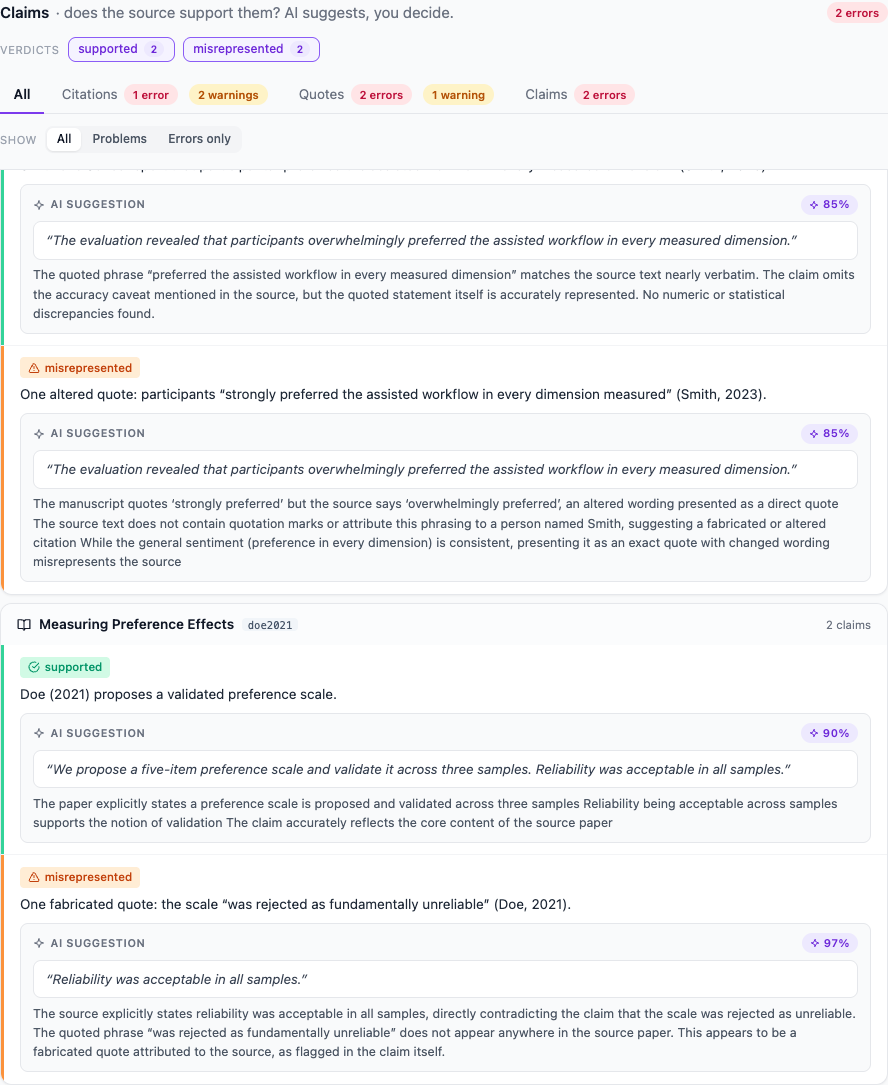
A fabricated quote caught with the source's own words. Full report.
LLMs made it trivial to produce manuscripts with fabricated citations, altered quotes, and claims the cited sources never made. Existing tools check that citations exist; citefact reads the full text of every cited source and checks that it supports what you wrote — then hands you a report with the evidence, before a reviewer finds it first.
🚀 Quickstart
# From a Zotero collection (Zotero 7+ running; no export needed):
uvx citefact check manuscript.md --zotero-collection "PhD/Chapter 3"

# Or from a BibTeX file and a folder of PDFs:
uvx citefact check manuscript.md --bib refs.bib --pdfs ./papers/
That's the whole setup: uvx fetches citefact, the report lands in ./citefact-report/report.html. The citation and quote checks are free and need no API key. The claims check uses an LLM with your own key — run uvx citefact setup once and it configures everything interactively, or pass --skip-claims to stay entirely keyless and offline.
🧭 Three Checks, Cheapest First
| Check | Question it answers | Method | Cost |
|---|---|---|---|
| 1 · Citations | Does every in-text citation exist in the bibliography, with a source document? | Deterministic | Free |
| 2 · Quotes | Is every direct quote, inline or block, really verbatim in its cited source? | Deterministic (normalized + fuzzy) | Free |
| 3 · Claims | Does the source actually support the claim attached to it? | LLM, with verbatim evidence per verdict | ~cents per source |
| Citation-existence checkers | citefact | |
|---|---|---|
| Citation exists in bibliography | ✅ | ✅ |
| Direct quotes verbatim in source | ❌ | ✅ |
| Source actually supports the claim | ❌ | ✅ |
| Works offline / keyless | varies | ✅ (checks 1+2) |
| Metadata / DOI linting | ✅ | ❌ (other tools do this well) |
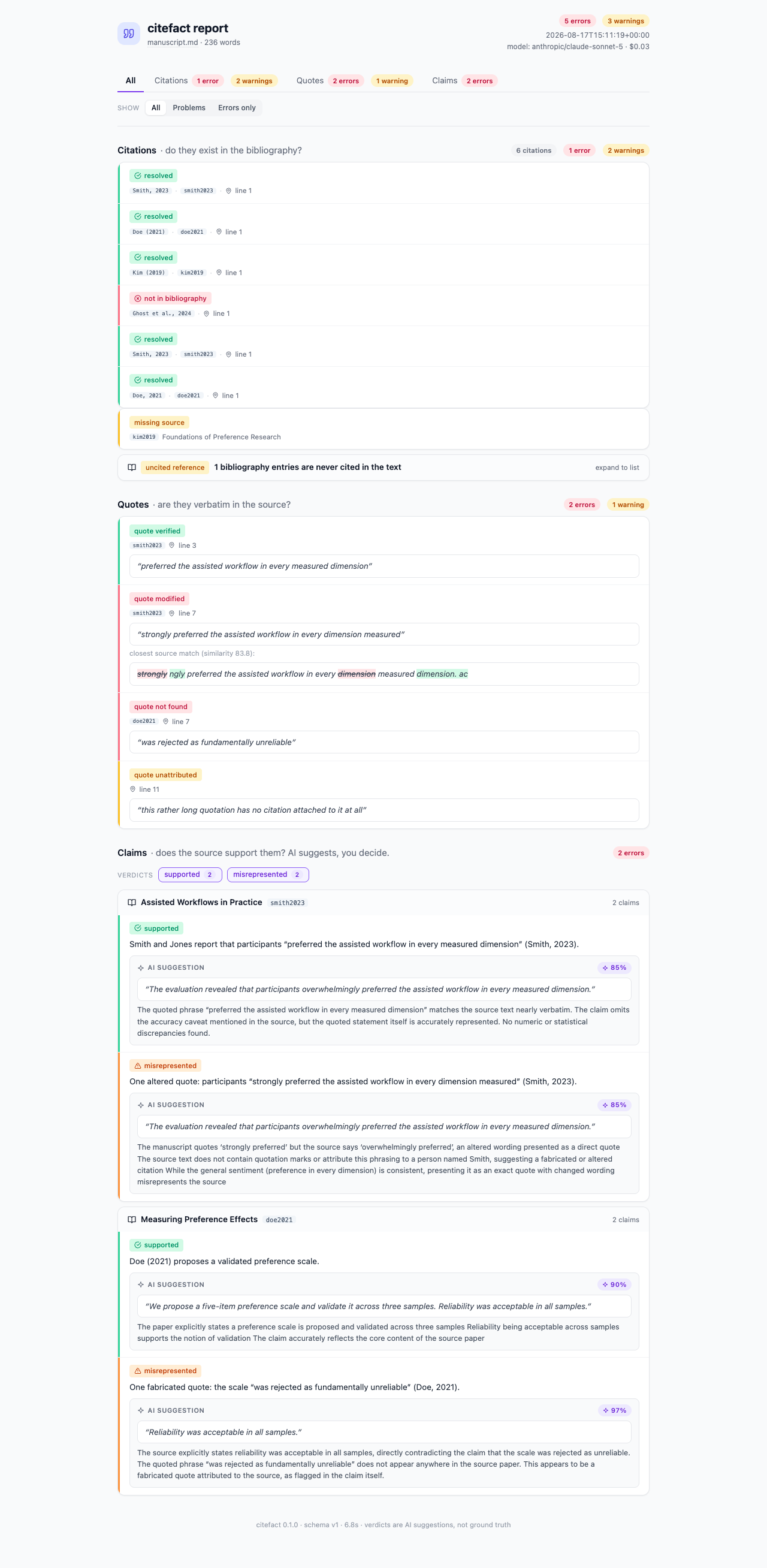
Every claim verdict (supported / partial / misrepresented / not_in_paper) carries a verbatim evidence quote, reasoning, and a confidence score. It is presented as an AI suggestion, never as ground truth: citefact reports, you decide.
✨ Why researchers keep it in the loop
- 📚 Zotero-native - point it at a collection and it reads metadata and attached PDFs through Zotero's local API; no exports, no Better BibTeX
- 🔒 Keyless mode -
--skip-claimscatches fabricated citations and altered quotes with zero network calls - 🤖 Your LLM, your key - Anthropic, OpenAI, or fully local via Ollama, all through LiteLLM
- 📊 One-file report - self-contained HTML (no CDN, no requests), with every citation's status, word-level diffs for altered quotes, and one-click links to the manuscript and each source PDF
- ⚡ Cached everything - PDF conversions, claim extraction, and verdicts are content-addressed; editing one paragraph re-verifies only what changed, and an unchanged re-run costs $0 in seconds. Conversions go through pagebound, so a paper any other pagebound tool already converted is reused, never reconverted
- 🕵️ Private by construction - no telemetry; the only writes are the cache and the report, and the only network traffic is your LLM provider
⚙️ How It Works
flowchart LR
    A[manuscript.md] --> D[Citation parser]
    B[Zotero / refs.bib] --> E[Bibliography catalog]
    C[source PDFs] --> F[pagebound<br/>Docling, content-hash cache]
    D --> G[Citations check]
    E --> G
    F --> G
    G --> H[Quotes check]
    H --> I[Claims check<br/>LLM + caches]
    I --> J[report.html + report.json]
- Parse - a deterministic parser extracts every in-text citation (narrative, parenthetical, multi-author lists, multi-citation groups) and resolves it against the bibliography by first-author surname + year.
- Convert - source PDFs become text via pagebound, which runs Docling once per PDF and caches the result by content hash and converter version. Scanned PDFs are OCR'd, and the report says so.
- Check - citations and quotes are verified deterministically; claims are extracted verbatim and judged per (claim, source) pair by the LLM, evidence included.
- Report - a filterable single-file
report.htmlplus a versionedreport.jsonfor CI.
🤖 For agents and LLM tools
An agent can drive citefact from --help alone: every command states what it writes, its exit codes and the shape of report.json, and citefact help COMMAND is the same text. The loop is three commands:
citefact doctor                                           # what is installed, exit 0 always
citefact check manuscript.md --bib refs.bib --pdfs papers/ --skip-claims --json --quiet > report.json
jq '.findings[] | select(.severity == "error") | {type, location, citation, quote}' report.json
Exit codes are the contract: 0 clean, 1 findings at or above --fail-on, 2 usage or execution error with the reason on stderr. Progress never touches stdout, so --json output is safe to pipe. Finding types are stable per level (orphan_citation, missing_source, quote_modified, claim_verdict, ...) and report.json carries schema_version; a claim_verdict with source_truncated: true was judged on a partial source and should be read as provisional; changes are listed in CHANGELOG.md. Converted source text is shared with pagebound, so an agent that wants to read a source itself can use pagebound path on the same cache.
📖 Usage
| Command | What it does |
|---|---|
citefact check MANUSCRIPT |
Run the audit and write the report |
citefact setup |
Interactive first-run: pre-download Docling, configure and validate your LLM key |
citefact doctor |
Show what is installed and missing, per feature |
citefact convert --pdfs DIR |
Pre-convert PDFs to warm the cache |
CI gating
citefact check manuscript.md --bib refs.bib --pdfs ./papers/ --skip-claims --fail-on error
Exit codes: 0 clean, 1 findings at or above --fail-on (default error), 2 execution error. Errors are the serious findings (fabricated citations, altered or unfound quotes, misrepresented/not_in_paper verdicts); --fail-on warning is stricter, --fail-on none just collects the report. Failed LLM calls surface as unverified findings and mark the run partial — never silently dropped.
Live progress
Long phases draw progress bars with ETA and running LLM cost on interactive terminals (plain lines in CI), and every run ends with a summary:
Verifying claims ━━━━━━━━━━━━━━╸━━  38/41  0:03:12  ETA 0:00:15  $0.31  smith2023

⚠️ Summary: 0 errors, 13 warnings (quotes 13) | cost $0.33 | 158.2s
Report: citefact-report/report.html
check flags reference
| Flag | Default | Meaning |
|---|---|---|
--bib FILE |
BibTeX bibliography (this or --zotero-collection) |
|
--zotero-collection NAME |
Zotero collection (name or "Parent/Child" path); needs Zotero 7+ running |
|
--pdfs DIR |
Folder of source PDFs, fuzzy-matched to entries lacking one | |
--skip-claims |
off | Citations + quotes only: free, keyless |
--only LEVELS |
all | Comma-separated subset: citations,quotes,claims |
--model / --provider |
anthropic/claude-sonnet-5 |
LLM for the claims check |
--fail-on |
error |
error | warning | none: what makes the exit code 1 |
--out DIR |
./citefact-report |
Where report.html + report.json land |
--json |
off | Also stream report.json to stdout |
--quiet |
off | Silence progress and summary |
--force |
off | Ignore the conversion cache |
Environment: CITEFACT_CACHE relocates the .citefact/ cache (written next to the manuscript by default); CITEFACT_MODEL pins a model; CITEFACT_MAX_SOURCE_CHARS sets how much of one source the claims check sends to the model (default 300000, about a long journal article). Anything cut is named in summary.sources_truncated and flagged on every verdict it affected, because a not_in_paper on a cut source may only mean "not in the part the model saw". citefact convert resolves its cache relative to the current directory, so run it from the manuscript's folder or set CITEFACT_CACHE.
Converted PDFs live in .citefact/pagebound/, the project's own pagebound store. If you also have a shared pagebound cache (~/.cache/pagebound, or PAGEBOUND_CACHE), citefact reads it first and copies hits into the project store; it never writes to the shared cache.
All finding types (what lands in the report)
| Finding | Check | Severity | Meaning |
|---|---|---|---|
orphan_citation |
citations | error | In-text citation with no bibliography entry (the fabricated-citation signal) |
uncited_reference |
citations | warning¹ | Bibliography entry never cited in the text |
missing_source |
citations | warning | Entry is cited but no PDF/text is available, so later checks skip it |
quote_verified |
quotes | info | Quote found verbatim in the source |
quote_modified |
quotes | error | Near match only; the report shows a word-level diff |
quote_not_found |
quotes | error | Quote does not appear in the cited source |
quote_unattributed |
quotes | warning | Long quote with no resolvable citation nearby |
quote_page_mismatch |
quotes | warning | Quote is verbatim in the source, but not on the page the citation names |
Quote findings carry form: inline for text between quotation marks, block for a Markdown > block quote (APA sets quotations of 40+ words that way, without marks). A block's trailing (Author, year, p. n) is not part of what is compared with the source. Text inside code fences and tables is never scanned for quotes.
Page locators (p. 47, pp. 47–49) are read from the citation and checked: a matched quote reports pdf_page (where it is in the PDF, linked from the HTML report) and page_found, the printed page number, when the PDF's numbering can be established from its running headers or from the bibliography entry's page range. A quote_page_mismatch is only raised when both sides are known and disagree; a PDF whose numbering is unknown never produces one.
| claim_verdict | claims | by verdict | supported info · partial warning · misrepresented/not_in_paper error · unverified warning |
¹ Demoted to info with --zotero-collection: a collection is a reading library, so uncited entries are normal there.
🤖 LLM Configuration
The easy path is one command:
uvx citefact setup
It asks for your provider, takes the API key with hidden input, validates it with a minimal call, and stores it in ~/.config/citefact/config.toml (owner-only permissions). Done — citefact check just works from then on.
Everything else is an override, in precedence order: --model / --provider flags > ANTHROPIC_API_KEY-style environment variables and CITEFACT_MODEL > the setup config file > the built-in default (anthropic/claude-sonnet-5). Any LiteLLM-supported provider works, including fully local:
uvx citefact check manuscript.md --bib refs.bib --model ollama/llama3.1
⚠️ Limitations
- Author-year (APA-like) citation styles only; numeric styles (Vancouver/IEEE) are on the roadmap
- Markdown manuscripts only in v0.1 (DOCX next; the manuscript itself cannot be a PDF)
- You supply the source PDFs; there is no automatic retrieval by DOI
- The first PDF conversion downloads the Docling environment (~1-2 GB, one-time) into the
uvcache - Claim verdicts are AI suggestions with the usual LLM failure modes; that is why every verdict carries its evidence
Roadmap: DOCX manuscripts → LaTeX (\cite{}) → numeric citation styles → stable JSON schema and JOSS submission. report.json already carries schema_version and is the contract for integrations; schema changes are listed in CHANGELOG.md.
For developers
git clone https://github.com/hearthresearch/citefact
cd citefact
uv sync
uv run pytest              # unit tests, LLM mocked
uv run pytest --run-evals  # opt-in LLM eval fixtures (costs money)
📄 License
🤝 Acknowledgments
- LiteLLM for provider-agnostic LLM access
- pagebound and Docling for PDF-to-Markdown conversion with page provenance
- ZotSeek - related tool: AI-powered semantic search for Zotero
citefact: Do your sources actually say what you claim? Built by José Fernandes
1 maintainer

Metadata
1 maintainer
Release files for citefact 0.3.0
For a detailed explanation of source distributions (sdists) and built distributions (wheels), please see the package formats documentation.
Source distribution (sdist)
| File | Size | Uploaded | |
|---|---|---|---|
| citefact-0.3.0.tar.gz | 749.4 kB | Details |
Built distribution (wheel)
| File | Interpreter | ABI | Platform | Reset |
|---|---|---|---|---|
| citefact-0.3.0-py3-none-any.whl | Python 3 | none | any | Details |
Total release size: 822.9 kB
Release files / citefact-0.3.0.tar.gz
| Download URL | citefact-0.3.0.tar.gz |
|---|---|
| Size | 749.4 kB |
| Tags | Source |
|
SHA-256 checksum How to use checksums |
0777a85ea3ca37dd3d1d6a042aaf2d2a64412cd5de55aac87b2154adc37330b7
|
|
BLAKE2b-256 checksum How to use checksums |
b2eb870ab583e0729a8c3e8731e5febb32f3066b407e98e748ab4d492c0834b5
|
| Upload date | |
|
Uploaded using Trusted Publishing? What is trusted publishing? |
No |
| Uploaded via |
uv/0.11.31 {"installer":{"name":"uv","version":"0.11.31","subcommand":["publish"]},"python":null,"implementation":{"name":null,"version":null},"distro":{"name":"macOS","version":null,"id":null,"libc":null},"system":{"name":null,"release":null},"cpu":null,"openssl_version":null,"setuptools_version":null,"rustc_version":null,"ci":null}
|
Release files / citefact-0.3.0-py3-none-any.whl
| Download URL | citefact-0.3.0-py3-none-any.whl |
|---|---|
| Size | 73.5 kB |
| Tags | Python 3 |
|
SHA-256 checksum How to use checksums |
3886c735817369c9b877d02655475a3ed422933000b021dc321b32b86570af14
|
|
BLAKE2b-256 checksum How to use checksums |
f584579a1ad3115a0658de363386617bf99a44226aaaffaac1725c7eab03eea2
|
| Upload date | |
|
Uploaded using Trusted Publishing? What is trusted publishing? |
No |
| Uploaded via |
uv/0.11.31 {"installer":{"name":"uv","version":"0.11.31","subcommand":["publish"]},"python":null,"implementation":{"name":null,"version":null},"distro":{"name":"macOS","version":null,"id":null,"libc":null},"system":{"name":null,"release":null},"cpu":null,"openssl_version":null,"setuptools_version":null,"rustc_version":null,"ci":null}
|