

Deterministic check runner and log digester for AI-assisted development loops
Let agents move fast.
Keep verification explicit, bounded, and machine-readable.







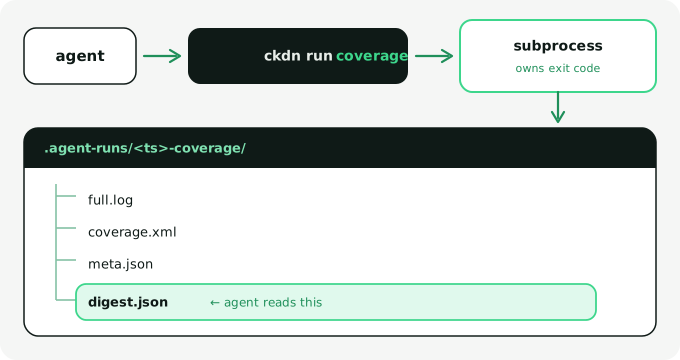
ckdn (short for checkdown) sits between a coding agent and your project’s verification tools. The agent never reads a 10 000-line pytest log and never decides from prose whether a run “looks green”.
Every check goes through one orchestrator that:
- owns the true process exit code,
- archives the full log as evidence,
- emits a bounded, machine-readable digest — the only thing the agent is supposed to read.
Text-based interpretation of tool output fails two ways: context bloat
(the agent drowns in a thousand-line log) and false green (a collection
error prints no FAILED lines, so a regex calls it clean). ckdn's answer is a
strict status model from both the exit code and a format-aware parser: the
two must agree before anything is called green. ckdn may downgrade green;
it never upgrades red.
Runtime: Python ≥ 3.11, stdlib only for the core CLI (zero third-party
dependencies). The optional MCP server is an extra (ckdn[mcp]).
Install
uv tool install ckdn          # global CLI
# or as a project dev dependency:
uv add --dev ckdn
Quick start
cd your-project
ckdn init                      # writes starter ckdn.toml
# edit commands / parsers / aliases to match the project
echo '.agent-runs/' >> .gitignore

ckdn checks                    # list configured checks
ckdn doctor                    # pre-flight: tools on PATH, commands fit parsers
ckdn run ruff                  # one atomic check → compact digest on stdout
ckdn run lint                  # alias → its members in order
ckdn run --all                 # every atomic check → one aggregate
ckdn show                      # pretty-print the latest run's digest
The starter config enables checks a given project may not have (coverage,
mypy, pre_commit, …); trim it first, or --all reports them as error.
ckdn run passes the original command’s nonzero exit code through, so it slots
into any hook or CI step where the raw command used to be — with a bounded,
schema-backed digest as a side effect. The one exception is the point of the
tool: a command that exits 0 on a non-green digest exits 1. A code outside
1–255 (a signal death) becomes 1, not the nearest bound.
Documentation
Full documentation lives at orenlab.github.io/ckdn:
- Get started — install and first check
- Status model — exit code × parser → one verdict; exit-code contract
- Digests & schemas — the machine-readable contract (
ckdn.digest/2) - Aliases & aggregates — grouped checks and routing
- Baselines — gate CI on new findings only
- Configuration —
ckdn.toml, command policy, working directory - CLI — command reference
- Parsers — built-ins, custom parsers, and plugins
- Agents & MCP — wiring ckdn into an agent loop
- Design & non-goals
License & community
- Copyright (c) 2026 Den Rozhnovskiy <rozhnovskiydenis@gmail.com>
- License: MIT (
SPDX-License-Identifier: MIT) - Changelog: CHANGELOG.md
- Security: SECURITY.md
- Contributing: CONTRIBUTING.md
- Code of Conduct: CODE_OF_CONDUCT.md
1 maintainer

Release files for ckdn 1.3.3
For a detailed explanation of source distributions (sdists) and built distributions (wheels), please see the package formats documentation.
Source distribution (sdist)
| File | Size | Uploaded | |
|---|---|---|---|
| ckdn-1.3.3.tar.gz | 316.6 kB | Details |
Built distribution (wheel)
| File | Interpreter | ABI | Platform | Reset |
|---|---|---|---|---|
| ckdn-1.3.3-py3-none-any.whl | Python 3 | none | any | Details |
Total release size: 416.5 kB
Release files / ckdn-1.3.3.tar.gz
| Download URL | ckdn-1.3.3.tar.gz |
|---|---|
| Size | 316.6 kB |
| Tags | Source |
|
SHA-256 checksum How to use checksums |
37651dd1c922b5fb87eff730fd07ff82b7bdf9efdd200fa6a2dfeb90d2e74c53
|
|
BLAKE2b-256 checksum How to use checksums |
6155798697f813fc629e01907eaf54f48fe82ec9294654164f7f53b36cc36d22
|
| Upload date | |
|
Uploaded using Trusted Publishing? What is trusted publishing? |
Yes |
| Uploaded via |
twine/7.0.0 CPython/3.13.14
|
Provenance
Provenance describes where a file came from. On PyPI, provenance is shared via attestations, which provide a verifiable record of the build or publishing details. View details, limitations and caveats.


PyPI Publish Attestation
PyPI verified that this artifact, at this checksum, originated from the publisher listed below.
Signed by GitHub Actions, verified by PyPI on Sep 26, 2026.
Transparency logRelease files / ckdn-1.3.3-py3-none-any.whl
| Download URL | ckdn-1.3.3-py3-none-any.whl |
|---|---|
| Size | 99.9 kB |
| Tags | Python 3 |
|
SHA-256 checksum How to use checksums |
4ce4775a7923dd689b99fd849c7a11b5079eaed5701b794250321b0de4934bc0
|
|
BLAKE2b-256 checksum How to use checksums |
9f35b714e0ca4d0714d77fe7559241b49b97c3cd4cd457ab755874bdc9fbd05b
|
| Upload date | |
|
Uploaded using Trusted Publishing? What is trusted publishing? |
Yes |
| Uploaded via |
twine/7.0.0 CPython/3.13.14
|
Provenance
Provenance describes where a file came from. On PyPI, provenance is shared via attestations, which provide a verifiable record of the build or publishing details. View details, limitations and caveats.
PyPI Publish Attestation
PyPI verified that this artifact, at this checksum, originated from the publisher listed below.
Signed by GitHub Actions, verified by PyPI on Sep 26, 2026.
Transparency log













