
ccr: the cheapest sufficient model for Claude Code





ccr routes each Claude Code task to the cheapest model and effort level that should be
enough for it, so your subscription goes further without you picking models by hand. You keep
typing plain claude.
ccr: T2 (sonnet/medium) — touches app/payments/ledger.py, 2 dependents, no tests found,
critical path: payments. Delegate implementation to ccr-implement; use Explore (haiku) for search.
Screenshots
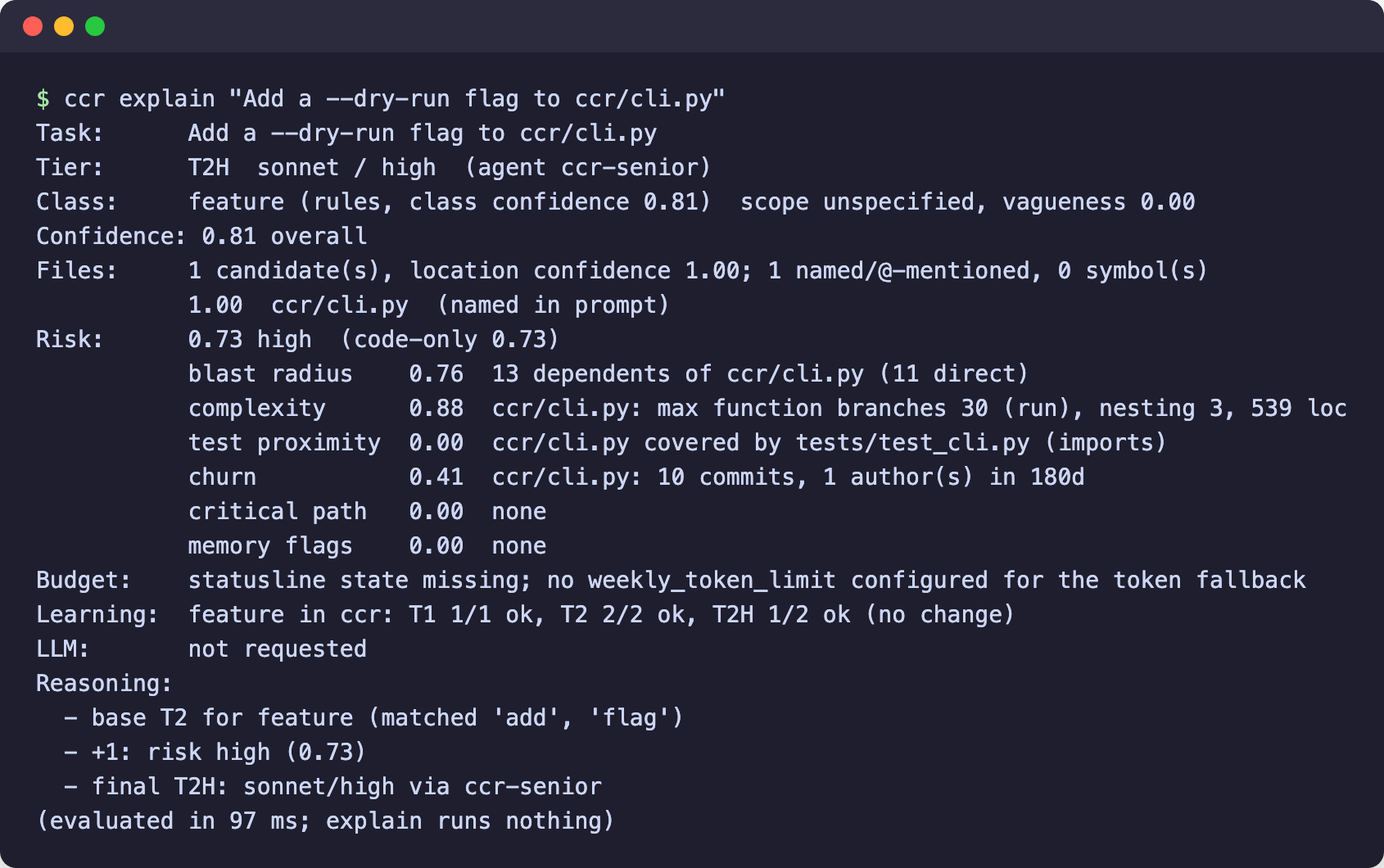
ccr explain shows the tier and exactly why, without running anything:
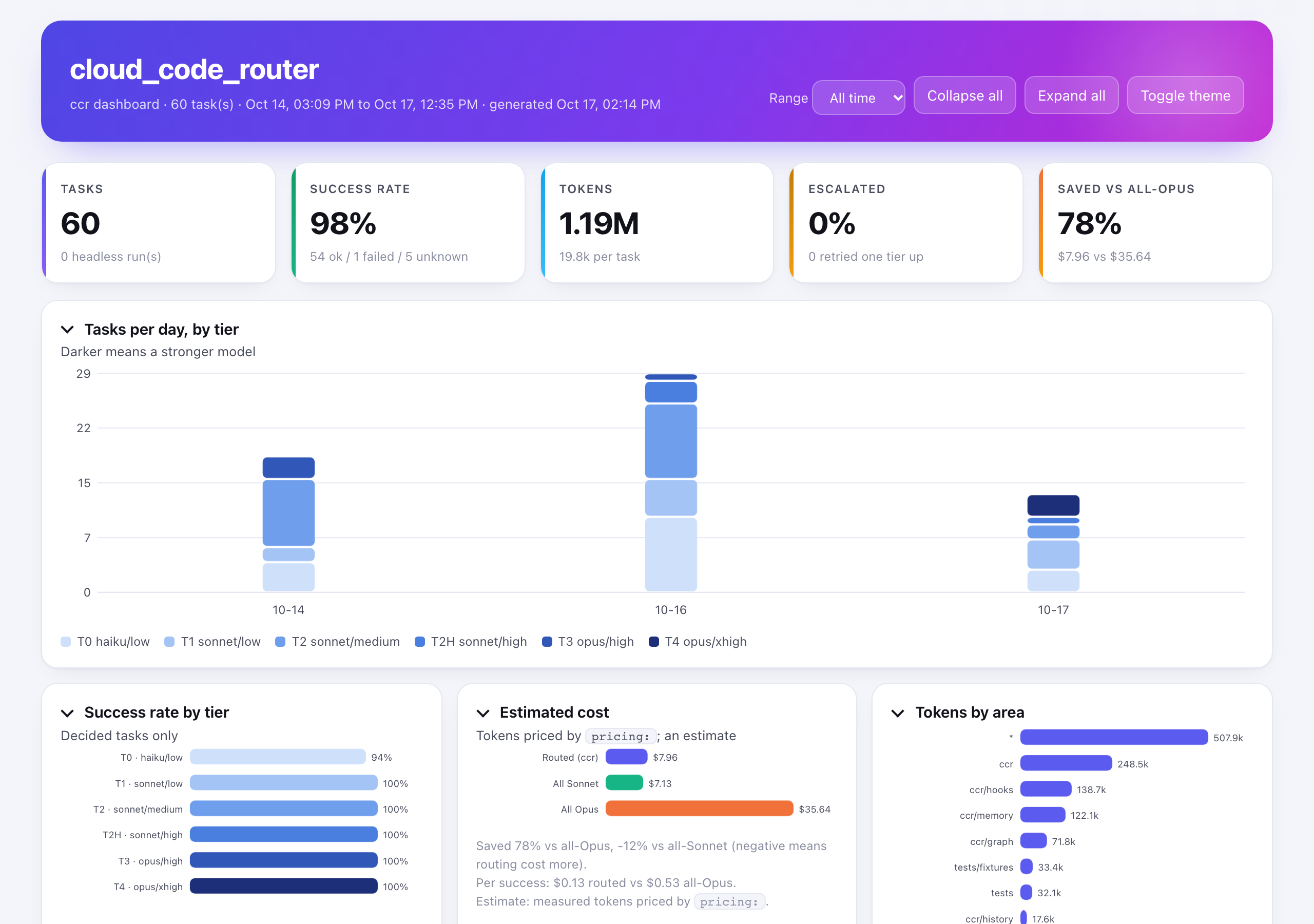
ccr dashboard writes a self-contained HTML report of tiers, success rate, estimated savings and
every routing decision:
How it works
For every prompt, a hook decides a tier using local, rule-based checks (no tokens spent, under half a second):
- Classify the task: question, bugfix, feature, refactor, migration, security, and so on.
- Locate the code it touches, using a local tree-sitter code graph (
.ccr/graph.db). - Score risk: dependents, complexity, test coverage, churn, critical paths (auth, payments,
migrations, infra, secrets) and notes in
CLAUDE.mdor memory. - Adjust with your team's past outcomes and your weekly usage.
- Hint Claude with one line, which delegates the work to a tiered
ccr-*subagent.
| Tier | Model / effort | Agent | Typical work |
|---|---|---|---|
| T0 | haiku / low | ccr-quick |
questions, lookups, typos, renames |
| T1 | sonnet / low | ccr-small |
tests, clear bug fixes, small edits |
| T2 | sonnet / medium | ccr-implement |
features, refactors, perf work |
| T2H | sonnet / high | ccr-senior |
risky or complex multi-file changes |
| T3 | opus / high | ccr-architect |
migrations, security, unclear bugs, design |
| T4 | opus / xhigh | ccr-critical |
critical-path changes only |
Install
Requires Python 3.10+, git, and Claude Code (claude) on PATH.
uv tool install claude-code-router
# or
pipx install claude-code-router
# or
pip install claude-code-router

ccr --help
The package is claude-code-router; the command it installs is ccr. To install the latest
unreleased code instead, use uv tool install git+https://github.com/ai-solution-architect-roadmap/claude-code-router.git.
Name clash: the npm package claude-code-router also installs a
ccrcommand. Install this tool soccron your PATH is this one.ccr doctorchecks.
The .claude/ folder in this repo is a working example of what ccr init generates (agents and
settings), because ccr routes its own development.
Quick start
cd your-project
ccr init --dry-run     # show the exact diff of every file it would touch; writes nothing
ccr init               # apply it (modified files are backed up to .ccr/backups/)
ccr doctor             # check the setup
ccr explain "Fix the off-by-one in paginate() in app/api/pagination.py"   # preview a decision
claude                 # work as usual
Re-running ccr init is safe. To skip routing for one prompt, put !noroute at the end of it.
Commands
Every command accepts --path DIR (project root, default .) and --help. Run ccr --help
for the list.
Setup
ccr init installs settings (model, hooks, status line), the ccr-* agents and
.ccr/config.yaml. Safe to re-run; modified files are backed up to .ccr/backups/.
| Option | Effect |
|---|---|
--dry-run |
Print the exact diff; write nothing |
--force |
Override your model/effortLevel and regenerate edited ccr agent files (with backups) |
--local |
Write settings to .claude/settings.local.json (personal, uncommitted) |
--no-statusline |
Do not install the status line relay |
--no-graph |
Skip building the code graph |
--command CMD |
Command prefix the hooks use to run ccr (default: auto-detect) |
ccr init --dry-run
ccr init --local --no-statusline
ccr profile [PATH] prints the detected languages, frameworks, file count and LOC, and the
suggested session default model/effort.
| Option | Effect |
|---|---|
--apply |
Write the suggestion into .claude/settings.json (overrides existing values) |
--dry-run |
With --apply: print the diff only |
--local |
With --apply: write .claude/settings.local.json instead |
ccr doctor checks the environment and project setup. --verbose logs details to
.ccr/local/ccr.log.
ccr graph builds or refreshes the code graph incrementally, or inspects it.
| Option | Effect |
|---|---|
--rebuild |
Drop and rebuild the graph |
--stats |
Show graph statistics |
--query SYMBOL |
Look up a symbol |
--offline |
Never download tree-sitter grammars |
Routing
ccr explain "<task>" shows the tier, scores, touched files and reasoning. Runs nothing.
--json gives machine-readable output; --llm asks haiku (your claude CLI) when rule
confidence is low.
ccr explain "Fix the off-by-one in paginate() in app/api/pagination.py"
ccr run "<task>" runs the task headlessly with claude -p at the routed tier and climbs
one tier if the attempt fails. Omit the task or pass - to read it from stdin.
| Option | Effect |
|---|---|
--tier T0..T4 |
Start at this tier instead of the routed one |
--max-turns N |
Turn cap per attempt (default run.max_turns) |
--max-budget-usd X |
Spend cap for the whole run, all attempts |
--max-escalations N |
Tiers to climb after a failure, 0 to 4 (default 1) |
--test-command CMD |
Shell command that must exit 0 for success (default run.test_command) |
--no-test |
Skip the test command |
--permission-mode MODE |
Passed to claude, e.g. acceptEdits |
--no-llm |
Rules only; never ask haiku to help classify |
--dry-run |
Show the routing and the command; run nothing |
--json |
Print a JSON summary instead of the result text |
ccr run "add a --dry-run flag to app/main.py" --test-command "pytest -q" --max-budget-usd 2
Feedback, stats and learning
ccr feedback [good|bad] marks the last routed task good or bad (a correction record is
appended; history is never rewritten). With no verdict it shows the last task. Use --id PREFIX
to target a task by id instead of the most recent one.
ccr stats shows usage, estimated savings, misroutes, tier distribution, and success and
escalation rates per tier, area and task class.
| Option | Effect |
|---|---|
--days N |
Only the last N days |
--misroutes |
List each over- and under-routed task |
--json |
Machine-readable output |
ccr dashboard writes a self-contained HTML dashboard (charts, savings, misroutes, recent
tasks). Options: --days N, --out FILE (default .ccr/local/dashboard.html), --open to open
it in the browser.
ccr calibrate fits failure odds on the routing signals and compares them with the rules.
Report only; it never changes routing. Needs about 30 decided tasks. --json for machine output.
ccr tune proposes config edits from misroute evidence as a diff. Nothing changes unless
you pass --apply, which backs up the config first.
ccr shadow re-runs sampled deep-tier tasks at a lower tier in a throwaway git worktree to
measure over-routing. Opt-in and costs real usage; without --yes it only prints the plan.
Needs hooks.store_prompts.
| Option | Effect |
|---|---|
--from-tier T |
Sample tasks routed to this tier or above (default T3) |
--shadow-tier T |
Tier to try instead (default: one below the task's tier) |
--sample N |
How many tasks to re-run, 1 to 50 (default 3) |
--max-budget-usd X |
Total spend cap across the sample |
--test-command CMD |
Must exit 0 for a shadow run to count as success |
--yes |
Actually run |
ccr export-benchmark writes a replay set from decided tasks with stored prompts to
--out FILE (default ccr-benchmark.json). Replay it with
uv run python scripts/bench_routing.py --prompts FILE.
Privacy
ccr purge deletes or scrubs locally stored prompts and shadow results. It shows what it
would do first and deletes only with --yes.
| Option | Effect |
|---|---|
--prompts |
Stored prompts and decisions |
--shadow |
Shadow-run results |
--older-than N |
Only prompts older than N days |
--redact |
Re-scrub existing stored prompts |
--yes |
Actually delete |
Internal (called by Claude Code, not by you)
ccr hook session-start|prompt|stopis the hook entry. It reads hook JSON on stdin and always exits 0.ccr statuslineis the status line relay. It records model, effort and rate limits, and prints a short line.--wrap "<cmd>"runs your own status line command and prints its output.
Configuration
ccr init creates .ccr/config.yaml; commit it. Any key you leave out uses the default. You
can change the tiers, class base tiers, critical paths and terms, risk weights, budget limits
and learning thresholds. See the full reference.
Accuracy
scripts/bench_routing.py replays a labelled prompt set against a fixture project with no API
calls. It reports under-routed and over-routed prompts and the estimated cost against all-Opus
and all-Sonnet baselines. The labels are judgment calls, so edit them to match your own work.
It measures routing quality, not answer quality.
Routing is strongest for clearly worded prompts in a supported language with a fresh graph.
It is weaker for prompts that name no code and for projects with unusual folder names until
you add your own critical_paths, critical_terms and hard_terms.
Privacy
All routing decisions run locally. The only model call ccr makes on its own is an optional,
opt-in classification by haiku through your own claude CLI. Local state lives in .ccr/.
Documentation
The reference covers the full configuration, team workflow, status line and budget pressure, hooks and fail-open behavior, headless runs, feedback and learning, privacy, limitations and troubleshooting.
Development
See CONTRIBUTING.md and the changelog.
uv sync
uv run pytest
uv run python scripts/bench_routing.py
License
1 maintainer

Metadata
1 maintainer
Release files for claude-code-router 0.1.1
For a detailed explanation of source distributions (sdists) and built distributions (wheels), please see the package formats documentation.
Source distribution (sdist)
| File | Size | Uploaded | |
|---|---|---|---|
| claude_code_router-0.1.1.tar.gz | 991.5 kB | Details |
Built distribution (wheel)
| File | Interpreter | ABI | Platform | Reset |
|---|---|---|---|---|
| claude_code_router-0.1.1-py3-none-any.whl | Python 3 | none | any | Details |
Total release size: 1.2 MB
Release files / claude_code_router-0.1.1.tar.gz
| Download URL | claude_code_router-0.1.1.tar.gz |
|---|---|
| Size | 991.5 kB |
| Tags | Source |
|
SHA-256 checksum How to use checksums |
7865393e8ba30397f6cd3f9890d2fc5759ec96febca97d521e3af5dd1ee30dd2
|
|
BLAKE2b-256 checksum How to use checksums |
646421588b1f5f4d769be75c4fce2792369c98531111645f7d364275cd2e3651
|
| Upload date | |
|
Uploaded using Trusted Publishing? What is trusted publishing? |
Yes |
| Uploaded via |
twine/7.0.0 CPython/3.13.14
|
Provenance
Provenance describes where a file came from. On PyPI, provenance is shared via attestations, which provide a verifiable record of the build or publishing details. View details, limitations and caveats.


PyPI Publish Attestation
PyPI verified that this artifact, at this checksum, originated from the publisher listed below.
Signed by GitHub Actions, verified by PyPI on Oct 17, 2026.
Transparency logRelease files / claude_code_router-0.1.1-py3-none-any.whl
| Download URL | claude_code_router-0.1.1-py3-none-any.whl |
|---|---|
| Size | 180.7 kB |
| Tags | Python 3 |
|
SHA-256 checksum How to use checksums |
5757a0f9ebcae219f8b79c5c8eefb056dba1b4dab53f7542a809f6f016b90dfd
|
|
BLAKE2b-256 checksum How to use checksums |
e3b739e97a5d05332dd0003522c9870deb845d5f8f8605c57b1dcca14fcaae5c
|
| Upload date | |
|
Uploaded using Trusted Publishing? What is trusted publishing? |
Yes |
| Uploaded via |
twine/7.0.0 CPython/3.13.14
|
Provenance
Provenance describes where a file came from. On PyPI, provenance is shared via attestations, which provide a verifiable record of the build or publishing details. View details, limitations and caveats.
PyPI Publish Attestation
PyPI verified that this artifact, at this checksum, originated from the publisher listed below.
Signed by GitHub Actions, verified by PyPI on Oct 17, 2026.
Transparency log












