
claude-code-workspaces
A library for your Claude Code conversations: search them, keep them, group them into named workspaces, and open a whole set back into Windows Terminal tabs and split panes.
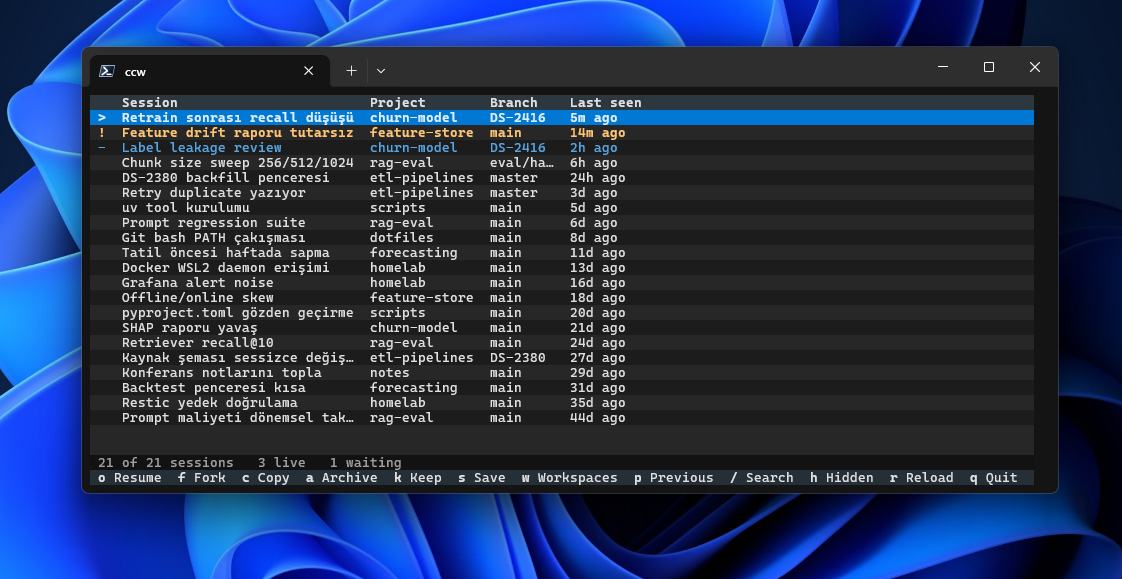
Your Claude Code conversations pile up on disk — hundreds of them, keyed by UUID, spread across every project you have touched. ccw is the list you never had: search them, set one aside, name a set of them, and open that set back into real tabs and panes, each in the right directory, each resuming the right conversation.
It reads what is on disk, so it reaches every conversation you have ever had — including the ones that started on another machine, in another terminal, or months ago.
ccw            # interactive TUI — search, keep, and open a set
ccw list       # the workspaces you have named
ccw restore    # rebuild what was open before a crash or a reboot
Before you install
- Windows 10 or 11, with Windows Terminal. Only the opening of panes is Windows-only, and Platform support explains why that is the one part that is.
- Nothing extra for PowerShell. Every pane runs in PowerShell 7 (
pwsh) when it is installed, and in the Windows PowerShell that ships with Windows otherwise. - Python 3.13 or later.
- Claude Code, recent enough for
claude agents --json, which arrived in 2.1.145. The tool also needs theCLAUDE_CODE_FORCE_SESSION_PERSISTENCEenvironment variable; that one is documented in Claude Code's environment-variable reference, but no release note says which version introduced it, so no minimum is claimed here. If your build is too old the symptom is specific: restored sessions do not show up inclaude agentsand write no transcript. If you see that, update Claude Code.
Install
Either line works and both give you a ccw command. If uv means nothing to you, take the second one: pip ships with Python.
uv tool install claude-code-workspaces
pip install claude-code-workspaces
With uv you can also run it once without installing anything. The package and the command have different names, so both have to be named:
uvx --from claude-code-workspaces ccw
First run
Type ccw. It reads what is already on your disk and opens a table of your conversations — nothing is written and no terminal opens until you ask for one.
Move with the arrow keys, / to search, q to quit. The keys that do something to the row you are on are o to resume it, f to fork it, k to keep it at the top of the list, a to archive it out of the way, and s to save the sessions running right now as a named workspace. w opens those saved workspaces, and that is where you reopen a whole set. The full list is along the bottom of the screen, so there is nothing to memorise.
What it does
- Every conversation, not just the live ones — the list is built from
~/.claude/projects, so it reaches sessions that finished, moved machine, or never ran under any session manager - Workspaces — name a set of sessions ("api-refactor") and open it whenever you want, across projects, into one tab layout
- Keep —
ksets a conversation aside with no typing; kept ones sit above the rest of the list until you come back to them - Live status — see which sessions are busy, idle, or waiting on you, taken from Claude Code's own
claude agents --json - Crash recovery —
ccw restorerebuilds what was open, from the last snapshot plus a modification-time heuristic, behind a checklist, with no daemon and no background service - Windows Terminal native — real tabs and split panes via
wt, no WSL and no multiplexer in between
Why another one
This is a crowded field, and the honest answer has three parts.
Claude Code already does a lot of this
If you are on a current CLI, claude agents is a session browser that ships with the product, and much of the "list my past conversations" story is now native. /resume in the agent view opens a picker of past sessions and resumes your pick (2.1.212); the picker defaults to the current directory, with Ctrl+A to widen it to all projects (2.1.108). /fork copies a conversation into a new session of its own (2.1.212). Sessions can be pinned so they stay alive when idle (2.1.147). A Notification hook fires when a session needs input or finishes (2.1.198). And since 2.1.248 opening a session you already resumed in another terminal no longer starts a second process on that conversation — the same guard ccw implements as RestorePlan.openable.
So use the native picker for one session. What it does not do is a set: its restore target is a background session in claude agents, not a pane in the terminal you are sitting in, and it opens one conversation at a time. ccw exists for the case where the unit is four conversations, in three directories, arranged in tabs.
The wider field
Several good tools read the same transcript store, so "it reads what is on disk" no longer separates anything on its own:
| Project | What it is |
|---|---|
| ccmanager (1.2k★) | A TUI that manages sessions across eight agent CLIs, without needing tmux |
| claude-squad (8.4k★) | Multiple agents in tmux, each in its own git worktree |
| claude-history (469★) | Fuzzy search across your transcripts, then resume or fork the hit |
| claude-code-log (1.2k★) | Turns transcripts into readable HTML |
| wt-restore-claude-tabs | Rebuilds Windows Terminal tabs from the same transcripts after a crash, from one bash file under WSL. Tabs, not panes, chosen by a time window |
| herdr (34k★) | An agent runtime: a background server holds the PTYs, so panes and the agents inside them outlive the client. Native Windows since v0.8.2 |
Star counts read 2026-09-01.
herdr deserves the specific mention, because it answers the crash case better than any restore tool does — it makes the loss rare instead of cheap. If losing panes to a crash is your whole problem, install a runtime; this README will not pretend otherwise. The difference that remains is what the two can see: a runtime knows the panes it started, while ccw reads every transcript on disk, which is why it can reach a conversation that no session manager was running for.
So when is ccw the wrong choice?
- You want one conversation back. Use
/resume, orclaude --resume <id>. That is one keystroke against installing a tool. - You want to search what was said inside conversations.
ccwfilters on title, path, branch and first message. Useclaude-history, orwt-restore-claude-tabs --grep. - You want your panes never to die. Use a runtime like herdr. Recovering afterwards is a worse answer than not losing it.
- You are on macOS or Linux and want panes reopened. Browsing, searching, keeping, archiving and naming workspaces work there already; only the step that opens panes needs Windows Terminal. See below.
- You want worktrees, cost dashboards, or several agent CLIs in one view. Those are
claude-squadandccmanager, and are deliberately out of scope here.
What is left, and what this tool is actually for: named, curated, cross-project sets of past conversations, restored into real Windows Terminal tabs and split panes. Nothing above does the set.
Platform support
The core — reading sessions, live status, workspaces — is platform independent, because it builds on claude agents --json and ~/.claude/projects, which are identical everywhere. Only launching panes is platform specific, and that lives behind a single Launcher interface. So on macOS and Linux ccw installs and runs, and everything up to opening a pane works: the list, search, keep and archive, and saving and editing workspaces. Pressing the key that opens one reports that Windows Terminal cannot be driven, and nothing else is affected.
Windows Terminal ships first because it is what the author runs and the only launcher this machine can honestly test. A tmux launcher is planned; contributions for other terminals are welcome.
Development
git clone https://github.com/volkanncicek/claude-code-workspaces
uv tool install --editable ./claude-code-workspaces
--editable means ccw is on PATH in every shell and still runs the working tree, so a change to the source takes effect without reinstalling. Adding a dependency needs uv tool install --editable . --force to refresh the tool's own environment; changing code does not.
CONTRIBUTING.md has the setup, the checks CI runs, and the conventions worth knowing before a pull request. SECURITY.md covers what the tool reads and writes, and how to report a vulnerability. CHANGELOG.md records what changed per release.
Not affiliated with Anthropic
This is an independent project. It is not affiliated with, endorsed by, or sponsored by Anthropic. "Claude" and "Claude Code" are Anthropic's.
License
MIT. See LICENSE.
1 maintainer

Metadata
1 maintainer
Release files for claude-code-workspaces 0.1.1
For a detailed explanation of source distributions (sdists) and built distributions (wheels), please see the package formats documentation.
Source distribution (sdist)
| File | Size | Uploaded | |
|---|---|---|---|
| claude_code_workspaces-0.1.1.tar.gz | 121.9 kB | Details |
Built distribution (wheel)
| File | Interpreter | ABI | Platform | Reset |
|---|---|---|---|---|
| claude_code_workspaces-0.1.1-py3-none-any.whl | Python 3 | none | any | Details |
Total release size: 180.5 kB
Release files / claude_code_workspaces-0.1.1.tar.gz
| Download URL | claude_code_workspaces-0.1.1.tar.gz |
|---|---|
| Size | 121.9 kB |
| Tags | Source |
|
SHA-256 checksum How to use checksums |
f6bbe5c8f782d53c59e56e99aad2b45fcf77e5abf85f043acf2cfc3cdb235738
|
|
BLAKE2b-256 checksum How to use checksums |
eea484eb263db06a9b8823e011b180012c83d66e458f903e7cb4e7e081a66772
|
| Upload date | |
|
Uploaded using Trusted Publishing? What is trusted publishing? |
Yes |
| Uploaded via |
twine/7.0.0 CPython/3.13.14
|
Provenance
Provenance describes where a file came from. On PyPI, provenance is shared via attestations, which provide a verifiable record of the build or publishing details. View details, limitations and caveats.


PyPI Publish Attestation
PyPI verified that this artifact, at this checksum, originated from the publisher listed below.
Signed by GitHub Actions, verified by PyPI on Sep 23, 2026.
Transparency logRelease files / claude_code_workspaces-0.1.1-py3-none-any.whl
| Download URL | claude_code_workspaces-0.1.1-py3-none-any.whl |
|---|---|
| Size | 58.6 kB |
| Tags | Python 3 |
|
SHA-256 checksum How to use checksums |
24afa9ee7814d95f8df79d562882b6813c60b11aad5ff87b5d67978d5c06100b
|
|
BLAKE2b-256 checksum How to use checksums |
eae7e91660a6065b44c6dc153df2a1487013bb66f13834461418d8fe6e213cbb
|
| Upload date | |
|
Uploaded using Trusted Publishing? What is trusted publishing? |
Yes |
| Uploaded via |
twine/7.0.0 CPython/3.13.14
|
Provenance
Provenance describes where a file came from. On PyPI, provenance is shared via attestations, which provide a verifiable record of the build or publishing details. View details, limitations and caveats.
PyPI Publish Attestation
PyPI verified that this artifact, at this checksum, originated from the publisher listed below.
Signed by GitHub Actions, verified by PyPI on Sep 23, 2026.
Transparency log













