
claude-credit-audit
English | 中文
Anthropic announced a billing change (effective 2026-06-15) that moves
claude -pandclaude-code-actionto a separate Agent SDK credit pool — then paused it on 2026-06-15, so for now nothing has changed. This tool forecasts what it would cost you if/when the change takes effect — so you're ready, not surprised.
A local CLI — or a Claude Code skill — that forecasts which agent calls would move from your Claude subscription to burning separate Agent SDK credit. It scans GitHub Actions workflows and scripts for claude -p, claude-code-action, and Agent SDK calls. Most tools track spend after the fact — this one scans your CI and scripts to predict it.
Quickstart
Requires Python ≥ 3.10.
pip install claude-credit-audit
claude-credit-audit /path/to/your-repo --plan max5x
Point it at a real repo that uses Claude in CI — not at this repo itself (its test fixtures contain sample claude -p calls). cost-audit works as a short alias for the command.
To run from a local clone (e.g. for development), see Development.
Background
Anthropic announced that, from 2026-06-15, non-interactive calls — claude -p (headless), the Claude Agent SDK, the Claude Code GitHub Actions integration (claude-code-action), and third-party apps — would no longer draw from your Claude subscription, consuming a separate monthly credit pool instead (Pro $20 / Max5x $100 / Max20x $200, billed at standard API rates; when it runs out, automated requests stop unless you enable usage credits, and unused credit doesn't roll over). Interactive claude in the terminal/IDE is unaffected.
Status (2026-06-16): the change is paused. Anthropic's note reads "for now, nothing has changed" —
claude -pandclaude-code-actionstill use your subscription today. This tool forecasts the impact if/when the change resumes, so you can plan ahead.
Usage
| Flag | Meaning | Default |
|---|---|---|
--plan |
subscription plan pro|max5x|max20x (sets the credit limit) |
max5x |
--lang |
report language en|zh |
en |
--pr-per-month |
monthly runs of pull_request / push workflows | 30 |
--issues-per-month |
monthly runs of issues / issue_comment workflows | 10 |
--manual-per-month |
monthly runs of workflow_dispatch / local scripts | 4 |
--tier |
force one token tier small|medium|large (overrides per-rule default) |
per-rule |
--format |
output format text|md|json |
text |
--output |
write to a file instead of stdout (use with --format md|json) |
stdout |
--fail-on-burn |
exit non-zero when the expected forecast exceeds the credit limit (for CI gating) | off |
--calibrate |
calibrate token tiers from local ~/.claude usage history |
off |
--claude-home |
Claude config dir (with --calibrate) |
~/.claude |
--version |
print version and exit | — |
Use in CI
Gate a pipeline on the forecast and emit a machine-readable artifact:
claude-credit-audit . --plan max5x --fail-on-burn --format json --output cost-report.json
--fail-on-burn exits non-zero when the expected forecast exceeds your credit limit (the report is still printed/written first), so a workflow step fails before you hit a silent CI stall. --format json is stable for scripting (forecast.expected, forecast.level, forecast.burnout_day, per-call cost_expected, plus data_as_of/data_stale).
Calibration
--calibrate parses real per-session token usage from ~/.claude/projects/**/*.jsonl (message.usage) and recomputes the small/medium/large tiers from the p25/p50/p90 of your actual history — turning a tier guess into a calibration. Notes:
- Cache reads are weighted 0.1× (otherwise the same cached context, re-read every turn, inflates a long session by orders of magnitude).
- By default it uses only non-interactive sessions (whose
entrypointisn't vscode/desktop), which better represent CI/headless size; if there are fewer than 3 it falls back to all sessions and labels the result "may overestimate".
Example reports
Real audits of public repositories, run with --plan max5x.
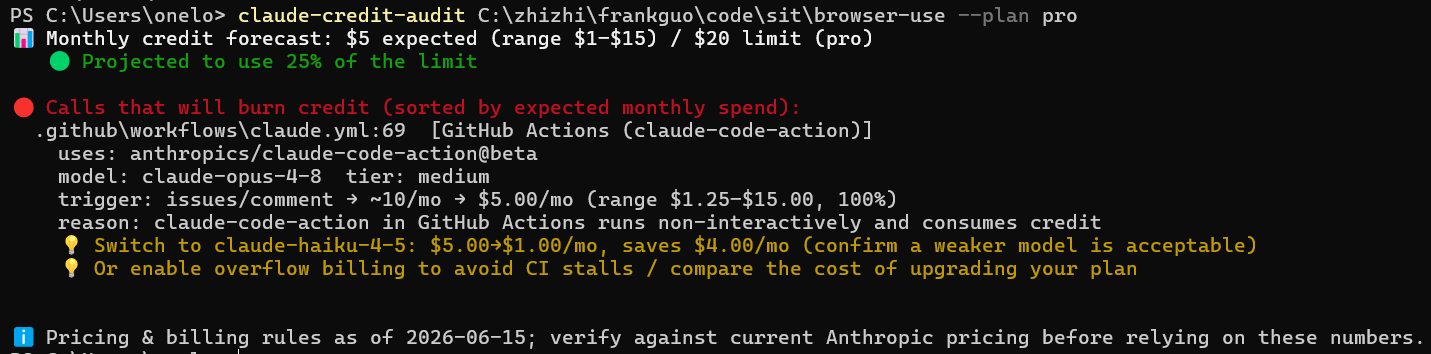
🔴 browser-use/browser-use — 32 MB, active Python project
A claude-code-action step in .github/workflows/claude.yml is flagged with its trigger, detected model, monthly cost, and cheaper alternatives.
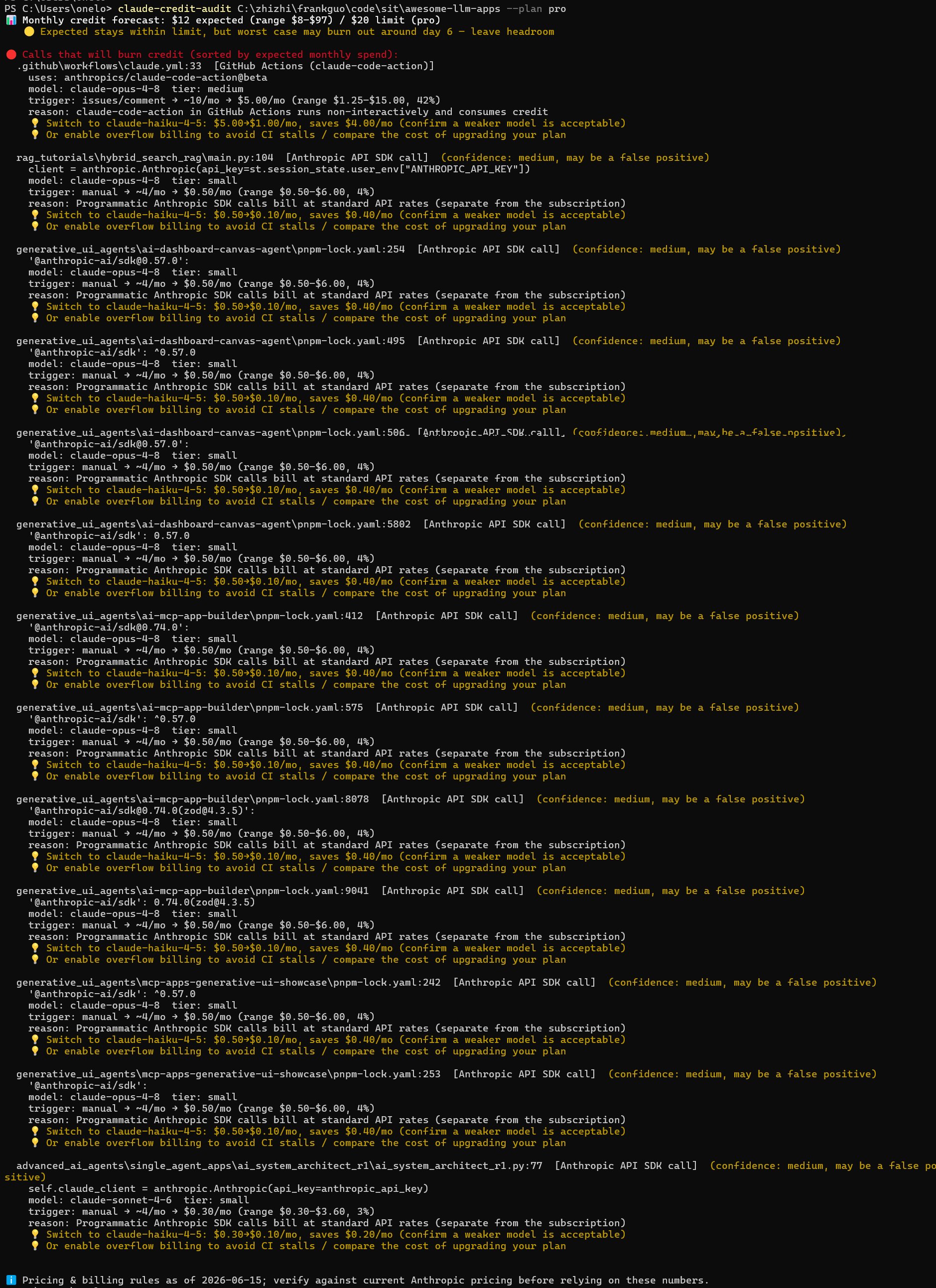
🔴 Shubhamsaboo/awesome-llm-apps — 204 MB
A large repository: the keyword pre-filter keeps the scan fast, and its claude-code-action workflow is detected and priced.
✅ JimLiu/baoyu-skills — 35 MB, Claude skills collection
No credit-burning calls. References to ~/.claude/… in config files and comments are correctly not flagged — no false positives.

How it works
- Range — small/large tiers give an optimistic–pessimistic band; the expected value uses each call type's default tier (headless → large, SDK → small, …).
- Frequency — parses workflow triggers (cron / pull_request / push / workflow_dispatch / issues / issue_comment) and multiplies by the matrix size, correctly distinguishing an
on.issuestrigger from apermissions.issuesgrant. - Model — when a
claude-*model id is present it prices by family, otherwise defaults to Opus. - Confidence — high/medium signals are counted in the forecast; low ones (indirect/install signals such as
npm install @anthropic-ai/claude-code,REVIEW_CLI_BIN: claude,spawn(claudePath, ['-p', …])) are listed separately under "verify manually" and are not counted, so guesses don't pollute the headline number.
FAQ
Is this billing change in effect right now?
No. Anthropic paused it on 2026-06-15 — "for now, nothing has changed." claude -p and claude-code-action still use your subscription today. The answers below describe what happens if/when the change resumes, which is what this tool forecasts.
Would my GitHub Action (claude-code-action) burn Agent SDK credit?
Yes, once the change takes effect — it runs non-interactively and would draw from the credit pool, not your subscription. This tool flags every claude-code-action step.
Would claude -p still count toward my Claude subscription?
No. Once in effect, headless claude -p (and the Claude Agent SDK) move to the separate Agent SDK credit pool.
What happens when the Claude Agent SDK credit runs out? Automated requests stop entirely unless you've enabled usage credits (overflow billing); unused credit doesn't roll over. That's why a forecast matters.
Is interactive claude in the terminal affected?
No — interactive Claude Code / terminal use stays on your subscription.
How is this different from usage trackers (e.g. ccusage)? Those report what you already spent. This scans your CI/scripts to predict what you'll spend before you run it.
Use as a Claude Code skill (or Codex)
This repo doubles as a Claude Code skill (the same SKILL.md format Codex uses) — SKILL.md is the entry point. As a skill you don't run any commands yourself; the agent runs the bundled CLI for you when your request matches (e.g. "audit whether this repo will burn credit").
No
pip installneeded for skill use. The skill is self-contained: it bundles the CLI undersrc/and a launcher (cost-audit.cmdon Windows,cost-audit.shon macOS/Linux) that locates Python andsrc/itself.
Prerequisite: Python ≥ 3.10 with PyYAML on PATH. The launcher checks for PyYAML and tells you to pip install pyyaml if it's missing.
Install (Claude Code)
The whole folder is the skill, so the simplest install is to clone it straight into your skills directory:
# macOS / Linux
git clone https://github.com/frankguodev/claude-credit-audit ~/.claude/skills/claude-credit-audit
# Windows (PowerShell)
git clone https://github.com/frankguodev/claude-credit-audit "$env:USERPROFILE\.claude\skills\claude-credit-audit"
That puts SKILL.md, src/, the data files, and the launchers under ~/.claude/skills/claude-credit-audit/ (Windows: %USERPROFILE%\.claude\skills\claude-credit-audit\). The extra files (tests/, README.md, …) are harmless.
Use it
- Start a new Claude Code session so it picks up the newly added skill.
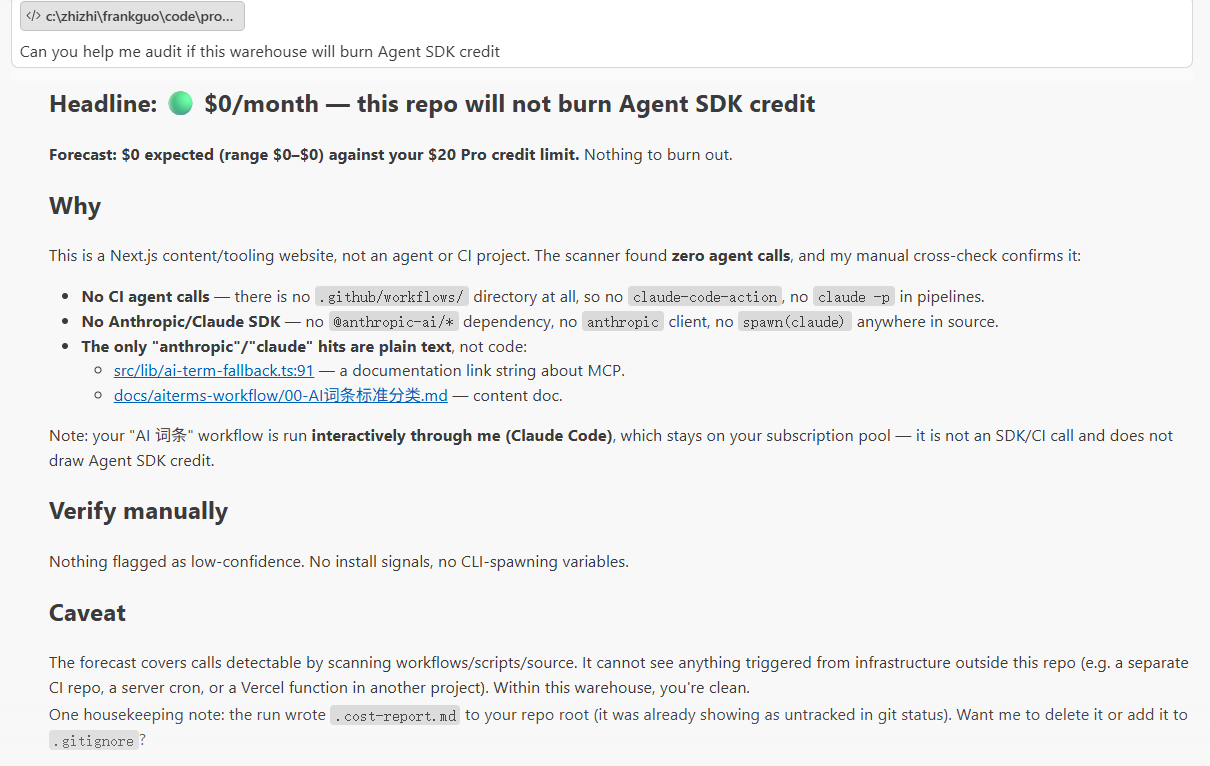
- Ask it in plain language, e.g. "audit whether this repo will burn Agent SDK credit" (Chinese works too — the skill replies in the language you ask in). The agent will run the audit and summarize the forecast, the calls that burn credit, and cheaper alternatives.
Example — the skill running inside a Claude Code chat:
Codex
Codex uses the same SKILL.md format; place this folder in Codex's skills directory instead (see Codex's own docs for its exact location), then trigger it the same conversational way.
Project layout
| Path | Purpose |
|---|---|
src/cost_audit/scanner.py |
scan the repo, extract & classify call sites |
src/cost_audit/estimator.py |
cron parsing + frequency × cost modeling |
src/cost_audit/reporter.py |
risk report + quantified alternatives (en/zh) |
src/cost_audit/calibrate.py |
calibrate token tiers from local usage logs |
src/cost_audit/i18n.py |
en/zh message catalog |
src/cost_audit/cli.py |
command-line entry point |
src/cost_audit/data/billing_rules.yaml |
billing rules (data-driven, updatable) |
src/cost_audit/data/pricing.yaml |
model prices + plan limits + token tiers |
tests/ |
pytest suite + sample fixtures |
Development
pip install -e ".[dev]"
ruff check src tests
pytest -q
CI (GitHub Actions) runs ruff + pytest on Python 3.10–3.12.
Limitations
- No real billing API; tiers are estimates — calibrate with
--calibrate(local history) or--tier. - Trigger frequencies come from flags, not auto-inferred.
- Model and matrix size are attributed per workflow job (the job containing the call); a model set only at the workflow's top-level
env:falls back to the default model. - Rules and prices live in
src/cost_audit/data/*.yaml; the report footer stamps theiras_ofdate and flags data older than 90 days — update them when Anthropic changes pricing.
License
Links
- X: frankguodev
1 maintainer

Metadata
1 maintainer
Release files for claude-credit-audit 0.1.1
For a detailed explanation of source distributions (sdists) and built distributions (wheels), please see the package formats documentation.
Source distribution (sdist)
| File | Size | Uploaded | |
|---|---|---|---|
| claude_credit_audit-0.1.1.tar.gz | 30.9 kB | Details |
Built distribution (wheel)
| File | Interpreter | ABI | Platform | Reset |
|---|---|---|---|---|
| claude_credit_audit-0.1.1-py3-none-any.whl | Python 3 | none | any | Details |
Total release size: 59.5 kB
Release files / claude_credit_audit-0.1.1.tar.gz
| Download URL | claude_credit_audit-0.1.1.tar.gz |
|---|---|
| Size | 30.9 kB |
| Tags | Source |
|
SHA-256 checksum How to use checksums |
587d7bae8ff9e056c61debfc452014b77a05d1c98c3e95b4b5f4a87002e35dbb
|
|
BLAKE2b-256 checksum How to use checksums |
24c269017f1edb83369a2382b6b9509b3b118c12a57a36f29d640adf7cf994ab
|
| Upload date | |
|
Uploaded using Trusted Publishing? What is trusted publishing? |
Yes |
| Uploaded via |
twine/6.1.0 CPython/3.13.12
|
Provenance
Provenance describes where a file came from. On PyPI, provenance is shared via attestations, which provide a verifiable record of the build or publishing details. View details, limitations and caveats.


PyPI Publish Attestation
PyPI verified that this artifact, at this checksum, originated from the publisher listed below.
Signed by GitHub Actions, verified by PyPI on Jun 16, 2026.
Transparency logRelease files / claude_credit_audit-0.1.1-py3-none-any.whl
| Download URL | claude_credit_audit-0.1.1-py3-none-any.whl |
|---|---|
| Size | 28.6 kB |
| Tags | Python 3 |
|
SHA-256 checksum How to use checksums |
fabd5fde1f8fbad46e39a65d7548ea2b21aefa809810a8a1868c28bdd2835d4e
|
|
BLAKE2b-256 checksum How to use checksums |
933af028fd80223aff467392f8594835c736b69ffc243d2426762aa7f2b5d22c
|
| Upload date | |
|
Uploaded using Trusted Publishing? What is trusted publishing? |
Yes |
| Uploaded via |
twine/6.1.0 CPython/3.13.12
|
Provenance
Provenance describes where a file came from. On PyPI, provenance is shared via attestations, which provide a verifiable record of the build or publishing details. View details, limitations and caveats.
PyPI Publish Attestation
PyPI verified that this artifact, at this checksum, originated from the publisher listed below.
Signed by GitHub Actions, verified by PyPI on Jun 16, 2026.
Transparency log













