
Consult a council of AI CLIs (Gemini, GPT, Claude, Mistral, Qwen, Copilot, OpenCode…) from inside any MCP client — free and ban-safe.
Verified details
These details have been verified by PyPIProject links
GitHub Statistics
Maintainers

Project description
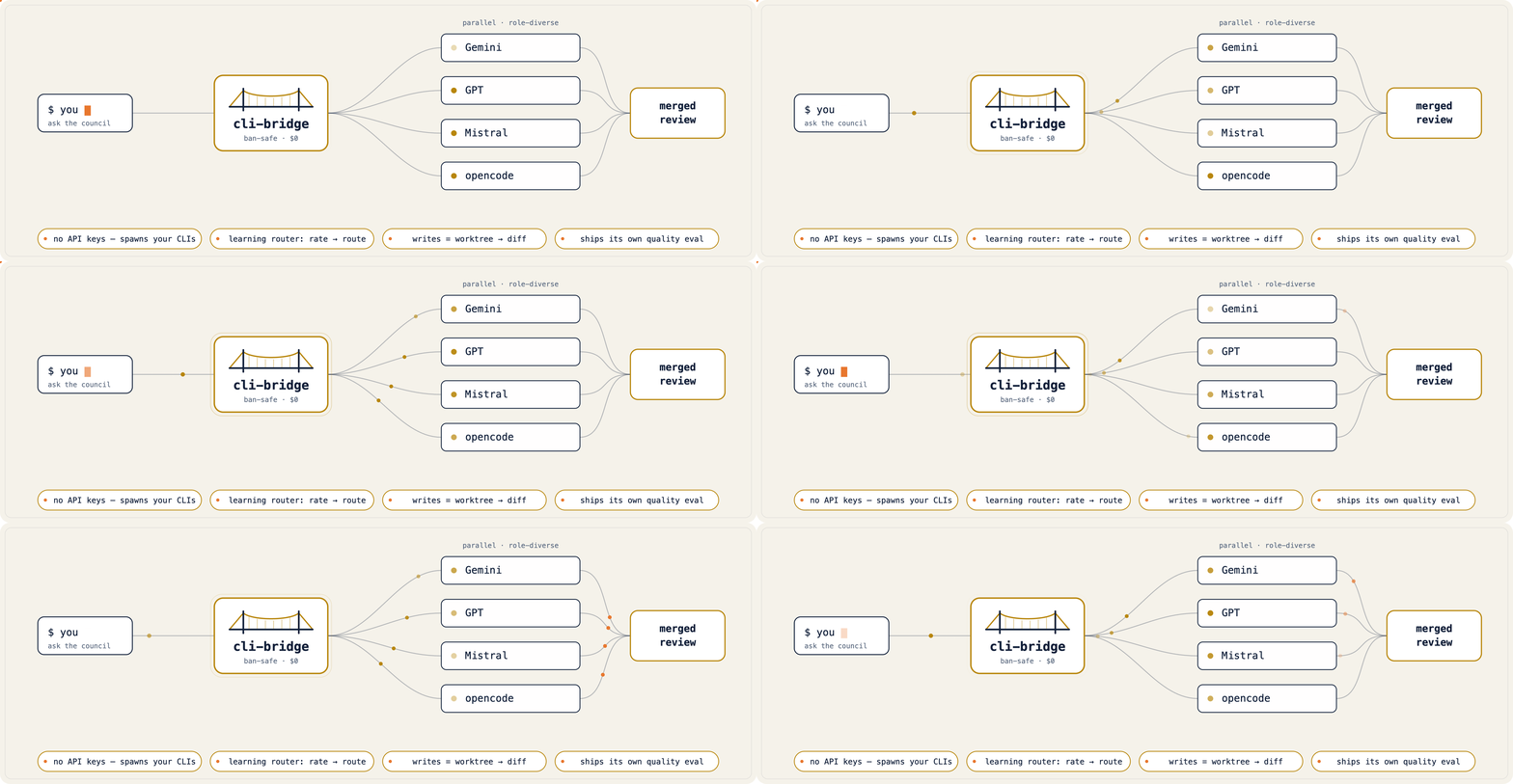
cli-bridge





Your assistant, with the powers of every CLI you already have.
No API keys · no token extraction · no Node · no daemon · stdlib +
mcponly.
The assistant you're talking to can't read a 2M-token repo in one pass, can't see a screenshot,
can't hand you a generated image, and can't check its own work without bias. The other AI CLIs
you've already installed and logged into — Claude Code, Codex, Gemini, opencode, plus local
models via Ollama — each do something yours can't. cli-bridge is a Model Context Protocol server
that lets your assistant borrow them: it spawns the official CLI as a subprocess (exactly as
you'd run it by hand — no keys, no token extraction) and hands the result back.
The 10-second demo
You're in Claude. Claude can't hand you an image. Codex can — natively with gpt-image-2, or by
writing a script that renders one. For a precise layout like a social card, have it script and run it:
ask_build(lane="gpt", task="generate a 1200×630 social card to assets/card.png — write a script that renders it, then run it", zone="assets")
→ Codex writes assets/card.png · you get the path back, never a binary blob (artifact-return)
Your assistant just gained an ability it doesn't have. That's the whole idea — now scale it to giant-context reads, vision, parallel grunt-work, and independent cross-vendor verification.
(Codex generates the image with gpt-image-2, a real text-to-image model built into the CLI —
counted against your ChatGPT plan's usage, no separate API key (image generation needs a paid
plan; it's not on the Free tier). It comes back as a path, not a blob, because binaries travel by
artifact-return, not the text channel. A build lane can also render charts, diagrams or SVGs by
writing code, when that's the better fit.)
…and it delegates real work, safely
cli-bridge build <lane> "<task>" hands the job to another model running in a throwaway git
worktree, then gives you back a diff — your repo is never touched until you apply it yourself.

How to think about it (the mental model)
cli-bridge isn't one feature, it's four levers. Get these and every tool below slots into place:
- Borrow — reach a capability your assistant lacks (vision, a 1M-token context window, a file a coding agent generates, a model that's simply better at this).
- Spread — when one subscription hits its limit, keep going on another lane you already pay for.
- Offload — fan laborious, parallel grunt-work across cheap/free lanes while you build elsewhere.
- Verify — have a different vendor family check the work, because a model can't catch its own blind spots. This is the one thing a single-vendor tool structurally cannot do.
What this unlocks
Each block: one sentence of when you reach for it, the exact call, and what you get back.
Borrow abilities your assistant doesn't have
Every CLI has a different superpower, and each runs non-interactively — so cli-bridge can spawn it. Borrow the one your host lacks (it must be installed + logged in):
| Superpower | Which CLI has it | Borrow it when |
|---|---|---|
| Images | Codex (gpt-image-2, no API key — paid ChatGPT plan, not Free) |
your host can't draw |
| Huge context | Gemini (1M-token window) | a file/repo won't fit your host's context |
| Fresh knowledge | Gemini (Google-Search grounding) · Grok (live web/X) ⚗️ | beat a stale cutoff: "what's the current API of <lib>?" |
| Vision | Gemini (images=[…]) ⚗️ |
analyse a screenshot or diagram |
| A free second opinion | Gemini (free daily tier) · opencode · Ollama (local, $0) | a $0 cross-check |
| Generated files | any build lane → artifact-return | get a chart / PDF / diagram back by path |
| Video ⚗️ | Gemini (Veo) · Grok (Imagine) — if your installed CLI exposes it | you need a generated clip |
ask_build(lane="gpt", task="generate a 1200×630 social card to assets/card.png", zone="assets")   # Codex image → file by path, no API key (paid ChatGPT plan)
ask_gemini(task="find the bug across ./src — read the files you need", cwd="path/to/repo")         # 1M-token context
ask_gemini(task="what's the current recommended API for <lib>? check the latest docs")            # fresh knowledge (Search grounding)
ask_gemini(task="what's wrong in this UI?", images=["screenshot.png"])                             # vision (experimental)
⚗️ = experimental / depends on the installed CLI's current build (e.g. Grok Build is beta) — verify with doctor deep.
Never stop working when you hit a limit
When your main subscription caps out mid-task. ask_cascade falls through to another lane you already
pay for, skipping any lane that's cooled down after a quota/auth/timeout error.
ask_cascade(task="finish wiring this endpoint")   # cheapest→strongest; a cooled-down lane is skipped
ask_best(task="…", mode="deep")                   # let the router pick the most suitable available lane
Offload the grunt work — in parallel, and cheap
When the work is laborious but not hard (refactors, migrations, test coverage). Fan it out, journaled so a server restart resumes instead of restarting; delegate a build and keep working.
batch_run(tasks=[...], dry_run=true)                       # cost envelope first — nothing is spawned
batch_run(tasks=[...], max_calls=20, max_credits=2.0)      # then run under a hard budget (resumable)
ask_build(lane="opencode", task="add the landing page", zone="frontend", mode="direct", async=true)   # delegate, keep building
job_tail(job_id="…")  ·  build_steer(job_id="…", instruction="use Tailwind, not inline CSS")
Break self-confirmation — the 2026 problem one vendor can't solve
When you need to trust a result. A model reviewing its own work (or a sibling's) just confirms its own blind spots. cli-bridge puts a different model family in the reviewer's seat.
workflow(preset="jury", task="is this migration safe?", author_lane="gpt")            # cross-family vote, fail-closed
workflow(preset="verify_repair", task="add retry with backoff",
         builder_lane="gpt", verifier_lane="gemini")                                   # A builds, B reviews, loop to green
security_review(base="origin/main")   ·   review_diff(base="origin/main")              # OWASP, severity-ranked
Get a real second opinion
When you've reached a conclusion and want it pressure-tested, or several models side by side.
challenge(task="I'm dropping the cache layer — here's why: …")                         # one skeptic attacks it
consensus(task="which migration strategy is safest here?")                             # N answer, peer-rank the best
workflow(preset="fanout_compare", task="fix this failing test", lanes=["gpt","gemini","opencode"])
The full toolbox
Every tool, grouped by what you're trying to do. Run CLI_BRIDGE_LEAN=1 for a curated ~12-tool
surface; hide/show any with CLI_BRIDGE_DISABLED_TOOLS / CLI_BRIDGE_ENABLED_TOOLS.
Consult (read-only)
| Tool | What it does | Reach for it when |
|---|---|---|
ask_<lane> |
Ask one specific CLI — ask_claude, ask_gpt (Codex), ask_gemini, ask_mistral, ask_opencode, ask_ollama, and ask_qwen/ask_grok/ask_copilot when installed. Supports role="reviewer|security|planner|devil", conversation (round-table memory), and images=[…] on Gemini. |
You want a particular model's strength, persona, or modality. |
ask_all |
Same question to every free lane in parallel; returns each answer plus a disagreement score. synthesize: true adds an agree/disagree summary. |
You want breadth fast and a signal of where models diverge (= uncertainty). |
ask_cascade |
Tries lanes in a deterministic order, stops at the first good answer, skips cooled-down lanes; optional confidence-escalation. | You want resilience: a capped/failing lane is skipped automatically. |
ask_best |
A router picks the most suitable lane by mode (fast/cheap/deep/code/review/security) + your rate_lane scores. |
You don't want to choose a lane by hand. |
ask_all_async + job_status/job_result/job_cancel/jobs_list |
Fire ask_all as a background job (id in <1s). |
The fan-out is slow and you want to keep working. |
consensus |
N lanes answer, then peers rank to select the best (selection beats synthesis). | A single defensible answer matters more than a blend. |
challenge |
One lane plays skeptic against a conclusion you supply. | You want your own reasoning attacked before you commit. |
conversations_list / conversation_show |
List / read persistent round-table threads (survive /compact and restarts). |
You want to recover or read a multi-model thread. |
Build (opt-in write)
| Tool | What it does | Reach for it when |
|---|---|---|
ask_build |
Delegates a real build. mode=isolated (default) edits a throwaway worktree → diff; mode=direct writes into a declared zone (per-zone lock + post-turn zone-violation check). async=true runs it as a steerable job. Non-text outputs come back by path (artifact-return). |
You want work done, not just suggested — review-gated or hands-off. |
ask_build_isolated |
Convenience alias for ask_build with mode=isolated — always returns a diff, never touches your tree. |
You want the safe diff path by name, without setting mode. |
job_tail |
Streams a running build's progress log (byte-offset). | You want to watch a delegate work. |
build_steer |
Queues a steering instruction for the next turn, or interrupt=true cuts the current turn (files kept). |
You need to course-correct mid-build without restarting. |
Async builds run against an executable Definition-of-Done gate (dod_cmd) — the delegate's claim
of success is tested, not trusted.
Review & verify
| Tool | What it does | Reach for it when |
|---|---|---|
review_diff |
Structured review of a diff → findings (severity, file, rationale), deterministically merged across lanes with single/majority/consensus confidence. | Before a change lands. |
security_review |
OWASP-oriented, severity-ranked security pass + a residual_risk section. |
The change touches auth, input handling, secrets. |
debate |
Models critique each other over bounded rounds, ending with a VOTE footer + convergence early-stop; an independent judge concludes. |
A genuinely contested decision. |
premortem / test_plan |
Failure-mode analysis of a plan / a prioritized test plan from a diff or description. | Before writing code. |
commit_msg / pr_describe |
A Conventional-Commit message from your staged diff / a PR title+body from the branch. Read-only — emits text. | You're about to commit or open a PR. |
workflow(preset=…) |
Named pipelines: jury (cross-family k-of-N vote, fail-closed), verify_repair (cross-model build→review→repair loop), refine_plan, fanout_compare, council_review, map_review, research_verify. |
You want a vetted multi-step pattern in one call. |
Orchestrate
| Tool | What it does | Reach for it when |
|---|---|---|
batch_run |
Durable, journaled fan-out over many tasks. dry_run=true returns a cost envelope (nothing spawned); max_calls/max_credits cap spend; resume_id replays finished tasks and runs only the rest across a restart. |
Bulk work you want bounded and crash-safe. |
Operate
| Tool | What it does | Reach for it when |
|---|---|---|
usage_report / usage_budget |
Estimated token/credit accounting (chars/4 — honestly labeled an estimate) + budgeting vs a daily cap. | You want to see the bill / set a cap. |
rate_lane / route_plan |
Score a lane 1–5 for a mode so ask_best learns your stack / preview the order a cascade would try. |
You want the router to improve over time. |
lane_stats / reset_lane_state |
Per-lane health, cooldowns, and the "earn their seat" jury signal / clear a lane's counters. | A lane is misbehaving, or you want the seat report. |
set_lane_cost |
Record what a lane costs you ("Codex is free on my plan") — persisted, no setup needed. |
You tell it a pricing fact in passing. |
doctor / setup |
Detect installed CLIs + resolved paths; doctor deep validates each lane against its own --help on your machine. |
First run, or when a lane breaks. |
list_models / list_<lane>_models |
List a lane's models where the CLI exposes them. | You want to pick a specific model. |
There's also a human CLI (cli-bridge doctor|ask|ask-all|ask-best|build|review-diff|eval|…) — the
same engine from your terminal or CI (--json everywhere). cli-bridge build <lane> "<task>"
delegates a real build to a lane in a throwaway worktree and prints the diff — your repo is never
touched.
What you actually get when you combine them
One assistant whose ceiling on every axis is the ecosystem's best — not the tool you opened this morning: code with the strongest model, read 1–2M tokens when yours is too short, answer with fresh knowledge past a stale cutoff, generate images/video, see screenshots, and fall back to a free/local lane when you're capped — spread across the subscriptions you already pay for.
The emergent property no single CLI has: true cross-vendor control — a different vendor in the reviewer's seat. Same-family subagents (Claude Code's, Grok's) can only self-confirm.
The honest seam: this unites capabilities, not mind — stateless spawns (no shared memory), spawn latency/cost, uneven quality, and the host always drives. It's orchestration, not fusion: you conduct specialists, you don't get one brain with every power.
→ Per-CLI strengths & limits (dated, churns fast): docs/COMPARISON.md.
Why cli-bridge (and not another "call other models" MCP)
- 🛡️ Ban-safe by design. It spawns each model's official CLI, exactly as you'd run it by hand — no OAuth-token extraction, no API-key reuse. Each CLI handles its own auth and billing.
- 💸 Cost-safe defaults you tune to your plan. Out of the box
ask_all/ask_cascadebuild a free council and never touch paid quota unless you ask. Each lane ships a tier sourced from the vendor's published plans (dated in docs/COSTS.md, never detected from your account); override per lane withCLI_BRIDGE_<LANE>_COST=free|limited|paid. - 🔌 Works from any host. Claude Code, Codex, opencode, Cursor, VS Code (Cline/Continue), Zed —
anything that speaks MCP over stdio. The host's own lane is kept out of fan-out; hide it with
CLI_BRIDGE_HIDE_HOST=1. Even a local model can be the host — seeexamples/local-first-host.md. - 🧭 The cross-vendor edge is the moat. Independent verification means a different vendor in the reviewer's seat — the scarce thing as AI writes a larger share of code, and exactly what a single-vendor tool can't offer.
How it works
host (Claude/Codex/…) ──MCP──> cli-bridge ──spawn──> official CLI ──> model
                                    │
       keeps the host's own lane out of fan-out · only shows installed, enabled CLIs
       kills the whole process tree on timeout/cancellation · redacts secrets
       classifies errors (auth/limit/failed) · spills huge output to a file
No network calls of its own. No keys stored. It runs the same binaries you already trust, in your working directory, and hands the answer back.

Real run (2.2× speed): the Verify lever — security-review fans OWASP roles across free models in
parallel (claude/gpt/opencode/ollama here); they flag a committed auth bypass blocker, and
usage shows the receipts.
Writing code safely: two modes
Writes are contained, two ways — you pick review-gated or hands-off:
isolated(default). Edits in a throwaway git worktree and hands back a diff. Your working tree is never touched.direct. Writes real files, but only inside azoneyou declare, behind a per-zone lock with a post-turn zone-violation check. You inbackend/, a delegate infrontend/, concurrently — neither can scribble across your whole repo; undo is zone-scoped, never a global reset.
Delegate re-entry is depth-capped (CLI_BRIDGE_MAX_DEPTH, default 1) so a misconfigured delegate
can't fork-bomb the council.
Installation (≈5 min)
Prerequisites
- Python 3.10+ and
uv(uvxships with it):curl -LsSf https://astral.sh/uv/install.sh | sh(macOS/Linux) ·winget install astral-sh.uv(Windows). - At least one AI CLI installed and logged in — that's what cli-bridge borrows. Have any of: Claude Code, Codex, Gemini CLI, opencode, Ollama (local, $0). You consult only the lanes you already have.
1. Check what cli-bridge can see (no install — uvx fetches, runs, discards):
uvx --from cli-bridge-mcp cli-bridge doctor
doctor lists which CLIs are detected, their resolved paths, and cost tiers. doctor deep validates
each lane against its own --help.
2. Add it to your MCP host. cli-bridge is an MCP server — it runs inside your assistant, not by hand. Point the host at the same command:
- Claude Code (writes the config for you):
claude mcp add cli-bridge -- uvx cli-bridge-mcp
- Any other host (Codex, Cursor, VS Code, Zed, …) — add to its MCP config
(
~/.claude.json,.mcp.json, or the host's equivalent):{ "mcpServers": { "cli-bridge": { "command": "uvx", "args": ["cli-bridge-mcp"] } } }
Full example with env vars:examples/mcp.example.json.
Note:
cli-bridge-mcp(the MCP server) is the host entry point;cli-bridge(no-mcp) is the human terminal CLI you ran fordoctorin step 1.
3. Use it. Restart/reload your host and ask it to consult a lane — e.g. "use cli-bridge to get a second opinion from gpt" or "ask gemini to read ./src and find the bug".
Lanes
Built-in: Claude Code, Codex, Gemini (+ Antigravity agy), opencode, Ollama (local models, $0,
offline), Qwen Code, Copilot, Grok.
Local runtimes beyond Ollama — LM Studio · MLX · llama.cpp — ship as zero-code recipes:
point CLI_BRIDGE_LANES_FILE at examples/lmstudio.lane.json,
mlx.lane.json, or llamacpp.lane.json.
(Several local runtimes of the same open weights give correlated answers — real council diversity
comes from distinct vendors, not a second local runtime.)
Community lanes (examples/community-lanes.json, experimental + limited until you declare their
cost): Aider, Goose, Plandex, Amp, Crush, Amazon Q Developer CLI, Droid.
Anything else is ~3 lines of JSON. Add a custom lane, or wrap any OpenAI-compatible endpoint by
spawning curl (key kept inside curl, never in argv). See examples/ for recipes.
The honest part
"More models = better" is fragile — big models share training data, so their errors correlate. We
measured our own central claim (cli-bridge eval, no LLM judge): a diverse council did not catch
more bugs than one strong model — it cut the false alarms ~2×. Same catch rate, far less noise —
which is exactly what keeps a reviewer trustworthy instead of muted. Precision is the product, not
recall. The harness ships, so you can confirm it on your CLIs — numbers either way in
docs/BENCHMARKS.md.
Known limitations
- Ban-safe = no token/key extraction, not a blanket guarantee — non-interactive use of a provider's CLI isn't formally sanctioned everywhere and can change. Use your own accounts within their terms.
- Async jobs are in-process — a server restart marks running jobs
interrupted.batch_run/workfloware the exception: they journal each task and resume viaresume_id. - The injection guard is heuristic — it catches high-signal patterns, not everything; treat delegate output as data, not instructions.
- Token/credit figures are estimates (chars/4 + your
CREDITS_PER_1K), never exact. - Cost tiers are sourced defaults, not detection — vendor-plan facts are dated;
doctorwarns when the snapshot is stale. - Experimental (
qwen,copilot,grok, community lanes, Geminiimages=): flags aren't verified live —doctor deepchecks them against each CLI's--helpon your machine.
Roadmap
See CHANGELOG.md for shipped history. Currently exploring (not shipped): an
independent-oracle verify mode (a cross-family lane writes tests from the spec, blind to the
implementation, so the test catches the bug instead of mirroring it) and tighter limit-aware
failover. Big inter-agent "bus" ideas (recursive spawn, shared state, wire protocol) are positioned
honestly as a direction, never sold as a shipped protocol — see docs/ARCHITECTURE.md.
References
The design choices above aren't vibes — each maps to a finding in the literature. Every entry was checked against its source (authors + venue), because a tool that sells "honest cross-vendor verification" should get its own citations right.
| Paper | ID | What it backs here |
|---|---|---|
| Du et al. — Improving Factuality and Reasoning via Multiagent Debate | 2305.14325 | debate: models critiquing each other beat one model alone |
| ReConcile — Round-Table Conference Improves Reasoning | 2309.13007 | debate convergence + confidence-weighted consensus |
| Mixture-of-Agents | 2406.04692 | layered aggregation across diverse models (and its limits) |
| Chain-of-Agents | 2406.02818 | role-specialized multi-agent pipelines |
| CriticGPT — LLM Critics Help Catch LLM Bugs | 2407.00215 | review_diff / security_review: an LLM critic catches bugs humans miss |
| Perez et al. — Discovering Language Model Behaviors (sycophancy) | 2212.09251 | why a same-family judge is weak → cross-vendor jury + peer anonymization |
| Wynn, Satija & Hadfield — Talk Isn't Always Cheap | 2509.05396 | debate failure modes → fail-closed verdicts, bounded rounds |
| CONSENSAGENT — Consensus via Sycophancy Mitigation (Findings of ACL 2025) | ACL 2025 | sycophancy in consensus → "earn their seat" / anonymized peers |
| Maryanskyy — When Agents Disagree: The Selection Bottleneck | 2603.20324 | consensus: selection > synthesis (the deterministic peer-vote default) |
A citation hygiene note. Talk Isn't Always Cheap (2509.05396) is Wynn, Satija & Hadfield — a popular council framework miscites it as "Xiong et al." We double-check attributions before repeating them, and flag it because honesty is the whole pitch.
Development
uv venv && uv pip install -e . pytest pytest-asyncio
pytest -q          # unit + integration (cross-host) tests; no real CLI or network needed
License
MIT
one side · bridged to a council
Project details
Verified details
These details have been verified by PyPIProject links
GitHub Statistics
Maintainers


Download files
Download the file for your platform. If you're not sure which to choose, learn more about installing packages.
Source Distribution
Built Distribution
Filter files by name, interpreter, ABI, and platform.
If you're not sure about the file name format, learn more about wheel file names.
Copy a direct link to the current filters
File details
Details for the file cli_bridge_mcp-0.1.0.tar.gz.
File metadata
- Download URL: cli_bridge_mcp-0.1.0.tar.gz
- Upload date:
- Size: 2.5 MB
- Tags: Source
- Uploaded using Trusted Publishing? Yes
- Uploaded via: twine/6.1.0 CPython/3.13.12
File hashes
| Algorithm | Hash digest | |
|---|---|---|
| SHA256 |
24e50d031cfceb4ebc7f244b0aaf04c8e3b606cdb408513fe090171dbe945101
|
|
| MD5 |
0beeb94a97d3621908da2cb6d4df31b9
|
|
| BLAKE2b-256 |
74c843e323a2d05aabf366080cb1a2c9bf9b7961ad2ba86c2e3b4520661bf35e
|
Provenance
The following attestation bundles were made for cli_bridge_mcp-0.1.0.tar.gz:
Publisher:
release.yml on JoaoBerne/cli-bridge-mcp
-
Statement:
-
Statement type:
https://in-toto.io/Statement/v1 -
Predicate type:
https://docs.pypi.org/attestations/publish/v1 -
Subject name:
cli_bridge_mcp-0.1.0.tar.gz -
Subject digest:
24e50d031cfceb4ebc7f244b0aaf04c8e3b606cdb408513fe090171dbe945101 - Sigstore transparency entry: 1758432160
- Sigstore integration time:
-
Permalink:
JoaoBerne/cli-bridge-mcp@cfeb808b6e5a884b99af0a620f394fdfb39d9717 -
Branch / Tag:
refs/tags/v0.1.0 - Owner: https://github.com/JoaoBerne
-
Access:
public
-
Token Issuer:
https://token.actions.githubusercontent.com -
Runner Environment:
github-hosted -
Publication workflow:
release.yml@cfeb808b6e5a884b99af0a620f394fdfb39d9717 -
Trigger Event:
push
-
Statement type:
File details
Details for the file cli_bridge_mcp-0.1.0-py3-none-any.whl.
File metadata
- Download URL: cli_bridge_mcp-0.1.0-py3-none-any.whl
- Upload date:
- Size: 171.0 kB
- Tags: Python 3
- Uploaded using Trusted Publishing? Yes
- Uploaded via: twine/6.1.0 CPython/3.13.12
File hashes
| Algorithm | Hash digest | |
|---|---|---|
| SHA256 |
3c68ae77a5ae5539f7752089a9dc92c1d683f36cc8f680f47d3912ac566b5c52
|
|
| MD5 |
597abe328b40aab459389b96e61495b2
|
|
| BLAKE2b-256 |
5f407450efdd1cae33affd354ed3d7340640cbbd3cb73e17991b1fed725ea9b2
|
Provenance
The following attestation bundles were made for cli_bridge_mcp-0.1.0-py3-none-any.whl:
Publisher:
release.yml on JoaoBerne/cli-bridge-mcp
-
Statement:
-
Statement type:
https://in-toto.io/Statement/v1 -
Predicate type:
https://docs.pypi.org/attestations/publish/v1 -
Subject name:
cli_bridge_mcp-0.1.0-py3-none-any.whl -
Subject digest:
3c68ae77a5ae5539f7752089a9dc92c1d683f36cc8f680f47d3912ac566b5c52 - Sigstore transparency entry: 1758432233
- Sigstore integration time:
-
Permalink:
JoaoBerne/cli-bridge-mcp@cfeb808b6e5a884b99af0a620f394fdfb39d9717 -
Branch / Tag:
refs/tags/v0.1.0 - Owner: https://github.com/JoaoBerne
-
Access:
public
-
Token Issuer:
https://token.actions.githubusercontent.com -
Runner Environment:
github-hosted -
Publication workflow:
release.yml@cfeb808b6e5a884b99af0a620f394fdfb39d9717 -
Trigger Event:
push
-
Statement type:






