

Read this in other languages: 日本語 | Español | Français | 한국어 | 中文 | Deutsch | Português | Italiano
Compare LLM outputs side-by-side from your terminal - 10 cloud providers + local models, with parallel streaming, batch evaluation, LLM-as-judge scoring, hallucination detection, and CI/CD-ready assertions.






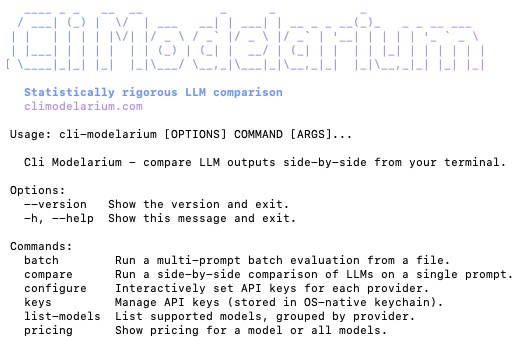
What it does
Cli Modelarium is a polished command-line tool for comparing LLM outputs across providers, models, system prompts, and temperatures - with live parallel streaming, batch evaluation, deterministic testing, and quality scoring built in.
Useful for evaluating which model fits your specific task, running prompt regression tests in CI/CD, comparing local models against cloud APIs, or building evaluation datasets - all from a single terminal command.
System requirements
- Python 3.11 or higher (Python 3.10 users: install
cli-modelarium==0.1.1) - ~150 MB disk space (including scipy and numpy)
- macOS (Apple Silicon and Intel), Windows 10+ (x64 and ARM), Linux (x64 and ARM)
- Internet access for the first install (PyPI wheel download)
Quick start
pip install cli-modelarium

# Configure API keys (saves securely to your OS keychain)
cli-modelarium configure

# Run your first comparison
cli-modelarium "Explain quantum computing in one sentence" \
  --models gpt-5.5,claude-opus-4-8,gemini-3.1-pro-preview \
  --temperatures 0,0.7
That's it. You'll see all three models stream their responses live in parallel, with latency, token counts, and cost displayed in a clean comparison table.
Features
🤖 Providers (10 cloud + unlimited local)
- Cloud providers: OpenAI, Anthropic, Google (Gemini), xAI (Grok), DeepSeek, Mistral, Groq, OpenRouter, Alibaba (DashScope), Z.AI (GLM)
- Local models: Ollama, LM Studio, vLLM, llama.cpp - any OpenAI-compatible server running on localhost
- Mix-and-match local and cloud models in the same comparison
- Choose any registered model id per call - not limited to the built-in group shortcuts
⚡ Parallel streaming
- Live token-by-token display across all models simultaneously
- Time-to-First-Token (TTFT) tracking per model
- See which model finishes first, watch outputs diverge in real time
- Streams from all 10 providers (SSE under the hood)
📊 Multiple comparison modes
- Single prompt vs. multiple models - quick "which is best?" comparisons
- Single prompt vs. multiple temperatures - see how randomness affects output
- Multiple system prompts vs. one user prompt - A/B test prompt engineering
- Batch mode - multi-prompt × multi-model for real evaluation work
- Local vs. cloud comparisons - quantify the gap (or lack thereof)
🧪 Evaluation features
- Statistical reproducibility analysis -
--runs Nruns each configuration N times and reports mean/median/stdev/CV of latency and tokens, output frequency, mode output, and output diversity. Combine with--check-hallucinationto measure hallucination rate across runs. - Deterministic assertions - 10 assertion types (
contains,regex,json_valid,json_schema,max_length_chars,latency_under,cost_under, and more) with pass/fail output and CI exit codes - LLM-as-a-judge scoring - Use one LLM to score outputs from others on quality criteria
- Judge panels - Multiple judges average scores for less biased evaluation
- Hallucination detection preset - Ready-to-use criteria for factual accuracy checking
- Custom criteria - Define your own scoring rubrics
- Self-evaluation auto-skip - Judge models automatically skipped when also being judged
💾 Output formats
- Live terminal - Rich-powered panels with progress bars and streaming display
- CSV - Spreadsheet-friendly (open in Excel, Google Sheets, pandas)
- JSON - Structured for scripts and pipelines
- Markdown - Pretty tables for blog posts and reports
- Exit codes - 0/1/2 reflecting pass/fail status for CI/CD
💰 Cost transparency
- Per-call cost shown from each provider's reported usage
- Total cost summary per comparison
- Judge cost shown separately when LLM-as-judge is enabled
- Local models displayed as "Free"
--max-costflag to prevent surprise bills
🔒 Security
- API keys stored in OS-native keychain via
keyring(Mac Keychain, Windows Credential Manager, Linux Secret Service) - Format validation catches paste errors before storage
- Error message redaction prevents key leakage in tracebacks
- Localhost-only validation for local model URLs
SECURITY.mdwith responsible disclosure policy
🛡️ Rate limit handling
- Per-provider concurrency limits (default 5) respect all tier baselines
- Automatic 429 retry with exponential backoff
- Anthropic 529 "overloaded" handled separately from rate limits
--concurrencyflag for power users on higher tiers- Graceful per-model failure (other models continue)
- DashScope free-tier and flagship Qwen (qwen3.7-max) rate limits are tighter than most providers; lower
--concurrencyif you encounter 429s
🌐 Cross-platform
- Works identically on macOS, Windows (10+ and ARM), and Linux
- All file I/O uses
pathlib+ explicit UTF-8 encoding - CSV writing uses
newline=""for Windows compatibility - Python 3.11+ required
📋 Developer experience
- Single CLI binary -
pip install cli-modelariumand you're done - Polished Rich-based UI - Claude Code-level terminal polish
- JSON output - Pipe into anything (
jq, scripts, monitoring) - CI/CD ready - Exit codes, structured output, GitHub Actions example included
- Apache 2.0 licensed - Use in any project, commercial or otherwise
Examples
Compare 3 models on a coding task
cli-modelarium "Write a Python function to find the longest palindromic substring" \
  --models gpt-5.5,claude-opus-4-7,gemini-3.1-pro-preview
Reproducibility analysis - run N times and see variance
cli-modelarium "What is quantum computing?" \
  --models gpt-5.5,claude-opus-4-7 \
  --runs 5
Each model gets called 5 times in parallel. The output shows mean/stdev of
latency, coefficient of variation, mode answer, and output diversity per
model. Combine with --check-hallucination and --judge to measure the
hallucination rate across runs.
Statistical significance testing
When you run two or more models with --runs > 1, cli-modelarium automatically
computes pairwise statistical significance tests (Welch's t-test by default)
with Bonferroni correction and Cohen's d effect sizes. The math is delegated
to scipy so results match the scientific Python ecosystem.
cli-modelarium "Solve this math problem step by step" \
  --models gpt-5.5,claude-opus-4-7 \
  --runs 20 \
  --judge gemini-3.1-pro-preview
The output adds a "Statistical Significance Tests" block with pairwise
p-values (corrected), Cohen's d effect sizes, and a significance verdict at
the chosen threshold. The default metric is the judge score when judging is
on, otherwise latency_ms.
Customise the analysis:
cli-modelarium "Q" \
  --models gpt-5.5,claude-opus-4-7,gemini-3.1-pro-preview \
  --runs 30 \
  --judge mistral-large-latest \
  --significance-test mann-whitney \
  --correction holm \
  --significance-threshold 0.01
Opt out:
cli-modelarium "Q" --models gpt-5.5,claude-opus-4-7 --runs 10 --no-significance
Bootstrap confidence intervals (v0.1.3)
Every reported mean comes with a bootstrap confidence interval showing
measurement uncertainty. CIs are auto-enabled whenever --runs > 1, and the
default method is BCa (bias-corrected and accelerated) — the publication-grade
standard.
cli-modelarium "Q" \
  --models gpt-5.5,claude-opus-4-7 \
  --runs 30 \
  --bootstrap-seed 42
For publication, always set --bootstrap-seed. Without a seed, CIs vary
slightly across invocations because the bootstrap resampling is stochastic.
Customise:
cli-modelarium "Q" --models gpt-5.5,claude-opus-4-7 --runs 30 \
  --ci-level 0.99 \
  --ci-method percentile \
  --bootstrap-resamples 10000 \
  --bootstrap-seed 42
Disable entirely:
cli-modelarium "Q" --models gpt-5.5,claude-opus-4-7 --runs 30 --no-confidence-intervals
Paired tests for same-prompt comparisons (v0.1.3)
When the same prompts are run on multiple models, paired tests have more
statistical power than independent-sample tests because they exploit the
within-prompt correlation. Pick paired-t for roughly-normal score
differences and wilcoxon-signed for ordinal or non-normal data.
cli-modelarium "Q" --models gpt-5.5,claude-opus-4-7 --runs 30 \
  --significance-test paired-t
cli-modelarium "Q" --models gpt-5.5,claude-opus-4-7 --runs 30 \
  --significance-test wilcoxon-signed
Paired tests automatically align observations by run_index, so they handle
asymmetric failures correctly (if model A succeeded runs [0,1,2,4,5] and
model B succeeded [0,1,3,4,5], only the intersection [0,1,4,5] is used).
McNemar's test for hallucination significance (v0.1.3)
When --check-hallucination is set with --runs > 1 and 2+ models, McNemar's
test automatically compares hallucination pass/fail outcomes between every
pair of models. The implementation uses the exact binomial test for small
discordant counts (n_discordant < 25) and Edwards continuity-corrected
chi-square otherwise.
cli-modelarium "Q" --models gpt-5.5,claude-opus-4-7 --runs 30 \
  --check-hallucination --expected-facts facts.txt \
  --bootstrap-seed 42
The output adds a "Binary Outcome Significance (McNemar)" block alongside the standard significance tests.
Batch evaluation with assertions
Create eval.json:
[
  {
    "id": "math-1",
    "prompt": "What is 2 + 2?",
    "assertions": [
      {"type": "contains", "value": "4"},
      {"type": "max_length_chars", "value": 100}
    ]
  },
  {
    "id": "json-1",
    "prompt": "List 3 colors in JSON array format",
    "assertions": [
      {"type": "json_valid"}
    ]
  }
]
Run it:
cli-modelarium batch eval.json \
  --models gpt-5.5,claude-opus-4-7 \
  --output results.csv
Score outputs with an LLM judge
cli-modelarium "Explain recursion in one paragraph" \
  --models gpt-5.5,claude-opus-4-7,gemini-3.1-pro-preview,local/llama-3.3-70b \
  --judge claude-opus-4-7 \
  --judge-criteria "accuracy,clarity,brevity"
Detect hallucinations against known facts
cli-modelarium "Tell me about the Eiffel Tower" \
  --models gpt-5.5,claude-opus-4-7 \
  --judge claude-opus-4-7 \
  --check-hallucination \
  --expected-facts "Built 1887-1889,Located in Paris France,Designed by Gustave Eiffel"
Compare local model against cloud APIs
# Start Ollama first: ollama run llama3.3
cli-modelarium "Summarize the key features of microservices architecture" \
  --models local/llama-3.3-70b,gpt-5.5,claude-opus-4-7
Run in CI/CD (GitHub Actions example)
- name: Run LLM evaluation
  env:
    OPENAI_API_KEY: ${{ secrets.OPENAI_API_KEY }}
    ANTHROPIC_API_KEY: ${{ secrets.ANTHROPIC_API_KEY }}
  run: |
    cli-modelarium batch ./eval/test_suite.json \
      --models gpt-5.5,claude-opus-4-7 \
      --output eval_results.json \
      --min-pass-rate 0.90
The command exits with code 1 if pass rate drops below 90%, failing the build.
Exit codes
| Code | Meaning |
|---|---|
0 |
Success. |
1 |
Assertion failure - one or more assertions did not pass. batch only; compare has no assertions. |
2 |
The run could not complete. |
Code 2 covers several distinct causes and does not distinguish between them: a missing API key, an unknown model, a retired model, a provider error, an exceeded cost cap, a malformed batch file, a rejected flag combination, an output-file conflict, or an exceeded batch size cap.
Two rules are worth knowing before you gate a pipeline on these:
- Call failures outrank assertions. If any model call fails,
batchexits2without reporting an assertion verdict, even if assertions also failed. A red suite and a broken API key look the same from the exit code. - An unreachable local server is not a failure.
list-models --localexits0when no server answers, so the exit code cannot be used to detect one.
To find out why a run failed, read the error field of each result from JSON output - it carries the provider's message, with credential-shaped strings redacted:
cli-modelarium batch ./eval/test_suite.json \
  --models gpt-5.5,claude-opus-4-7 \
  --output-format json --output results.json
code=$?
if [ "$code" -eq 2 ]; then
  jq -r '.results[] | select(.error) | "\(.model): \(.error)"' results.json
fi
--output-format json is required - the default output carries no machine-readable error field. Note that failures which happen before any model is called (a missing key, an unknown model, a bad batch file) produce no JSON at all; the console message is the only signal in those cases.
Privacy note: JSON output embeds the full prompt and the full model response for every result, alongside any provider error message. Treat results.json as sensitive before committing it or uploading it as a public CI artifact.
More examples
The examples/ folder contains focused demo scripts for
every major feature:
basic_comparison.sh- simple multi-model comparisonreproducibility_analysis.sh- variance analysis with--runsstatistical_significance.sh- significance tests with correctionpublication_grade_eval.sh- bootstrap CIs + paired tests with reproducible seedsmcnemar_hallucination.sh- McNemar's test for hallucination ratesbatch_evaluation.json- multi-prompt batch with assertionsci_eval_suite.json+github_actions_workflow.yml- CI/CD integration template
See examples/README.md for the full list.
Configuration
API keys
Cli Modelarium stores API keys in your OS-native keychain (Mac Keychain, Windows Credential Manager, or Linux Secret Service via keyring). Keys never touch disk in plain text.
# Interactive setup (recommended)
cli-modelarium configure

# Or set individually
cli-modelarium keys set openai
cli-modelarium keys set anthropic
cli-modelarium keys set google

# Check which keys are configured
cli-modelarium keys list

# Remove a key
cli-modelarium keys delete openai
You can also use environment variables (useful for CI/CD):
export OPENAI_API_KEY=sk-...
export ANTHROPIC_API_KEY=sk-ant-...
export GOOGLE_API_KEY=...
Environment variables take precedence over keychain storage.
Headless Linux servers
On Linux servers without a desktop environment (no gnome-keyring, KWallet, or other Secret Service backend), the OS keyring may not be available — common on CI/CD runners, cloud VMs, and Docker containers. In that case, skip cli-modelarium configure and keys set entirely, and use environment variables instead:
export OPENAI_API_KEY="sk-..."
export ANTHROPIC_API_KEY="sk-ant-..."
export GOOGLE_API_KEY="..."        # or GEMINI_API_KEY
export MISTRAL_API_KEY="..."
export XAI_API_KEY="xai-..."
export DEEPSEEK_API_KEY="sk-..."
export GROQ_API_KEY="gsk_..."
export OPENROUTER_API_KEY="sk-or-..."
export DASHSCOPE_API_KEY="sk-..."
cli-modelarium checks environment variables before the OS keyring, so this works out of the box. If you prefer a keyring on Linux, install gnome-keyring (GNOME), KWallet (KDE), or keyrings.alt (file-based fallback).
Local models (Ollama, LM Studio, etc.)
Local models work via OpenAI-compatible endpoints - no API keys needed. The tool auto-detects the default Ollama port.
# Default: assumes Ollama at localhost:11434
cli-modelarium "test" --models local/llama-3.3

# Use LM Studio instead
cli-modelarium "test" --models local/qwen-3-32b --local-url http://localhost:1234/v1

# Save a custom local URL as default
cli-modelarium keys set local --base-url http://localhost:1234/v1
Supported providers
| Provider | API Keys Needed | Streaming | Cost Tracking |
|---|---|---|---|
| OpenAI (GPT-5, GPT-5 mini, o3, o4-mini, etc.) | ✅ | ✅ | ✅ |
| Anthropic (Claude Opus 4.8, Sonnet 4.6, Haiku 4.5, etc.) | ✅ | ✅ | ✅ |
| Google (Gemini 3.5 Flash, Gemini 3.1 Pro, etc.) | ✅ | ✅ | ✅ |
| xAI (Grok 4.3, etc.) | ✅ | ✅ | ✅ |
| DeepSeek (V4 Pro, V4 Flash, etc.) | ✅ | ✅ | ✅ |
| Mistral (Large, Medium, Small) | ✅ | ✅ | ✅ |
| Groq (Llama 3.3, Llama 4 Scout, gpt-oss) | ✅ | ✅ | ✅ |
| OpenRouter (8 registered IDs: Qwen, DeepSeek R1, Llama 3.3, gpt-oss, GLM) | ✅ | ✅ | ✅ |
| Alibaba/DashScope (Qwen3.7 Max, Qwen3.6 Flash, Qwen3 Coder, etc.; select Qwen models, International/Singapore) | ✅ | ✅ | ✅ |
| Z.AI/GLM (GLM-5.2, GLM-4.7, GLM-4.5 Air, etc.; OpenAI-compatible, overseas endpoint) | ✅ | ✅ | ✅ |
| Local: Ollama | ❌ | ✅ | Free |
| Local: LM Studio | ❌ | ✅ | Free |
| Local: vLLM | ❌ | ✅ | Free |
| Local: llama.cpp server | ❌ | ✅ | Free |
Run cli-modelarium list-models to see all currently supported models.
Model groups
Instead of listing model IDs, --models accepts a group shortcut. Static groups expand verbatim: every member listed below runs, so you need a key for each provider the group spans, and the run aborts on the first one missing. The dynamic groups all and all-local are the exception - those resolve against what you actually have configured.
Static groups (fixed membership):
| Group | Models |
|---|---|
all-premium / all-flagship |
gpt-5.5, claude-opus-4-8, gemini-3.1-pro-preview, grok-4.3, deepseek-v4-pro, mistral-large-latest, qwen3.7-max, glm-5.2 |
all-budget |
gpt-5.4-nano, claude-haiku-4-5, gemini-3.1-flash-lite, grok-4.20-0309-non-reasoning, deepseek-v4-flash, mistral-small-latest, qwen3.7-plus, glm-4.5-air |
all-reasoning |
o3, o4-mini, deepseek-v4-pro, magistral-medium-latest, magistral-small-latest, glm-5.2 |
all-cheap |
gpt-4o-mini, claude-haiku-4-5, gemini-2.5-flash-lite, deepseek-v4-flash, mistral-small-latest, qwen-flash, glm-4.7-flashx |
all-open-weight |
openai/gpt-oss-120b, openai/gpt-oss-safeguard-20b, llama-3.3-70b-versatile, meta-llama/llama-4-scout-17b-16e-instruct |
Dynamic groups (resolved at runtime):
all— every cloud model you have a configured API key for (excludes local models and OpenRouter). This can fan out to many models, so pair it with--max-cost.all-local— every model reported by your running local server (Ollama / LM Studio / vLLM / llama.cpp). If no server is reachable, you get a clear message instead of an error.
cli-modelarium "Explain CAP theorem" --models all-budget
cli-modelarium "Explain CAP theorem" --models all --max-cost 0.50
cli-modelarium "Explain CAP theorem" --models all-local
How it works
Cli Modelarium uses a modular provider abstraction layer that hides the API differences between OpenAI's messages array, Anthropic's top-level system parameter, Google's system_instruction, and others. Every provider implements the same async streaming interface, so the CLI can run them all in parallel with asyncio.gather().
Cost calculations come from each provider's reported usage field (input tokens, output tokens, cached tokens) multiplied by current pricing constants. Pricing data was verified from official provider documentation on July 29, 2026 - see Notes & Limitations for caveats.
For local models, the same OpenAI Python SDK is used with a custom base_url, since Ollama, LM Studio, vLLM, and llama.cpp all expose OpenAI-compatible REST endpoints.
Notes & Limitations
Pricing data
All pricing built into Cli Modelarium was verified from official provider documentation on July 29, 2026. The Z.AI/GLM prices are the one exception: they carry an earlier June 22, 2026 verification date, were not part of the most recent pass, and their entries are unchanged since then. LLM pricing changes frequently (sometimes monthly). The pricing_as_of date is carried in JSON output and shown in the console; CSV and Markdown output do not include it. Always verify against each provider's official pricing page before relying on cost calculations for budgeting or production decisions.
Prices are each provider's standard/list public rate per 1M tokens (not batch, priority, off-peak, or promotional pricing); for input-size-tiered models the entry/short-context tier is shown, and cached pricing is the cache-read rate. DashScope/Qwen costs reflect non-thinking rates (the tool sends enable_thinking=false).
Run cli-modelarium pricing (or pricing --all) for current per-model rates.
Rate limits
Rate limit handling and the default per-provider concurrency settings are based on provider rate limits verified June 21, 2026. Your specific tier's limits may differ from the defaults assumed here. Verify your current limits against the provider's official dashboard before building production capacity assumptions.
Model availability
Models supported by Cli Modelarium reflect what providers offered on July 29, 2026. Providers regularly release new models, deprecate older ones, and adjust capabilities. If a model in the registry no longer works, run cli-modelarium list-models and check the provider's documentation.
Not a production-grade gateway
Cli Modelarium is designed for evaluation and comparison - running ad-hoc side-by-side tests across providers from a developer terminal. It is NOT a production inference gateway. If you need production-scale routing, load balancing, fallback chains, or SLA-managed inference, look for tools specifically built for that purpose.
Token count comparisons across providers
Token counts shown in results are reported by each provider's API. Different providers use different tokenizers, so "output tokens" is not directly comparable across providers for the same text. If you're comparing cost efficiency for production use, run real prompts in your actual workload - don't rely solely on per-token math across providers.
LLM-as-a-Judge usage
Cli Modelarium includes optional LLM-as-a-judge scoring (enabled with the --judge flag), which uses one LLM to evaluate outputs from other LLMs. This is standard benchmarking methodology and is permitted under the Terms of Service of all supported providers as evaluation/benchmarking activity.
When using --judge, you are responsible for following the Terms of Service of each provider whose models you use. Each provider's ToS applies to both the models being judged and the judge model itself.
Judge bias notice: LLM judges have documented biases (self-preference, same-family preference, verbosity preference). Judge scores are useful signal, not ground truth. Use judge panels (--judges with multiple models) to reduce bias.
Hallucination detection
The hallucination detection preset is a useful comparison signal between models, not a ground-truth validation. Detection accuracy varies based on the judge model used, the domain knowledge required, and whether reference facts are provided via --expected-facts. Use it for relative quality comparison, not absolute correctness verification.
Comparison methodology
LLMs are non-deterministic at temperature > 0 - re-running the same prompt may produce different outputs. A single comparison run shows you ONE sample from each model, not a definitive quality verdict.
To draw more reliable conclusions:
- Use
--runs 5(or higher) to automatically run each comparison N times and see statistical summaries: mean/median latency, coefficient of variation, mode output, and output diversity. Coefficient of variation below 0.05 indicates stable model behavior across runs. - For hallucination consistency analysis, combine
--runswith--check-hallucinationto see how often the model produces hallucinations across multiple runs (the hallucination rate). - Use
--temperatures 0for more deterministic outputs. Some models do not accept a temperature setting at all -claude-opus-4-7,claude-opus-4-8,claude-opus-5,claude-sonnet-5,claude-fable-5,o3,o4-mini,gpt-5andgpt-5.5. The tool omits the field for those so the call still succeeds, and they run at their provider's default instead. - Compare across multiple prompts, not just one
- Use the
--output jsonflag to save runs for systematic analysis (with--runs > 1the JSON includes per-cellstats_by_cellaggregates)
Those nine models are called without the temperature field, and models_without_temperature in the JSON output names the ones affected by any given run. Three consequences are worth knowing. A multi-value --temperatures sweep against one of them issues identical requests rather than a sweep, and the tool prints a warning when that happens. The temperature shown in the results table, the CSV and each JSON result record is the value you requested, not the value applied. And --significance is where this can change a conclusion rather than a label: comparing a model that omits temperature against one that honours it produces a variance difference that is a sampling artifact, which Welch or Mann-Whitney will report as though it were a model-quality difference. That case does warn: any significance run mixing an affected model with an unaffected one prints a Temperature not applied panel naming the models that ran at the provider default, and sets significance_temperature_mixed to true in the JSON output. A multi-temperature run that is also mixed gets both messages in a single panel. CSV carries no equivalent signal.
About the author
Cli Modelarium was built by Lavelle Hatcher Jr.
Connect
- 💼 LinkedIn: linkedin.com/in/lavellehatcherjr
- 🐙 GitHub: github.com/lavellehatcherjr
- 💬 Questions about this project: open an issue
- 📩 Collaboration/opportunities: reach out via LinkedIn
Why I built this
Comparing LLM outputs across providers is tedious - different SDKs, different auth patterns, different response shapes, no easy way to see them side-by-side with cost and latency data. The polished cloud playgrounds only show one provider at a time, and the available open source options either focus on production routing or are full evaluation platforms optimized for teams.
Cli Modelarium is the small, focused CLI tool that does one thing well: side-by-side comparison with quality scoring, assertions, batch mode, and streaming - all designed for the terminal-first developer workflow.
It's intentionally focused: no production routing, no agent orchestration, no fine-tuning, no GUI. Just clean, fast comparison from the command line.
Built with a modular provider abstraction, parallel execution, transparent cost calculation, and secure key storage via OS keychain systems for local users.
Contributing
Issues and PRs welcome. See CONTRIBUTING.md for guidelines.
For security issues, please see SECURITY.md - do not file public issues for security concerns.
License
Licensed under the Apache License, Version 2.0.
See the NOTICE file for attribution requirements.
Built by Lavelle Hatcher Jr
Licensed under Apache 2.0. Issues, PRs, and conversations welcome.
1 maintainer

Download files
Download the file for your platform. If you're not sure which to choose, learn more about installing packages.
Source Distribution
Built Distribution
Filter files by name, interpreter, ABI, and platform.
If you're not sure about the file name format, learn more about wheel file names.
Copy a direct link to the current filters
File details
Details for the file cli_modelarium-0.1.5.tar.gz.
File metadata
- Download URL: cli_modelarium-0.1.5.tar.gz
- Upload date:
- Size: 357.3 kB
- Tags: Source
- Uploaded using Trusted Publishing? No
- Uploaded via: twine/7.0.0 CPython/3.13.13
File hashes
| Algorithm | Hash digest | |
|---|---|---|
| SHA256 |
c6374cc8becb8bdf0a1a1af12bb2789e69d820dafef78df5ffb6c1c549af8f5d
|
|
| MD5 |
da7ea3eb104d95dd2b0ffb2d357bcd67
|
|
| BLAKE2b-256 |
c8f53fa116e28818571f3e90cd0370fb80f46ac01faf6341a79c70acf5bec5d7
|
File details
Details for the file cli_modelarium-0.1.5-py3-none-any.whl.
File metadata
- Download URL: cli_modelarium-0.1.5-py3-none-any.whl
- Upload date:
- Size: 127.9 kB
- Tags: Python 3
- Uploaded using Trusted Publishing? No
- Uploaded via: twine/7.0.0 CPython/3.13.13
File hashes
| Algorithm | Hash digest | |
|---|---|---|
| SHA256 |
bb2d007158cfca0907a8bfbdac8279e6c4554804bef81b30e3fc90222c1bcd58
|
|
| MD5 |
0d23695e6aa7355b36c511a8fa5cdc3b
|
|
| BLAKE2b-256 |
664b47dcf372166c0941baed8870e3502e5b1076ac03b094b2c28e83368fe43e
|







