
⚜️ Clientele
What is Clientele?
Clientele is a comprehensive framework for building and maintaining API Integrations.
Focus on the functionality and the data you want from an API, and let Clientele handle the rest.
Build, test, and maintain API integrations confidently.


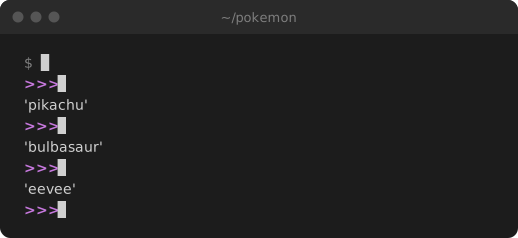
Example code
from clientele import api
from pydantic import BaseModel

client = api.APIClient(base_url="https://pokeapi.co/api/v2/")

class Pokemon(BaseModel):
    name: str

@client.get("/pokemon/{id}")
def get_pokemon_name(id: int, result: Pokemon) -> str:
    return result.name
Why use Clientele?
- A comfortable abstraction - Encourages consistency and focus on the functionality.
- Easy to learn - Clientele is visually similar to popular python API server frameworks.
- Easy to test - All the testing tools you need to maintain API integrations.
- Easy to configure - Sensible HTTP defaults and plenty of hooks for customisation.
- Easy data validation - Built in data validation using Pydantic.
- Core built-ins - Caching, Network, and Retry handling built specifically for HTTP.
- Use your own HTTP - Clientele can support any Python HTTP library.
- OpenAPI support - Build your own client, or scaffold one from an OpenAPI schema.
- GraphQL support - Clientele has a GraphQLClient tailored for GraphQL APIs.
Async support
@client.get("/pokemon/{id}")
async def get_pokemon_name(id: int, result: Pokemon) -> str:
    return result.name
Automatic data validation
from clientele import api as clientele_api
from .my_pydantic_models import CreateBookRequest, CreateBookResponse

client = clientele_api.APIClient(base_url="http://localhost:8000")


@client.post("/books")
def create_book(data: CreateBookRequest, result: CreateBookResponse) -> CreateBookResponse:
    return result
GraphQL support
from pydantic import BaseModel
from clientele.graphql import GraphQLClient

client = GraphQLClient(base_url="https://api.github.com/graphql")

class Repository(BaseModel):
    name: str
    stargazerCount: int

class RepositoryQueryData(BaseModel):
    repository: Repository

class RepositoryQueryResponse(BaseModel):
    data: RepositoryQueryData

@client.query("""
    query($owner: String!, $name: String!) {
        repository(owner: $owner, name: $name) {
            name
            stargazerCount
        }
    }
""")
def get_repo(owner: str, name: str, result: RepositoryQueryResponse) -> Repository:
    return result.data.repository
Works with Python API frameworks
Building an API service in Python? Clientele can build you a client library in seconds.
Clientele is built and tested to be 100% compatible with the OpenAPI schemas generated from:
- FastAPI
- Django REST Framework via drf-spectacular
- Django Ninja
See the working demos in our server_examples/ directory.
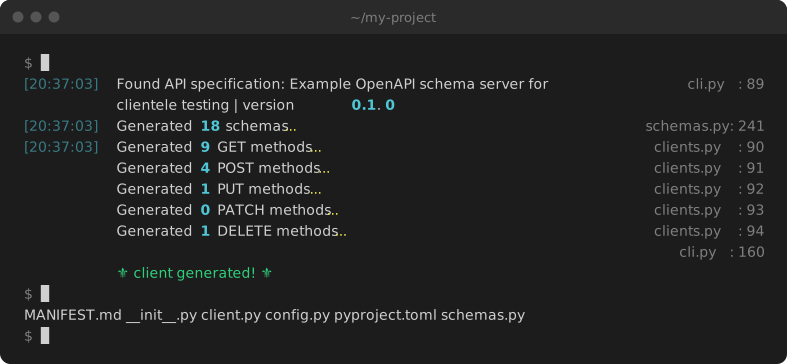
OpenAPI support
Clientele can create scaffolding for an API client from an OpenAPI schema with:
- Pydantic models generated from the schema objects.
- Decorated function signatures generated from schema operations.
- Async support if you want a client with concurrency.
- A tiny output that is only 3 files big.
- Regeneration-friendly - update your API, regenerate, review the git diff, then ship it!
- Formatted code thanks to Ruff.
Getting Started
👉 Read the full documentation for all documentation.
1 maintainer

Metadata
1 maintainer
Release files for clientele 3.0.0
For a detailed explanation of source distributions (sdists) and built distributions (wheels), please see the package formats documentation.
Source distribution (sdist)
| File | Size | Uploaded | Provenance | Actions |
|---|---|---|---|---|
| clientele-3.0.0.tar.gz | 1.4 MB | Without provenance | Details for clientele-3.0.0.tar.gz |
Built distribution (wheel)
| File | Interpreter | ABI | Platform | Actions Reset |
|---|---|---|---|---|
| clientele-3.0.0-py3-none-any.whl | Python 3 | none | any | Details for clientele-3.0.0-py3-none-any.whl |
Total release size: 1.5 MB
Release files / clientele-3.0.0.tar.gz
| Download URL | clientele-3.0.0.tar.gz |
|---|---|
| Size | 1.4 MB |
| Tags | Source |
|
SHA-256 checksum How to use checksums |
472230aa6bd4ec50c3b5d5d2fd3cbdd08acf398cb266ebe5929d36af0a668e33
|
|
BLAKE2b-256 checksum How to use checksums |
3e7ff2625adc834b57785f4653d0ee3cd26b210d1dd804ec549bb3e78b1255a8
|
| Upload date | |
|
Uploaded using Trusted Publishing? What is trusted publishing? |
No |
| Uploaded via |
uv/0.13.7 {"installer":{"name":"uv","version":"0.13.7","subcommand":["publish"]},"python":null,"implementation":{"name":null,"version":null},"distro":{"name":"macOS","version":null,"id":null,"libc":null},"system":{"name":null,"release":null},"cpu":null,"openssl_version":null,"setuptools_version":null,"rustc_version":null,"ci":null}
|
Release files / clientele-3.0.0-py3-none-any.whl
| Download URL | clientele-3.0.0-py3-none-any.whl |
|---|---|
| Size | 82.7 kB |
| Tags | Python 3 |
|
SHA-256 checksum How to use checksums |
c146bf74bf05eae6e0933b909f0e6fb4f3286627eda76f82915c528b9707a103
|
|
BLAKE2b-256 checksum How to use checksums |
a9e8578fa5e6be909b40eb34693f40556ada0ea9d3949684f0cef638837c797c
|
| Upload date | |
|
Uploaded using Trusted Publishing? What is trusted publishing? |
No |
| Uploaded via |
uv/0.13.7 {"installer":{"name":"uv","version":"0.13.7","subcommand":["publish"]},"python":null,"implementation":{"name":null,"version":null},"distro":{"name":"macOS","version":null,"id":null,"libc":null},"system":{"name":null,"release":null},"cpu":null,"openssl_version":null,"setuptools_version":null,"rustc_version":null,"ci":null}
|
Security for clientele 3.0.0
Provenance
Provenance describes where a file came from. On PyPI, provenance is shared via attestations, which provide a verifiable record of the build or publishing details. View details, limitations and caveats.
No provenance found
None of the files in this release were uploaded with provenance metadata.
A note on package security
PyPI is a repository for distributing packages, not a service for auditing them. While third-party security researchers and our staff do their best to detect and remove malicious packages, PyPI cannot guarantee the quality, security or suitability of any given package.
To learn more about protecting yourself from malicious actors, visit our package security documentation.














