


clix
An easy to use clipboard manager made using tkinter.
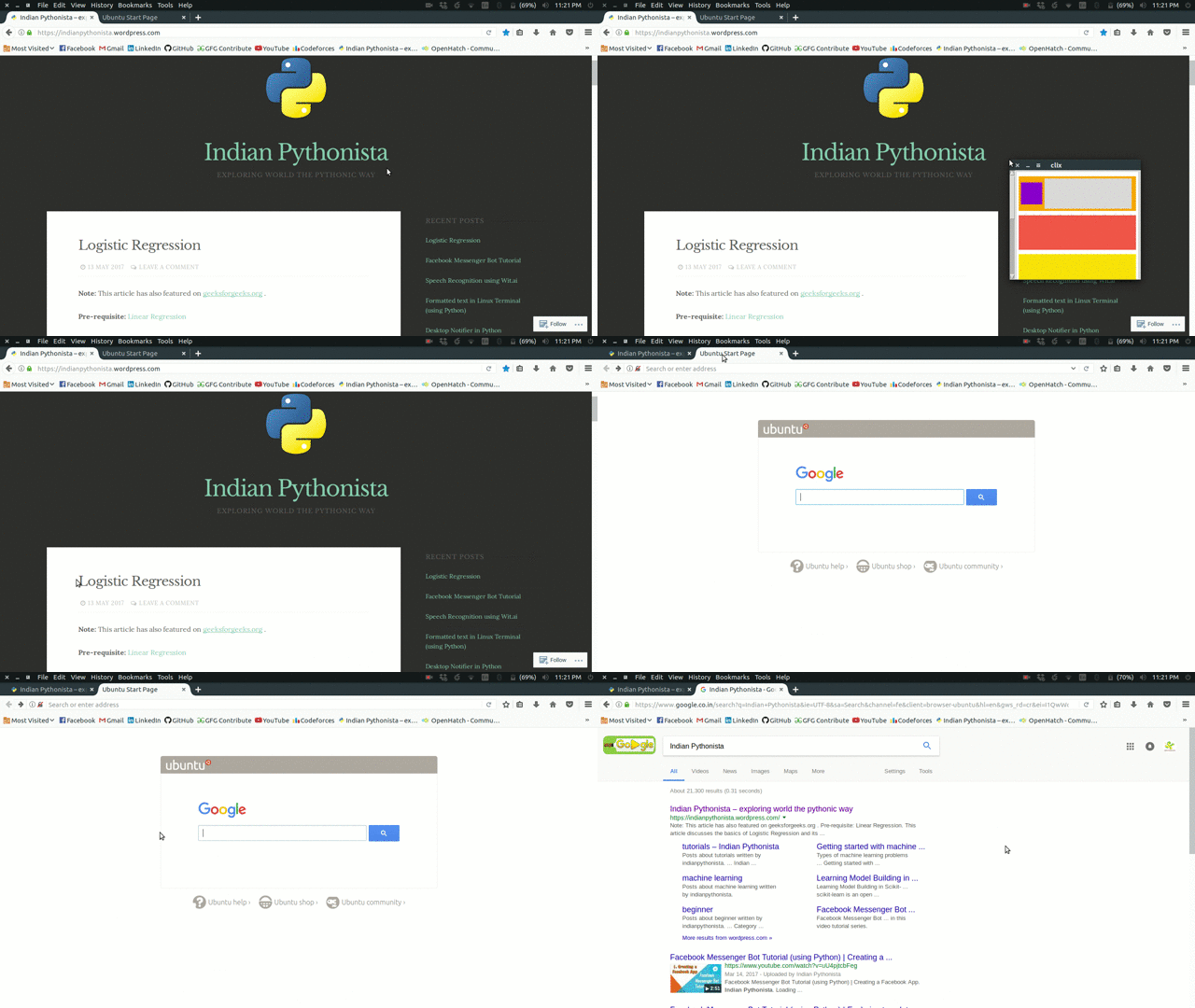
Note: Currently, clix works only on Linux systems.
Installation
To install clix, simply,
$ pip install clix
If you get ImportError for Xlib module, install it using this command:
$ sudo apt-get install python-xlib
Usage
To run clix, open terminal and run this command:
$ clix
if error shown try:
$ sudo clix
Note: Leave this terminal open as long as you want to use clix.
Another alternative is to use this command:
$ nohup clix &
Now, you can close the terminal but clix will keep running.
To close clix, open a terminal and simply run:
$ pkill clix
Press Ctrl + space keys to open clix GUI. Initially, all clip frames are empty.
Now, as you copy any text, (using Ctrl + c keys), the text is saved to topmost frame of clix clipboard.
Whenever you want to paste any clip, just open clix GUI (usin Ctrl + space keys) and click on clip it button to copy clip text to main clipboard.
Now, simply pressing Ctrl + v keys will paste the desired clip text!
CLI usage to configure keys
$ clix [-h] [-s SET_KEYBINDING] [-a] [-c]
You can always use $ clix -h command to open this help message:
optional arguments:
  -h, --help            show this help message and exit
  -s SET_KEYBINDING, --set-keybinding SET_KEYBINDING
                        Set alternate key binding. Default is LCTRL+SPACE
                        Format :- <KEY1>+<KEY2>. Ex:- RCTRL+RALT. To see
                        availble key bindings use 'clix -a' option
  -a, --available-keybindings
                        Show available key bindings
  -c, --show-current-keybinding
TODO
[X] Add support for user configurable keys.
[ ] Add support for Windows and MacOS.
[ ] Create a file system to log the clipboard.
[ ] Improve UI.
[ ] Add more functionalities.
Want to contribute?
Clone the repository
$ git clone http://github.com/nikhilkumarsingh/clix
Install dependencies
$ pip install -r requirements.txt
Remove the . prefix from .pyxhook and .gui for the following imports in clix.py, so it changes from:
from .pyxhook import HookManager
from .gui import clipboard
to:
from pyxhook import HookManager
from gui import clipboard
To test local version of clix:
$ pip install -U .
Finally, do report bugs and help us make clix more and more productive!
1 maintainer

Metadata
1 maintainer
Release files for clix 1.0.8
For a detailed explanation of source distributions (sdists) and built distributions (wheels), please see the package formats documentation.
Source distribution (sdist)
| File | Size | Uploaded | Provenance | Actions |
|---|---|---|---|---|
| clix-1.0.8.tar.gz | 15.2 kB | Without provenance | Details for clix-1.0.8.tar.gz |
Release files / clix-1.0.8.tar.gz
| Download URL | clix-1.0.8.tar.gz |
|---|---|
| Size | 15.2 kB |
| Tags | Source |
|
SHA-256 checksum How to use checksums |
d0b84ba4b053ef6297042231cc419bac87df981bedbed7ac672f164a7663482c
|
|
BLAKE2b-256 checksum How to use checksums |
62245b62c5eae789cef51650401f366ee94724822efd4aada71df29450b0caf2
|
| Upload date | |
|
Uploaded using Trusted Publishing? What is trusted publishing? |
No |
Security for clix 1.0.8
Provenance
Provenance describes where a file came from. On PyPI, provenance is shared via attestations, which provide a verifiable record of the build or publishing details. View details, limitations and caveats.
No provenance found
None of the files in this release were uploaded with provenance metadata.
A note on package security
PyPI is a repository for distributing packages, not a service for auditing them. While third-party security researchers and our staff do their best to detect and remove malicious packages, PyPI cannot guarantee the quality, security or suitability of any given package.
To learn more about protecting yourself from malicious actors, visit our package security documentation.














