
Admin Dashboard App for FastAPI/Flask/Django



Screenshots
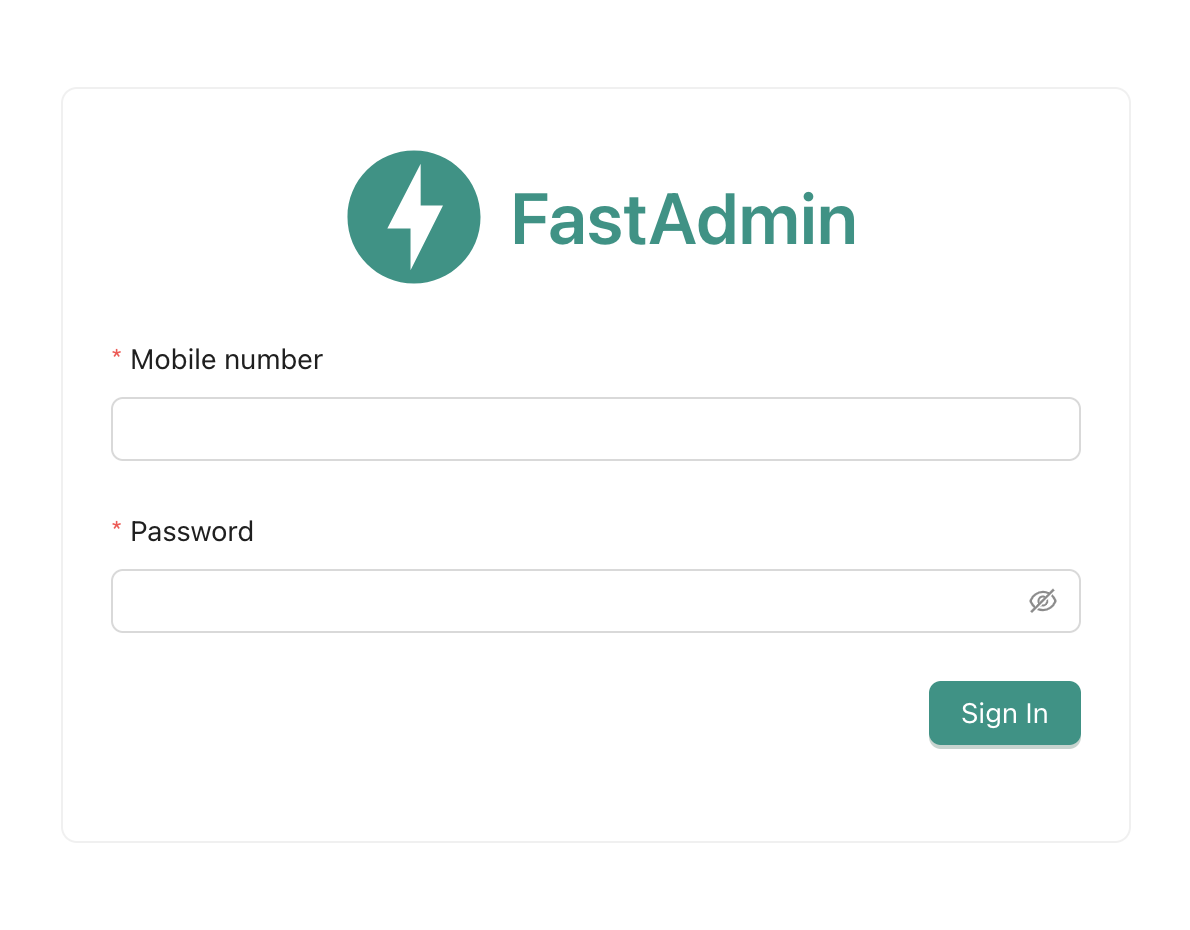
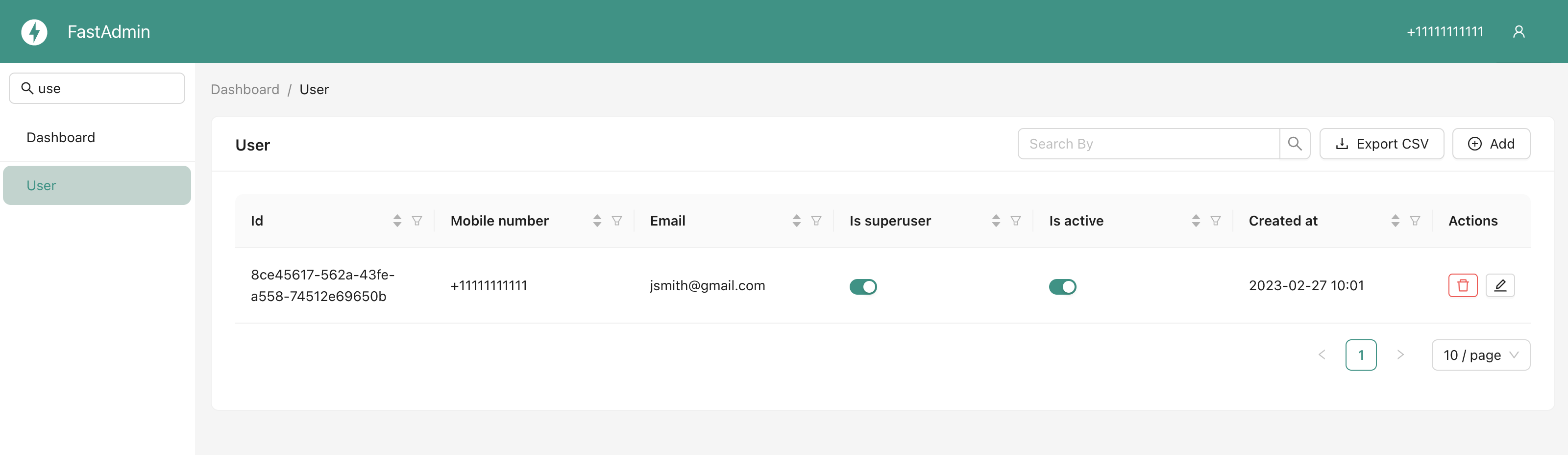
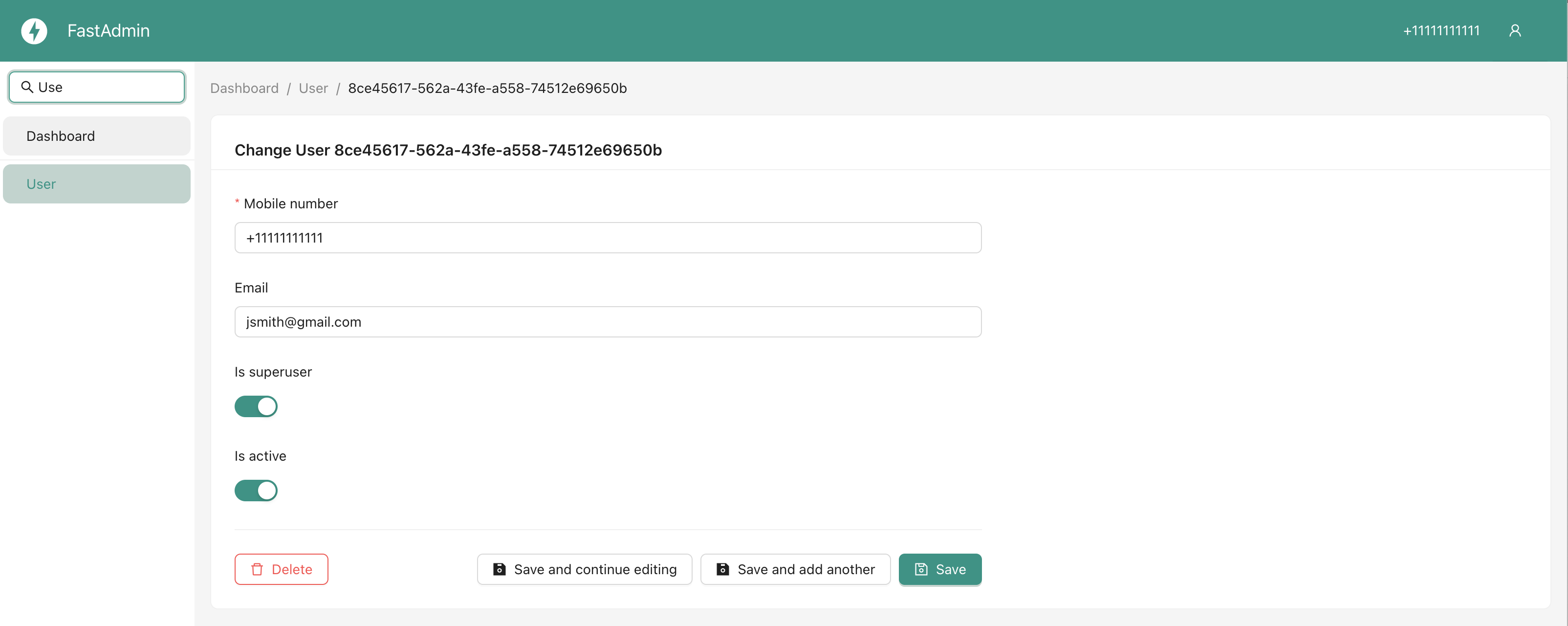

Introduction
FastAdmin is an easy-to-use Admin Dashboard App for FastAPI/Django/Flask inspired by Django Admin.
FastAdmin was built with relations in mind and admiration for the excellent and popular Django Admin. It's engraved in its design that you may configure your admin dashboard for FastAPI/Django/Flask easiest way.
FastAdmin is designed to be minimalistic, functional and yet familiar.
Getting Started
If you have any questions that are beyond the scope of the documentation, Please feel free to email us.
Installation
Follow the steps below to setup FastAdmin:
Install the package using pip:
Note: For zsh and macos use: pip install fastadmin[fastapi,django]
pip install fastadmin[fastapi,django]  # for fastapi with django orm
pip install fastadmin[fastapi,tortoise-orm]  # for fastapi with tortoise orm
pip install fastadmin[fastapi,pony]  # for fastapi with pony orm
pip install fastadmin[fastapi,sqlalchemy]  # for fastapi with sqlalchemy orm
pip install fastadmin[django]  # for django with django orm
pip install fastadmin[django,pony]  # for django with pony orm
pip install fastadmin[flask,sqlalchemy]  # for flask with sqlalchemy
Install the package using poetry:
poetry add 'fastadmin[fastapi,django]'  # for fastapi with django orm
poetry add 'fastadmin[fastapi,tortoise-orm]'  # for fastapi with tortoise orm
poetry add 'fastadmin[fastapi,pony]'  # for fastapi with pony orm
poetry add 'fastadmin[fastapi,sqlalchemy]'  # for fastapi with sqlalchemy orm
poetry add 'fastadmin[django]'  # for django with django orm
poetry add 'fastadmin[django,pony]'  # for django with pony orm
poetry add 'fastadmin[flask,sqlalchemy]'  # for flask with sqlalchemy
Configure required settings using virtual environment variables:
Note: You can add these variables to .env and use python-dotenv to load them. See all settings here
export ADMIN_USER_MODEL=User
export ADMIN_USER_MODEL_USERNAME_FIELD=username
export ADMIN_SECRET_KEY=secret_key
Quick Tutorial
Setup FastAdmin for a framework
FastAPI
from fastapi import FastAPI

from fastadmin import fastapi_app as admin_app

app = FastAPI()

app.mount("/admin", admin_app)
Django
from django.urls import path

from fastadmin import get_django_admin_urls as get_admin_urls
from fastadmin.settings import settings

urlpatterns = [
    path(f"{settings.ADMIN_PREFIX}/", get_admin_urls()),
]
Flask
from flask import Flask

from fastadmin import flask_app as admin_app

app = Flask(__name__)

app.register_blueprint(admin_app, url_prefix="/admin")
Register ORM models
Tortoise ORM
import typing as tp
from uuid import UUID

import bcrypt
from tortoise import fields
from tortoise.models import Model

from fastadmin import TortoiseModelAdmin, WidgetType, register


class User(Model):
    username = fields.CharField(max_length=255, unique=True)
    hash_password = fields.CharField(max_length=255)
    is_superuser = fields.BooleanField(default=False)
    is_active = fields.BooleanField(default=False)
    avatar_url = fields.TextField(null=True)

    def __str__(self):
        return self.username


@register(User)
class UserAdmin(TortoiseModelAdmin):
    exclude = ("hash_password",)
    list_display = ("id", "username", "is_superuser", "is_active")
    list_display_links = ("id", "username")
    list_filter = ("id", "username", "is_superuser", "is_active")
    search_fields = ("username",)
    formfield_overrides = {  # noqa: RUF012
        "username": (WidgetType.SlugInput, {"required": True}),
        "password": (WidgetType.PasswordInput, {"passwordModalForm": True}),
        "avatar_url": (
            WidgetType.Upload,
            {
                "required": False,
                # Disable crop image for upload field
                # "disableCropImage": True,
            },
        ),
    }

    async def authenticate(self, username: str, password: str) -> int | None:
        user = await self.model_cls.filter(phone=username, is_superuser=True).first()
        if not user:
            return None
        if not bcrypt.checkpw(password.encode(), user.hash_password.encode()):
            return None
        return user.id

    async def change_password(self, id: UUID | int, password: str) -> None:
        user = await self.model_cls.filter(id=id).first()
        if not user:
            return
        user.hash_password = bcrypt.hashpw(password.encode(), bcrypt.gensalt()).decode()
        await user.save(update_fields=("hash_password",))

    async def orm_save_upload_field(self, obj: tp.Any, field: str, base64: str) -> None:
        # convert base64 to bytes, upload to s3/filestorage, get url and save or save base64 as is to db (don't recomment it)
        setattr(obj, field, base64)
        await obj.save(update_fields=(field,))
Django ORM
from django.db import models

from fastadmin import DjangoModelAdmin, register


class User(models.Model):
    username = models.CharField(max_length=255, unique=True)
    hash_password = models.CharField(max_length=255)
    is_superuser = models.BooleanField(default=False)
    is_active = models.BooleanField(default=False)

    def __str__(self):
        return self.username


@register(User)
class UserAdmin(DjangoModelAdmin):
    exclude = ("hash_password",)
    list_display = ("id", "username", "is_superuser", "is_active")
    list_display_links = ("id", "username")
    list_filter = ("id", "username", "is_superuser", "is_active")
    search_fields = ("username",)

    def authenticate(self, username, password):
        obj = User.objects.filter(username=username, is_superuser=True).first()
        if not obj:
            return None
        if not obj.check_password(password):
            return None
        return obj.id
SQL Alchemy
import typing as tp
import uuid

import bcrypt
from sqlalchemy import Boolean, Integer, String, Text, select, update
from sqlalchemy.ext.asyncio import async_sessionmaker, create_async_engine
from sqlalchemy.orm import DeclarativeBase, Mapped, mapped_column

from fastadmin import SqlAlchemyModelAdmin, register

sqlalchemy_engine = create_async_engine(
    "sqlite+aiosqlite:///:memory:",
    echo=True,
)
sqlalchemy_sessionmaker = async_sessionmaker(sqlalchemy_engine, expire_on_commit=False)


class Base(DeclarativeBase):
    pass


class User(Base):
    __tablename__ = "user"

    id: Mapped[int] = mapped_column(Integer, primary_key=True, nullable=False)
    username: Mapped[str] = mapped_column(String(length=255), nullable=False)
    hash_password: Mapped[str] = mapped_column(String(length=255), nullable=False)
    is_superuser: Mapped[bool] = mapped_column(Boolean, default=False, nullable=False)
    is_active: Mapped[bool] = mapped_column(Boolean, default=False, nullable=False)
    avatar_url: Mapped[str | None] = mapped_column(Text, nullable=True)

    def __str__(self):
        return self.username


@register(User, sqlalchemy_sessionmaker=sqlalchemy_sessionmaker)
class UserAdmin(SqlAlchemyModelAdmin):
    exclude = ("hash_password",)
    list_display = ("id", "username", "is_superuser", "is_active")
    list_display_links = ("id", "username")
    list_filter = ("id", "username", "is_superuser", "is_active")
    search_fields = ("username",)

    async def authenticate(self, username: str, password: str) -> uuid.UUID | int | None:
        sessionmaker = self.get_sessionmaker()
        async with sessionmaker() as session:
            query = select(self.model_cls).filter_by(username=username, password=password, is_superuser=True)
            result = await session.scalars(query)
            obj = result.first()
            if not obj:
                return None
            if not bcrypt.checkpw(password.encode(), obj.hash_password.encode()):
                return None
            return obj.id

    async def change_password(self, id: uuid.UUID | int, password: str) -> None:
        sessionmaker = self.get_sessionmaker()
        async with sessionmaker() as session:
            hash_password = bcrypt.hashpw(password.encode(), bcrypt.gensalt()).decode()
            query = update(self.model_cls).where(User.id.in_([id])).values(hash_password=hash_password)
            await session.execute(query)
            await session.commit()

    async def orm_save_upload_field(self, obj: tp.Any, field: str, base64: str) -> None:
        sessionmaker = self.get_sessionmaker()
        async with sessionmaker() as session:
            # convert base64 to bytes, upload to s3/filestorage, get url and save or save base64 as is to db (don't recomment it)
            query = update(self.model_cls).where(User.id.in_([obj.id])).values(**{field: base64})
            await session.execute(query)
            await session.commit()
Pony ORM
import typing as tp
import uuid

import bcrypt
from pony.orm import Database, LongStr, Optional, PrimaryKey, Required, commit, db_session

from fastadmin import PonyORMModelAdmin, register

db = Database()
db.bind(provider="sqlite", filename=":memory:", create_db=True)


class User(db.Entity):  # type: ignore [name-defined]
    _table_ = "user"
    id = PrimaryKey(int, auto=True)
    username = Required(str)
    hash_password = Required(str)
    is_superuser = Required(bool, default=False)
    is_active = Required(bool, default=False)
    avatar_url = Optional(LongStr, nullable=True)

    def __str__(self):
        return self.username


@register(User)
class UserAdmin(PonyORMModelAdmin):
    exclude = ("hash_password",)
    list_display = ("id", "username", "is_superuser", "is_active")
    list_display_links = ("id", "username")
    list_filter = ("id", "username", "is_superuser", "is_active")
    search_fields = ("username",)

    @db_session
    def authenticate(self, username: str, password: str) -> uuid.UUID | int | None:
        obj = next((f for f in User.select(username=username, password=password, is_superuser=True)), None)  # fmt: skip
        if not obj:
            return None
        if not bcrypt.checkpw(password.encode(), obj.hash_password.encode()):
            return None
        return obj.id

    @db_session
    def change_password(self, id: uuid.UUID | int, password: str) -> None:
        obj = next((f for f in self.model_cls.select(id=id)), None)
        if not obj:
            return
        hash_password = bcrypt.hashpw(password.encode(), bcrypt.gensalt()).decode()
        obj.hash_password = hash_password
        commit()

    @db_session
    def orm_save_upload_field(self, obj: tp.Any, field: str, base64: str) -> None:
        obj = next((f for f in self.model_cls.select(id=obj.id)), None)
        if not obj:
            return
        # convert base64 to bytes, upload to s3/filestorage, get url and save or save base64 as is to db (don't recomment it)
        setattr(obj, field, base64)
        commit()
Documentation
See full documentation here.
License
This project is licensed under the MIT License - see the LICENSE file for details.
1 maintainer

Metadata
1 maintainer
Release files for cloudintel-fastadmin 0.23.2.1
For a detailed explanation of source distributions (sdists) and built distributions (wheels), please see the package formats documentation.
Source distribution (sdist)
| File | Size | Uploaded | |
|---|---|---|---|
| cloudintel_fastadmin-0.23.2.1.tar.gz | 1.2 MB | Details |
Built distribution (wheel)
| File | Interpreter | ABI | Platform | Reset |
|---|---|---|---|---|
| cloudintel_fastadmin-0.23.2.1-py3-none-any.whl | Python 3 | none | any | Details |
Total release size: 2.3 MB
Release files / cloudintel_fastadmin-0.23.2.1.tar.gz
| Download URL | cloudintel_fastadmin-0.23.2.1.tar.gz |
|---|---|
| Size | 1.2 MB |
| Tags | Source |
|
SHA-256 checksum How to use checksums |
a3cc60d2fd73a3341fffaffcbe815bbc0a48cab9ed55c2c9e6f6051a7ff3bd75
|
|
BLAKE2b-256 checksum How to use checksums |
cd50b6d181eff43cb93cf45fe53dfeecc682273e75ac06ddc9fce0bd93d4ecb0
|
| Upload date | |
|
Uploaded using Trusted Publishing? What is trusted publishing? |
No |
| Uploaded via |
twine/6.2.0 CPython/3.10.15
|
Release files / cloudintel_fastadmin-0.23.2.1-py3-none-any.whl
| Download URL | cloudintel_fastadmin-0.23.2.1-py3-none-any.whl |
|---|---|
| Size | 1.2 MB |
| Tags | Python 3 |
|
SHA-256 checksum How to use checksums |
0429c8ec6b7f98a2b667d1e84d32108067b8469ea20404eacf64761dde168323
|
|
BLAKE2b-256 checksum How to use checksums |
dd8e9380e726c9978f9dcfc13013593f426586c3950ef0667153f1571e9eab7d
|
| Upload date | |
|
Uploaded using Trusted Publishing? What is trusted publishing? |
No |
| Uploaded via |
twine/6.2.0 CPython/3.10.15
|














