
Python SDK for CMDOP agent interaction

Project description
CMDOP
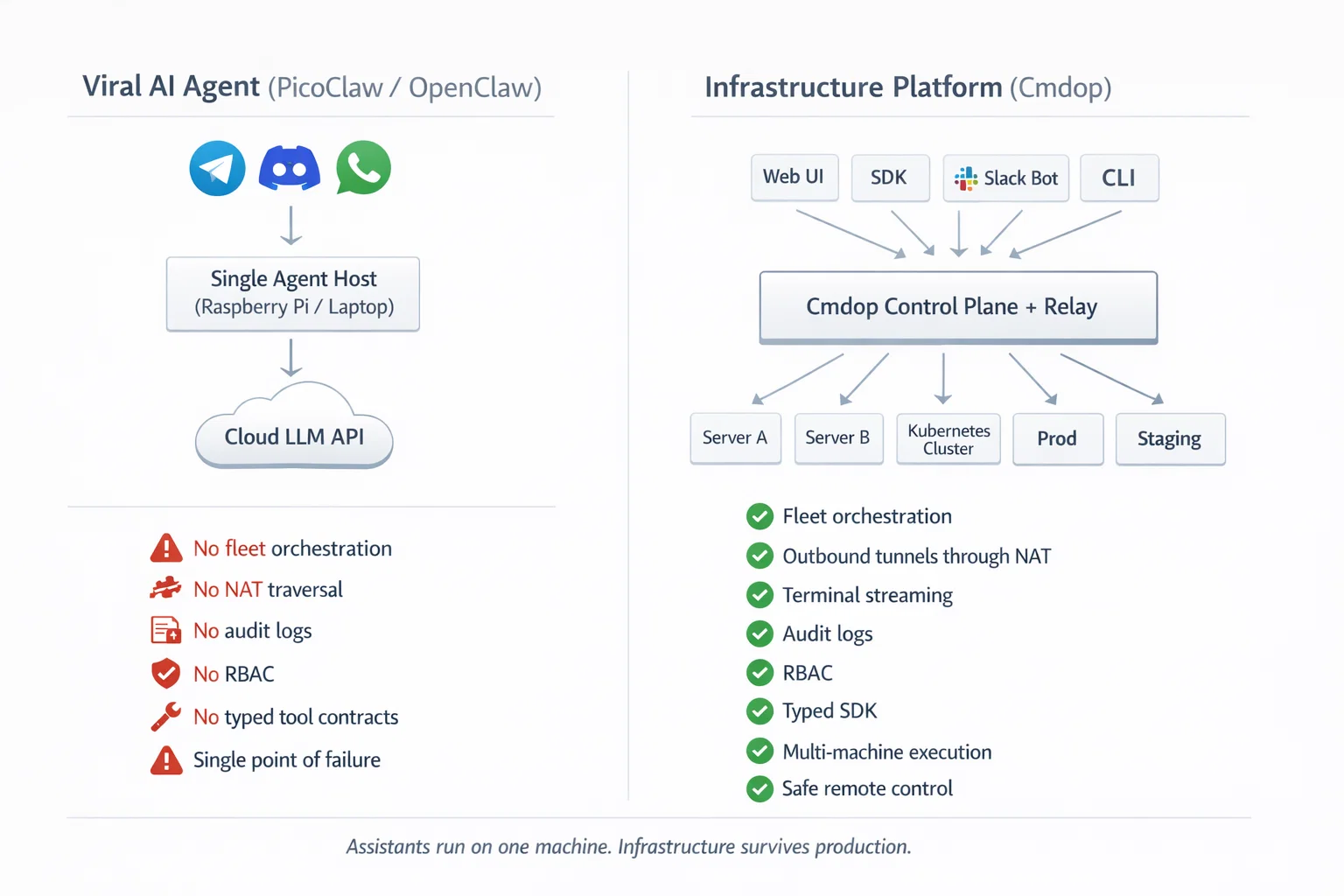
Your OS. Online.
Full access to your machines from anywhere. Not files — the whole system.
Your Code ──── Cloud Relay ──── Agent (on server)
                   │
       Outbound only, works through any NAT/firewall
Why CMDOP?
| Problem | CMDOP Solution |
|---|---|
| VPN requires client install | SDK works without VPN |
| SSH needs port forwarding | Agent uses outbound connection |
| Screen sharing is laggy | gRPC streaming, real-time |
| File sync is just files | Full OS access: terminal + files + browser |
| AI returns text | Structured output with Pydantic |
| No reusable workflows | Skills: predefined AI tasks with tools |
Install
pip install cmdop
Quick Start
from cmdop import AsyncCMDOPClient

async with AsyncCMDOPClient.remote(api_key="cmdop_xxx") as client:
    # Terminal
    await client.terminal.set_machine("my-server")
    output, code = await client.terminal.execute("uname -a")

    # Files
    content = await client.files.read("/etc/hostname")
    await client.files.write("/tmp/config.json", b'{"key": "value"}')

    # AI Agent with typed output
    from pydantic import BaseModel

    class Health(BaseModel):
        cpu: float
        memory: float
        issues: list[str]

    await client.agent.set_machine("my-server")
    result = await client.agent.run("Check server health", output_model=Health)
    health: Health = result.data  # Typed!

    # Skills — run predefined AI workflows
    await client.skills.set_machine("my-server")
    skills = await client.skills.list()
    result = await client.skills.run("code-review", "Review the auth module")

    # Browser automation on remote machine
    with client.browser.create_session() as b:
        b.navigate("https://internal-app.local")
        b.click("button.submit")
Connection
from cmdop import CMDOPClient, AsyncCMDOPClient

# Remote (via cloud relay) - works through any NAT
client = CMDOPClient.remote(api_key="cmdop_xxx")

# Local (direct IPC to running agent)
client = CMDOPClient.local()

# Async
async with AsyncCMDOPClient.remote(api_key="cmdop_xxx") as client:
    ...
Terminal
Execute commands, stream output, SSH into machines.
async with AsyncCMDOPClient.remote(api_key="cmdop_xxx") as client:
    # Set target machine once
    await client.terminal.set_machine("my-server")

    # Execute and get output
    output, code = await client.terminal.execute("ls -la")
    print(output.decode())

    # Interactive operations
    await client.terminal.send_input("echo hello\n")
    await client.terminal.resize(120, 40)
    await client.terminal.send_signal(SignalType.SIGINT)
SSH-like interactive session:
# CLI
cmdop ssh my-server

# Python
from cmdop.services.terminal.tui.ssh import ssh_connect
asyncio.run(ssh_connect('my-server', 'cmd_xxx'))
Real-time streaming:
stream = client.terminal.stream()
stream.on_output(lambda data: print(data.decode(), end=""))
await stream.attach(session.session_id)
await stream.send_input(b"tail -f /var/log/app.log\n")
Session discovery:
# List all machines
response = await client.terminal.list_sessions()
for s in response.sessions:
    print(f"{s.machine_hostname}: {s.status}")

# Get specific machine
session = await client.terminal.get_active_session("prod-server")
Files
Read, write, list files on remote machines. No scp/sftp needed.
# Set target machine once
await client.files.set_machine("my-server")

# File operations
files = await client.files.list("/var/log", include_hidden=True)
content = await client.files.read("/etc/nginx/nginx.conf")
await client.files.write("/tmp/config.json", b'{"key": "value"}')

# More operations
await client.files.copy("/src", "/dst")
await client.files.move("/old", "/new")
await client.files.mkdir("/new/dir")
await client.files.delete("/tmp/old", recursive=True)
info = await client.files.info("/path/file.txt")
AI Agent
Run AI tasks with structured, typed output.
from pydantic import BaseModel, Field

class ServerHealth(BaseModel):
    hostname: str
    cpu_percent: float = Field(description="CPU usage percentage")
    memory_percent: float
    disk_free_gb: float
    issues: list[str] = Field(description="List of detected issues")

await client.agent.set_machine("my-server")
result = await client.agent.run(
    prompt="Check server health and report any issues",
    output_model=ServerHealth,
)

# Typed response - not just text!
health: ServerHealth = result.data
if health.cpu_percent > 90:
    alert(f"{health.hostname} CPU critical!")
Skills
Run predefined AI workflows on remote machines. Skills are reusable prompt templates with tool access.
await client.skills.set_machine("my-server")

# List available skills
skills = await client.skills.list()
for skill in skills:
    print(f"{skill.name}: {skill.description} ({skill.origin})")

# Inspect a skill
detail = await client.skills.show("code-review")
if detail.found:
    print(detail.content)   # System prompt markdown
    print(detail.source)    # File path on machine

# Run a skill
result = await client.skills.run("code-review", "Review the auth module")
print(result.text)
print(f"Took {result.duration_seconds}s, {result.usage.total_tokens} tokens")
Structured output:
from pydantic import BaseModel

class Review(BaseModel):
    score: int
    summary: str
    issues: list[str]

result = await client.skills.run(
    "code-review",
    "Review the auth module",
    output_model=Review,
)
review: Review = result.data
print(f"Score: {review.score}/10")
Custom options:
from cmdop import SkillRunOptions

result = await client.skills.run(
    "summarize",
    "Summarize the project README",
    options=SkillRunOptions(model="openai/gpt-4o", timeout_seconds=120),
)
Browser
Automate browsers on remote machines. Bypass CORS, inherit cookies.
from cmdop.services.browser.models import WaitUntil

with client.browser.create_session(headless=False) as s:
    s.navigate("https://shop.com", wait_until=WaitUntil.NETWORKIDLE)

    # Interact
    s.click("button.buy", move_cursor=True)
    s.type("input[name=q]", "search term")
    s.wait_for(".results")

    # Extract
    title = s.execute_script("return document.title")
    screenshot = s.screenshot()
    cookies = s.get_cookies()
create_session parameters:
| Parameter | Default | Description |
|---|---|---|
headless |
False |
Run browser without UI |
provider |
"camoufox" |
Browser provider |
profile_id |
None |
Profile for session persistence |
block_images |
False |
Disable loading images |
block_media |
False |
Disable loading audio/video |
Browser Capabilities
Scrolling:
s.scroll.js("down", 500)           # JS scroll
s.scroll.to_bottom()               # Page bottom
s.scroll.to_element(".item")       # Scroll into view
s.scroll.infinite(extract_fn, limit=100)  # Infinite scroll with extraction
Input:
s.input.click_js(".btn")           # JS click (reliable)
s.input.click_all("See more")      # Click all matching
s.input.key("Escape")              # Press key
s.input.hover(".tooltip")          # Hover
s.input.mouse_move(500, 300)       # Move cursor
DOM:
s.dom.html(".container")           # Get HTML
s.dom.text(".title")               # Get text
s.dom.extract(".items", "href")    # Get attribute list
s.dom.select("#country", "US")     # Dropdown select
s.dom.close_modal()                # Close dialogs
Fetch (bypass CORS):
data = s.fetch.json("/api/items")         # Fetch JSON
results = s.fetch.all(["/api/a", "/api/b"])  # Parallel
Network capture:
s.network.enable(max_exchanges=1000)
s.navigate(url)

api = s.network.last("/api/data")
data = api.json_body()

posts = s.network.filter(
    url_pattern="/api/posts",
    methods=["GET", "POST"],
    status_codes=[200],
)

s.network.export_har()  # Export to HAR
NetworkAnalyzer
Discover API endpoints by capturing traffic.
from cmdop.helpers import NetworkAnalyzer

with client.browser.create_session(headless=False) as b:
    analyzer = NetworkAnalyzer(b)

    snapshot = analyzer.capture(
        "https://example.com/products",
        wait_seconds=30,
        countdown_message="Click pagination!",
    )

    if snapshot.api_requests:
        best = snapshot.best_api()
        print(best.url)
        print(best.item_count)
        print(best.to_curl())      # curl command
        print(best.to_httpx())     # Python code
Download
Download files from URLs via remote server.
from pathlib import Path

async with AsyncCMDOPClient.remote(api_key="cmdop_xxx") as client:
    # Set target machine
    await client.download.set_machine("my-server")
    client.download.configure(api_key="cmdop_xxx")

    result = await client.download.url(
        url="https://example.com/large-file.zip",
        local_path=Path("./large-file.zip"),
    )

    if result.success:
        print(result)  # DownloadResult(ok, 139.2MB, 245.3s, 0.6MB/s)
Handles cloud relay limits automatically:
- Small files (≤10MB): Direct chunked transfer
- Large files (>10MB): Split on remote, download parts
SDKBaseModel
Auto-cleaning Pydantic model for scraped data.
from cmdop import SDKBaseModel

class Product(SDKBaseModel):
    __base_url__ = "https://shop.com"
    name: str = ""    # "  iPhone 15  \n" → "iPhone 15"
    price: int = 0    # "$1,299.00" → 1299
    rating: float = 0 # "4.5 stars" → 4.5
    url: str = ""     # "/p/123" → "https://shop.com/p/123"

products = Product.from_list(raw["items"])  # Auto dedupe + filter
Architecture
┌─────────────┐    gRPC/HTTP2    ┌─────────────┐    gRPC    ┌─────────┐
│   Python    │◀────────────────▶│   Cloud     │◀──────────▶│  Agent  │
│     SDK     │   Bidirectional  │   Relay     │  Outbound  │  (Go)   │
└─────────────┘                  └─────────────┘            └─────────┘
Key points:
- Agent makes outbound connection (no port forwarding)
- SDK connects via gRPC (works through any firewall)
- All services multiplexed over single connection
Comparison
| Feature | CMDOP | Tailscale | ngrok | SSH |
|---|---|---|---|---|
| Terminal streaming | gRPC | VPN + SSH | No | Yes |
| File operations | Built-in | SFTP | No | SCP |
| Browser automation | Built-in | No | No | No |
| AI agent | Built-in | No | No | No |
| Reusable AI skills | Built-in | No | No | No |
| NAT traversal | Outbound | WireGuard | Outbound | Port forward |
| Client install | None | VPN client | None | SSH client |
| Structured output | Pydantic | No | No | No |
Requirements
- Python 3.10+
- CMDOP agent running locally or API key for remote access
Links
Release history Release notifications | RSS feed


Download files
Download the file for your platform. If you're not sure which to choose, learn more about installing packages.
Source Distribution
Built Distribution
Filter files by name, interpreter, ABI, and platform.
If you're not sure about the file name format, learn more about wheel file names.
Copy a direct link to the current filters
File details
Details for the file cmdop-2026.3.3.1.tar.gz.
File metadata
- Download URL: cmdop-2026.3.3.1.tar.gz
- Upload date:
- Size: 250.8 kB
- Tags: Source
- Uploaded using Trusted Publishing? No
- Uploaded via: twine/6.2.0 CPython/3.10.18
File hashes
| Algorithm | Hash digest | |
|---|---|---|
| SHA256 |
4b26e245b2fef60d87cfa2544337edba8329f6c52c84508a5dde9266cb0aca07
|
|
| MD5 |
976e0f85edcecc028f378e2ed7412956
|
|
| BLAKE2b-256 |
8e48292c78d87288778373ddf20606c4bb0cd601471cb6f8d0e03d01c9c83f76
|
File details
Details for the file cmdop-2026.3.3.1-py3-none-any.whl.
File metadata
- Download URL: cmdop-2026.3.3.1-py3-none-any.whl
- Upload date:
- Size: 399.4 kB
- Tags: Python 3
- Uploaded using Trusted Publishing? No
- Uploaded via: twine/6.2.0 CPython/3.10.18
File hashes
| Algorithm | Hash digest | |
|---|---|---|
| SHA256 |
255f0a56914d56dac670e6cac5648c371c7b7309d246bc4de6363127a1e9544e
|
|
| MD5 |
21de1e340278556b27baa95e5716006a
|
|
| BLAKE2b-256 |
6ad80c1d7cef976f0243b4c4ebaebd1d1e2d8ddd9d00e1540351bae14586f7a5
|






