
CMNE
Contextual Minimum-Norm Estimates for MEG and EEG
An LSTM learns how brain activity evolves over time and uses that context to sharpen standard source estimates such as dSPM.






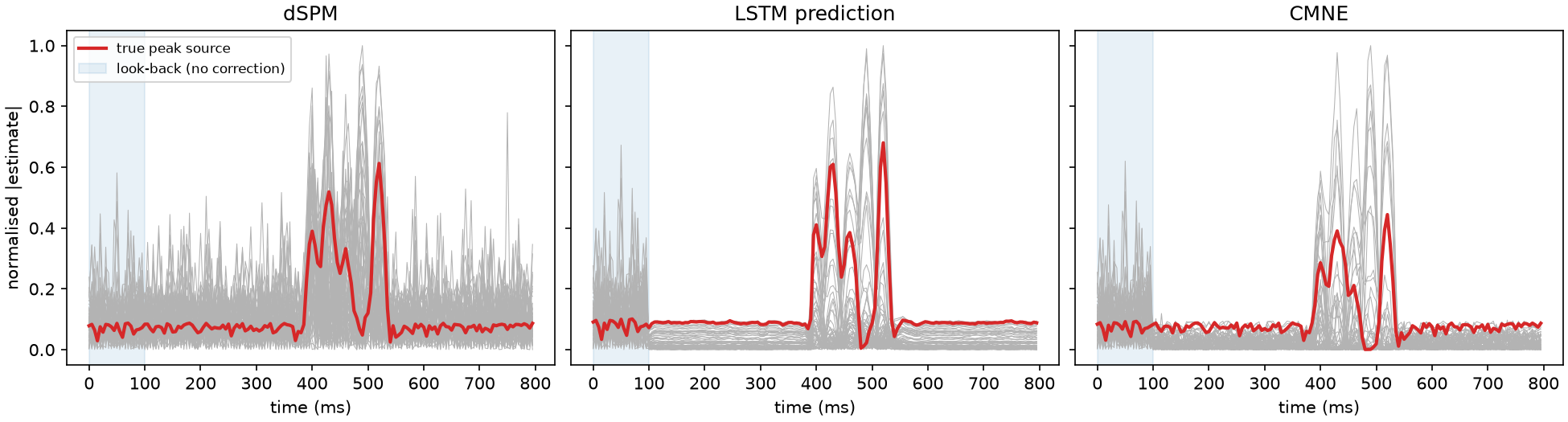
Simulated burst travelling across five sources (red: true peak source). CMNE suppresses background activity that dSPM leaves in. Generated by examples/quickstart_simulation.py.
Contents
- How it works
- Installation
- Quick start
- Reproducing the paper
- Running on modest hardware
- API overview
- Changes from the original code
- Citation
How it works
Methods such as MNE, dSPM and sLORETA estimate every time sample on its own. Brain activity, however, unfolds over time: what happens now depends on what happened just before. CMNE uses this context in three steps.
- Estimate. Compute a standard source estimate $\hat q_t$ (dSPM), rectify it and z-score each source.
- Predict. Give the last $k$ CMNE estimates $b_{t-k}, \dots, b_{t-1}$ to an LSTM network, which predicts the next estimate.
- Correct. Use the prediction, scaled to a maximum of one, as a per-source weight on the current estimate:
$$ b_t = w_t \odot \hat q_t, \qquad w_t = \frac{\left| \mathrm{LSTM}(b_{t-k}, \dots, b_{t-1}) \right|}{\max \left| \mathrm{LSTM}(b_{t-k}, \dots, b_{t-1}) \right|} $$
For the first $k$ samples there is no history yet, so $b_t = \hat q_t$. Each new $b_t$ is fed back into the LSTM, so the estimate is refined recursively.
In the paper, CMNE gave higher source-space SNR, lower spatial dispersion and smaller localisation errors than dSPM, both on simulated epileptiform spikes and on recorded auditory steady-state responses (ASSR).
Features
| Hardware | CPU, NVIDIA CUDA or Apple Silicon (MPS), chosen automatically; bfloat16 on CUDA |
| Memory | Training windows are generated on the fly, so memory grows with the sensor data rather than the source space |
| Speed | The inverse operator is folded into a single matrix; many trials run as one batch |
| Deployment | Export to ONNX and run with ONNX Runtime, without PyTorch |
| MNE-Python | Works directly with Epochs, SourceEstimate and inverse operators |
| Fidelity | Implements Eqs. 9–13, the control estimate and the metrics of Eqs. 22–26, tested against literal reference implementations |
Installation
pip install cmne            # PyTorch + MNE-Python
pip install "cmne[onnx]"    # adds ONNX export and ONNX Runtime
pip install "cmne[viz]"     # adds matplotlib for the examples
For GPU training, install the matching PyTorch build first; CMNE picks it up automatically.
Development install
git clone https://github.com/chdinh/cmne && cd cmne
python -m venv .venv && source .venv/bin/activate
pip install -e ".[dev]"
pytest
Quick start
Try it in seconds
cmne demo
This trains a small model on simulated EEG on the CPU and compares it with dSPM at the peak of the activity:
dSPM  peak error  46.2 mm   spatial dispersion  58.4 mm
CMNE  peak error   0.0 mm   spatial dispersion  40.0 mm
Python
import cmne
from mne.minimum_norm import apply_inverse

# epochs: mne.Epochs, inv: mne.minimum_norm.InverseOperator
kernel = cmne.inverse_kernel(epochs.info, inv, lambda2=1 / 9, method="dSPM")

# Train on single-trial dSPM estimates (paper settings: k = 80, d = 1280)
model = cmne.fit(
    epochs[train], kernel, look_back=80, num_units=1280, n_steps=250, validation=epochs[test]
)
model.save("cmne.pt")

# Apply to an averaged response
stc = apply_inverse(epochs[test].average(), inv, 1 / 9, "dSPM", pick_ori="normal")
result = cmne.apply_cmne(stc, model)
result.cmne.plot(subject="sample", subjects_dir=subjects_dir)
apply_cmne returns three estimates:
| Field | Content |
|---|---|
result.sensing |
rectified, z-scored input estimate $\hat q_t$ |
result.prediction |
raw LSTM prediction |
result.cmne |
contextual estimate $b_t$ |
They are SourceEstimate objects if the input was one, NumPy arrays otherwise. To process many signals at once, pass an array of shape (n_signals, n_sources, n_times).
ONNX Runtime
cmne.export_onnx(model, "cmne.onnx")
predictor = cmne.OnnxPredictor("cmne.onnx")  # PyTorch not required
result = cmne.apply_cmne(stc, predictor)
Command line
cmne train  --raw sub01_raw.fif --inv sub01-inv.fif --events sub01-eve.fif -o cmne.pt
cmne export cmne.pt -o cmne.onnx
cmne apply  --raw sub01_raw.fif --inv sub01-inv.fif --events sub01-eve.fif \
            --model cmne.onnx --n-average 20 -o results/
cmne <command> --help lists all options, including epoch window, rejection thresholds, MEG-only, look-back and number of units.
Reproducing the paper
The ASSR data set used in the paper (MEG + EEG, ~4.3 GB) is available on OSF. The script downloads it on first use:
python examples/assr_paper.py --data ~/cmne_data              # paper settings
python examples/assr_paper.py --data ~/cmne_data --units 256   # faster, for laptops
| Setting | Value (paper and default) |
|---|---|
| Inverse | dSPM, SNR 3, loose orientation 0.2, normal component |
| Normalisation | rectified, z-scored per source (Eq. 9) |
| Look-back $k$, units $d$ | 80, 1280 |
| Training | 250 minibatches of 30 epochs × 20 windows |
| Split | 85 % training, 15 % test (indices shipped with the data) |
| Evaluation | average of 20 held-out epochs |
Running on modest hardware
Most parameters sit in the LSTM input layer, which grows with the number of units $d$ times the number of sources. For 5,124 sources:
num_units |
Parameters | Size (fp32) | Suitable for |
|---|---|---|---|
| 128 | 3.4 M | 13 MB | any laptop |
| 256 | 6.8 M | 27 MB | laptop CPU, Apple Silicon |
| 640 | 18.0 M | 72 MB | entry-level GPU, M-series Mac |
| 1280 (paper) | 39.4 M | 157 MB | GPU with ≥ 6 GB |
If memory is still tight, lower epochs_per_batch and windows_per_epoch (default 30 × 20 = 600 windows per step).
Inference speed at paper scale on an Apple M-series CPU (python benchmarks/bench_inference.py):
| Backend | 1 signal | 20 signals, batched |
|---|---|---|
| PyTorch | 43 ms per step | 7.6 ms per step and signal |
| ONNX Runtime | 41 ms per step | 18.9 ms per step and signal |
API overview
| Function / class | Purpose |
|---|---|
inverse_kernel |
Inverse operator as one (n_sources, n_channels) matrix |
fit → CMNEModel |
Train the LSTM |
CMNEModel.save / load / predict |
Store, load and run a model |
apply_cmne → CMNEResult |
Contextual estimate (Eqs. 10–13) |
control_estimate |
The paper's control estimate without LSTM |
export_onnx, OnnxPredictor |
ONNX export and inference |
peak_localization_error, spatial_dispersion, source_snr |
Metrics (Eqs. 22–26) |
simulate_data, fetch_assr |
Simulated data and the ASSR data set |
Changes from the original code
Version 0.2 is a rewrite of the 2017–2022 research code, which is kept in archive/. Besides moving from TensorFlow/Keras to PyTorch, it fixes:
- Normalisation mismatch. The network was trained on signed z-scored dSPM but applied to rectified, max-normalised dSPM. Both now use Eq. 9.
- Weighting. The estimate was multiplied by the raw, possibly negative prediction instead of the normalised weight of Eq. 11. The old behaviour remains available with
normalize_weights=False. - Windowing. One valid training window per epoch was dropped.
- Crashes.
train()used undefined variables and returned nothing;Dataindexed a method and compared arrays with== None;Settingsfailed if the results folder did not exist. - Hard-coded sizes. The evaluation assumed 5,124 sources and $k$ = 80; both now come from the model.
- Robustness. Division by zero for constant sources; the data download relied on shell
mv/rm.
Citation
If CMNE is useful for your work, please cite:
Dinh C, Samuelsson JG, Hunold A, Hämäläinen MS, Khan S. Contextual MEG and EEG Source Estimates Using Spatiotemporal LSTM Networks. Frontiers in Neuroscience 15:552666 (2021). doi:10.3389/fnins.2021.552666
@article{dinh2021cmne,
  title   = {Contextual {MEG} and {EEG} Source Estimates Using Spatiotemporal {LSTM} Networks},
  author  = {Dinh, Christoph and Samuelsson, John G. and Hunold, Alexander and
             H{\"a}m{\"a}l{\"a}inen, Matti S. and Khan, Sheraz},
  journal = {Frontiers in Neuroscience},
  volume  = {15},
  pages   = {552666},
  year    = {2021},
  doi     = {10.3389/fnins.2021.552666}
}
An earlier version is available as a preprint: arXiv:1909.02636.
License
MIT © 2017–2026 the CMNE authors.
1 maintainer

Metadata
1 maintainer
Release files for cmne 0.2.1
For a detailed explanation of source distributions (sdists) and built distributions (wheels), please see the package formats documentation.
Source distribution (sdist)
| File | Size | Uploaded | |
|---|---|---|---|
| cmne-0.2.1.tar.gz | 28.8 kB | Details |
Built distribution (wheel)
| File | Interpreter | ABI | Platform | Reset |
|---|---|---|---|---|
| cmne-0.2.1-py3-none-any.whl | Python 3 | none | any | Details |
Total release size: 51.9 kB
Release files / cmne-0.2.1.tar.gz
| Download URL | cmne-0.2.1.tar.gz |
|---|---|
| Size | 28.8 kB |
| Tags | Source |
|
SHA-256 checksum How to use checksums |
05be219477d276219d24e8e4c0033f0b54a16970672d41fb1cb7ed87a720080c
|
|
BLAKE2b-256 checksum How to use checksums |
f88cc90d97dc1c817a2525fc41b5ff93aff43f1670b05681a4fa89566c9c16b3
|
| Upload date | |
|
Uploaded using Trusted Publishing? What is trusted publishing? |
Yes |
| Uploaded via |
twine/7.0.0 CPython/3.13.14
|
Provenance
Provenance describes where a file came from. On PyPI, provenance is shared via attestations, which provide a verifiable record of the build or publishing details. View details, limitations and caveats.


PyPI Publish Attestation
PyPI verified that this artifact, at this checksum, originated from the publisher listed below.
Signed by GitHub Actions, verified by PyPI on Oct 4, 2026.
Transparency logRelease files / cmne-0.2.1-py3-none-any.whl
| Download URL | cmne-0.2.1-py3-none-any.whl |
|---|---|
| Size | 23.2 kB |
| Tags | Python 3 |
|
SHA-256 checksum How to use checksums |
09fa65f65c09c7b51f90cc72002d88b0616c599017ffc07c4048e65196d83904
|
|
BLAKE2b-256 checksum How to use checksums |
ad8b77eef6fad6d3e24d06e085d20174ada37e4e69b63359684552bd52ac28af
|
| Upload date | |
|
Uploaded using Trusted Publishing? What is trusted publishing? |
Yes |
| Uploaded via |
twine/7.0.0 CPython/3.13.14
|
Provenance
Provenance describes where a file came from. On PyPI, provenance is shared via attestations, which provide a verifiable record of the build or publishing details. View details, limitations and caveats.
PyPI Publish Attestation
PyPI verified that this artifact, at this checksum, originated from the publisher listed below.
Signed by GitHub Actions, verified by PyPI on Oct 4, 2026.
Transparency log













