
cnnsim: Chua–Yang cellular neural networks in PyTorch


cnnsim simulates and trains cellular neural networks (CNNs) as introduced by Chua and Yang
(1988) — not to be confused with convolutional neural networks. A cellular neural network is a
grid of cells, each with a continuous state that follows an ordinary differential equation. Every
cell is coupled to its neighbourhood through two small templates: the feedback template A
acts on the outputs of the neighbouring cells, the control template B on a static input
image u, and a bias z shifts the operating point:
dx/dt = -x + A ⊛ y + B ⊛ u + z, y = f(x) (default f = clip(x, -1, 1); black = +1, white = -1)
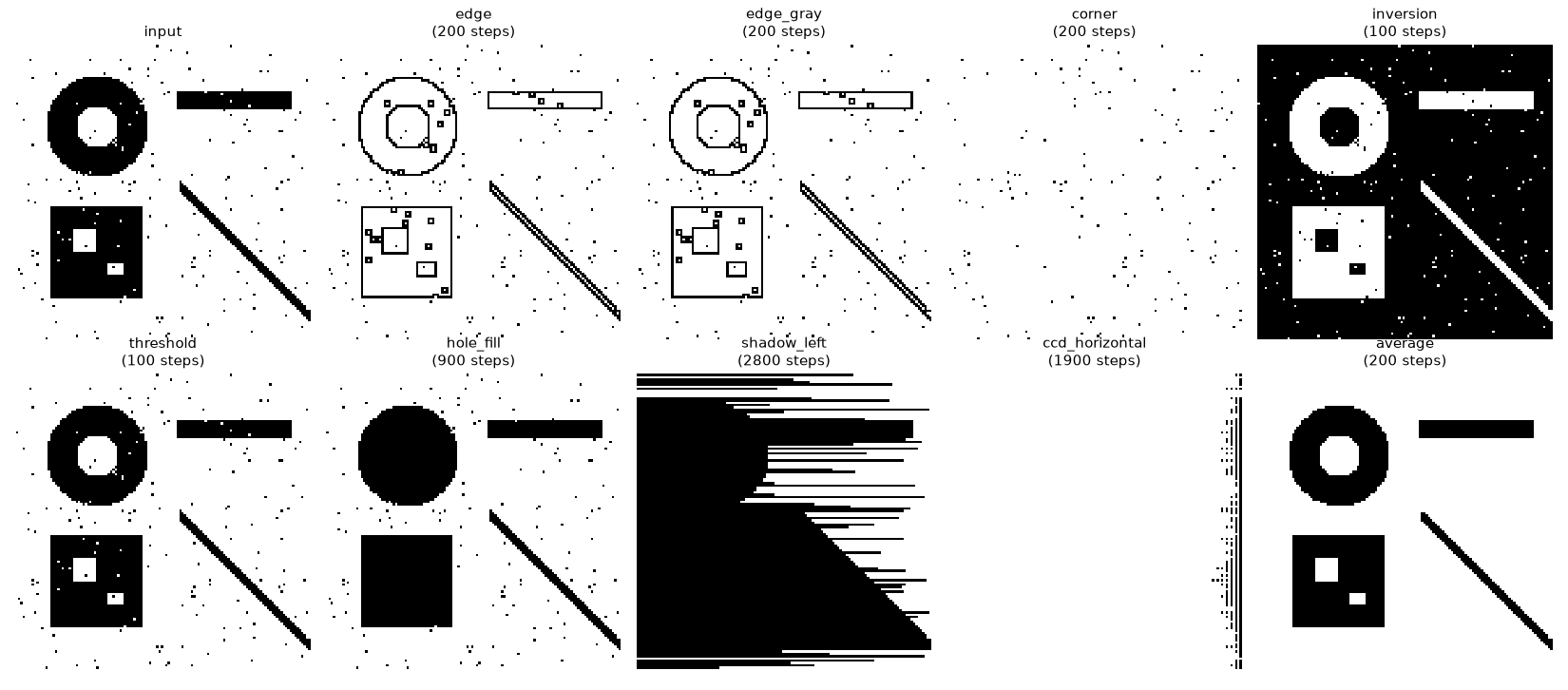
The whole behaviour of the network is set by a handful of numbers. With classic templates it performs image processing (edge and corner detection, hole filling, connected-component detection); with general templates, output functions and boundaries it is a flexible model of spatially extended nonlinear dynamics, and the templates can be learned from data.
What cnnsim offers:
- Fast simulation of batches of networks in PyTorch — on the GPU with
torch.compile, CUDA graphs and hand-written Triton kernels (billions of cell updates per second), or on the CPU. - A generalised model: odd k×k templates, several output functions, fixed / zero-flux / periodic / closed-spiral boundaries, bias maps, and per-sample templates for parameter sweeps.
- Template learning by backpropagation through the dynamics (exact gradients, gradient checkpointing, many candidates trained in parallel), plus gradient-free baselines (simulated annealing, CMA-ES).
- Classic templates from the literature, checked by tests.
Installation
pip install cnnsim
cnnsim needs Python ≥ 3.11 and PyTorch ≥ 2.8. pip installs PyTorch from PyPI; for a specific
CUDA build, install PyTorch first following the PyTorch instructions.
The fused Triton backend (backend="fused") needs an NVIDIA GPU and Triton, which ships with
the Linux CUDA builds of PyTorch; everywhere else cnnsim falls back to plain PyTorch.
With PyTorch < 2.11, compile=True on the CPU also needs setuptools (pip install setuptools),
which those PyTorch versions use but do not declare.
Usage
import torch
from cnnsim import CNNSimulator, Template, Boundary, templates as T

sim = CNNSimulator(compile=True, cuda_graph=True)          # fastest GPU mode
r = sim.run(T.HOLE_FILL, u, steps=5000, dt=0.1, tol=1e-3)  # u: (H,W), (N,H,W) or (N,1,H,W) in [-1, 1]
y = r["y"]                                                 # output, plus r["x"], r["steps"], r["history"]

# own template
my = Template(A=[[0,0,0],[0,2,0],[0,0,0]], B=[[0,0,0],[0,1,0],[0,0,0]], z=0.5,
              x0="input", boundary=Boundary("zeroflux"))

# per-sample templates (e.g. a parameter sweep): A, B of shape (N,k,k), z of shape (N,)
r = sim.run(None, u, A=A_batch, B=B_batch, z=z_batch, boundary=Boundary("fixed", -1))

# generalised model: any odd k×k (A and B may differ), output functions, closed-spiral
# boundary, separate input boundary, bias map z of shape (H,W)
from cnnsim import Output
r = sim.run(None, u, A=A5x5, B=B3x3, z=zmap, x0="input",
            boundary=Boundary("spiral"), boundary_u=Boundary("fixed", 0.0),
            output=Output("sigmoid", beta=1.0))
Model options
| options | |
|---|---|
| boundary | fixed (Dirichlet, value), zeroflux (Neumann), periodic (torus), spiral (closed spiral: row-major ring, neighbour of flat index p at (di,dj) is p + di·W + dj mod HW) |
output Output(kind, beta) |
pwl clip(x) · sigmoid 2/(1+e^(−βx))−1 · tanh tanh(βx) · sign (surrogate gradient of clip(βx)) · identity |
| templates | odd k×k, A and B independent; shared or per sample |
| bias z | scalar, per sample (N,), or map (H,W) / (N,1,H,W) |
| initial state | zero, input, ones, minus_ones, or a tensor |
Differentiable core
cnnsim.dynamics (correlate, bias_map, derivative, make_steps) consists of pure tensor
functions; gradients flow through the whole integration (checked by torch.autograd.gradcheck
in the tests). CNNSimulator is the fast no-grad path on top of the same functions.
Fused backend (Triton)
backend="fused" (in CNNSimulator and train.Dynamics) integrates with hand-written Triton
kernels: one program per grid, the state kept in registers for all steps, boundaries (incl. the
spiral) as index arithmetic. Training uses a hand-written discrete adjoint (backward pass through
the Euler steps) instead of autograd. Values and gradients agree with the stencil path to float32
rounding (tests/test_fused.py). Euler only, odd k ≤ 7, H·W ≤ 16384; other cases fall back to
the stencil path automatically. Training with k > 3 and the spiral boundary uses the compiled
stencil path (faster there); for the other boundaries the compiled k = 5 path is slow (the
F.pad modes do not fuse well) and the fused backward is used: per minibatch of 16 × 50 series,
5×5, 0.29 vs 4.8 s (fixed), 0.27 vs 4.4 s (periodic), 1.8 vs 4.4 s (zeroflux). Forward passes use
the fused kernels for every k. Policy: fused.prefer_for_training(boundary, k).
Training a typical research workload — 16 candidates × 200 series of 64×64, minibatches of 50, 200 Euler steps, spiral boundary, sigmoid (RTX 5060 Ti):
| compiled stencil | fused | |
|---|---|---|
| 3×3, training epoch | 0.74 s | 0.18 s (4.1×) |
| 3×3, evaluating 16 × 200 series | 1.44 s | 0.05 s (29×) |
| 5×5, training epoch | 0.84 s | (stencil used for spiral) |
| 5×5, evaluating 16 × 200 series | 2.53 s | 0.12 s (21×) |
Training templates
Templates are learned by backpropagation through the dynamics (exact gradients of the Euler/RK4 integration, memory bounded by gradient checkpointing). Every template carries a population dimension P: P independent candidates (multi-start) are trained simultaneously in one batched simulation of P × D grids.
from cnnsim import Boundary, Output
from cnnsim.params import TemplateParams, TemplateSpec
from cnnsim.train import Dynamics, fit, simulate
from cnnsim.losses import image_loss

dyn = Dynamics(boundary=Boundary("fixed", -1.0), output=Output("tanh"), steps=60, dt=0.2,
               x0="zero", compile=True)
spec = TemplateSpec(size_A=3, size_B=3, sym_A="isotropic", sym_B="none")   # 3 + 9 + 1 free parameters
params = TemplateParams(spec, population=16, device="cuda")
res = fit(params, image_loss("mse"), {"u": u, "target": y_ref}, dyn,
          val={"u": u_val, "target": y_val}, epochs=300, lr=0.05)
A, B, z = res.best()           # (16,3,3), (16,3,3), (16,): best parameters per candidate
TemplateSpec: template sizes, symmetry (none,central,mirror_lr,mirror_ud,mirror,rot90,isotropic), masks, and which of A, B, z are learned. One free parameter per orbit of template cells under the symmetry group, so constraints hold exactly.fit: AdamW, cosine schedule, per-candidate gradient clipping, minibatches, optional convergence penalty (settle_weight× mean |dx/dt| at the end), best-per-candidate tracking on validation data. Any lossloss_fn(y (P,D,1,H,W), batch) -> (P,)works.cnnsim.losses: per-imagemse,msen(SCNN normalised MSE),mae,pixel_error_rate, read-outmean_output, aggregations over samples (mean,max,rms,harmonic).cnnsim.optim: gradient-free baselines with batched evaluation —simulated_annealing(parallel chains) andcmaes;objective(params, loss_fn, data, dyn)turns a training problem into f: (Q, n_free) -> (Q,).
Performance options
backend="stencil"(default) writes the 3x3 correlation as 9 shifted multiply-adds; withcompile=Truethe whole Euler step (pad + stencil + clip + update) becomes one fused kernel.backend="conv"uses cuDNNconv2d.cuda_graph=Truerecordschunk(default 20) steps as one CUDA graph, removing launch overhead.B ⊛ u + zis computed once (constant for a static input).integrator="rk4"is available; Euler with dt 0.1–0.2 is the classic choice.
Benchmark (RTX 5060 Ti, Ryzen 7 5700X, WSL2, torch 2.14, float32)
Time per Euler step, single image (python benchmark.py); in brackets: Gcell-updates/s.
| config | 64² | 256² | 1024² | 2048² | 4096² |
|---|---|---|---|---|---|
| cpu-eager-conv | 47 µs | 486 µs | 10.5 ms | 51 ms | – |
| cpu-compiled (8 thr) | 17 µs | 296 µs | 2.5 ms [0.42] | 12.0 ms | – |
| gpu-eager-conv | 158 µs | 162 µs | 134 µs [7.8] | 607 µs | 3.6 ms |
| gpu-compiled | 22 µs | 15 µs | 32 µs [33] | 143 µs | 645 µs |
| gpu-conv-graph | 9 µs | 13 µs | 78 µs [13] | 607 µs | 3.6 ms |
| gpu-compiled-graph | 1.6 µs | 3.1 µs | 31 µs [34] | 142 µs [30] | 645 µs [26] |
Batch of 64 images, gpu-compiled-graph: 128² → 29 µs/step (36 Gcell/s), 512² → 624 µs (27 Gcell/s).
Takeaways:
- Fused + CUDA graph vs eager GPU (conv): ~100x faster at 64², ~50x at 256², 4–6x at ≥1024². vs compiled CPU: ~10x at 64², 80–95x at 256²–2048².
- At 4096² it sustains ~300 GB/s effective (read x, bias; write x), i.e. close to the memory bandwidth limit.
- Eager PyTorch on the GPU is launch-bound (~150 µs/step regardless of size) – always use compile + graph.
Note: torch.compile specialises on shape; the first run of a new size compiles for a few seconds.
Development
git clone https://github.com/thorstenkranz/cnnsim && cd cnnsim
uv sync                      # dev environment; torch from the CUDA 13 index (RTX 50xx needs CUDA >= 12.8)
uv run python -m pytest -q   # CUDA/Triton tests are skipped without a GPU
uv run python demo.py        # -> output/templates.png
uv run python benchmark.py
Layout: cnnsim/dynamics.py (differentiable core), boundary.py, outputs.py, simulator.py
(fast simulator), fused.py + _fused_kernels.py (Triton backend), templates.py (edge,
edge_gray, corner, inversion, threshold, hole_fill, shadow_left, ccd_horizontal, average),
params.py, train.py, losses.py, optim.py (training); tests/.
Versioning
cnnsim follows semantic versioning. Before 1.0, a minor release
(0.x → 0.x+1) may contain breaking changes, which are marked in the
changelog; patch releases
(0.x.y → 0.x.y+1) only fix bugs. The public API is what the README documents and the names
exported by cnnsim and its modules without a leading underscore.
License
MIT, see LICENSE.
1 maintainer

Metadata
1 maintainer
Release files for cnnsim 0.4.0
For a detailed explanation of source distributions (sdists) and built distributions (wheels), please see the package formats documentation.
Source distribution (sdist)
| File | Size | Uploaded | Provenance | Actions |
|---|---|---|---|---|
| cnnsim-0.4.0.tar.gz | 39.2 kB | With provenance | Details for cnnsim-0.4.0.tar.gz |
Built distribution (wheel)
| File | Interpreter | ABI | Platform | Actions Reset |
|---|---|---|---|---|
| cnnsim-0.4.0-py3-none-any.whl | Python 3 | none | any | Details for cnnsim-0.4.0-py3-none-any.whl |
Total release size: 72.9 kB
Release files / cnnsim-0.4.0.tar.gz
| Download URL | cnnsim-0.4.0.tar.gz |
|---|---|
| Size | 39.2 kB |
| Tags | Source |
|
SHA-256 checksum How to use checksums |
2a48a8b8494197f0fb3f178d43637035c938ba9b2025c598d6e391922e1e160f
|
|
BLAKE2b-256 checksum How to use checksums |
e210cbf9aae6581c93384a99b9a024b20709a9e60e5c7a903e481dc53adef230
|
| Upload date | |
|
Uploaded using Trusted Publishing? What is trusted publishing? |
Yes |
| Uploaded via |
twine/7.0.0 CPython/3.13.16
|
Provenance
Provenance describes where a file came from. On PyPI, provenance is shared via attestations, which provide a verifiable record of the build or publishing details. View details, limitations and caveats.


PyPI Publish Attestation
PyPI verified that this artifact, at this checksum, originated from the publisher listed below.
Signed by GitHub Actions, verified by PyPI on Nov 27, 2026.
Transparency logRelease files / cnnsim-0.4.0-py3-none-any.whl
| Download URL | cnnsim-0.4.0-py3-none-any.whl |
|---|---|
| Size | 33.7 kB |
| Tags | Python 3 |
|
SHA-256 checksum How to use checksums |
23c13e8874e3184bfb77cf305bdcea0d60bb240092a941da7cfb4069968c356a
|
|
BLAKE2b-256 checksum How to use checksums |
ba9ab76c259e7879470e57b24658d7694897b200c739d4a8feeac4776441e8ff
|
| Upload date | |
|
Uploaded using Trusted Publishing? What is trusted publishing? |
Yes |
| Uploaded via |
twine/7.0.0 CPython/3.13.16
|
Provenance
Provenance describes where a file came from. On PyPI, provenance is shared via attestations, which provide a verifiable record of the build or publishing details. View details, limitations and caveats.
PyPI Publish Attestation
PyPI verified that this artifact, at this checksum, originated from the publisher listed below.
Signed by GitHub Actions, verified by PyPI on Nov 27, 2026.
Transparency logSecurity for cnnsim 0.4.0
Provenance
Provenance describes where a file came from. On PyPI, provenance is shared via attestations, which provide a verifiable record of the build or publishing details. View details, limitations and caveats.
Full provenance
Both files in this release have been uploaded with provenance metadata.
Attestation for cnnsim-0.4.0.tar.gz
PyPI Publish Attestation
PyPI verified that this artifact, at this checksum, originated from the publisher listed below.
Signed by GitHub Actions, verified by PyPI on Nov 27, 2026.
Transparency logA note on package security
PyPI is a repository for distributing packages, not a service for auditing them. While third-party security researchers and our staff do their best to detect and remove malicious packages, PyPI cannot guarantee the quality, security or suitability of any given package.
To learn more about protecting yourself from malicious actors, visit our package security documentation.













