
MCP server for indexing and querying codebases using CocoIndex
Verified details
These details have been verified by PyPIProject links
GitHub Statistics
Maintainers

Project description

AST-based semantic code search that just works
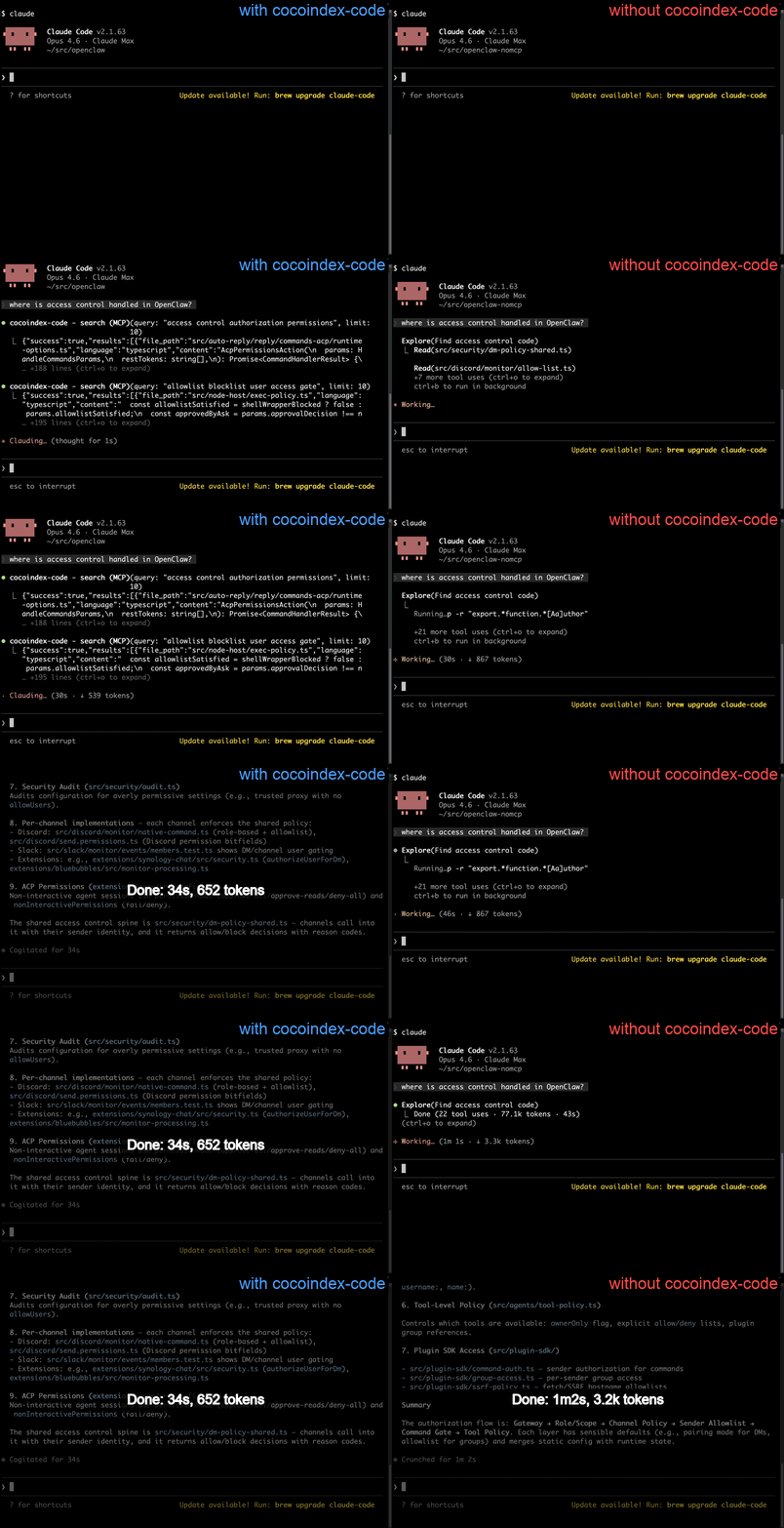
A lightweight, effective (AST-based) semantic code search tool for your codebase. Built on CocoIndex — a Rust-based ultra performant data transformation engine. Use it from the CLI, or integrate with Claude, Codex, Cursor — any coding agent — via Skill or MCP.
- Instant token saving by 70%.
- 1 min setup — install and go, zero config needed!







🌟 Please help star CocoIndex if you like this project!
Deutsch | English | Español | français | 日本語 | 한국어 | Português | Русский | 中文
Get Started — zero config, let's go!
Install
Using pipx:
pipx install 'cocoindex-code[full]'          # batteries included (local embeddings)
pipx upgrade cocoindex-code                  # upgrade
Using uv:
uv tool install --upgrade 'cocoindex-code[full]'
Two install styles — they mirror the Docker image variants of the same names:
cocoindex-code[full]— batteries-included. Pulls insentence-transformersso local embeddings (no API key required) work out of the box. Theccc initinteractive prompt defaults to Snowflake/snowflake-arctic-embed-xs.cocoindex-code(slim) — LiteLLM-only; requires a cloud embedding provider and API key. Use when you don't want the local-embedding deps (~1 GB of torch + transformers).
Next, set up your coding agent integration — or jump to Manual CLI Usage if you prefer direct control.
Coding Agent Integration
Skill (Recommended)
Install the ccc skill so your coding agent automatically uses semantic search when needed:
npx skills add cocoindex-io/cocoindex-code
That's it — no ccc init or ccc index needed. The skill teaches the agent to handle initialization, indexing, and searching on its own. It will automatically keep the index up to date as you work.
The agent uses semantic search automatically when it would be helpful. You can also nudge it explicitly — just ask it to search the codebase, e.g. "find how user sessions are managed", or type /ccc to invoke the skill directly.
Works with Claude Code and other skill-compatible agents.
MCP Server
Alternatively, use ccc mcp to run as an MCP server:
Claude Code
claude mcp add cocoindex-code -- ccc mcp
Codex
codex mcp add cocoindex-code -- ccc mcp
OpenCode
opencode mcp add
Enter MCP server name: cocoindex-code
Select MCP server type: local
Enter command to run: ccc mcp
Or use opencode.json:
{
  "$schema": "https://opencode.ai/config.json",
  "mcp": {
    "cocoindex-code": {
      "type": "local",
      "command": [
        "ccc", "mcp"
      ]
    }
  }
}
Once configured, the agent automatically decides when semantic code search is helpful — finding code by description, exploring unfamiliar codebases, fuzzy/conceptual matches, or locating implementations without knowing exact names.
Note: The
cocoindex-codecommand (without subcommand) still works as an MCP server for backward compatibility. It auto-creates settings from environment variables on first run.
MCP Tool Reference
When running as an MCP server (ccc mcp), the following tool is exposed:
search — Search the codebase using semantic similarity.
search(
    query: str,                          # Natural language query or code snippet
    limit: int = 5,                      # Maximum results (1-100)
    offset: int = 0,                     # Pagination offset
    refresh_index: bool = True,          # Refresh index before querying
    languages: list[str] | None = None,  # Filter by language (e.g. ["python", "typescript"])
    paths: list[str] | None = None,      # Filter by path glob (e.g. ["src/utils/*"])
)
Returns matching code chunks with file path, language, code content, line numbers, and similarity score.
Manual CLI Usage
You can also use the CLI directly — useful for manual control, running indexing after changing settings, checking status, or searching outside an agent.
ccc init                                # initialize project (creates settings)
ccc index                               # build the index
ccc search "authentication logic"       # search!
The background daemon starts automatically on first use.
Tip:
ccc indexauto-initializes if you haven't runccc inityet, so you can skip straight to indexing.
CLI Reference
| Command | Description |
|---|---|
ccc init |
Initialize a project — creates settings files, adds .cocoindex_code/ to .gitignore |
ccc index |
Build or update the index (auto-inits if needed). Shows streaming progress. |
ccc search <query> |
Semantic search across the codebase |
ccc status |
Show index stats (chunk count, file count, language breakdown) |
ccc mcp |
Run as MCP server in stdio mode |
ccc doctor |
Run diagnostics — checks settings, daemon, model, file matching, and index health |
ccc reset |
Delete index databases. --all also removes settings. -f skips confirmation. |
ccc daemon status |
Show daemon version, uptime, and loaded projects |
ccc daemon restart |
Restart the background daemon |
ccc daemon stop |
Stop the daemon |
Search Options
ccc search database schema                           # basic search
ccc search --lang python --lang markdown schema      # filter by language
ccc search --path 'src/utils/*' query handler        # filter by path
ccc search --offset 10 --limit 5 database schema     # pagination
ccc search --refresh database schema                 # update index first, then search
By default, ccc search scopes results to your current working directory (relative to the project root). Use --path to override.
Docker
A Docker image is available for teams who want a reproducible, dependency-free
setup — no Python, uv, or system dependencies required on the host.
The recommended approach is a persistent container: start it once, and use
docker exec to run CLI commands or connect MCP sessions to it. The daemon
inside stays warm across sessions, so the embedding model is loaded only once.
Choosing an image
Two variants are published from each release:
| Tag | Size | Embedding backends | When to pick |
|---|---|---|---|
cocoindex/cocoindex-code:latest (slim, default) |
~450 MB | LiteLLM (cloud: OpenAI, Voyage, Gemini, Ollama, …) | Most users. Cloud-backed embeddings, smaller image, fast pulls. |
cocoindex/cocoindex-code:full |
~5 GB | sentence-transformers (local) + LiteLLM | When you want local embeddings without an API key, or an offline-ready container. Heavier because of torch + transformers. |
The rest of this section uses :latest — substitute :full in the image: /
docker run commands if you want the full variant.
Mac users running the
:fullvariant: local embedding inference is CPU-only inside Docker, because Docker on macOS can't access Apple's Metal (MPS) GPU. If you want local embeddings and fast inference, install natively instead:pipx install 'cocoindex-code[full]'. The:latest(slim) variant is unaffected — LiteLLM runs the model on the provider's side, so Docker vs. native makes no difference.
Quick start — docker compose up -d
Bring it up in one line — no clone needed (bash / zsh):
# macOS / Windows
docker compose -f <(curl -L https://raw.githubusercontent.com/cocoindex-io/cocoindex-code/refs/heads/main/docker/docker-compose.yml) up -d

# Linux (aligns file ownership on bind-mounted paths with your host user)
PUID=$(id -u) PGID=$(id -g) docker compose -f <(curl -L https://raw.githubusercontent.com/cocoindex-io/cocoindex-code/refs/heads/main/docker/docker-compose.yml) up -d
Or grab docker/docker-compose.yml and run docker compose up -d next to it (works on any shell, including Windows cmd / PowerShell).
By default your home directory is mounted into the container (set
COCOINDEX_HOST_WORKSPACE to narrow this to a specific code folder). Index
data and the embedding model cache persist in a Docker volume across
restarts. Your global settings file at $HOME/.cocoindex_code/global_settings.yml
is visible and editable on the host; edits take effect on your next ccc command.
Pick a different image: set
COCOINDEX_CODE_IMAGEto override the default. For example, the:fullvariant or GHCR:COCOINDEX_CODE_IMAGE=cocoindex/cocoindex-code:full docker compose up -d COCOINDEX_CODE_IMAGE=ghcr.io/cocoindex-io/cocoindex-code:latest docker compose up -d
Or: docker run
Docker Desktop (macOS / Windows)
docker run -d --name cocoindex-code \
  --volume "$HOME:/workspace" \
  --volume cocoindex-data:/var/cocoindex \
  -e COCOINDEX_CODE_HOST_PATH_MAPPING="/workspace=$HOME" \
  cocoindex/cocoindex-code:latest
Linux (with PUID/PGID)
docker run -d --name cocoindex-code \
  -e PUID=$(id -u) -e PGID=$(id -g) \
  --volume "$HOME:/workspace" \
  --volume cocoindex-data:/var/cocoindex \
  -e COCOINDEX_CODE_HOST_PATH_MAPPING="/workspace=$HOME" \
  cocoindex/cocoindex-code:latest
Shell wrapper for ccc commands
Paste this into ~/.bashrc / ~/.zshrc so ccc feels native on the host
and picks up the right project based on your current directory:
ccc() {
  docker exec -it -e COCOINDEX_CODE_HOST_CWD="$PWD" cocoindex-code ccc "$@"
}
Now cd into any project under your workspace and run ccc init, ccc index,
ccc search ..., ccc status, etc. — it just works.
Connect your coding agent
Claude Code
Register MCP from inside the target project so $PWD points there:
claude mcp add cocoindex-code -- docker exec -i \
  -e COCOINDEX_CODE_HOST_CWD="$PWD" cocoindex-code ccc mcp
Or via .mcp.json:
{
  "mcpServers": {
    "cocoindex-code": {
      "type": "stdio",
      "command": "docker",
      "args": [
        "exec",
        "-i",
        "-e",
        "COCOINDEX_CODE_HOST_CWD=${PWD}",
        "cocoindex-code",
        "ccc",
        "mcp"
      ]
    }
  }
}
Note: use
-i(not-it). The-tflag allocates a terminal, which interferes with MCP's JSON messaging over stdin/stdout — only add it for interactiveccccommands likeccc init.
Codex
codex mcp add cocoindex-code -- docker exec -i \
  -e COCOINDEX_CODE_HOST_CWD="$PWD" cocoindex-code ccc mcp
Upgrading from an older image
Earlier images used separate cocoindex-db and cocoindex-model-cache
volumes; the current image consolidates them into a single cocoindex-data
volume. Before pulling the new image, drop the old container and volumes —
indexes rebuild on your next ccc index, and the embedding model is
re-populated automatically on first start:
docker rm -f cocoindex-code
docker volume rm cocoindex-db cocoindex-model-cache
Configuration via environment variables
Pass configuration to docker run / compose with -e:
# Extra extensions (e.g. Typesafe Config, SBT build files)
-e COCOINDEX_CODE_EXTRA_EXTENSIONS="conf,sbt"

# Exclude build artefacts (Scala/SBT example)
-e COCOINDEX_CODE_EXCLUDE_PATTERNS='["**/target/**","**/.bloop/**","**/.metals/**"]'

# Set an API key
-e VOYAGE_API_KEY=your-key
Security note: mounting
$HOMEgives the container read/write access to everything under it. If that's too broad, bind-mount a narrower directory instead (COCOINDEX_HOST_WORKSPACE=/path/to/code).
Build the image locally
docker build -t cocoindex-code:local -f docker/Dockerfile .
Features
- Semantic Code Search: Find relevant code using natural language queries when grep doesn't work well, and save tokens immediately.
- Ultra Performant: ⚡ Built on top of ultra performant Rust indexing engine. Only re-indexes changed files for fast updates.
- Multi-Language Support: Python, JavaScript/TypeScript, Rust, Go, Java, C/C++, C#, SQL, Shell, and more.
- Embedded: Portable and just works, no database setup required!
- Flexible Embeddings: Local SentenceTransformers via the
[full]extra (free, no API key!) or 100+ cloud providers via LiteLLM.
Configuration
Configuration lives in two YAML files, both created automatically by ccc init.
User Settings (~/.cocoindex_code/global_settings.yml)
Shared across all projects. Controls the embedding model and environment variables for the daemon.
embedding:
  provider: sentence-transformers                    # or "litellm"
  model: Snowflake/snowflake-arctic-embed-xs
  device: mps                                        # optional: cpu, cuda, mps (auto-detected if omitted)
  min_interval_ms: 300                               # optional: pace LiteLLM embedding requests to reduce 429s; defaults to 5 for LiteLLM

  # Optional extra kwargs passed to the embedder, separately for indexing vs query.
  # `ccc init` auto-populates these for known models (e.g. Cohere, Voyage, Nvidia NIM,
  # nomic-ai code-retrieval models, Snowflake arctic-embed).
  # indexing_params:
  #   input_type: search_document        # litellm: input_type
  # query_params:
  #   input_type: search_query           # sentence-transformers: prompt_name

envs:                                                # extra environment variables for the daemon
  OPENAI_API_KEY: your-key                           # only needed if not already in your shell environment
Note: The daemon inherits your shell environment. If an API key (e.g.
OPENAI_API_KEY) is already set as an environment variable, you don't need to duplicate it inenvs. Theenvsfield is only for values that aren't in your environment.
Custom location: set
COCOINDEX_CODE_DIRto placeglobal_settings.ymlsomewhere other than~/.cocoindex_code/— useful if you want the file to live alongside your projects (e.g. on a synced folder).
indexing_params / query_params
Some embedding models expose different modes for documents vs queries (asymmetric retrieval). For example, Cohere's v3 models want input_type: search_document when embedding corpus content and input_type: search_query when embedding a user query; several SentenceTransformers models use prompt_name: passage / prompt_name: query for the same purpose. These knobs live under indexing_params and query_params:
embedding:
  provider: litellm
  model: cohere/embed-english-v3.0
  indexing_params:
    input_type: search_document
  query_params:
    input_type: search_query
ccc init populates these automatically for models it recognizes — including all Cohere v3, Voyage, Nvidia NIM, Gemini embedding (gemini/gemini-embedding-*, gemini/text-embedding-*, gemini/embedding-* — LiteLLM auto-maps input_type to Gemini's task_type), nomic-ai/CodeRankEmbed, nomic-ai/nomic-embed-code, nomic-ai/nomic-embed-text-v1/v1.5, mixedbread-ai/mxbai-embed-large-v1, and the Snowflake/snowflake-arctic-embed-* family — and prints the chosen defaults. For other models, it leaves a commented-out template under embedding: so you can fill it in by hand.
OpenAI embeddings (text-embedding-3-*, text-embedding-ada-002) are intentionally not in the list: they're symmetric and have no equivalent knob.
Accepted keys: prompt_name (sentence-transformers) and input_type (litellm). Other keys are rejected at daemon startup with a clear error. Note: dimensions is intentionally not exposed here — output dimension must be identical for indexing and query, so it's a model-wide setting rather than a per-side knob.
Doctor checks both sides. ccc doctor exercises the model once with indexing_params and once with query_params, reporting each as a separate Model Check (indexing) / Model Check (query) entry — so a misconfiguration on one side is diagnosable without hiding behind the other.
Legacy-bridge warning: if you're upgrading from an earlier version and your global_settings.yml uses nomic-ai/CodeRankEmbed or nomic-ai/nomic-embed-code without indexing_params / query_params, the daemon continues to apply the previous behavior (prompt_name: query at query time) and prints a one-time warning asking you to make the setting explicit. You can silence the warning by adding an empty block such as query_params: {}.
Project Settings (<project>/.cocoindex_code/settings.yml)
Per-project. Controls which files to index.
include_patterns:
  - "**/*.py"
  - "**/*.js"
  - "**/*.ts"
  - "**/*.rs"
  - "**/*.go"
  # ... (sensible defaults for 28+ file types)

exclude_patterns:
  - "**/.*"                # hidden directories
  - "**/__pycache__"
  - "**/node_modules"
  - "**/dist"
  # ...

language_overrides:
  - ext: inc               # treat .inc files as PHP
    lang: php

chunkers:
  - ext: toml              # use a custom chunker for .toml files
    module: example_toml_chunker:toml_chunker
.cocoindex_code/is automatically added to.gitignoreduring init.
Use chunkers when you want to control how a file type is split into chunks before indexing.
module: example_toml_chunker:toml_chunker means:
example_toml_chunkeris a local Python moduletoml_chunkeris the function inside that module
In practice, this usually means:
- you create a Python file in your project, for example
example_toml_chunker.py - you add a function in that file
- you point
settings.ymlat it withmodule.path:function_name
The function should use this signature:
from pathlib import Path
from cocoindex_code.chunking import Chunk

def my_chunker(path: Path, content: str) -> tuple[str | None, list[Chunk]]:
    ...
pathis the file being indexedcontentis the full text of that file- return
language_overrideas a string like"toml"if you want to override language detection - return
Noneaslanguage_overrideif you want to keep the detected language - return a
list[Chunk]with the chunks you want stored in the index
See src/cocoindex_code/chunking.py for the public types and tests/example_toml_chunker.py for a complete example.
Embedding Models
With the [full] extra installed, ccc init defaults to a local SentenceTransformers model (Snowflake/snowflake-arctic-embed-xs) — no API key required. To use a different model, edit ~/.cocoindex_code/global_settings.yml.
The
envsentries below are only needed if the key isn't already in your shell environment — the daemon inherits your environment automatically.
Ollama (Local)
embedding:
  model: ollama/nomic-embed-text
Set OLLAMA_API_BASE in envs: if your Ollama server is not at http://localhost:11434.
OpenAI
embedding:
  model: text-embedding-3-small
  min_interval_ms: 300                               # optional: override the 5ms LiteLLM default
envs:
  OPENAI_API_KEY: your-api-key
Azure OpenAI
embedding:
  model: azure/your-deployment-name
envs:
  AZURE_API_KEY: your-api-key
  AZURE_API_BASE: https://your-resource.openai.azure.com
  AZURE_API_VERSION: "2024-06-01"
Gemini
embedding:
  model: gemini/gemini-embedding-001
envs:
  GEMINI_API_KEY: your-api-key
Mistral
embedding:
  model: mistral/mistral-embed
envs:
  MISTRAL_API_KEY: your-api-key
Voyage (Code-Optimized)
embedding:
  model: voyage/voyage-code-3
envs:
  VOYAGE_API_KEY: your-api-key
Cohere
embedding:
  model: cohere/embed-v4.0
envs:
  COHERE_API_KEY: your-api-key
AWS Bedrock
embedding:
  model: bedrock/amazon.titan-embed-text-v2:0
envs:
  AWS_ACCESS_KEY_ID: your-access-key
  AWS_SECRET_ACCESS_KEY: your-secret-key
  AWS_REGION_NAME: us-east-1
Nebius
embedding:
  model: nebius/BAAI/bge-en-icl
envs:
  NEBIUS_API_KEY: your-api-key
Any LiteLLM-supported model works. When using a LiteLLM model, set provider: litellm (or omit provider — LiteLLM is the default for non-sentence-transformers models).
Local SentenceTransformers Models
Set provider: sentence-transformers and use any SentenceTransformers model (no API key required).
Example — general purpose text model:
embedding:
  provider: sentence-transformers
  model: nomic-ai/nomic-embed-text-v1.5
GPU-optimised code retrieval:
nomic-ai/CodeRankEmbed delivers significantly better code retrieval than the default model. It is 137M parameters, requires ~1 GB VRAM, and has an 8192-token context window.
embedding:
  provider: sentence-transformers
  model: nomic-ai/CodeRankEmbed
Note: Switching models requires re-indexing your codebase (ccc reset && ccc index) since the vector dimensions differ.
Supported Languages
| Language | Aliases | File Extensions |
|---|---|---|
| c | .c |
|
| cpp | c++ | .cpp, .cc, .cxx, .h, .hpp |
| csharp | csharp, cs | .cs |
| css | .css, .scss |
|
| dtd | .dtd |
|
| fortran | f, f90, f95, f03 | .f, .f90, .f95, .f03 |
| go | golang | .go |
| html | .html, .htm |
|
| java | .java |
|
| javascript | js | .js |
| json | .json |
|
| kotlin | .kt, .kts |
|
| lua | .lua |
|
| markdown | md | .md, .mdx |
| pascal | pas, dpr, delphi | .pas, .dpr |
| php | .php |
|
| python | .py |
|
| r | .r |
|
| ruby | .rb |
|
| rust | rs | .rs |
| scala | .scala |
|
| solidity | .sol |
|
| sql | .sql |
|
| swift | .swift |
|
| toml | .toml |
|
| tsx | .tsx |
|
| typescript | ts | .ts |
| xml | .xml |
|
| yaml | .yaml, .yml |
Custom Database Location
By default, index databases (cocoindex.db and target_sqlite.db) live alongside settings in <project>/.cocoindex_code/. When running in Docker, you may want the databases on the container's native filesystem for performance (LMDB doesn't work well on mounted volumes) while keeping the source code and settings on a mounted volume.
Set COCOINDEX_CODE_DB_PATH_MAPPING to remap database locations by path prefix:
COCOINDEX_CODE_DB_PATH_MAPPING=/workspace=/db-files
With this mapping, a project at /workspace/myrepo stores its databases in /db-files/myrepo/ instead of /workspace/myrepo/.cocoindex_code/. Settings files remain in the original location.
Multiple mappings are comma-separated and resolved in order (first match wins):
COCOINDEX_CODE_DB_PATH_MAPPING=/workspace=/db-files,/workspace2=/db-files2
Both source and target must be absolute paths. If no mapping matches, the default location is used.
Troubleshooting
Run ccc doctor to diagnose common issues. It checks your settings, daemon health, embedding model, file matching, and index status — all in one command.
sqlite3.Connection object has no attribute enable_load_extension
Some Python installations (e.g. the one pre-installed on macOS) ship with a SQLite library that doesn't enable extensions.
macOS fix: Install Python through Homebrew:
brew install python3
Then re-install cocoindex-code (see Get Started for install options):
Using pipx:
pipx install cocoindex-code       # first install
pipx upgrade cocoindex-code       # upgrade
Using uv (install or upgrade):
uv tool install --upgrade cocoindex-code
Legacy: Environment Variables
If you previously configured cocoindex-code via environment variables, the cocoindex-code MCP command still reads them and auto-migrates to YAML settings on first run. We recommend switching to the YAML settings for new setups.
| Environment Variable | YAML Equivalent |
|---|---|
COCOINDEX_CODE_EMBEDDING_MODEL |
embedding.model in global_settings.yml |
COCOINDEX_CODE_DEVICE |
embedding.device in global_settings.yml |
COCOINDEX_CODE_ROOT_PATH |
Run ccc init in your project root instead |
COCOINDEX_CODE_EXCLUDED_PATTERNS |
exclude_patterns in project settings.yml |
COCOINDEX_CODE_EXTRA_EXTENSIONS |
include_patterns + language_overrides in project settings.yml |
Large codebase / Enterprise
CocoIndex is an ultra efficient indexing engine that also works on large codebases at scale for enterprises. In enterprise scenarios it is a lot more efficient to share indexes with teammates when there are large or many repos. We also have advanced features like branch dedupe etc designed for enterprise users.
If you need help with remote setup, please email our maintainer linghua@cocoindex.io, happy to help!
Contributing
We welcome contributions! Before you start, please install the pre-commit hooks so that linting, formatting, type checking, and tests run automatically before each commit:
pip install pre-commit
pre-commit install
This catches common issues — trailing whitespace, lint errors (Ruff), type errors (mypy), and test failures — before they reach CI.
For more details, see our contributing guide.
License
Apache-2.0
Project details
Verified details
These details have been verified by PyPIProject links
GitHub Statistics
Maintainers
Release history Release notifications | RSS feed


Download files
Download the file for your platform. If you're not sure which to choose, learn more about installing packages.
Source Distribution
Built Distribution
Filter files by name, interpreter, ABI, and platform.
If you're not sure about the file name format, learn more about wheel file names.
Copy a direct link to the current filters
File details
Details for the file cocoindex_code-0.2.30.tar.gz.
File metadata
- Download URL: cocoindex_code-0.2.30.tar.gz
- Upload date:
- Size: 66.1 kB
- Tags: Source
- Uploaded using Trusted Publishing? Yes
- Uploaded via: twine/6.1.0 CPython/3.13.12
File hashes
| Algorithm | Hash digest | |
|---|---|---|
| SHA256 |
17bde654d4055a1200c097c92fb1292a859d77f4eb65d609fd8cc2f794b4f176
|
|
| MD5 |
52a437f4f198e45db685c66aac88b934
|
|
| BLAKE2b-256 |
84a169af65963b2ffabe0120024c40e4f93d9a3d56608fabcd93d5c054b4d25b
|
Provenance
The following attestation bundles were made for cocoindex_code-0.2.30.tar.gz:
Publisher:
release.yml on cocoindex-io/cocoindex-code
-
Statement:
-
Statement type:
https://in-toto.io/Statement/v1 -
Predicate type:
https://docs.pypi.org/attestations/publish/v1 -
Subject name:
cocoindex_code-0.2.30.tar.gz -
Subject digest:
17bde654d4055a1200c097c92fb1292a859d77f4eb65d609fd8cc2f794b4f176 - Sigstore transparency entry: 1383146499
- Sigstore integration time:
-
Permalink:
cocoindex-io/cocoindex-code@9700655aa69c418ade360f2bebca86a02f2b14ce -
Branch / Tag:
refs/tags/v0.2.30 - Owner: https://github.com/cocoindex-io
-
Access:
public
-
Token Issuer:
https://token.actions.githubusercontent.com -
Runner Environment:
github-hosted -
Publication workflow:
release.yml@9700655aa69c418ade360f2bebca86a02f2b14ce -
Trigger Event:
release
-
Statement type:
File details
Details for the file cocoindex_code-0.2.30-py3-none-any.whl.
File metadata
- Download URL: cocoindex_code-0.2.30-py3-none-any.whl
- Upload date:
- Size: 66.6 kB
- Tags: Python 3
- Uploaded using Trusted Publishing? Yes
- Uploaded via: twine/6.1.0 CPython/3.13.12
File hashes
| Algorithm | Hash digest | |
|---|---|---|
| SHA256 |
9d1a0ddcbb48b921a71a2cb2a3865ec3c41f4978ee7c2cc72b86a6e205c319b8
|
|
| MD5 |
d8c8ad1d8052e6d98ba3cd77783002f3
|
|
| BLAKE2b-256 |
821dcc053074cb3ea8059b3f38aee01bc0e10b8d69472074ae9529e383542df8
|
Provenance
The following attestation bundles were made for cocoindex_code-0.2.30-py3-none-any.whl:
Publisher:
release.yml on cocoindex-io/cocoindex-code
-
Statement:
-
Statement type:
https://in-toto.io/Statement/v1 -
Predicate type:
https://docs.pypi.org/attestations/publish/v1 -
Subject name:
cocoindex_code-0.2.30-py3-none-any.whl -
Subject digest:
9d1a0ddcbb48b921a71a2cb2a3865ec3c41f4978ee7c2cc72b86a6e205c319b8 - Sigstore transparency entry: 1383146531
- Sigstore integration time:
-
Permalink:
cocoindex-io/cocoindex-code@9700655aa69c418ade360f2bebca86a02f2b14ce -
Branch / Tag:
refs/tags/v0.2.30 - Owner: https://github.com/cocoindex-io
-
Access:
public
-
Token Issuer:
https://token.actions.githubusercontent.com -
Runner Environment:
github-hosted -
Publication workflow:
release.yml@9700655aa69c418ade360f2bebca86a02f2b14ce -
Trigger Event:
release
-
Statement type:






