
cocotbext-qspi
QSPI flash verification for cocotb: a bus driver, a device-level API over the JEDEC command set, and a NOR flash model to test against.
Requires cocotb 2.0+. Tests run on Icarus Verilog.
pip install cocotbext-qspi
Why another SPI extension
cocotbext-spi covers
single-lane SPI. This one covers flash specifically: dual and quad I/O
reads, the write-enable latch, status polling, page program and sector
erase — and it targets cocotb 2.x.
Pointing a testbench at the models
The Verilog ships inside the package, so there is nothing to vendor. Ask the package where it is:
VERILOG_DIR := $(shell python3 -c \
    "import cocotbext.qspi as q; print(q.verilog_dir())")

VERILOG_SOURCES  = $(VERILOG_DIR)/qspi_flash.v
VERILOG_SOURCES += $(VERILOG_DIR)/qspi_flash_test.v
Or from Python, cocotbext.qspi.verilog_dir() returns a pathlib.Path.
Usage
import cocotb
from cocotb.clock import Clock
from cocotbext.qspi import QspiFlash, CMD_QIOR4

@cocotb.test()
async def test_flash(dut):
    cocotb.start_soon(Clock(dut.clk, 20, unit="ns").start())

    flash = QspiFlash(dut)
    await flash.initialize()

    assert await flash.read_id() == [0xEF, 0x40, 0x18]

    # program() sets WEL, then polls the status register until WIP clears.
    await flash.program(0x1000, [0xDE, 0xAD, 0xBE, 0xEF])

    assert await flash.read(0x1000, 4) == [0xDE, 0xAD, 0xBE, 0xEF]
    assert await flash.read(0x1000, 4, opcode=CMD_QIOR4) == [0xDE, 0xAD, 0xBE, 0xEF]

    await flash.erase_sector(0x1000)
    assert await flash.read(0x1000, 4) == [0xFF] * 4
The protocol, and two things that catch people out
SPI mode 0: the master launches data while the clock is low, the device samples it on the rising edge, and vice versa.
The opcode is always single-lane. Only the address, mode byte and data widen. A quad I/O read is not "everything on four lanes" — it is one single-lane command byte, then four-lane address and data. Getting this wrong is the most common reason a driver talks to nothing.
Programming only clears bits. NOR flash needs an erase to set a bit back
to 1. Programming 0x0F over 0xF0 gives 0x00, not 0x0F.
What it looks like on the wire
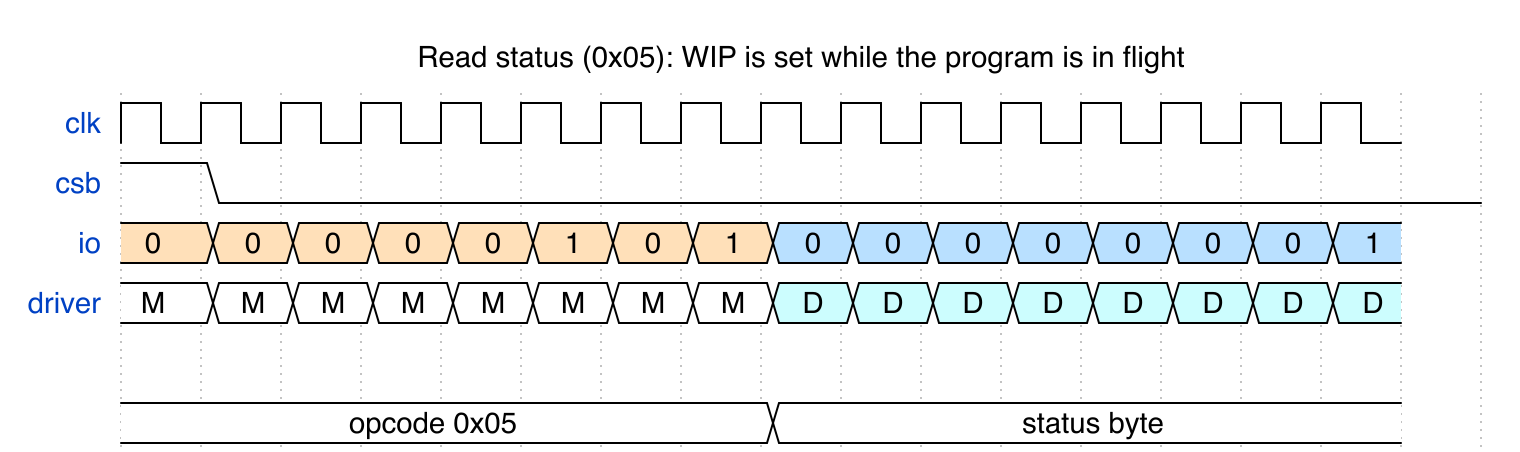
All three diagrams below are generated from a real simulation — capture.py
runs the transactions, Icarus dumps a VCD, and render.py draws it. Nothing
is drawn by hand, so they cannot drift away from what the model does.
A quad I/O read. The opcode goes out one bit per clock on a single lane; only then does the bus widen to four lanes for the address and data. Note the eight dummy cycles, where neither side drives while the bus turns around:

The same byte read three ways. This is the whole point of the wide modes — 40 clocks single-lane, 36 dual, 26 quad, for one byte at the same address:

A status read while a program is in flight. The device answers 0x01 — WIP
set — which is what wait_ready() polls for:
To regenerate them:
make -C docs/waveforms        # run the sim, dump capture.vcd
make -C docs/waveforms svg    # capture.vcd -> *.svg
Commands
| Opcode | Name | Address | Data |
|---|---|---|---|
0x06 |
Write enable | — | — |
0x04 |
Write disable | — | — |
0x05 |
Read status | — | 1 lane, repeats |
0x9F |
JEDEC id | — | 1 lane, 3 bytes |
0x03 |
Read | 1 lane | 1 lane |
0xBB |
Fast read dual I/O | 2 lanes | 2 lanes, after mode byte + dummy |
0xEB |
Fast read quad I/O | 4 lanes | 4 lanes, after mode byte + dummy |
0x02 |
Page program | 1 lane | 1 lane; needs WEL, sets WIP |
0x20 |
Sector erase (4 KB) | 1 lane | — ; needs WEL, sets WIP |
0x66 / 0x99 |
Reset enable / reset | — | — |
RSTEN arms a reset for the next command only; anything in between
cancels it, so a stray 0x99 cannot reset a device mid-operation.
initialize() issues the pair, so a test cannot inherit the write enable
latch from whatever ran before it.
Status register: bit 0 WIP (write in progress), bit 1 WEL (write enable
latch). wait_ready() polls it rather than assuming a fixed delay, which is
what a real controller must do.
Bus signals
QspiBus.from_entity(dut) picks up clk, csb and io, plus io_out and
io_oe.
A simulator will not let a testbench drive an inout net, so the top level
splits the master's half into a value and a per-lane output enable:
wire [3:0] io;
assign io[0] = io_oe[0] ? io_out[0] : 1'bz;
assign io[1] = io_oe[1] ? io_out[1] : 1'bz;
assign io[2] = io_oe[2] ? io_out[2] : 1'bz;
assign io[3] = io_oe[3] ? io_out[3] : 1'bz;
Per-lane, not bus-wide: in single-lane mode the master drives io0 while
the device answers on io1.
Note also that csb is left uninitialised in qspi_flash_test.v. The model
frames transactions on chip-select edges, and an initialiser there races
cocotb's first write at time 0 — the edge is lost and the device never
starts. initialize() drives the sequence explicitly.
Testing
Two suites, and the split matters:
make -C tests                      # against our own JEDEC model: 11 tests
make -C tests -f Makefile.interop  # against PicoSoC's spiflash.v: 5 tests
The interop suite drives
spiflash.v — a model this project
did not write — and checks the bytes against known $readmemh content.
That distinction earned its keep. Testing only against our own model proves the driver and the model agree; it does not prove either is right. Driving somebody else's model immediately found that the master was dropping the first bit of every byte — our model had the same off-by-one assumption, so the closed loop had been happily agreeing with itself.
Layout
| Path | Contents |
|---|---|
cocotbext/qspi/qspi_flash.py |
QspiFlash — JEDEC command set, status polling |
cocotbext/qspi/qspi_master.py |
QspiMaster — byte transfers at 1/2/4 lanes |
cocotbext/qspi/qspi_bus.py |
QspiBus — signal bundle |
cocotbext/qspi/verilog/qspi_flash.v |
NOR flash model: WEL, WIP, page program, sector erase |
cocotbext/qspi/verilog/qspi_flash_test.v |
cocotb top level |
tests/reference/ |
third-party model for interop (ISC, see its README) |
Licence
MIT. tests/reference/spiflash.v is ISC, © Claire Xenia Wolf.
1 maintainer

Metadata
1 maintainer
Release files for cocotbext-qspi 0.2.0
For a detailed explanation of source distributions (sdists) and built distributions (wheels), please see the package formats documentation.
Source distribution (sdist)
| File | Size | Uploaded | |
|---|---|---|---|
| cocotbext_qspi-0.2.0.tar.gz | 18.1 kB | Details |
Built distribution (wheel)
| File | Interpreter | ABI | Platform | Reset |
|---|---|---|---|---|
| cocotbext_qspi-0.2.0-py3-none-any.whl | Python 3 | none | any | Details |
Total release size: 33.1 kB
Release files / cocotbext_qspi-0.2.0.tar.gz
| Download URL | cocotbext_qspi-0.2.0.tar.gz |
|---|---|
| Size | 18.1 kB |
| Tags | Source |
|
SHA-256 checksum How to use checksums |
e9f31c671e616e267b1ae5679d04c781f6aa1cd4266a3982847ec33a8305c087
|
|
BLAKE2b-256 checksum How to use checksums |
56e5e2ed982d72c7721453815b99cfbc9ddb7704bdf809f7d7ac16d22377b6d2
|
| Upload date | |
|
Uploaded using Trusted Publishing? What is trusted publishing? |
Yes |
| Uploaded via |
twine/7.0.0 CPython/3.13.14
|
Provenance
Provenance describes where a file came from. On PyPI, provenance is shared via attestations, which provide a verifiable record of the build or publishing details. View details, limitations and caveats.


PyPI Publish Attestation
PyPI verified that this artifact, at this checksum, originated from the publisher listed below.
Signed by GitHub Actions, verified by PyPI on Sep 19, 2026.
Transparency logRelease files / cocotbext_qspi-0.2.0-py3-none-any.whl
| Download URL | cocotbext_qspi-0.2.0-py3-none-any.whl |
|---|---|
| Size | 14.9 kB |
| Tags | Python 3 |
|
SHA-256 checksum How to use checksums |
84dfd7cff5dcb0ba05afca3fc4e96f0a289d7ded54bfb3a0428f4b8e078f1052
|
|
BLAKE2b-256 checksum How to use checksums |
1726585f5b378f705ec32871bd093ec2da3d2d22fa3aaad9c73e7d6d2cf393a3
|
| Upload date | |
|
Uploaded using Trusted Publishing? What is trusted publishing? |
Yes |
| Uploaded via |
twine/7.0.0 CPython/3.13.14
|
Provenance
Provenance describes where a file came from. On PyPI, provenance is shared via attestations, which provide a verifiable record of the build or publishing details. View details, limitations and caveats.
PyPI Publish Attestation
PyPI verified that this artifact, at this checksum, originated from the publisher listed below.
Signed by GitHub Actions, verified by PyPI on Sep 19, 2026.
Transparency log












