
An MCP server that indexes local code into a graph database to provide context to AI assistants.

Project description
🏗️ CodeGraphContext (CGC)
Turn code repositories into a queryable graph for AI agents.
🌐 Languages:
- 🇬🇧 English
- 🇨🇳 中文
- 🇰🇷 한국어
- 🇺🇦 Українська
- 🇷🇺 Русский
- 🇯🇵 日本語 (Soon)
- 🇪🇸 Español (Soon)
🌍 Help translate CodeGraphContext to your language by raising an issue & PR on https://github.com/Shashankss1205/CodeGraphContext/issues!
Bridge the gap between deep code graphs and AI context.















A powerful MCP server and CLI toolkit that indexes local code into a graph database to provide context to AI assistants and developers. Use it as a standalone CLI for comprehensive code analysis or connect it to your favorite AI IDE via MCP for AI-powered code understanding.
📍 Quick Navigation
- 🚀 Quick Start
- 🌐 Supported Programming Languages
- 🛠️ CLI Toolkit
- 🤖 MCP Server
- 🗄️ Database Options
- 🔬 SCIP indexing (optional)
✨ Experience CGC
👨🏻💻 Installation and CLI
Install in seconds with pip and unlock a powerful CLI for code graph analysis.

🛠️ Indexing in Seconds
The CLI intelligently parses your tree-sitter nodes to build the graph.

🤖 Powering your AI Assistant
Use natural language to query complex call-chains via MCP.

Project Details
- Version: 0.4.8
- Authors: Shashank Shekhar Singh shashankshekharsingh1205@gmail.com
- License: MIT License (See LICENSE for details)
- Website: CodeGraphContext
👨💻 Maintainer
CodeGraphContext is created and actively maintained by:
Shashank Shekhar Singh
- 📧 Email: shashankshekharsingh1205@gmail.com
- 🐙 GitHub: @Shashankss1205
- 🔗 LinkedIn: Shashank Shekhar Singh
- 🌐 Website: codegraphcontext.vercel.app
Contributions and feedback are always welcome! Feel free to reach out for questions, suggestions, or collaboration opportunities.
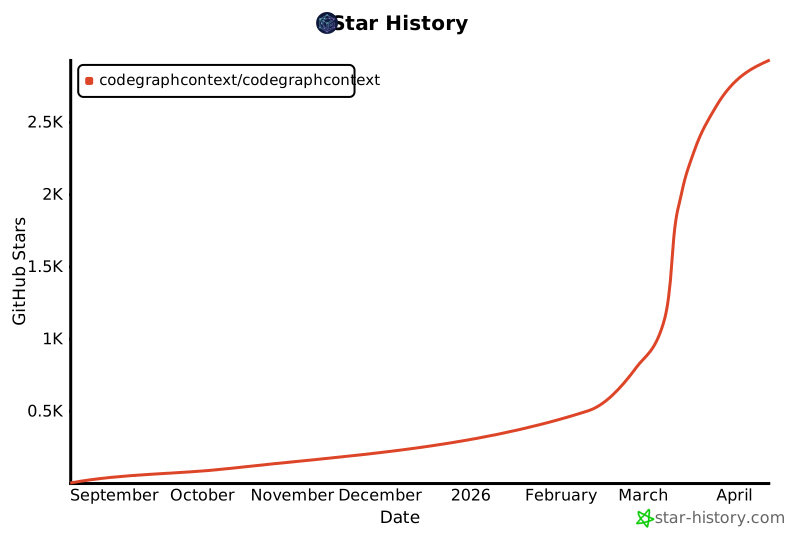
Star History
Features
- Code Indexing: Analyzes code and builds a knowledge graph of its components.
- Relationship Analysis: Query for callers, callees, class hierarchies, call chains and more.
- Pre-indexed Bundles: Load famous repositories instantly with
.cgcbundles - no indexing required! (Learn more) - Live File Watching: Watch directories for changes and automatically update the graph in real-time (
codegraphcontext watch). - Interactive Setup: A user-friendly command-line wizard for easy setup.
- Dual Mode: Works as a standalone CLI toolkit for developers and as an MCP server for AI agents.
- Multi-Language Support: Full support for 20 programming languages.
- Flexible Database Backend: KuzuDB (Default), FalkorDB Lite (Typical Unix default), FalkorDB Remote, Nornic DB, or Neo4j (all platforms via Docker/native).
Supported Programming Languages
CodeGraphContext provides comprehensive parsing and analysis for the following languages:
| Language | Language | Language | |||
|---|---|---|---|---|---|
| 🐍 | Python | 📜 | JavaScript | 🔷 | TypeScript |
| ☕ | Java | 🏗️ | C / C++ | #️⃣ | C# |
| 🐹 | Go | 🦀 | Rust | 💎 | Ruby |
| 🐘 | PHP | 🍎 | Swift | 🎨 | Kotlin |
| 🎯 | Dart | 🐪 | Perl | 🌙 | Lua |
| 🚀 | Scala | λ | Haskell | 💧 | Elixir |
| ⚛️ | TSX |
Each language parser extracts functions, classes, methods, parameters, inheritance relationships, function calls, and imports to build a comprehensive code graph.
Database Options
CodeGraphContext supports multiple graph database backends to suit your environment:
| Feature | KuzuDB | FalkorDB Lite | Neo4j / Nornic DB |
|---|---|---|---|
| Typical default | Standard Default (embedded, powered by KuzuDB) | Unix (Python 3.12+, when falkordblite works) |
When explicitly configured |
| Setup | Zero-config / Embedded | Zero-config / In-process | Docker / External |
| Platform | All (Windows Native, macOS, Linux) | Unix-only (Linux/macOS/WSL) | All Platforms |
| Use Case | Desktop, IDE, Local development | Specialized Unix development | Enterprise, Massive graphs |
| Requirement | pip install kuzu |
pip install falkordblite |
Neo4j Server / Docker / Nornic Cloud |
| Speed | ⚡ Extremely Fast | ⚡ Fast | 🚀 Scalable |
| Persistence | Yes (to disk) | Yes (to disk) | Yes (to disk) |
SCIP indexing (optional)
When SCIP_INDEXER=true in your CGC config (~/.codegraphcontext/.env), some languages use external SCIP indexers for more accurate calls and inheritance than Tree-sitter heuristics alone.
C and C++ use scip-clang, which requires a compile_commands.json file (a JSON compilation database): one entry per translation unit with the real compiler command (include paths, -D defines, -std, etc.). Without it, scip-clang cannot run; CGC logs a warning and falls back to Tree-sitter for that repo. Typical ways to produce the file: CMake with -DCMAKE_EXPORT_COMPILE_COMMANDS=ON, or wrap your real build with Bear (e.g. bear -- make). CGC also looks under build/ and cmake-build-*/ for that filename.
C# uses scip-dotnet (Roslyn); you need a normal .csproj / .sln and a successful restore—no compile_commands.json.
SCIP is independent of which graph database you use (Kuzu, Neo4j, etc.); the same flag applies to all backends.
Used By
CodeGraphContext is already being explored by developers and projects for:
- Static code analysis in AI assistants
- Graph-based visualization of projects
- Dead code and complexity detection
If you’re using CodeGraphContext in your project, feel free to open a PR and add it here! 🚀
Dependencies
neo4j>=5.15.0watchdog>=3.0.0stdlibs>=2023.11.18typer>=0.9.0rich>=13.7.0inquirerpy>=0.3.4python-dotenv>=1.0.0tree-sitter>=0.21.0(not installed on Python 3.13)tree-sitter-language-pack>=0.6.0(not installed on Python 3.13)pyyamlpathspec>=0.12.1falkordb>=0.1.0falkordblite>=0.1.0(Unix only)kuzu(KuzuDB engine)fastapi>=0.100.0uvicorn>=0.22.0requests>=2.28.0protobuf>=3.20,<3.21
Note: Python 3.10-3.14 is supported.
🚀 Installation & Quick Start
-
Install the toolkit:
pip install codegraphcontext
-
Troubleshooting (Command not found): If the
codegraphcontextcommand is not found, run this one-line fix:curl -sSL https://raw.githubusercontent.com/CodeGraphContext/CodeGraphContext/main/scripts/post_install_fix.sh | bash
-
Database Setup (Automatic): CodeGraphContext uses an embedded graph database by default.
- KuzuDB: Default for all platforms.
- FalkorDB Lite: Preferred on Unix/macOS if available.
- Neo4j: Run
codegraphcontext neo4j setupto use an external server.
For CLI Toolkit Mode
Start using immediately with CLI commands:
# Index your current directory
codegraphcontext index .

# List all indexed repositories
codegraphcontext list

# Analyze who calls a function
codegraphcontext analyze callers my_function

# Find complex code
codegraphcontext analyze complexity --threshold 10

# Find dead code
codegraphcontext analyze dead-code

# Watch for live changes (optional)
codegraphcontext watch .

# See all commands
codegraphcontext help
See the full CLI Commands Guide for all available commands and usage scenarios.
🎨 Premium Interactive Visualization
CodeGraphContext can generate stunning, interactive knowledge graphs of your code. Unlike static diagrams, these are premium web-based explorers:
- Premium Aesthetics: Dark mode, glassmorphism, and modern typography (Outfit/JetBrains Mono).
- Interactive Inspection: Click any node to open a detailed side panel with symbol information, file paths, and context.
- Quick Search: Live-search through the graph to find specific symbols instantly.
- Intelligent Layouts: Force-directed and hierarchical layouts that make complex relationships readable.
- Zero-Dependency Viewing: Standalone HTML files that work in any modern browser.
# Visualize function calls
codegraphcontext analyze calls my_function --viz

# Explore class hierarchies
codegraphcontext analyze tree MyClass --viz

# Visualize search results
codegraphcontext find pattern "Auth" --viz
🤖 For MCP Server Mode
Configure your AI assistant to use CodeGraphContext:
-
Setup: Run the MCP setup wizard to configure your IDE/AI assistant:
codegraphcontext mcp setup
The wizard can automatically detect and configure:
- VS Code
- Cursor
- Windsurf
- Claude
- Gemini CLI
- ChatGPT Codex
- Cline
- RooCode
- Amazon Q Developer
- Kiro
Upon successful configuration,
codegraphcontext mcp setupwill generate and place the necessary configuration files:- It creates an
mcp.jsonfile in your current directory for reference. - It stores your database credentials securely in
~/.codegraphcontext/.env. - It updates the settings file of your chosen IDE/CLI (e.g.,
.claude.jsonor VS Code'ssettings.json).
-
Start: Launch the MCP server:
codegraphcontext mcp start
-
Use: Now interact with your codebase through your AI assistant using natural language! See examples below.
Ignoring Files (.cgcignore)
You can tell CodeGraphContext to ignore specific files and directories by creating a .cgcignore file in the root of your project. This file uses the same syntax as .gitignore.
Example .cgcignore file:
# Ignore build artifacts
/build/
/dist/

# Ignore dependencies
/node_modules/
/vendor/

# Ignore logs
*.log
MCP Client Configuration
The codegraphcontext mcp setup command attempts to automatically configure your IDE/CLI. If you choose not to use the automatic setup, or if your tool is not supported, you can configure it manually.
Add the following server configuration to your client's settings file (e.g., VS Code's settings.json or .claude.json):
{
  "mcpServers": {
    "CodeGraphContext": {
      "command": "codegraphcontext",
      "args": [
        "mcp",
        "start"
      ],
      "env": {
        "NEO4J_URI": "YOUR_NEO4J_URI",
        "NEO4J_USERNAME": "YOUR_NEO4J_USERNAME",
        "NEO4J_PASSWORD": "YOUR_NEO4J_PASSWORD"
      },
      "disabled": false,
      "alwaysAllow": []
    }
  }
}
If installed via pipx
If you installed CodeGraphContext using pipx, use the following configuration instead:
{
  "mcpServers": {
    "CodeGraphContext": {
      "command": "pipx",
      "args": [
        "run",
        "codegraphcontext",
        "mcp",
        "start"
      ],
      "env": {
        "NEO4J_URI": "YOUR_NEO4J_URI",
        "NEO4J_USERNAME": "YOUR_NEO4J_USERNAME",
        "NEO4J_PASSWORD": "YOUR_NEO4J_PASSWORD"
      },
      "disabled": false,
      "alwaysAllow": []
    }
  }
}
Natural Language Interaction Examples
Once the server is running, you can interact with it through your AI assistant using plain English. Here are some examples of what you can say:
Indexing and Watching Files
-
To index a new project:
- "Please index the code in the
/path/to/my-projectdirectory." OR - "Add the project at
~/dev/my-other-projectto the code graph."
- "Please index the code in the
-
To start watching a directory for live changes:
- "Watch the
/path/to/my-active-projectdirectory for changes." OR - "Keep the code graph updated for the project I'm working on at
~/dev/main-app."
When you ask to watch a directory, the system performs two actions at once:
- It kicks off a full scan to index all the code in that directory. This process runs in the background, and you'll receive a
job_idto track its progress. - It begins watching the directory for any file changes to keep the graph updated in real-time.
This means you can start by simply telling the system to watch a directory, and it will handle both the initial indexing and the continuous updates automatically.
- "Watch the
Querying and Understanding Code
-
Finding where code is defined:
- "Where is the
process_paymentfunction?" - "Find the
Userclass for me." - "Show me any code related to 'database connection'."
- "Where is the
-
Analyzing relationships and impact:
- "What other functions call the
get_user_by_idfunction?" - "If I change the
calculate_taxfunction, what other parts of the code will be affected?" - "Show me the inheritance hierarchy for the
BaseControllerclass." - "What methods does the
Orderclass have?"
- "What other functions call the
-
Exploring dependencies:
- "Which files import the
requestslibrary?" - "Find all implementations of the
rendermethod."
- "Which files import the
-
Advanced Call Chain and Dependency Tracking (Spanning Hundreds of Files): The CodeGraphContext excels at tracing complex execution flows and dependencies across vast codebases. Leveraging the power of graph databases, it can identify direct and indirect callers and callees, even when a function is called through multiple layers of abstraction or across numerous files. This is invaluable for:
-
Impact Analysis: Understand the full ripple effect of a change to a core function.
-
Debugging: Trace the path of execution from an entry point to a specific bug.
-
Code Comprehension: Grasp how different parts of a large system interact.
-
"Show me the full call chain from the
mainfunction toprocess_data." -
"Find all functions that directly or indirectly call
validate_input." -
"What are all the functions that
initialize_systemeventually calls?" -
"Trace the dependencies of the
DatabaseManagermodule."
-
-
Code Quality and Maintenance:
- "Is there any dead or unused code in this project?"
- "Calculate the cyclomatic complexity of the
process_datafunction insrc/utils.py." - "Find the 5 most complex functions in the codebase."
-
Repository Management:
- "List all currently indexed repositories."
- "Delete the indexed repository at
/path/to/old-project."
Contributing
Contributions are welcome! 🎉
Please see our CONTRIBUTING.md for detailed guidelines.
If you have ideas for new features, integrations, or improvements, open an issue or submit a Pull Request.
Join discussions and help shape the future of CodeGraphContext.
Release history Release notifications | RSS feed


Download files
Download the file for your platform. If you're not sure which to choose, learn more about installing packages.
Source Distribution
Built Distribution
Filter files by name, interpreter, ABI, and platform.
If you're not sure about the file name format, learn more about wheel file names.
Copy a direct link to the current filters
File details
Details for the file codegraphcontext-0.4.8.tar.gz.
File metadata
- Download URL: codegraphcontext-0.4.8.tar.gz
- Upload date:
- Size: 5.3 MB
- Tags: Source
- Uploaded using Trusted Publishing? No
- Uploaded via: twine/6.2.0 CPython/3.12.3
File hashes
| Algorithm | Hash digest | |
|---|---|---|
| SHA256 |
3ac0b3ee545ed8dddbcd1d90b638c4f6530aa076ca244f623c80856974d090e3
|
|
| MD5 |
40a3796f74c550109bf605f0b70441b0
|
|
| BLAKE2b-256 |
13205141fabb9d900659beb4c4f20c683d996863a832a391f801a889e9b869f1
|
File details
Details for the file codegraphcontext-0.4.8-py3-none-any.whl.
File metadata
- Download URL: codegraphcontext-0.4.8-py3-none-any.whl
- Upload date:
- Size: 5.4 MB
- Tags: Python 3
- Uploaded using Trusted Publishing? No
- Uploaded via: twine/6.2.0 CPython/3.12.3
File hashes
| Algorithm | Hash digest | |
|---|---|---|
| SHA256 |
1ca4d25a448fc0cf9fe11466ae44b8b9aae70efe2904cb37a6a2489ff59b7b8b
|
|
| MD5 |
1bea2ab3ac1132a8ec2043a1f3982828
|
|
| BLAKE2b-256 |
e7e1364b4eeb0cf422a8027de10cc3b95c3dbe8d265bd3501f73913338dbd919
|






