
A learning game that turns the code AI wrote for you into a galaxy you light up by understanding it.
Verified details
These details have been verified by PyPIProject links
GitHub Statistics
Maintainers

Project description
Codemble
Turn AI-built code into a galaxy you actually understand.
Codemble is a local-first learning game for projects built with Claude Code, Codex, and other coding agents. It maps real parser evidence into a 3D galaxy and a flat architecture map, then lights each region only after you prove you understand it.
Your project · Your key · Your machine · No invented structure





Quick start · Learning loop · Documentation · Test Codemble
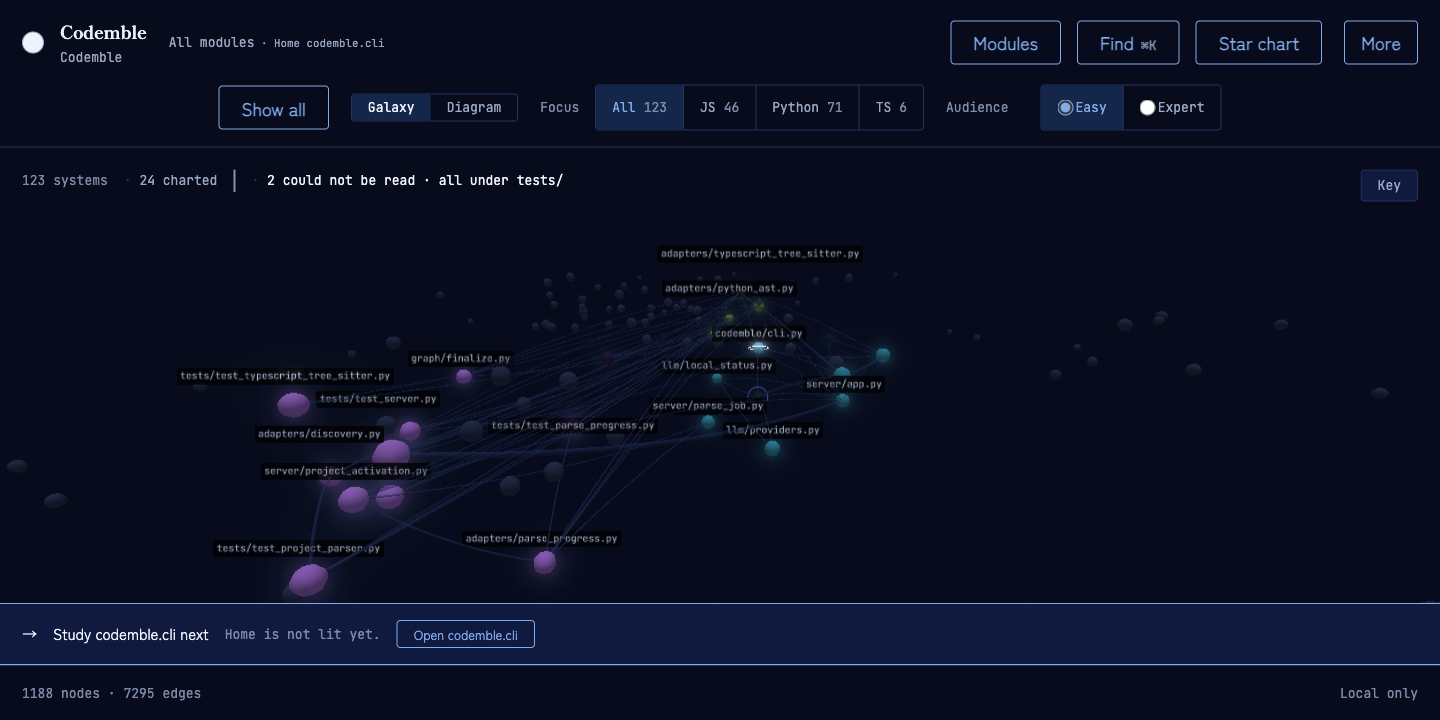
Galaxy level. Every system is one module; size is lines of code, brightness is how many distinct structures call it. Files the parser could not read stay visible and say so.
[!IMPORTANT] Codemble is in its Phase 1 tester release. It maps Python, JavaScript, TypeScript, and mixed projects in one parser-proven galaxy, installable straight from PyPI with an in-app project picker. The technical release is complete; unaided learner runs are the evidence still being collected. Try the ten-minute tester loop.
Quick start
Two steps. The first is once per machine; the second is how you run Codemble from then on.
| Step | Command | |
|---|---|---|
 |
1 · Install uv — the runner that fetches Codemble on demand | brew install uv |
 |
2 · Chart your project — nothing to install, nothing left behind | uvx codemble |
Installing uv without Homebrew
# macOS · Linux
curl -LsSf https://astral.sh/uv/install.sh | sh

# Windows (PowerShell)
powershell -ExecutionPolicy ByPass -c "irm https://astral.sh/uv/install.ps1 | iex"
Already have pipx? You can skip uv entirely: pipx install codemble, then run
codemble. Plain pip install codemble works too. uv is the recommended path
because uvx runs the current release without adding anything to your system
Python.
Codemble opens your browser — pick your project folder there. To skip the
picker, pass a path: codemble ./your-ai-built-project.
The wheel already contains the web app, so Node.js is not required. No API key is needed for the galaxy, the map, the structural summary, source viewer, language Lens, checks, lighting, or saved progress. Add your own Anthropic or OpenAI key only if you want grounded prose explanations:
export ANTHROPIC_API_KEY=sk-ant-... # or OPENAI_API_KEY=sk-...
Prefer to send nothing anywhere? Point Codemble at a local Ollama instead — same grounding validation, loopback only, never automatic:
ollama pull gemma4:12b && export CODEMBLE_PROVIDER=ollama
Installation, configuration, and troubleshooting →
How the learning loop works
| Step | What Codemble does | What you gain |
|---|---|---|
| 1. Chart | Parses your project without running its code or package scripts | A deterministic map made from source evidence |
| 2. Navigate | Two layers over one graph: a 3D galaxy on scripted camera rails, and a flat map of architecture and workflow | Orientation without getting lost in free flight |
| 3. Study | Shows the real source, exact line numbers, neighbors, and parser-detected language idioms | Context tied to code you can inspect |
| 4. Prove | Generates and scores checks from the graph—never from the model | A region lights only when understanding is demonstrated |
| 5. Return | Saves progress locally; changing one file re-dims only its module | A living map that stays honest as the project changes |
No XP. No streaks. No leaderboard. The visible reward is the useful one: more of your own code becomes a sky you understand.
What it looks like
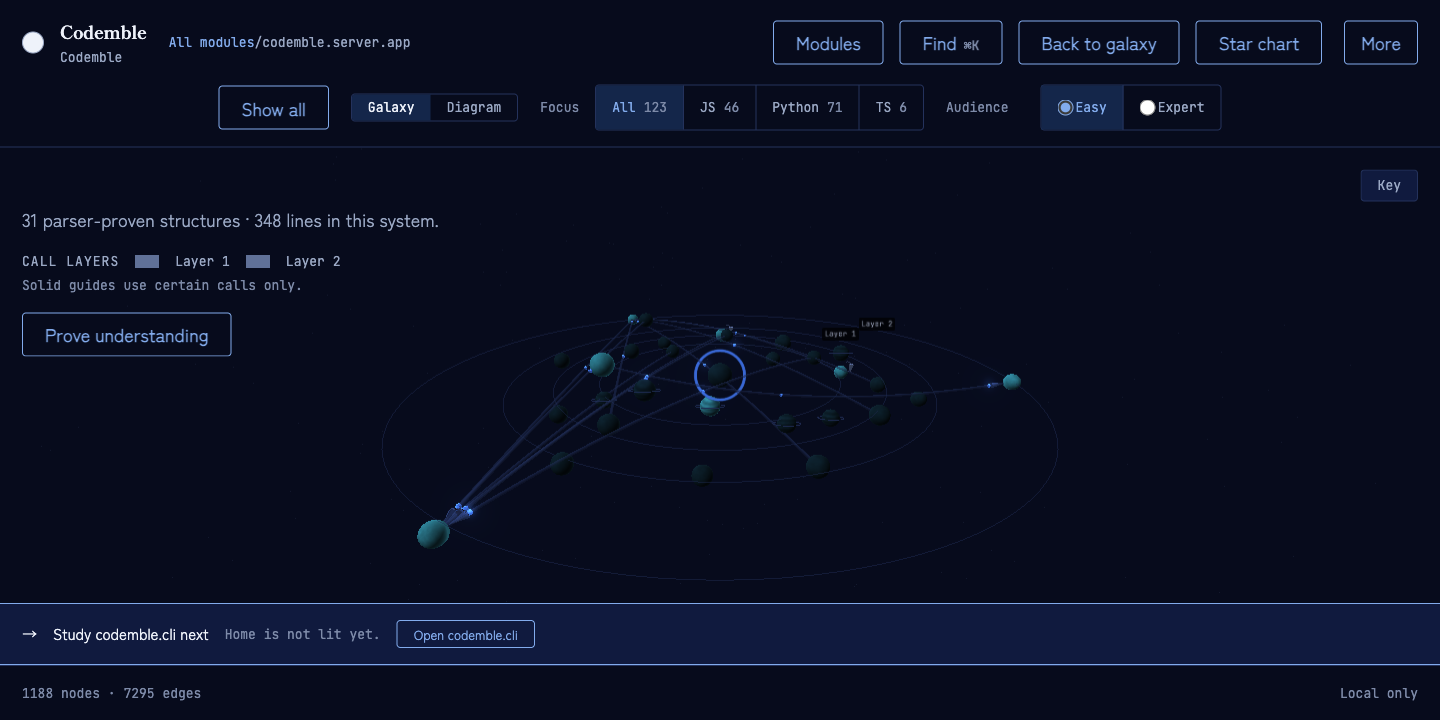
System level. Members orbit by call depth, so the inner ring runs first.
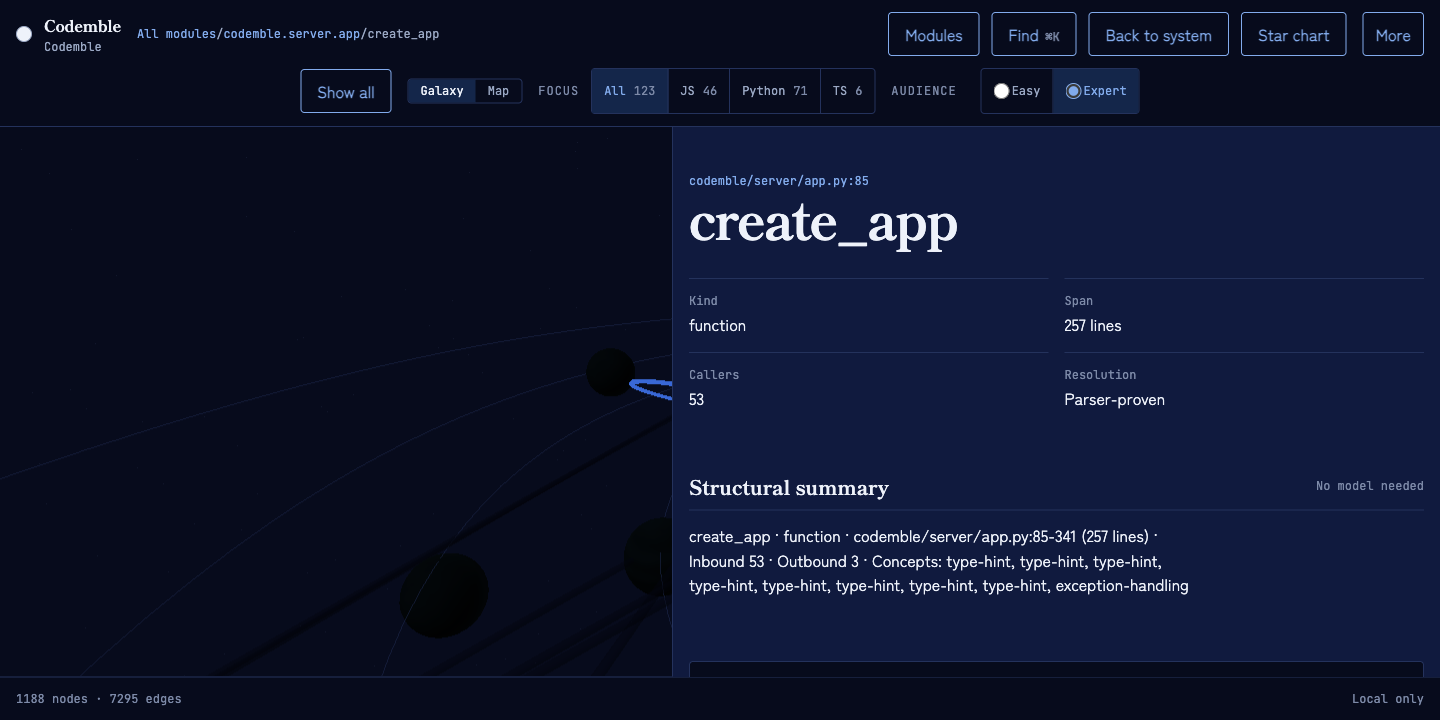
Study. Everything on this panel except the narration comes from the parser — and this one has no model configured at all.
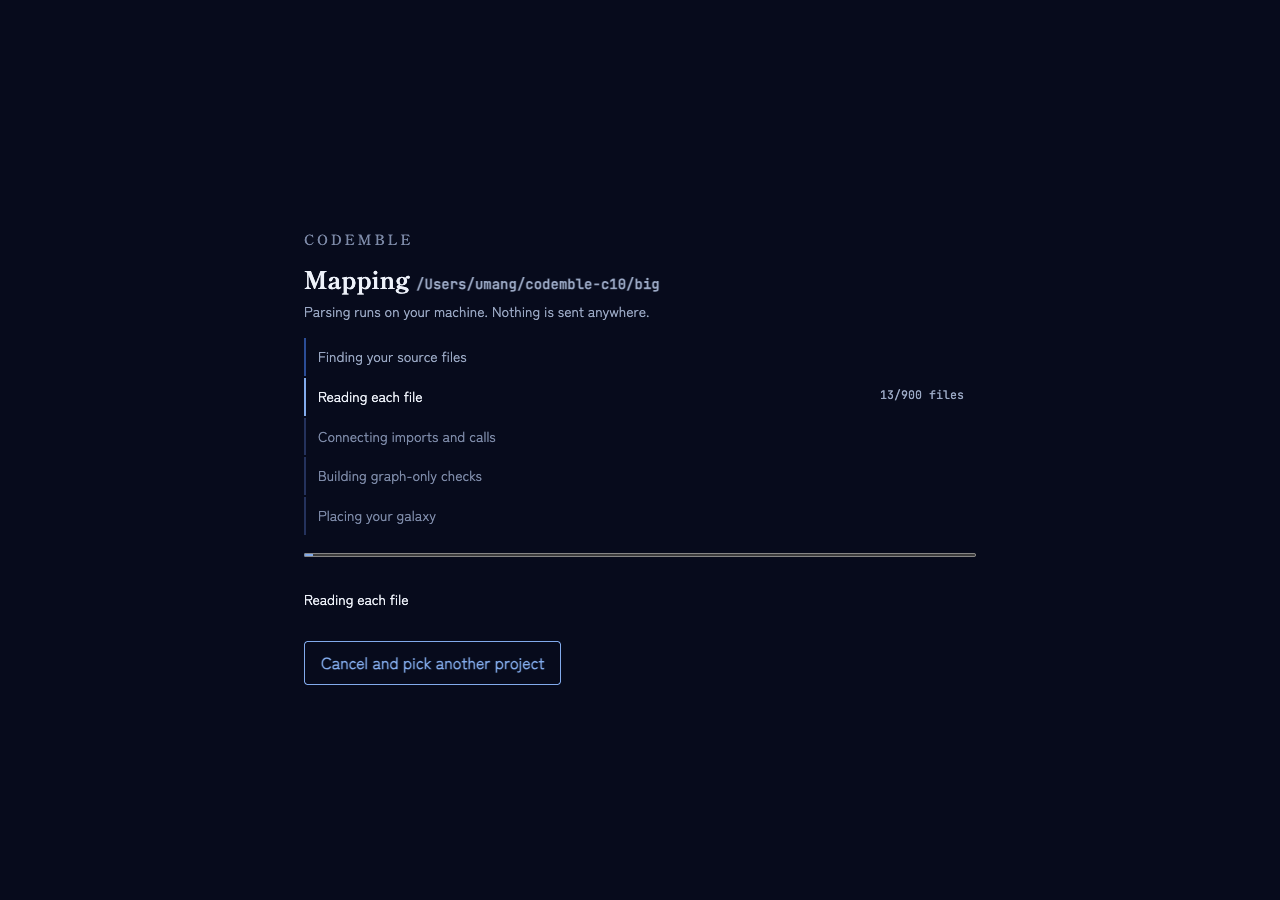
Large projects (up to roughly 1,000 source files) parse in the background with visible staged progress — a real file count while reading, named steps while resolving — so a big project never looks like a frozen tab. Cancel any time to pick another.
Two layers over one graph
Codemble draws the same parser evidence two ways, switchable in the header. The map cannot show you a relationship the galaxy does not have — both layouts are computed in the graph layer and served as data.
| Layer | What it is | When it helps |
|---|---|---|
| Galaxy | 3D, camera on rails through galaxy → system → study | Orientation, and the shape of the whole project |
| Map · Architecture | Modules as boxes, grouped by folder, layered by import distance from Home | Seeing how the project fits together |
| Map · Workflow | The call tree from your entrypoint, depth by depth | Seeing what runs first |
The Map is plain SVG, so it still works on a machine that cannot draw WebGL.
Open a structure, read what the parser knows first
The study panel builds itself outward from the most certain evidence: a
structural summary written from parser facts alone — no key, no network, no
model — then grounded narration if you configured a provider, then every
connection into and out of the structure with its direction, its certainty, and
a file:line you can click, then the real source and the language Lens notes.
Sections other than the narration never involve a model at all.
Easy or Expert
A header toggle changes how Codemble talks to you and how much it puts on screen: plain language, larger type, the Map by default, and a hint chip naming the nearest unlit region to Home — counted in import hops over the graph, not chosen by a model. It never changes graph truth, coordinates, progress, or how a check is scored.
You can also switch project or change Home without leaving the app.
Read the galaxy
| In the galaxy | In your project |
|---|---|
| A star system | One source module |
| A planet | A function or class |
| The Home system | The selected parser-ranked entrypoint |
| A route or edge | An import or call; approximate calls are labeled possible |
| Size | Lines of code |
| Brightness and glow | How many distinct structures call it |
| Nebula tint | Language, at galaxy level |
| Orbit ring | Call depth — the inner ring runs first |
| Drifting particles | A call the parser proved; a possible call stays still |
| Dim → lit | Not yet proven → understood |
Understanding owns the top of the brightness range: the unlit ramp stops below the amber a lit star uses, so a busy module you have not proven can never outshine one you have. Pass a region's checks and that system plays a short amber "nebula dawn" — after the light is already saved, so the animation marks a fact rather than delivering one.
Python-only, JavaScript-only, TypeScript-only, and mixed projects share the same graph contract. Language focus changes only what you are looking at; it never changes coordinates, progress, or parser truth.
Honest by construction
Codemble is built for learners who may not yet be able to spot a confident mistake. Accuracy therefore outranks spectacle:
- Structure, entrypoints, concepts, imports, and calls come from parsers.
- Every explanation points to a real
file:lineand may name only supplied identifiers and relationships. - Language Lens notes appear only where a parser detected the construct.
- Check answers come from the graph, never an LLM.
- Approximate relationships stay visibly uncertain — a distinct colour and no drifting particles in the 3D galaxy, a genuinely dashed line in the 2D map, and the legend swatch follows whichever layer is on screen.
- Provider output that fails grounding validation is withheld instead of being softened into a guess.
Read the full correctness contract. A wrong explanation is a highest-severity bug—report it without mercy.
Local-first, with an explicit AI boundary
| Stays on your machine | Leaves only when you ask |
|---|---|
| Project discovery and parsing | The bounded Study context sent to your configured provider |
| Graph, structural summary, language Lens, and checks | A request triggered only when you open Study |
| Local server and packaged web app | Nothing in the background |
Progress and explanation cache in ~/.codemble/ |
No accounts, telemetry, or Codemble cloud |
| Narration too, if you choose a local Ollama | Nothing at all in that case |
No model at all? Codemble remains a complete parser-backed map and learning game; only the optional prose narration is unavailable.
Boundaries that keep the map truthful
- Supported source: Python 3.11+, JavaScript/JSX, TypeScript/TSX, and mixed projects. Unsupported languages stay outside the graph rather than being guessed.
- Scale: above roughly 1,000 supported source files, choose a subdirectory —
the in-app picker offers the busiest scopes as buttons and accepts a typed
path, or pass
codemble --path ./project/subdirectory. - Ambiguous Home: choose a parser-ranked entrypoint in the app or pass
--entrypoint NODE_ID. - Broken source: syntax errors remain visible; Codemble maps safe partial evidence instead of crashing or inventing the missing structure.
- Rendering: the 3D galaxy needs WebGL. If your machine cannot draw it, the Map layer still works — it is plain SVG over the same parser evidence, not a degraded guess.
Help test the release
The most valuable contribution right now is not a feature request. It is a first run on a real AI-built project:
- Follow the ten-minute tester guide.
- Light at least one system.
- Report confusion verbatim—never paste private source or API keys.
Develop
python -m venv .venv && source .venv/bin/activate
pip install -e ".[dev]"
pytest && ruff check .

(cd web && npm install && npm run check)
(cd docs-site && npm install && npm run check && npm run build)
The load-bearing design and architecture contracts are documented, not implied:
Roadmap
| Horizon | Work |
|---|---|
| Now | Collect unaided first-run evidence on the current release across supported project types |
| Next | Go, Rust, and Java adapters; level-of-detail rendering for larger repositories |
| Later | Read-only share links, new quest types, and the coordinated public launch |
The public roadmap separates shipped work from planned work. Milestones move only when their acceptance evidence exists.
License
Codemble is released under the Apache License 2.0.
Built for the moment after “AI made it work” and before “I know how it works.”
Project details
Verified details
These details have been verified by PyPIProject links
GitHub Statistics
Maintainers
Release history Release notifications | RSS feed


Download files
Download the file for your platform. If you're not sure which to choose, learn more about installing packages.
Source Distribution
Built Distribution
Filter files by name, interpreter, ABI, and platform.
If you're not sure about the file name format, learn more about wheel file names.
Copy a direct link to the current filters
File details
Details for the file codemble-0.5.0.tar.gz.
File metadata
- Download URL: codemble-0.5.0.tar.gz
- Upload date:
- Size: 3.3 MB
- Tags: Source
- Uploaded using Trusted Publishing? Yes
- Uploaded via: twine/6.1.0 CPython/3.13.14
File hashes
| Algorithm | Hash digest | |
|---|---|---|
| SHA256 |
70829d8cf6b3e6f52a75eea25d04fede3562302eb0317fb3acb5f57975f9118d
|
|
| MD5 |
f518e56d036a61e46404e6e83005e4ed
|
|
| BLAKE2b-256 |
f44b2ce775ba6f23936b8cb0e277eb143adb1b5a5c88a3cb51ef406579a6e9aa
|
Provenance
The following attestation bundles were made for codemble-0.5.0.tar.gz:
Publisher:
publish-pypi.yml on udhawan97/Codemble
-
Statement:
-
Statement type:
https://in-toto.io/Statement/v1 -
Predicate type:
https://docs.pypi.org/attestations/publish/v1 -
Subject name:
codemble-0.5.0.tar.gz -
Subject digest:
70829d8cf6b3e6f52a75eea25d04fede3562302eb0317fb3acb5f57975f9118d - Sigstore transparency entry: 2208623006
- Sigstore integration time:
-
Permalink:
udhawan97/Codemble@03ee4a17a6c1be52c3480186152d69ef0e4fbedf -
Branch / Tag:
refs/tags/v0.5.0 - Owner: https://github.com/udhawan97
-
Access:
public
-
Token Issuer:
https://token.actions.githubusercontent.com -
Runner Environment:
github-hosted -
Publication workflow:
publish-pypi.yml@03ee4a17a6c1be52c3480186152d69ef0e4fbedf -
Trigger Event:
release
-
Statement type:
File details
Details for the file codemble-0.5.0-py3-none-any.whl.
File metadata
- Download URL: codemble-0.5.0-py3-none-any.whl
- Upload date:
- Size: 780.8 kB
- Tags: Python 3
- Uploaded using Trusted Publishing? Yes
- Uploaded via: twine/6.1.0 CPython/3.13.14
File hashes
| Algorithm | Hash digest | |
|---|---|---|
| SHA256 |
08029becb6863d461834919022eadb62af71e768db26e78a9c2f576d8d3927b9
|
|
| MD5 |
075dde80630e7b876921e80df5b89c3e
|
|
| BLAKE2b-256 |
5954b60653e47b18862b641b9bda3f190f5f9a9faf5e03146988a10d66c8b223
|
Provenance
The following attestation bundles were made for codemble-0.5.0-py3-none-any.whl:
Publisher:
publish-pypi.yml on udhawan97/Codemble
-
Statement:
-
Statement type:
https://in-toto.io/Statement/v1 -
Predicate type:
https://docs.pypi.org/attestations/publish/v1 -
Subject name:
codemble-0.5.0-py3-none-any.whl -
Subject digest:
08029becb6863d461834919022eadb62af71e768db26e78a9c2f576d8d3927b9 - Sigstore transparency entry: 2208623187
- Sigstore integration time:
-
Permalink:
udhawan97/Codemble@03ee4a17a6c1be52c3480186152d69ef0e4fbedf -
Branch / Tag:
refs/tags/v0.5.0 - Owner: https://github.com/udhawan97
-
Access:
public
-
Token Issuer:
https://token.actions.githubusercontent.com -
Runner Environment:
github-hosted -
Publication workflow:
publish-pypi.yml@03ee4a17a6c1be52c3480186152d69ef0e4fbedf -
Trigger Event:
release
-
Statement type:






