

Searchable codebase wikis and context for coding agents
Point it at any repo, get a searchable Wiki and an MCP server for your coding agent.


Quickstart · Website · Discord · Documentation · CodeGraph · MCP · Agent Integrations · Languages






python -m pip install "codenib[graph,mcp]==0.2.2"
codenib codegraph init /path/to/your/repo
That one command detects the repository languages, installs the pinned package-level graph providers it can manage, builds BM25 plus a source-linked symbol graph, and registers the resulting MCP server with installed Codex and Claude Code clients. It is local, open source, requires no model or cloud, and does not write configuration or indexes into the target repository.
News
- 2026-08-21 — CodeNib 0.2.2 repository source authority. Authenticated indexing now admits absolute symlinks only when they resolve inside the same pinned checkout, and exact root-relative exclusions persist across indexing, CodeGraph, MCP, Wiki, and Web runtimes. Release notes
- 2026-08-13 — CodeNib 0.2.1 CodeGraph onboarding. One command prepares a repository graph and connects it to Codex and Claude Code, with idempotent status, safe uninstall, and installed-wheel MCP graph verification. CodeGraph guide
- 2026-08-08 — RepoNavigator Jump adapter. The published single-tool RepoNavigator contract now resolves symbol definitions through a persisted SCIP occurrence or injected LSP signal, with graph-only resolution disclosed as a degraded fallback. Support boundary
- 2026-08-05 — CodeNib 0.2.0. Build a static Wiki and reusable context artifact once, then serve it through Pages or the official MCP package. Hybrid retrieval and managed SCIP/LSP providers ship in the same CLI. Release notes
- 2026-08-05 — SweRank recipe. Run SweRank retrieval and reranking over a local checkout. Example
- 2026-08-04 — Native repository explorer. CodeNib's planner now targets the SWE-Explore source-region protocol. Validation
- 2026-08-03 — Native LocAgent policy. LocAgent runs directly on CodeNib views without LocAgent, LiteLLM, or LlamaIndex dependencies. Support matrix
- 2026-08-02 — OrcaLoca SearchAgent. OrcaLoca's six-tool search loop now reuses CodeNib's symbol graph. Support matrix
System Architecture
| Layer | Responsibility |
|---|---|
| View compiler | Chunk source and materialize BM25, dense, graph, and navigation views; reuse current artifacts and atomically rebuild affected views |
| View manifest | Record repository identity, source fingerprint, builder profile, capabilities, status, and artifact location independently for each view |
| Context serving | Execute lexical, semantic, hybrid, reranked, and structural query plans while preserving repository-relative source locations |
| Agent runtime | Expose capability-aware MCP and LSP-shaped tools, assemble bounded evidence, and return citations that agents and humans can inspect |
repository change
  -> reuse current views or rebuild affected views
  -> publish a capability-bearing manifest
  -> plan repository queries
  -> deliver bounded, source-linked context
On a later commit, CodeNib reuses views whose source and builder identities are still current. A requested view affected by source or policy changes currently rebuilds in an isolated generation; file- and symbol-level delta repair remains disabled until it can use the same pinned source authority.
Quickstart
Requires Python 3.10+ and Git. For an agent-ready CodeGraph with no model or API key, install the graph and MCP extras and run one command:
python -m pip install "codenib[graph,mcp]==0.2.2"
codenib codegraph init /path/to/repository
codegraph init detects Codex and Claude Code, installs only the detected
languages' package-managed providers, builds reusable bm25 and
symbol_graph views, and asks each native client CLI to own its configuration.
Run codenib codegraph status /path/to/repository to diagnose the complete
path or codenib codegraph uninstall /path/to/repository to remove only the
managed client registrations. The index remains reusable.
Repositories can persist exact root-relative subtree exclusions when generated or vendored content should not be indexed:
codenib codegraph init /path/to/repository \
  --exclude-dir ios/Pods \
  --exclude-dir generated/api
Paths use repository-relative POSIX spelling (/) and name exact subtrees,
not globs. Repeat --exclude-dir to replace the complete custom exclusion set. Later
init and index runs reuse that policy from the manifest; use
--clear-exclude-dirs to return to the default source surface. CodeNib does not
implicitly treat .gitignore as an indexing policy, because tracked and local
ignored source can still be intentional input.
Zoekt supports the default source policy only when its fixed commit tree
exactly matches the authenticated checkout and contains no tracked path that
the default policy excludes. It does not currently support a non-empty custom
exclusion set. A command that explicitly requests the zoekt view, including
--preset full, fails closed when either condition is unmet; use the
CodeGraph, fast, or semantic paths instead.
In 0.2.2 the authenticated MCP search_zoekt runtime requires Linux /proc
so the child process can inherit the exact retained shard generation; other
platforms fail closed instead of reopening a mutable shard path.
For a browser Wiki with hybrid BM25+dense retrieval, install the semantic extra:
python -m pip install "codenib[semantic]==0.2.2"
codenib wiki /path/to/repository
Both paths keep reusable state under ~/.codenib/repositories and leave the
target checkout unchanged. Set CODENIB_HOME to relocate state. The
0.2.2 release notes record the
upgrade boundary and installed-product evidence.
Preview the CodeGraph operations without installing, indexing, or configuring an agent:
codenib codegraph init /path/to/repository --dry-run
For a structural view, CodeNib detects the repository languages and manages only their package-level providers; operating-system and project prerequisites remain explicit:
python -m pip install "codenib[graph]==0.2.2"
codenib toolchain install /path/to/repository --scope graph
codenib doctor /path/to/repository --require graph
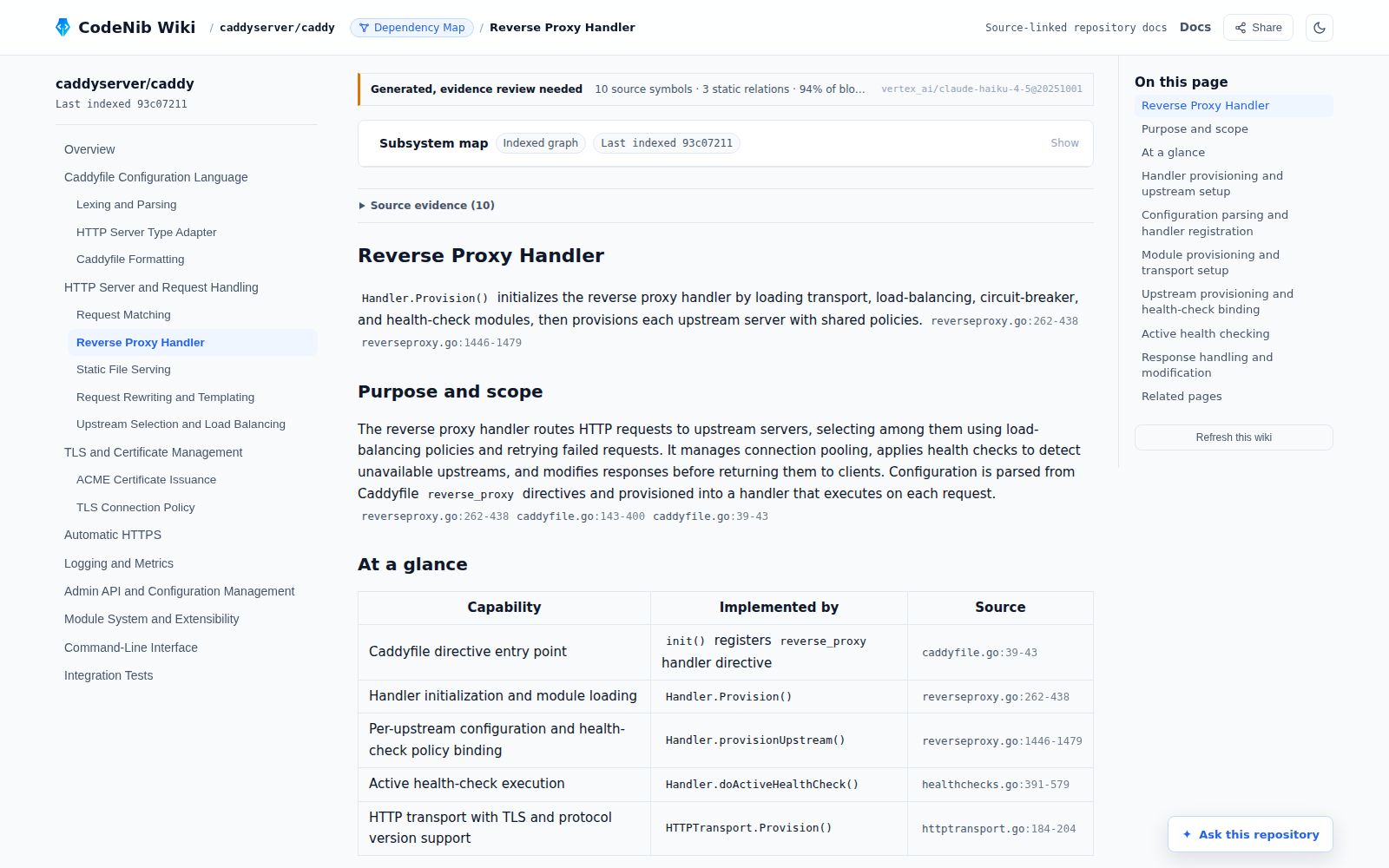
Export that indexed commit as a serverless Wiki when a live Ask backend is not needed:
codenib export /path/to/repository --output /tmp/repository-wiki
The export contains a versioned provenance manifest, precomputed Wiki pages, source citations, and available page-level dependency data. It contains no provider credential; interactive Ask and runtime graph exploration remain on the local or MCP serving path.
For a repository-hosted Wiki, CodeNib also ships a reusable GitHub workflow
that builds or reuses the same manifest, deploys the static site to Pages,
and uploads the matching commit-addressed context artifact. Its default
semantic route builds BM25 and vector views with a cached local Hugging Face
model and needs no API key. An explicit fast route avoids the model download;
a BYO OpenAI-compatible endpoint can replace local embedding. Query-time search
remains in the local or MCP runtime. See
GitHub Pages.
The published BM25/vector artifact can then be verified against an exact local
checkout and served through MCP without rebuilding the repository views.
See the Quickstart for ports, advanced indexing, and troubleshooting.
Serve An Agent
The recommended path configures installed Codex and Claude Code clients through their native CLIs:
python -m pip install "codenib[graph,mcp]==0.2.2"
codenib codegraph init /path/to/repository
Ask the agent to start with explore_context for bounded, source-verified
repository context and use dependency_subgraph for caller impact or callee
dependencies. The MCP server also exposes ranked BM25, regex, definition,
reference, route, and bounded source-read tools. See the
CodeGraph guide for client scopes,
diagnostics, uninstall behavior, and language prerequisites, and the
MCP Server for the complete tool contract.
The same planner is available directly to Python agents:
from codenib.agent import RepositoryContextExplorer

with RepositoryContextExplorer.from_repository(
    "/path/to/repository", policy="auto"
) as explorer:
    result = explorer.explore("where is request retry behavior implemented?", top_k=10)
Each result includes source-validated evidence plus the selected plan, capabilities, loaded views, fusion, graph, and reranking trace.
What CodeNib Provides
| Surface | Purpose |
|---|---|
| View compiler | Build independently managed views, reuse current generations, and atomically rebuild changed views under one source identity |
| Agent context runtime | Plan capability-aware retrieval and navigation, then assemble bounded source-linked evidence |
| Retrieval | BM25, dense-vector, regex/trigram, Zoekt, fusion, and reranking paths; see the validated model matrix |
| Structural context | SCIP/LSP-backed symbol graphs with source locations and typed edges |
| MCP and LSP-shaped tools | Serve one manifest to coding agents without tying the runtime to one agent framework |
| Agent compatibility | Reuse one manifest across revision-pinned LocAgent, Agentless, CoSIL, and OrcaLoca contracts, plus the published RepoNavigator jump contract over SCIP/LSP definition signals; see the support matrix |
| Benchmark compatibility | Evaluate native exploration against pinned external datasets and scorers, including SWE-Explore; see the dataset and benchmark matrix |
| Local inspection | Audit the same context through Wiki pages, Ask answers, citations, and the Dependency Map |
| Evaluation harness | Measure retrieval, navigation, incremental maintenance, and context policies on the same artifacts |
Language support varies by surface. The generated capability matrix records chunking, graph, incremental, and C++ decoder support.
Documentation
- Quickstart
- GitHub Pages
- MCP Server
- Agent Integrations
- RAG Models and Planner
- Benchmarks and Evaluation
- Web UI
- Language Capabilities
- Concepts and development guides
Build the documentation site locally with:
python -m pip install -e ".[dev]"
mkdocs serve
Development
git clone https://github.com/sysevol-ai/CodeNib.git
cd CodeNib
make dev
make test
The test suite is split into unit, integration, serial integration, core, graph-consumer, and slow tiers. See CI/CD before running the credential- or toolchain-dependent tiers.
Status
CodeNib 0.2.2 is a beta release. The CLI and manifest format are usable, but
public interfaces may still change before a stable release. Historical
research artifacts retain their published dataset identifiers; the maintained
package, import namespace, commands, and repository use CodeNib. See
Naming.
Citation
If you use CodeNib in your research, please cite our arXiv paper:
@misc{yu2026codenibmultiviewdataserving,
      title={CodeNib: A Multi-View Data System for Serving Repository Context to Coding Agents},
      author={Zhongming Yu and Hengjia Yu and Boqin Yuan and Shuting Zhao and Yizhao Chen and Aryan Dokania and Mihir Jagtap and Jiayu Chang and Yitong Ma and Yash Jayswal and Wentao Ni and Hejia Zhang and Zhaoling Chen and Gangda Deng and Jishen Zhao},
      year={2026},
      eprint={2607.25431},
      archivePrefix={arXiv},
      primaryClass={cs.SE},
      url={https://arxiv.org/abs/2607.25431},
}
Project
Website · Changelog · Contributing
License
CodeNib is licensed under the Apache License, Version 2.0.
1 maintainer

Release files for codenib 0.2.2
For a detailed explanation of source distributions (sdists) and built distributions (wheels), please see the package formats documentation.
Source distribution (sdist)
| File | Size | Uploaded | |
|---|---|---|---|
| codenib-0.2.2.tar.gz | 3.2 MB | Details |
Built distributions (wheels)
| File | Interpreter | ABI | Platform | Reset |
|---|---|---|---|---|
| codenib-0.2.2-cp310-abi3-manylinux_2_28_x86_64.whl | CPython 3.10 | abi3 | Linux glibc 2.28+ x86-64 | Details |
| codenib-0.2.2-cp310-abi3-manylinux_2_28_aarch64.whl | CPython 3.10 | abi3 | Linux glibc 2.28+ ARM64 | Details |
Total release size: 9.8 MB
Release files / codenib-0.2.2.tar.gz
| Download URL | codenib-0.2.2.tar.gz |
|---|---|
| Size | 3.2 MB |
| Tags | Source |
|
SHA-256 checksum How to use checksums |
b6e8b92f936edabd45f0dbc67ea4162812ab79259bf8b57bbd79296a036aa8c7
|
|
BLAKE2b-256 checksum How to use checksums |
3c477b07a41303a0c339291162463141a860e021b2e969520959f9bfd1b2941d
|
| Upload date | |
|
Uploaded using Trusted Publishing? What is trusted publishing? |
Yes |
| Uploaded via |
twine/7.0.0 CPython/3.13.14
|
Provenance
Provenance describes where a file came from. On PyPI, provenance is shared via attestations, which provide a verifiable record of the build or publishing details. View details, limitations and caveats.


PyPI Publish Attestation
PyPI verified that this artifact, at this checksum, originated from the publisher listed below.
Signed by GitHub Actions, verified by PyPI on Aug 21, 2026.
Transparency logRelease files / codenib-0.2.2-cp310-abi3-manylinux_2_28_x86_64.whl
| Download URL | codenib-0.2.2-cp310-abi3-manylinux_2_28_x86_64.whl |
|---|---|
| Size | 3.3 MB |
| Tags | CPython 3.10 Linux glibc 2.28+ x86-64 abi3 |
|
SHA-256 checksum How to use checksums |
9ced40f6bb1b55636fbb133c7fc1e0aa371feadcc54d2ad5371c5b7f47d06fce
|
|
BLAKE2b-256 checksum How to use checksums |
de0611790dba407057e29eb5728b956f2c0af1dae833423bf24a40d578d18328
|
| Upload date | |
|
Uploaded using Trusted Publishing? What is trusted publishing? |
Yes |
| Uploaded via |
twine/7.0.0 CPython/3.13.14
|
Provenance
Provenance describes where a file came from. On PyPI, provenance is shared via attestations, which provide a verifiable record of the build or publishing details. View details, limitations and caveats.
PyPI Publish Attestation
PyPI verified that this artifact, at this checksum, originated from the publisher listed below.
Signed by GitHub Actions, verified by PyPI on Aug 21, 2026.
Transparency logRelease files / codenib-0.2.2-cp310-abi3-manylinux_2_28_aarch64.whl
| Download URL | codenib-0.2.2-cp310-abi3-manylinux_2_28_aarch64.whl |
|---|---|
| Size | 3.3 MB |
| Tags | CPython 3.10 Linux glibc 2.28+ ARM64 abi3 |
|
SHA-256 checksum How to use checksums |
909c82a5854fa159197903f3a3c7755578783acbeb1a8261d081f11c82e983e0
|
|
BLAKE2b-256 checksum How to use checksums |
037bcd68f7213e492b4e50a181032f66cfc07621728229cc97415ff97cfd5249
|
| Upload date | |
|
Uploaded using Trusted Publishing? What is trusted publishing? |
Yes |
| Uploaded via |
twine/7.0.0 CPython/3.13.14
|
Provenance
Provenance describes where a file came from. On PyPI, provenance is shared via attestations, which provide a verifiable record of the build or publishing details. View details, limitations and caveats.
PyPI Publish Attestation
PyPI verified that this artifact, at this checksum, originated from the publisher listed below.
Signed by GitHub Actions, verified by PyPI on Aug 21, 2026.
Transparency log













