
CodeSextant




A practical code navigation and change-impact tool for AI coding agents and human developers.
See the codebase
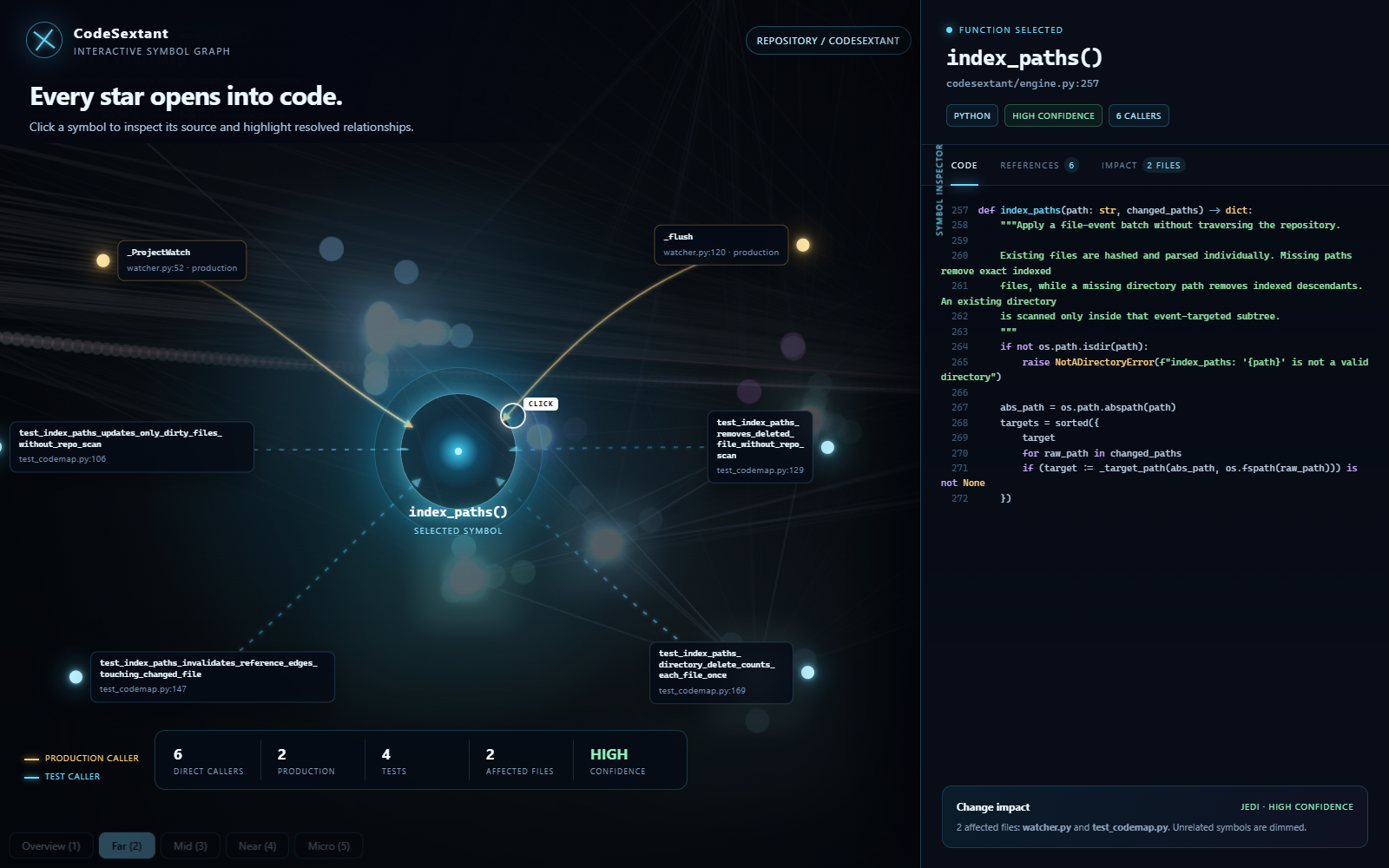
CodeSextant indexed its own repository for this WebGPU prototype. The published package exposes the graph through the CLI and HTTP API in text or JSON. The renderer is not included in the package.
Each star is a symbol with a file, line number, and source snippet. Selecting one opens the code and highlights its direct callers while unrelated symbols fade. Production and test edges use separate styles.
The selected symbol is index_paths() at codesextant/engine.py:257. The inspector shows six high-confidence callers across two affected files.
CodeSextant builds a local graph of symbols and reference edges so agents and developers can trace callers, locate code, and estimate change impact before editing.
For AI agents, the index turns repository structure into targeted queries for the files and symbols worth reading. Developers can use the same graph through the CLI or HTTP API. The daemon updates it from native file events.
Python and TypeScript/JavaScript references are resolved through imports. Other supported languages return low-confidence name matches. CodeSextant runs locally without an API key and does not send source code off the machine.
Install · Open the GUI · Give it to an AI agent · Language support
Quick start
CodeSextant is tested on CPython 3.10 through 3.13.
python -m pip install codesextant
codesextant gui .
The second command indexes the current project, starts the local daemon, and opens the dashboard in your default browser. To connect an AI coding agent, also install the CodeSextant skill.
Platform support
The complete test suite runs on every push across Windows, macOS, and Linux with CPython 3.10, 3.11, 3.12, and 3.13.
| Platform | Tested environment | Notes |
|---|---|---|
| Windows | GitHub-hosted Windows x64 runner | Use PowerShell, Command Prompt, or another terminal. Windows ARM64 and 32-bit are not covered by CI. |
| macOS | GitHub-hosted macOS runner | Intel and Apple Silicon dependency wheels are available, but CI covers the current hosted runner only. |
| Linux | GitHub-hosted Ubuntu runner | Other distributions may work when CodeSextant's binary dependencies provide compatible wheels. |
The CLI works without a desktop. The GUI requires a local browser. Git is optional, but repositories with Git automatically respect .gitignore, .git/info/exclude, and global Git ignore rules during indexing.
Open the GUI
Run this from the project you want to inspect:
codesextant gui .
Use an absolute path if the project is elsewhere:
codesextant gui "C:\path\to\your\project"
The command opens a short-lived local session URL, then redirects the browser to http://127.0.0.1:8790/. The long-lived API token never appears in the URL or page. The dashboard shows daemon status and indexed projects. From a project row, use Reindex to apply source changes, Map to list important symbols, and References to inspect callers by symbol name.
The dashboard is the current GUI. The star map shown above is a separate prototype and is not included in the published package. See the getting started guide for headless use, daemon controls, and troubleshooting.
Visual map
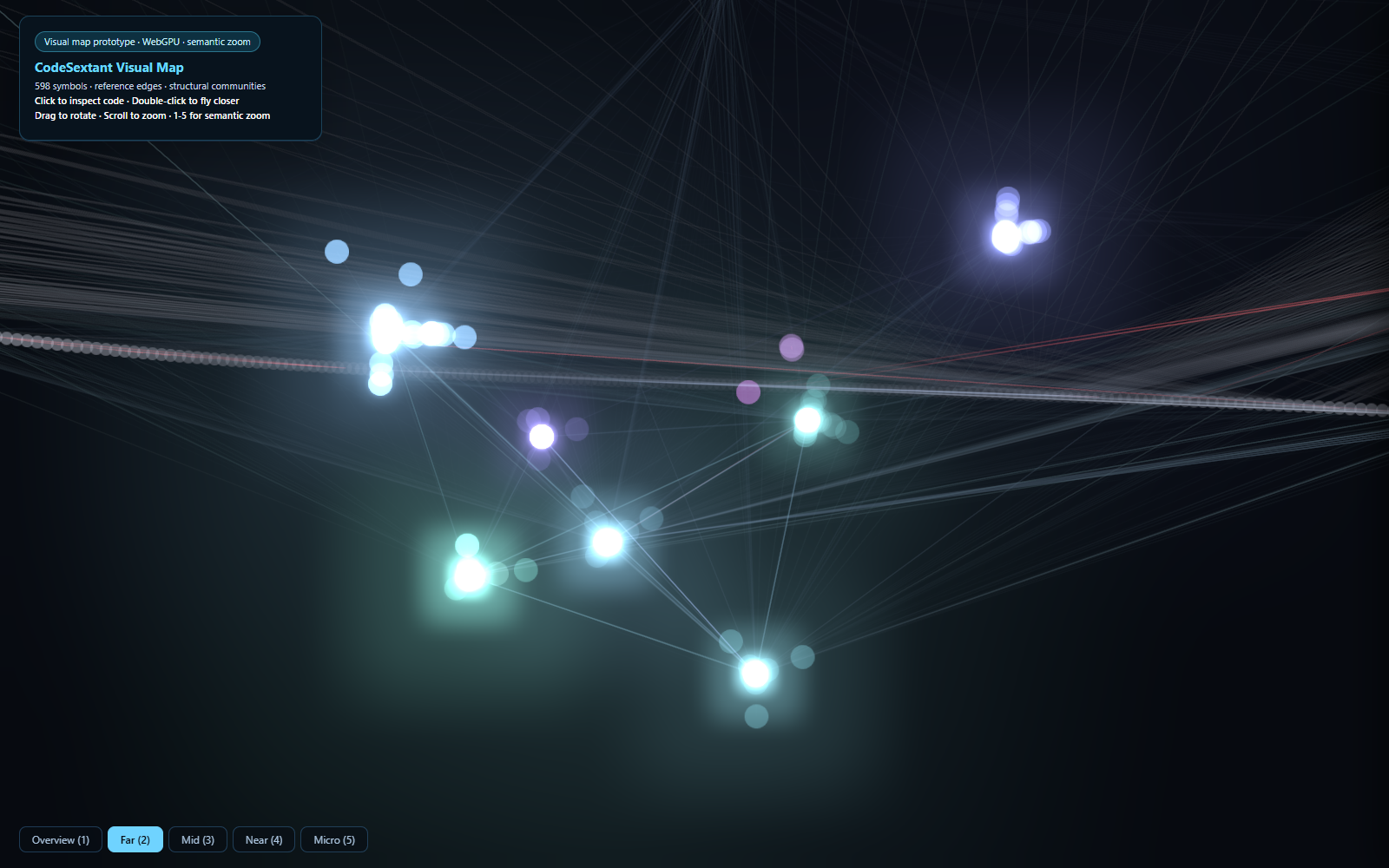
The overview groups symbols by their reference edges. Tightly connected code forms compact constellations, while tangled coupling produces overlap and visual noise.
The prototype supports source inspection, rotation, semantic zoom, and navigation from the repository overview to an individual symbol. It does not yet normalize layouts across machines or aggregate modules for very large repositories.
Why use an index
Name matching cannot distinguish same-named symbols in different scopes. In collision-heavy repositories, searches for names such as handle, run, and Config can return many false positives. For Python and TypeScript/JavaScript, CodeSextant resolves imports and stores the graph in a shared local service.
How it works
| Import resolution | Python uses jedi, and TS/JS uses ts-morph findReferences. Resolved references are high confidence, while name matches are low confidence and require source verification. |
| One shared daemon | A cross-process file lock and exclusive listen socket allow only one active process per machine. Claude Code, Cursor, the CLI, and HTTP clients can use the same instance. Projects have separate persistent SQLite databases keyed by absolute repository path. |
| Language coverage | Python and TypeScript/JavaScript have import-resolved references. Go, Rust, C#, Java, C, C++, Kotlin, Swift, PHP, Ruby, Bash, and Lua use tree-sitter symbol extraction with low-confidence name-matched references. |
| Event-driven updates | Native file events send created, edited, moved, and deleted paths to the indexer. Full scans are reserved for initial indexing and recovery. |
| Persistent reconnect | A new terminal, agent, or conversation reconnects to the existing SQLite index. The selected project is reconciled in the background after a daemon restart, so an existing graph can answer immediately. A full rebuild is not required. |
| Local only | Runs without cloud calls or API keys. Source and index data stay on the machine. |
| Budgeted output | map uses weighted PageRank to return the most important N symbols that fit a token budget, rather than dumping the whole graph. |
Give CodeSextant to your agent
The PyPI package includes the CodeSextant SKILL.md. Install it after pip install codesextant:
codesextant install-skill
The command detects Codex, Claude Code, and the open Agent Skills home on the current machine. To choose a skill root explicitly, pass it once or repeat it for several agents:
codesextant install-skill --target ~/.codex/skills
codesextant install-skill --target ~/.claude/skills
The installed layout is:
.agents/skills/codesextant/SKILL.md    # Codex and compatible agents
.claude/skills/codesextant/SKILL.md   # Claude Code
Keep the entry filename as SKILL.md. The containing codesextant directory is the skill
name under the Agent Skills specification.
If an agent does not support skill directories, attach that one Markdown file and ask the agent to use it while editing. The skill treats CodeSextant as an opportunistic accelerator, never a hard gate: it makes one bounded attempt, uses the map to narrow what should be read, and falls back immediately to focused AST, text, and source reads if the service is busy or unavailable. It also preserves confidence labels instead of treating name matches as confirmed callers.
Resolved TS/JS references require Node 20 or newer and npm install inside ts_bridge/,
which is available only in the GitHub repository. The PyPI package resolves Python
references and returns low-confidence name matches for TS/JS. Clone the repository if
you need ts-morph resolution.
Commands
python -m codesextant index      <repo>                     # build or incrementally update the index
python -m codesextant gui        <repo>                     # index, start the daemon, and open the GUI
python -m codesextant map        <repo> [--budget N]        # most important symbols, within a token budget
python -m codesextant references <repo> <symbol> [--src-root R] [--def-path D]
python -m codesextant symbols    <repo> [--file F]
python -m codesextant status     <repo>
python -m codesextant cache                                 # managed index cache usage
# any command takes --json for machine-readable output
Running the daemon without opening a browser:
codesextant gui . --no-browser
python -m codesextant.daemon ensure   # idempotent: starts one only if none is running
python -m codesextant.daemon ping     # strict liveness check (verifies /health brand, not just the port)
python -m codesextant.daemon stop
HTTP endpoints require a path-bound HMAC proof derived from the local secret in ~/.codesextant/daemon.token. The secret itself is never sent over HTTP. Endpoints take project=<absolute repo path> where applicable, so use CodesextantClient instead of constructing authentication headers yourself:
GET /health /get_symbols /get_map /status (?fresh=1 to compare against git HEAD) /projects;
POST /find_references /reindex.
On Windows, tools/register_windows_startup.ps1 optionally registers one startup check at login. Run it as administrator to add boot-time start as well. It is idempotent, so re-running it also upgrades older repeating tasks. Normal recovery is demand-driven: the next client request starts a missing daemon and retries once.
Architecture
┌── CodeSextant daemon (Python, port 8790, single instance, shared by local tools) ─┐
│   tree-sitter symbol extraction + jedi / ts-morph import resolution               │
│   incremental SQLite (content hash + git HEAD freshness) + weighted PageRank      │
│   per-project isolation: sha1(repo path) -> ~/.codesextant/<key>.db               │
│   HTTP API + deadline-bound route workers + self-contained dashboard on GET /     │
└───────────────────────────────────────────────────────────────────────────────────┘
        ▲ one daemon, many clients: CLI, agent skills, IDE webviews, HTTP clients
An exclusive socket and cross-process file lock keep at most one daemon active per machine, so agents and developer tools share one graph instead of starting separate indexers. Interactive symbol, map, reference, hierarchy, and impact requests have short deadlines and reserved execution capacity separate from rebuild and background work. The daemon exits after three idle hours by default. The persistent indexes remain on disk, and the next client starts the daemon again.
Large cold map queries are served from a SQLite covering index plus a revision-checked JSON snapshot. Direct in-process callers also use a small memory LRU; isolated HTTP workers rely on the persistent snapshots across requests. Every snapshot is a cache keyed on index revision and query parameters; SQLite remains the only source of truth, and any change invalidates them.
Queue waits and coalesced followers honor their own request deadlines, and indexing checks cancellation between files. A timed-out follower detaches from a shared result. CPython cannot safely interrupt a thread in the middle of Jedi, tree-sitter, SQLite, or another native call, so production HTTP engine routes run in disposable child processes. When an owner reaches its request deadline, the daemon terminates and reaps that exact child process tree before releasing the execution slot. Background reconciliation retains a separate one-shot hard timeout for a native call that never returns. No periodic watchdog is used.
Local security and stored data
Every data route is authenticated, including health and project listings. The dashboard shell contains no index data and its API calls require a short-lived session opened by codesextant gui. A single-use 60-second bootstrap stores that session only in the current tab's sessionStorage, then removes the code from the address bar. It does not use a cookie or persistent browser storage. Requests with a mismatched loopback Host header are rejected, request bodies and pre-auth connections are bounded, and the dashboard ships with a restrictive content security policy.
Indexes are ordinary SQLite files, not encrypted vaults. They contain absolute paths, symbols, references, hashes, and extracted comments or docstrings. They do not contain full source files. Processes running as the same OS user, or identities allowed by the storage directory ACL, can read them. At quiescent daemon shutdown, CodeSextant removes cache groups for repositories missing beyond the grace period, then applies least-recently-used cleanup only when managed indexes exceed the configured quota. Projects used by that daemon lifetime are excluded. Every SQLite and snapshot user holds an OS-locked project lease, so cleanup skips groups still open in another CLI or process. Credentials, logs, locks, and unknown files are never candidates. Run codesextant cache to inspect managed usage. To remove all local indexes and credentials, stop the daemon and delete ~/.codesextant. CodeSextant sends no telemetry and uploads no index data.
Configuration
All settings are environment variables. Boolean flags accept 1/true/yes/on case-insensitively.
| Variable | Default | Effect |
|---|---|---|
CODESEXTANT_HOME |
~/.codesextant |
SQLite database directory |
CODESEXTANT_PORT |
8790 |
daemon port |
CODESEXTANT_IDLE_TIMEOUT_SEC |
10800 |
idle seconds before the daemon exits; 0 disables idle shutdown |
CODESEXTANT_CACHE_MAX_BYTES |
10737418240 |
managed index bytes that trigger shutdown-time LRU cleanup |
CODESEXTANT_CACHE_TARGET_RATIO |
0.9 |
fraction of the quota retained after LRU cleanup |
CODESEXTANT_CACHE_MISSING_GRACE_DAYS |
30 |
age before a cache for a missing repository can be removed |
CODESEXTANT_CACHE_TOUCH_INTERVAL_SEC |
60 |
minimum interval between access marker updates per project |
CODESEXTANT_INTERACTIVE_TIMEOUT_SEC |
15 |
client deadline for symbols, map, references, hierarchy, and impact |
CODESEXTANT_MAP_TIMEOUT_SEC |
unset | optional client deadline override for cold map queries |
CODESEXTANT_MAP_CACHE_SIZE |
4 |
trimmed map results retained by direct in-process callers |
CODESEXTANT_NAMEGRAPH_MAX_FILES |
adaptive | override the file-scan cap; adapts 12 to 5000 by symbol count when unset |
CODESEXTANT_NAMEGRAPH_MAX_UNIQUE_EDGES |
250000 |
hard cap so generated code cannot exhaust memory |
CODESEXTANT_WATCH_ENABLED |
on | filesystem watcher for proactive incremental indexing |
CODESEXTANT_WATCH_IDLE_TTL_SEC |
10800 |
idle seconds before a quiescent project watcher is detached |
CODESEXTANT_WATCH_DEBOUNCE_MS |
2000 |
delay that combines a burst of file events into one dirty-path update |
CODESEXTANT_WATCH_RETRY_MAX_SEC |
60 |
maximum exponential backoff after an incremental index is rejected or fails |
CODESEXTANT_WATCH_RETRY_JITTER |
0.2 |
random spread applied to watcher retries to prevent synchronized retry bursts |
CODESEXTANT_WATCH_RECOVERY_FOLLOWER_CAP |
8 |
maximum first-query recovery followers for one project |
CODESEXTANT_HEAVY_GLOBAL_CAP |
4 |
maximum heavy jobs running across all repositories |
CODESEXTANT_INTERACTIVE_GLOBAL_RESERVE |
3 |
global slots reserved for interactive graph requests; one slot remains for maintenance |
CODESEXTANT_HEAVY_QUEUE_CAP |
8 |
base queued jobs allowed per repository |
CODESEXTANT_INTERACTIVE_QUEUE_RESERVE |
2 |
extra queue slots reserved for agent navigation queries |
CODESEXTANT_PRIORITY_AGING_SEC |
30 |
wait time before queued work rises one priority level |
CODESEXTANT_HEAVY_TIMEOUT_SEC |
900 |
default client and server deadline for batch and maintenance requests |
CODESEXTANT_HEAVY_STUCK_SEC |
1800 |
one-shot hard timeout for a native heavy call; 0 disables it |
CODESEXTANT_ROUTE_WORKER_PROCESS |
on | isolate production HTTP engine calls so request deadlines can terminate native work |
CODESEXTANT_STATUS_DB_TIMEOUT_MS |
150 |
best-effort SQLite budget for the immediate status endpoint |
CODESEXTANT_STATUS_GIT_TIMEOUT_SEC |
0.5 |
Git freshness budget when status?fresh=1 is requested |
CODESEXTANT_STATUS_TIMEOUT_SEC |
2 |
client transport deadline for the diagnostic status request |
CODESEXTANT_OVERLOAD_RETRY_AFTER_SEC |
5 |
Retry-After value returned with an overload response |
CODESEXTANT_MAX_BODY_BYTES |
65536 |
maximum JSON request body size |
CODESEXTANT_MAX_HANDLER_THREADS |
64 |
maximum concurrent HTTP handlers, including pre-auth connections |
CODESEXTANT_PREAUTH_TIMEOUT_SEC |
5 |
socket read timeout before request authentication completes |
CODESEXTANT_AUTH_TIME_SKEW_SEC |
60 |
acceptance window for a single-use signed request proof |
CODESEXTANT_AUTH_REPLAY_CAP |
8192 |
bounded in-memory nonce replay cache |
CODESEXTANT_BROWSER_SESSION_CAP |
64 |
maximum active dashboard sessions held in daemon memory |
CODESEXTANT_TS_MORPH_DISABLED |
off | force TS/JS to name matching |
CODESEXTANT_NODE |
node |
Node executable used by the TS/JS bridge; IDE hosts can provide their bundled runtime |
CODESEXTANT_TS_MORPH_TIMEOUT |
30 |
ts-morph subprocess timeout, seconds |
CODESEXTANT_GIT_FRESHNESS_DISABLED |
off | stop comparing the index against git HEAD |
CODESEXTANT_CSRF_GUARD |
on | Origin allowlist for signed native integrations; dashboard writes always require exact same-origin |
A few lower-level language-inference knobs (CODESEXTANT_INFER_LANG_*) are documented in the source.
Testing
python -m pytest tests/ -q
The suite covers the daemon lifecycle, incremental indexing, map scalability, snapshot invalidation, and reference resolution across the supported languages.
Known limitations
- Reference lookup needs the right
--src-rootwhen the import root lives in a subdirectory (.../src). Get it wrong and high-confidence references are silently missed. - When several symbols share a name, omitting
--def-pathmeans the first candidate definition wins, and high-confidence results may legitimately come back as zero. All candidates are listed so you can disambiguate. - PageRank quality depends on how dense the reference edges are, and those accumulate as
find_referencesis called. A freshly indexed repo produces a rougher map than one that has been queried for a while. - High-confidence TS/JS resolution requires
npm installints_bridge/, which is included only in the GitHub repository. PyPI installations return low-confidence name matches for TS/JS. - Go and Rust use tree-sitter symbols and low-confidence name-matched references. Their imports are not resolved.
- Event-driven updates require the daemon to be running. After downtime, the first graph query can return the existing index while one background reconciliation runs. Its
index_lifecycle.stale_possiblefield tells callers to verify affected source.status?fresh=1remains available for an explicit Git HEAD check.
Repository layout
| Path | What it is |
|---|---|
codesextant/ |
The Python implementation. This is what pip install codesextant gives you and what the docs above describe. |
ts_bridge/ |
A small Node helper the Python side shells out to for ts-morph reference resolution. Git only; the pip package does not carry it. |
tests/ |
Test suite for the Python implementation. |
ts/ |
In-progress TypeScript rewrite. It is not imported by codesextant/ or included in the published package. |
Licence
MIT. See LICENSE.
The name comes from the sextant, an instrument used to find a position when landmarks are out of sight.
The core is free and open source. A planned commercial edition will add a shared team index, multi-agent access controls and audit logs, private deployment, and supported integrations.
1 maintainer

Metadata
1 maintainer
Release files for codesextant 0.19.0
For a detailed explanation of source distributions (sdists) and built distributions (wheels), please see the package formats documentation.
Source distribution (sdist)
| File | Size | Uploaded | |
|---|---|---|---|
| codesextant-0.19.0.tar.gz | 306.3 kB | Details |
Built distribution (wheel)
| File | Interpreter | ABI | Platform | Reset |
|---|---|---|---|---|
| codesextant-0.19.0-py3-none-any.whl | Python 3 | none | any | Details |
Total release size: 520.7 kB
Release files / codesextant-0.19.0.tar.gz
| Download URL | codesextant-0.19.0.tar.gz |
|---|---|
| Size | 306.3 kB |
| Tags | Source |
|
SHA-256 checksum How to use checksums |
d90155c45935a7c82811cc094c1e7cba393e88dc315b075a7457fb11b5a2c9bf
|
|
BLAKE2b-256 checksum How to use checksums |
e3f27f32be5f5b18b4f6183685b4f57967983ea4fc1018250218d881653e18fb
|
| Upload date | |
|
Uploaded using Trusted Publishing? What is trusted publishing? |
No |
| Uploaded via |
twine/6.2.0 CPython/3.11.9
|
Release files / codesextant-0.19.0-py3-none-any.whl
| Download URL | codesextant-0.19.0-py3-none-any.whl |
|---|---|
| Size | 214.4 kB |
| Tags | Python 3 |
|
SHA-256 checksum How to use checksums |
72a48d32df947ea402dc7bd7492da9259b0ee215bc4564ff17a63c766abb1bf5
|
|
BLAKE2b-256 checksum How to use checksums |
cb6fc8f575934b9695ec72c51d93cd3c482a4d9efdac32f7159e346b2e79b479
|
| Upload date | |
|
Uploaded using Trusted Publishing? What is trusted publishing? |
No |
| Uploaded via |
twine/6.2.0 CPython/3.11.9
|














