
CogPIE: Cognitive Pattern Inference Engine



A hybrid multi-layer password candidate generator that models cognitive biases in human password creation. CogPIE predicts PII-derived passwords with high accuracy by combining semantic expansion, psychologically-motivated transforms, probabilistic ranking (Markov + PCFG), entropy scoring, and policy-aware filtering.
46.6% coverage on 13,487 real leaked credentials (51.4% case-insensitive), outperforming all 6 competing tools by +8.3pp or more.
Architecture
CogPIE implements a 5-layer pipeline that transforms a target profile into ranked password candidates:
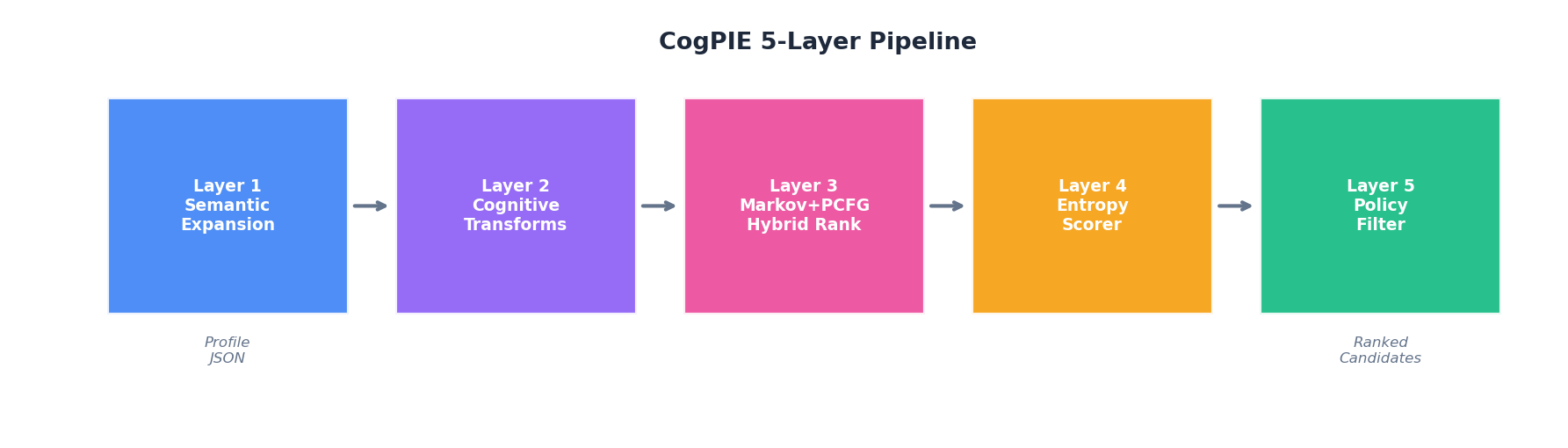
| Layer | Component | Function |
|---|---|---|
| 1 | Semantic Expander | Expands profile tokens (names, dates, keywords) into variants: nicknames, abbreviations, transliterations, cultural forms |
| 2 | Cognitive Transforms | Applies bias-driven rules: leetspeak, case mutations, anchoring suffixes, position-serial patterns, cross-field joins |
| 3 | Markov+PCFG Hybrid | Scores candidates using a character-level Markov model combined with PCFG structural templates trained on real corpora |
| 4 | Entropy Scorer | Estimates practical guessability (zxcvbn-inspired), penalizes low-entropy and rewards high-probability patterns |
| 5 | Policy Filter | Enforces password policy constraints (length, complexity) with CRC32 deduplication |
Installation
pip install cogpie
For CUDA-accelerated ranking (20x speedup):
pip install cogpie[gpu]
Requires Python >= 3.10. GPU backend requires PyTorch >= 2.0 with CUDA.
Quick Start
from cogpie import CogPIEEngine

engine = CogPIEEngine()

profile = {
    "names": ["joao", "silva"],
    "dates": ["1990", "0315"],
    "keywords": ["flamengo", "guitar"],
    "pets": ["rex"],
    "companies": ["acme"],
    "phones": [],
    "emails": ["joao.silva@gmail.com"],
    "old_passwords": ["joao123"],
    "numbers": ["42"],
}

candidates = engine.generate(profile, max_candidates=10000)
for password, meta in candidates[:10]:
    print(f"{password}: {meta['hybrid_score']:.6f}")
CLI
# Basic usage
cogpie --profile target.json --max 50000 -o candidates.txt

# With corpus training (improves Markov ranking)
cogpie --profile target.json --corpus rockyou.txt --max 100000 -o output.txt

# With password policy enforcement
cogpie --profile target.json --policy-min 8 --policy-classes 3 --max 50000

# GPU acceleration + statistics
cogpie --profile target.json --corpus rockyou.txt --max 100000 --stats -v
Profile JSON Format
{
    "names": ["first_name", "last_name", "nickname"],
    "dates": ["1990", "0315", "2510"],
    "keywords": ["favorite_team", "hobby", "band"],
    "pets": ["pet_name"],
    "companies": ["employer"],
    "phones": ["11999998888"],
    "emails": ["user@example.com"],
    "old_passwords": ["known_old_password"],
    "numbers": ["lucky_number", "apartment"]
}
Benchmark Results
Real-World Credential Benchmark (N=13,487)
Evaluated against 13,487 real leaked credentials with embedded PII extracted from public breach compilations (260K+ credentials, PII-filtered, no synthetic data). Each tool received the same profile data and a budget of 10,000 candidates.
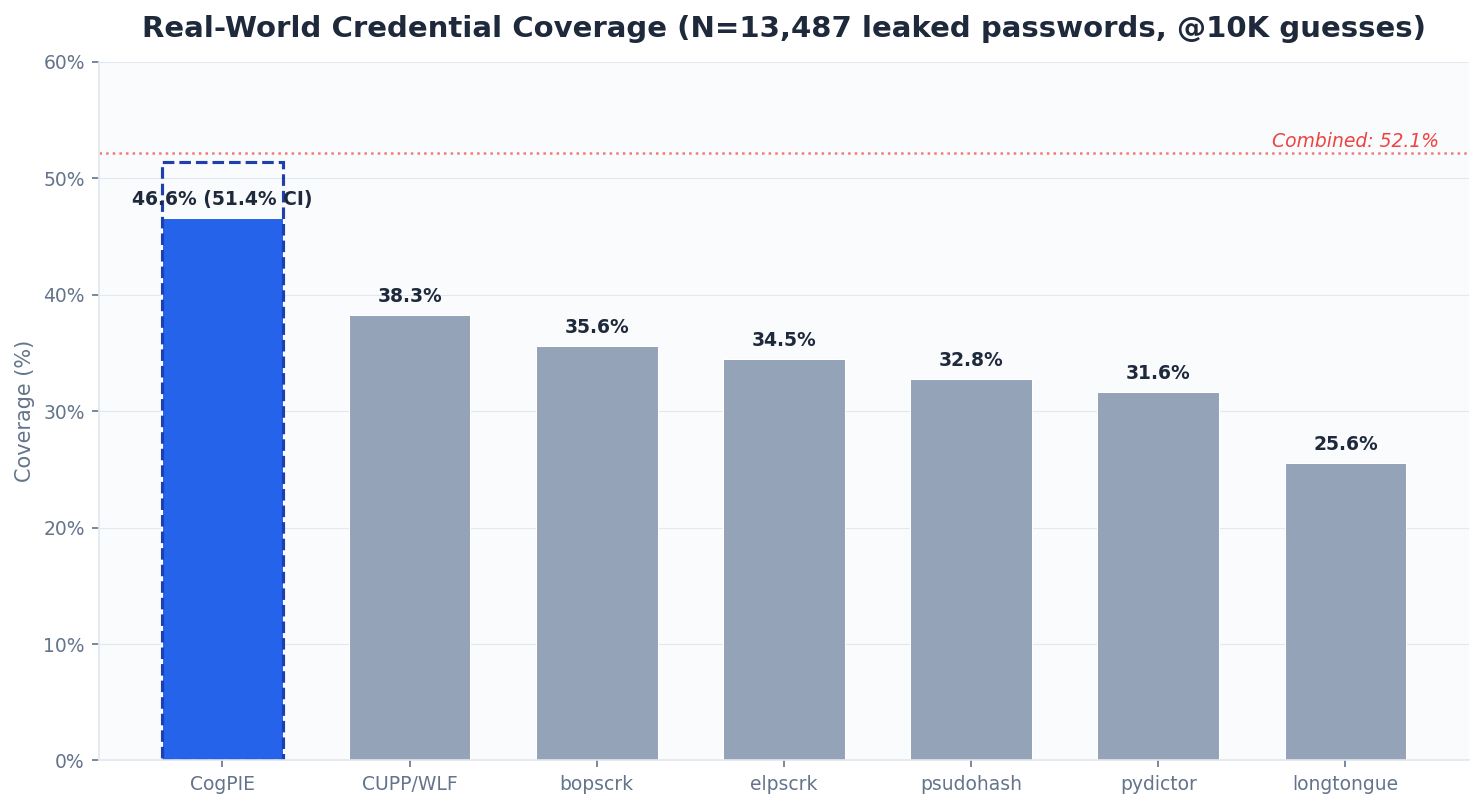
| Tool | Hits | Coverage | CI Coverage | Exclusive | Med. Rank |
|---|---|---|---|---|---|
| CogPIE | 6,286 | 46.6% | 51.4% | 541 | 20 |
| CUPP/WLF | 5,161 | 38.3% | 38.5% | 674 | 8 |
| bopscrk | 4,799 | 35.6% | 36.5% | 2 | 6 |
| elpscrk | 4,652 | 34.5% | 35.0% | 3 | 9 |
| psudohash | 4,418 | 32.8% | 33.2% | 9 | 20 |
| pydictor | 4,267 | 31.6% | 32.4% | 2 | 10 |
| longtongue | 3,446 | 25.6% | 26.3% | 0 | 9 |
| Combined | 7,032 | 52.1% |
Key findings:
- CogPIE leads by +8.3pp over the next best tool (CUPP, 38.3%)
- 541 exclusive hits: passwords found only by CogPIE, invisible to all 6 competitors
- CogPIE alone covers 89.4% of the combined 7-tool coverage (6,286 / 7,032)
- Corpus is globally diverse: 73.3% webmail, 3.8% CN/TW/HK, 0.6% .br domains
- 95% CI for CogPIE coverage: [45.8%, 47.5%]
Exclusive Hits Analysis
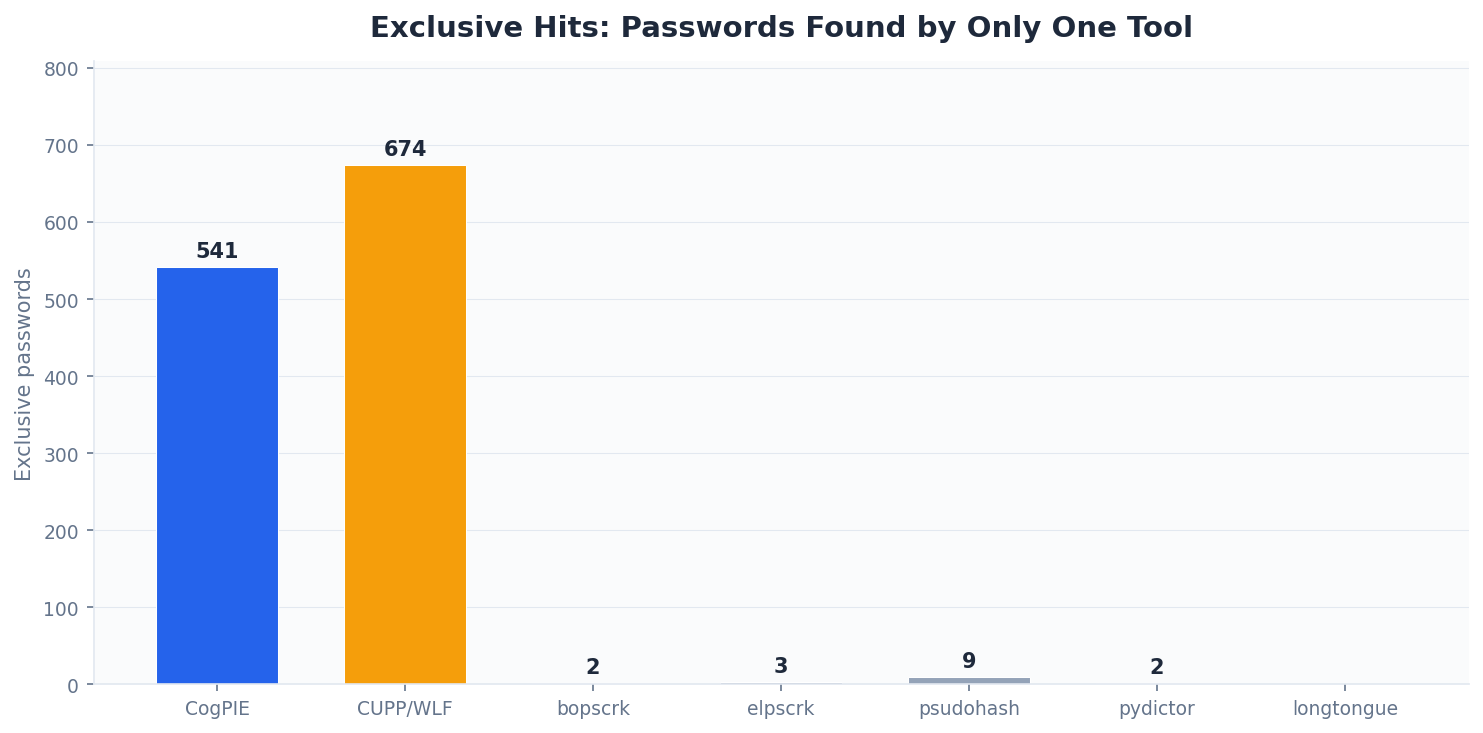
CogPIE's 541 exclusive hits demonstrate that cognitive bias modeling captures password patterns orthogonal to traditional combinatorial heuristics. These are passwords that no other tool generates within 10K candidates.
Persona Benchmark (10 profiles, @50K candidates)
Controlled evaluation with 10 synthetic personas (15-31 ground-truth passwords each) against 8 real external tools.
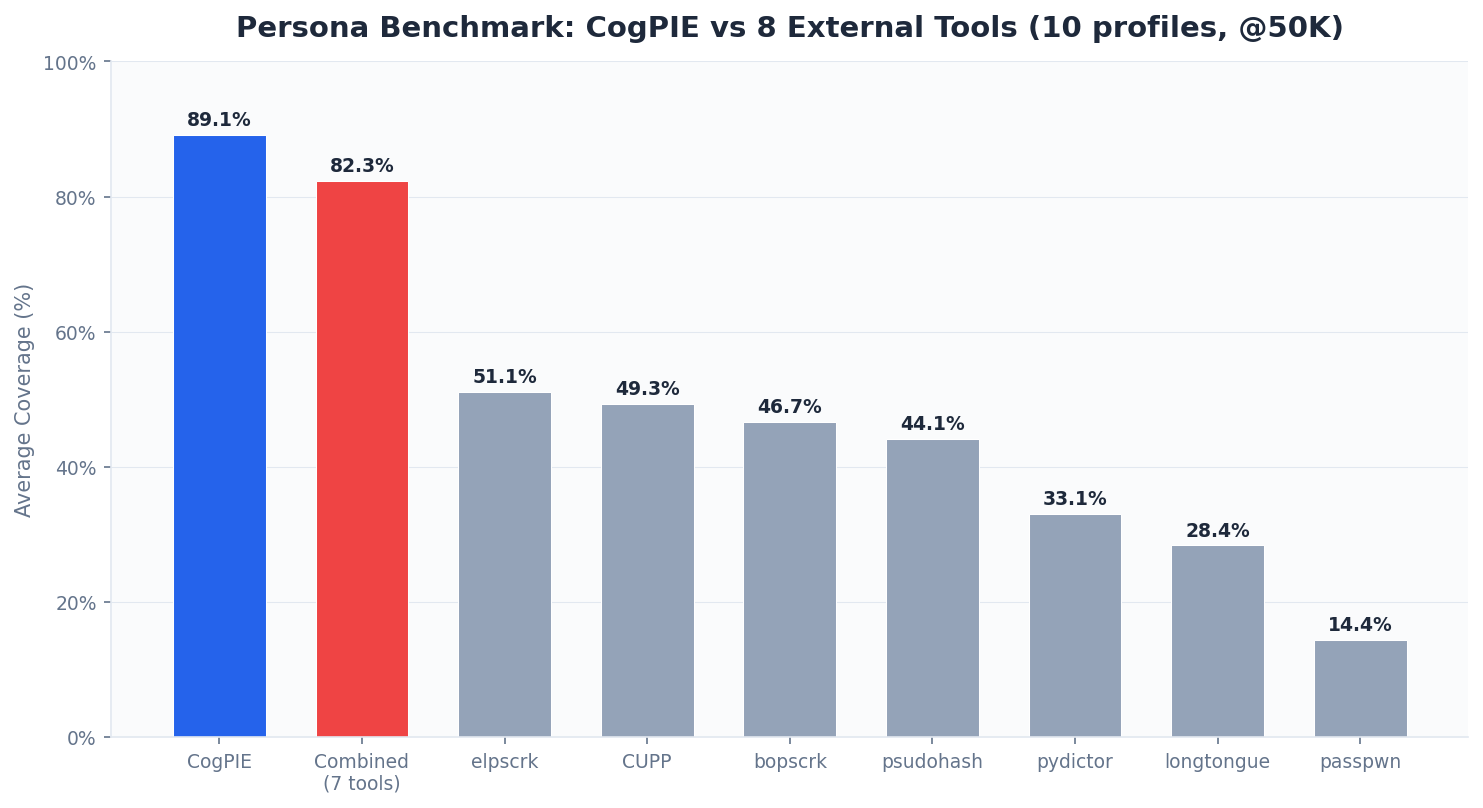
| Tool | Avg Coverage | vs CogPIE |
|---|---|---|
| CogPIE | 89.1% | baseline |
| Combined (7 tools) | 82.3% | -6.8pp |
| elpscrk | 51.1% | -38.0pp |
| CUPP | 49.3% | -39.8pp |
| bopscrk | 46.7% | -42.4pp |
| psudohash | 44.1% | -45.0pp |
| pydictor | 33.1% | -56.0pp |
| longtongue | 28.4% | -60.7pp |
| passpwn | 14.4% | -74.7pp |
CogPIE wins 10/10 personas individually against any single tool, and 7/10 against the combined output of all 7 competitors merged.
GPU Acceleration
CUDA backend provides 20x throughput on RTX 4060 (1M training corpus):
| Mode | Time/Profile | VRAM |
|---|---|---|
| CPU | 15.12s | 0 |
| GPU (CUDA) | 0.75s | 174 MB |
Falls back to CPU automatically when CUDA is unavailable:
engine = CogPIEEngine(use_gpu=True) # auto-fallback if no CUDA
How It Works
CogPIE is grounded in cognitive science research on password creation behavior:
- Anchoring bias: users build passwords around a recognizable base word
- Position-serial effect: modifications concentrate at the start and end
- Hyperbolic discounting: memorability is prioritized over security
- Familiarity heuristic: personally significant tokens (names, dates, pets) dominate
The engine exploits these biases systematically across 5 layers, producing candidates ordered by estimated real-world probability. Training on a password corpus (e.g., RockYou) calibrates the Markov+PCFG ranker to match observed character-level and structural patterns.
The central thesis, supported by empirical evidence at scale: cognitive bias in password creation is universal, cross-cultural, and resistant to complexity policies. It is not a failure of education but a fundamental property of human cognition.
API Reference
CogPIEEngine
class CogPIEEngine:
    def __init__(
        self,
        alpha: float = 0.6,        # Markov weight in hybrid score
        beta: float = 0.4,         # PCFG weight in hybrid score
        markov_order: int = 3,     # Character n-gram order
        use_gpu: bool = False,     # Enable CUDA acceleration
    ): ...

    def generate(
        self,
        profile: dict[str, Any],
        policy: PasswordPolicy | None = None,
        max_candidates: int = 100_000,
    ) -> list[tuple[str, dict[str, Any]]]: ...

    def train(self, corpus_path: str, max_lines: int = 0) -> int: ...
PasswordPolicy
from cogpie.policy_filter import PasswordPolicy

policy = PasswordPolicy(
    min_length=8,
    max_length=64,
    min_char_classes=3,  # lowercase, uppercase, digits, special
)
correlate_password
from cogpie.pii_correlator import correlate_password

result = correlate_password("joao1990!")
# result.category: "hybrid" (name + date components)
# result.name_match: "joao"
# result.date_match: "1990"
Requirements
- Python >= 3.10
- No mandatory dependencies (stdlib only)
- Optional: PyTorch >= 2.0 with CUDA for GPU acceleration
Research
CogPIE is backed by an academic paper with 42 references, formal mathematical foundations for each layer, complexity analysis, and empirical validation. Mappings to MITRE ATT&CK (T1110), CWE-521, OWASP A07:2021, and NIST SP 800-63B.
Author
Andre Henrique de Oliveira (@mrhenrike) / Uniao Geek
License
1 maintainer

Metadata
1 maintainer
Release files for cogpie 1.0.1
For a detailed explanation of source distributions (sdists) and built distributions (wheels), please see the package formats documentation.
Source distribution (sdist)
| File | Size | Uploaded | Provenance | |
|---|---|---|---|---|
| cogpie-1.0.1.tar.gz | 38.6 kB | Without provenance | Details |
Built distribution (wheel)
| File | Interpreter | ABI | Platform | Reset |
|---|---|---|---|---|
| cogpie-1.0.1-py3-none-any.whl | Python 3 | none | any | Details |
Total release size: 78.8 kB
Release files / cogpie-1.0.1.tar.gz
| Download URL | cogpie-1.0.1.tar.gz |
|---|---|
| Size | 38.6 kB |
| Tags | Source |
|
SHA-256 checksum How to use checksums |
1b57661e83fb6705b63b13d80982299266d10e9f4d218d3b7d41667b7448bc8e
|
|
BLAKE2b-256 checksum How to use checksums |
d935250640846db47560634a992bf65784996d4c4c4b657594bf8c2de16cc0cb
|
| Upload date | |
|
Uploaded using Trusted Publishing? What is trusted publishing? |
No |
| Uploaded via |
twine/6.2.0 CPython/3.14.4
|
Release files / cogpie-1.0.1-py3-none-any.whl
| Download URL | cogpie-1.0.1-py3-none-any.whl |
|---|---|
| Size | 40.2 kB |
| Tags | Python 3 |
|
SHA-256 checksum How to use checksums |
4d63cb67f92906f69cb00a2499d1a8357e8b66fb87c69d8a456d1459ad376308
|
|
BLAKE2b-256 checksum How to use checksums |
aa5f373fa15db5ab73abc7f0d9c617f91aeaf00c8ac9bb33d5c322ab831b5e08
|
| Upload date | |
|
Uploaded using Trusted Publishing? What is trusted publishing? |
No |
| Uploaded via |
twine/6.2.0 CPython/3.14.4
|
Security for cogpie 1.0.1
Provenance
Provenance describes where a file came from. On PyPI, provenance is shared via attestations, which provide a verifiable record of the build or publishing details. View details, limitations and caveats.
No provenance found
None of the files in this release were uploaded with provenance metadata.
A note on package security
PyPI is a repository for distributing packages, not a service for auditing them. While third-party security researchers and our staff do their best to detect and remove malicious packages, PyPI cannot guarantee the quality, security or suitability of any given package.














