
colorcat
Generate maximally distinct colors for categorical data palettes (chart series, legend entries, cluster labels).
>>> from colorcat import palette
>>> palette(5)
['#d001ff', '#00ad01', '#680000', '#0000ce', '#ff4100']
>>> palette(8, background="black")
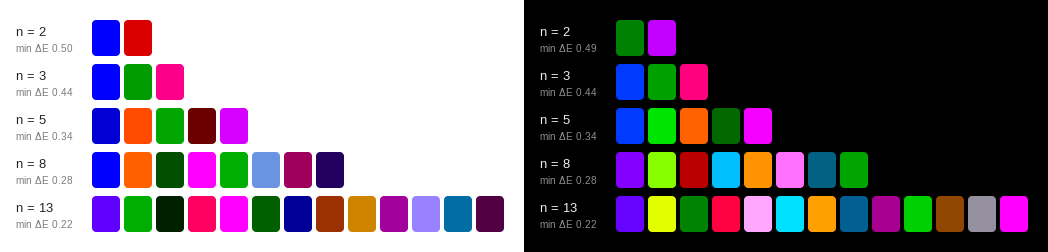
- Colors are chosen to maximize the smallest perceptual distance between any two of them and between each of them and the background and its opposite (black on white, white on black), so nothing blends into plot lines or text.
- Deterministic: the same arguments and
seedalways give the same palette. - NumPy is the only dependency. Python 3.12+.
Install
uv add colorcat # once published; from a checkout: uv sync
Usage
from colorcat import palette, min_distance

palette(6)  # on a white background (the default)
palette(6, background="black")  # lighter colors for dark backgrounds
palette(6, min_contrast=4.5)  # WCAG AA contrast with the background
palette(4, fixed=["#e41a1c", "#377eb8"])  # 4 NEW colors that extend two you already use
palette(4, exclude=["#00aa00"])  # keep clear of a color used elsewhere
palette(6, cvd=["deutan", "protan"])  # also distinct for red-green color blindness
palette(6, color_format="rgb")  # (r, g, b) tuples; also "oklab" and "oklch"
palette(6, seed=3)  # a different, similarly good palette

min_distance(palette(6))  # distance between the closest pair
palette(n, *, background, min_contrast, restart_count, exclude, fixed, cvd, color_format, seed)
| Argument | Default | Meaning |
|---|---|---|
n |
Number of colors, >= 0. |
|
background |
"white" |
"white" or "black", the color the palette is drawn on. Other values raise ValueError. |
min_contrast |
3 |
Minimum WCAG contrast ratio (1 to 15) between every color and the background. 3 is the WCAG minimum for graphical objects such as chart marks; use 4.5 for text. Higher values leave fewer colors to choose from, so the closest-pair distance drops. |
restart_count |
4 |
Independent optimizer runs (each followed by 16 basin-hopping moves); the best is kept. More is never worse, just slower (roughly 1-3.5 s for 4 at n up to 30). |
exclude |
() |
Hex colors the new colors must stay distinct from. Not returned. |
fixed |
() |
Hex colors already in use; the n new colors extend them. Never moved or returned, and exempt from the built-in ranges. |
cvd |
() |
One or more of "protan", "deutan", "tritan" (or a single name). Every pair must then be distinct to normal vision and as seen with each deficiency (full dichromacy, Machado et al. 2009 simulation). The closest-pair distance drops as views are added, more so for larger n. |
color_format |
"hex" |
"hex" ("#rrggbb"), "rgb" (0-255 ints), "oklab" (L, a, b) or "oklch" (L, C, h in degrees). |
seed |
0 |
Seed for the random starting points; None uses fresh entropy. |
Colors come back ordered so that the first is the most distant from the background and its
opposite, and each next one is the farthest from those before it. Each n is optimized separately, so
palette(4) is not the first four colors of palette(5).
palette warns (it does not fail) if the closest pair differs by less than ΔE_OK 0.03,
which happens only for very large n.
min_distance(colors, *, cvd=())
ΔE_OK between the two closest colors of a list of hex strings (inf for fewer than two).
With cvd, the closest pair over normal vision and each listed deficiency.
Command line
colorcat 8 --background black
colorcat 4 --fixed '#e41a1c' '#377eb8' --format rgb
python -m colorcat 6 --seed 3
How it works
- Color space: OKLab, where Euclidean distance (ΔE_OK) approximates perceived difference. The conversions are implemented directly in NumPy.
- Constraints: every color must have at least
min_contrastWCAG contrast with the background,(Y_light + 0.05) / (Y_dark + 0.05)on relative luminanceY. This is a one-sided bound onY(on white,Y <= 0.30at the default 3:1). Chroma and hue have no bounds of their own; the sRGB gamut is the only other limit. The opposite of the background (black on white, white on black: where lines and text are drawn) is not a constraint but a fixed point the colors are repelled from, like the background itself. - Optimization: colors are particles repelled from each other and from fixed anchors
(the background, its opposite,
fixedandexclude) by the Riesz energyE_p = (1/p) log Σ d_ij^-p, which tends to the max-min distance aspgrows. Projected gradient descent with apschedule of 4, 8, 16, 32 minimizes it, restricted to the feasible region. The landscape has local optima, so it is restarted fromrestart_countrandom starts (each with its own child ofSeedSequence(seed)). After its first descent, each restart does 16 basin-hopping moves: re-seed one of the colors in the closest pair at the roomiest spot, re-descend (p= 16, 32), and keep the result only if the closest-pair distance improved. - Quantization: the best restart is chosen after snapping to 8-bit sRGB, so the reported distances are those of the colors you actually get.
Quality
benchmarks/benchmark.py compares palette with random feasible colors, greedy
farthest-point sampling and Okabe-Ito / Tableau 10 / Set1. On white, the smallest
pairwise ΔE_OK (including the background and its opposite) is:
| n | colorcat | farthest-point | random | best named palette |
|---|---|---|---|---|
| 5 | 0.33 | 0.31 | 0.07 | 0.17 |
| 10 | 0.22 | 0.19 | 0.04 | 0.08 |
| 20 | 0.17 | 0.13 | 0.02 | |
| 30 | 0.14 | 0.11 | 0.02 |
Results vary by about 5% across seeds at small n.
Not in v1
Planned for later: user-set lightness, chroma and hue ranges; arbitrary backgrounds
(the "opposite" color repelled alongside the background would need defining);
partial-severity CVD (cvd= simulates full dichromacy); and alternative methods (farthest-point,
which gives prefix-stable palettes).
Development
uv sync
uv run pytest                              # ~30 s
uv run python benchmarks/benchmark.py      # quality vs. baselines
uv run python benchmarks/make_gallery.py   # regenerate docs/gallery.svg
Layout: _oklab.py (conversions), _distance.py (the single distance definition),
_constraints.py (built-in ranges), _feasible.py (gamut and projection),
_energy.py (optimizer), _format.py (parsing, quantization, formats),
palette.py (public API), cli.py. See plan.md for the design.
1 maintainer

Metadata
1 maintainer
Release files for colorcat 0.1.0
For a detailed explanation of source distributions (sdists) and built distributions (wheels), please see the package formats documentation.
Source distribution (sdist)
| File | Size | Uploaded | Provenance | Actions |
|---|---|---|---|---|
| colorcat-0.1.0.tar.gz | 19.2 kB | Without provenance | Details for colorcat-0.1.0.tar.gz |
Built distribution (wheel)
| File | Interpreter | ABI | Platform | Actions Reset |
|---|---|---|---|---|
| colorcat-0.1.0-py3-none-any.whl | Python 3 | none | any | Details for colorcat-0.1.0-py3-none-any.whl |
Total release size: 43.9 kB
Release files / colorcat-0.1.0.tar.gz
| Download URL | colorcat-0.1.0.tar.gz |
|---|---|
| Size | 19.2 kB |
| Tags | Source |
|
SHA-256 checksum How to use checksums |
837e4619dfd825d612f4e585dece4c68778be34e0fc7df736ba9cfd296acdb60
|
|
BLAKE2b-256 checksum How to use checksums |
d8e5f2145194469dfd9d7ae85f17bed2704410d513552ddfcceff4265b8f7784
|
| Upload date | |
|
Uploaded using Trusted Publishing? What is trusted publishing? |
No |
| Uploaded via |
uv/0.12.7 {"installer":{"name":"uv","version":"0.12.7","subcommand":["publish"]},"python":null,"implementation":{"name":null,"version":null},"distro":{"name":"macOS","version":null,"id":null,"libc":null},"system":{"name":null,"release":null},"cpu":null,"openssl_version":null,"setuptools_version":null,"rustc_version":null,"ci":null}
|
Release files / colorcat-0.1.0-py3-none-any.whl
| Download URL | colorcat-0.1.0-py3-none-any.whl |
|---|---|
| Size | 24.7 kB |
| Tags | Python 3 |
|
SHA-256 checksum How to use checksums |
f6126625fdea572be31ec8b272355c88729cde2eb0e6c1180804dfed18d3dcc3
|
|
BLAKE2b-256 checksum How to use checksums |
c22ef8fd0a009f777c28a4a2d193a57c43f803eb14d9177fed09778d6e770d44
|
| Upload date | |
|
Uploaded using Trusted Publishing? What is trusted publishing? |
No |
| Uploaded via |
uv/0.12.7 {"installer":{"name":"uv","version":"0.12.7","subcommand":["publish"]},"python":null,"implementation":{"name":null,"version":null},"distro":{"name":"macOS","version":null,"id":null,"libc":null},"system":{"name":null,"release":null},"cpu":null,"openssl_version":null,"setuptools_version":null,"rustc_version":null,"ci":null}
|
Security for colorcat 0.1.0
Provenance
Provenance describes where a file came from. On PyPI, provenance is shared via attestations, which provide a verifiable record of the build or publishing details. View details, limitations and caveats.
No provenance found
None of the files in this release were uploaded with provenance metadata.
A note on package security
PyPI is a repository for distributing packages, not a service for auditing them. While third-party security researchers and our staff do their best to detect and remove malicious packages, PyPI cannot guarantee the quality, security or suitability of any given package.
To learn more about protecting yourself from malicious actors, visit our package security documentation.














