
Colorize text and data structures in the terminal with ANSI escape codes and themed decorators.

Project description
ColorDoll: Nested ANSI Colorization for Python

ColorDoll is a Python library that provides flexible and powerful ANSI colorization, including nested colorization and theming for complex data structures like dictionaries, lists, JSON, and YAML strings.
And, it's fairly Quick.
🚀 Performance Benchmarks ⏱️
(amd 3800, 3200mhz ram, single XPG-8200 nvme, win11) - v0.1.7
| Function | Runs | Min Time (sec) | Max Time (sec) | Avg Time (sec) | As milliseconds | Runs / second |
|---|---|---|---|---|---|---|
colorize |
10,000 | 0.000006 | 0.000006 | 0.000006 | 0.006 | ~165000 |
theme_colorize |
10,000 | 0.000059 | 0.000060 | 0.000059 | 0.059 | ~16950 |
| Themed Decorator | 10,000 | 0.000023 | 0.000023 | 0.000023 | 0.023 | ~43450 |
Features
- Nested Colorization: Handles nested ANSI color codes gracefully, ensuring correct color rendering even with complex formatting.
- Theming: Supports predefined and custom themes for consistent colorization across your output.
- Data Structure Coloring: Colorizes dictionaries, lists, JSON, and YAML strings recursively, highlighting keys, values, and different data types.
- Decorator Support: Provides decorators for easily colorizing function outputs and applying themes, including monotone (single-color) wraps.
- Customizable Configurations: Allows loading color configurations from JSON or YAML files/strings, or dictionaries.
- YAML Output: Provides a handler for colorized YAML output of structured data.
- Color Removal: Includes a utility handler to strip ANSI color codes from output.
- Extensible Output Formatting: Supports custom output handlers for diverse formatting needs.
Installation
pip install colordoll
For YAML-specific features (like YamlHandler or loading YAML configurations), you'll also need PyYAML:
pip install PyYAML
Alternatively, you might be able to install with an extra:
pip install colordoll[yaml]
(Check the project's setup.py or pyproject.toml for available extras.)
Usage
Basic Colorization
from colordoll import default_colorizer, red, blue, bright_black, bg_blue

# Using color functions
print(red("This is red text."))
print(blue("This is blue text."))

# Using the colorize method with foreground and background colors
yellow_text = default_colorizer.colorize("This is yellow text on blue background\nSome terminals have trouble with both, but it is there on highlight", "yellow")
added_bg = bg_blue(yellow_text)
print(added_bg)

# Handling nested colors correctly
print(bright_black(f"This is {red('red text')} inside grey text."))
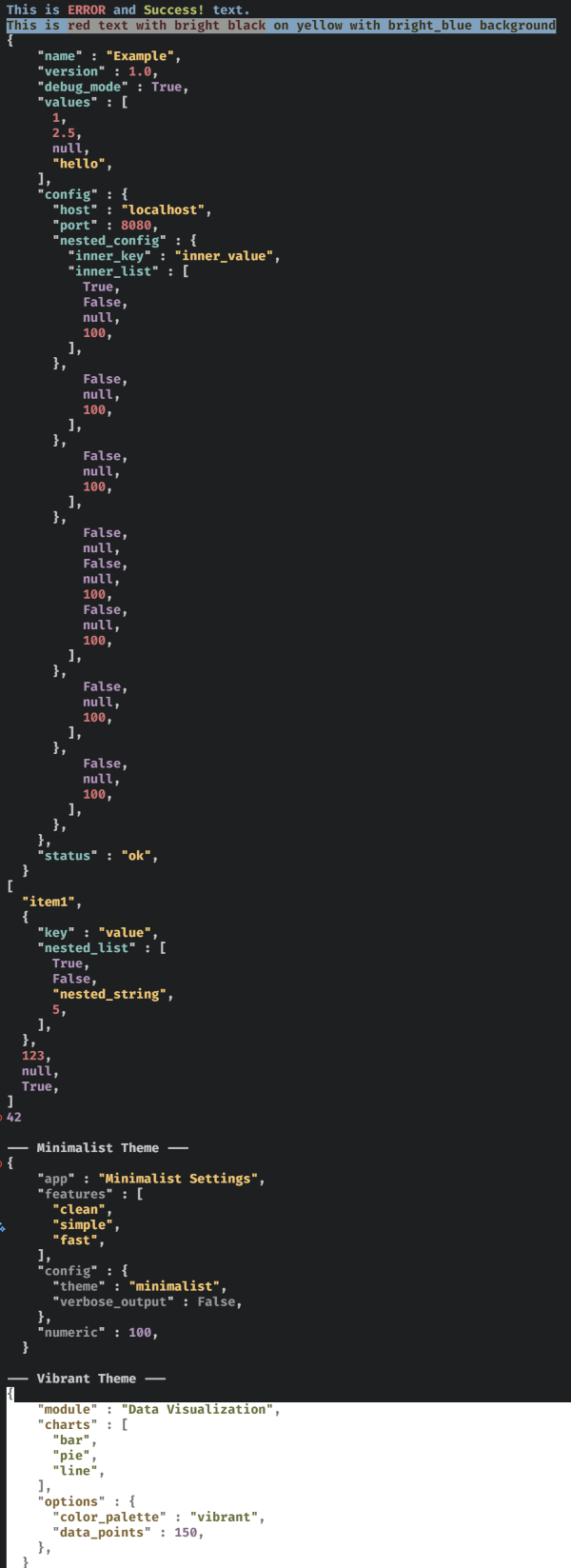
Themed Colorization (JSON/Dict)
The default output handler formats data structures like dictionaries and lists into a JSON-like string.
from colordoll import default_colorizer, darktheme, vibranttheme, DataHandler

# Ensure default handler is DataHandler (it usually is by default)
default_colorizer.set_output_handler(DataHandler())


@darktheme
def get_data():
    return {"key1": "value1", "key2": [1, 2, 3], "key3": True}


@vibranttheme
def get_other_data():
    return [{"name": "Item 1", "value": 10}, {"name": "Item 2", "value": 20}]


print(get_data())
print(get_other_data())
Monotone Theming (Wrap Decorators)
Quickly theme an entire structured output with a single color using wrap decorators.
from colordoll import wrapmono


@wrapmono("red")
def get_all_red_data():
    return {"alert": "System critical", "items": [1, 2, 3], "active": False}


@wrapmono("green")
def get_all_green_data():
    return {"info": "System nominal", "details": {"status": "OK", "code": 200}}


print(get_all_red_data())
print(get_all_green_data())
Custom Themes and Configurations
from colordoll import Colorizer, ColorConfig, DataHandler

# Ensure DataHandler is used for this example if not default
custom_colorizer = Colorizer(output_handler=DataHandler())


# Load a custom color configuration from a JSON file
# config = ColorConfig("my_colors.json")  # my_colors.json contains your custom color definitions
# colorizer_with_custom_config = Colorizer(config, output_handler=DataHandler())

# Create a custom theme
my_theme = {"key": "bright_magenta", "string": "cyan", "number": "yellow", "bool": "green", "null": "red", "other": "blue"}

# Colorize data using the custom theme
data_to_color = {"my_key": "my_value", "numbers": [1.00, 2.6, 3], "valid": None}
colored_data = custom_colorizer.theme_colorize(data_to_color, my_theme)
print(colored_data)
YAML Output
ColorDoll can output data as colorized YAML. Requires PyYAML.
from colordoll import default_colorizer, YamlHandler, light_theme_colors

# Set the output handler to YamlHandler
default_colorizer.set_output_handler(YamlHandler())

my_data = {"project": "ColorDoll", "version": "0.1", "features": ["theming", "yaml_output", "nested_colors"], "config": {"active": True, "level": 5}}

colored_yaml_output = default_colorizer.theme_colorize(my_data, light_theme_colors)
print(colored_yaml_output)

# Remember to set the handler back if you need JSON/Dict output later
# from colordoll import DataHandler
# default_colorizer.set_output_handler(DataHandler())
Removing ANSI Colors
You can strip ANSI color codes from the output.
from colordoll import default_colorizer, ColorRemoverHandler, DataHandler, vibrant_theme_colors

# Sample data
data_to_process = {"message": "This is a colorful message!", "id": 12345}

# 1. Get a normally colored output (using DataHandler)
default_colorizer.set_output_handler(DataHandler())
normally_colored_output = default_colorizer.theme_colorize(data_to_process, vibrant_theme_colors)
print(f"Normally Colored:\n{normally_colored_output}")

# 2. Get output with colors stripped (using ColorRemoverHandler)
# ColorRemoverHandler internally uses DataHandler to format, then strips colors.
default_colorizer.set_output_handler(ColorRemoverHandler())
stripped_output = default_colorizer.theme_colorize(data_to_process, vibrant_theme_colors)
print(f"\nColors Stripped:\n{stripped_output}")

# Set handler back to DataHandler for normal operations if needed
default_colorizer.set_output_handler(DataHandler())
Contributing
Contributions are welcome! Please feel free to submit pull requests or open issues.
License
This project is licensed under the MIT License.
Change Log
v0.1.7 (Current Release)
- Updated performance benchmarks with latest figures for v0.1.7.
- Improved internal logic for
colorizefor more robust nested color and background/foreground combination handling. - Documentation enhancements and README update to reflect new features.
- General code cleanup and minor internal refinements.
v0.1.6
- Added "monotone wrap" decorators (e.g.,
red_wrap,blue_wrap,bright_cyan_wrap) for quick single-color theming of structured data output. - Expanded the set of direct color function decorators (e.g.,
red_deco,blue_deco).
v0.1.5
- Implemented
ColorRemoverHandlerto strip ANSI escape codes from formatted output, allowing for easy generation of plain text versions.
v0.1.4
- Added
YamlHandlerfor colorized YAML output of dictionaries and lists. RequiresPyYAML. - Enhanced
ConfigLoaderto support loading color configurations from YAML files and strings, in addition to JSON and dictionaries.
v0.1.3
- Introduced a pluggable
OutputHandlersystem (OutputHandler,DataHandler) allowing for more flexible and extensible output formatting. - Refactored
Colorizerto utilize the newOutputHandlersystem fortheme_colorizeoperations.
v0.1.2
- Added performance benchmarks (
bench.py) to the repository. - Minor refactorings and code improvements.
v0.1 (Initial Release)
- Implemented core colorization functionality for basic string coloring.
- Created robust nested colorization and background colorization abilities.
- Introduced theming for structured data (dictionaries, lists) and decorator support (
@darktheme, etc.). - Enabled custom color configurations via dictionaries (and implicitly JSON files).
- Included various pre-defined themes (dark, light, vibrant, minimalist).
Release history Release notifications | RSS feed


Download files
Download the file for your platform. If you're not sure which to choose, learn more about installing packages.
Source Distribution
Built Distribution
Filter files by name, interpreter, ABI, and platform.
If you're not sure about the file name format, learn more about wheel file names.
Copy a direct link to the current filters
File details
Details for the file colordoll-0.1.7.tar.gz.
File metadata
- Download URL: colordoll-0.1.7.tar.gz
- Upload date:
- Size: 13.7 kB
- Tags: Source
- Uploaded using Trusted Publishing? No
- Uploaded via: twine/6.1.0 CPython/3.12.8
File hashes
| Algorithm | Hash digest | |
|---|---|---|
| SHA256 |
180f4b712f3f2379a47d1a0b406d5ae5b213a96d769dc8a30aae29371867c8d7
|
|
| MD5 |
074f647508580f7edfd6ceb69f9e8706
|
|
| BLAKE2b-256 |
17bf63b7ac0633ff1487892f85939546e20f3c5ef2835404edac65364908f305
|
File details
Details for the file colordoll-0.1.7-py3-none-any.whl.
File metadata
- Download URL: colordoll-0.1.7-py3-none-any.whl
- Upload date:
- Size: 10.9 kB
- Tags: Python 3
- Uploaded using Trusted Publishing? No
- Uploaded via: twine/6.1.0 CPython/3.12.8
File hashes
| Algorithm | Hash digest | |
|---|---|---|
| SHA256 |
da673d69971c0fb714b96eeb5551a6d6583abcbb0a2dc698b83d52a3f24a36c0
|
|
| MD5 |
072128f3b723bf01b77078ae1c19a2fd
|
|
| BLAKE2b-256 |
07e68baec7b89f2449276bbe7780fb1079799bcaba5fea17e1a567f21b9c76e5
|






