
ship
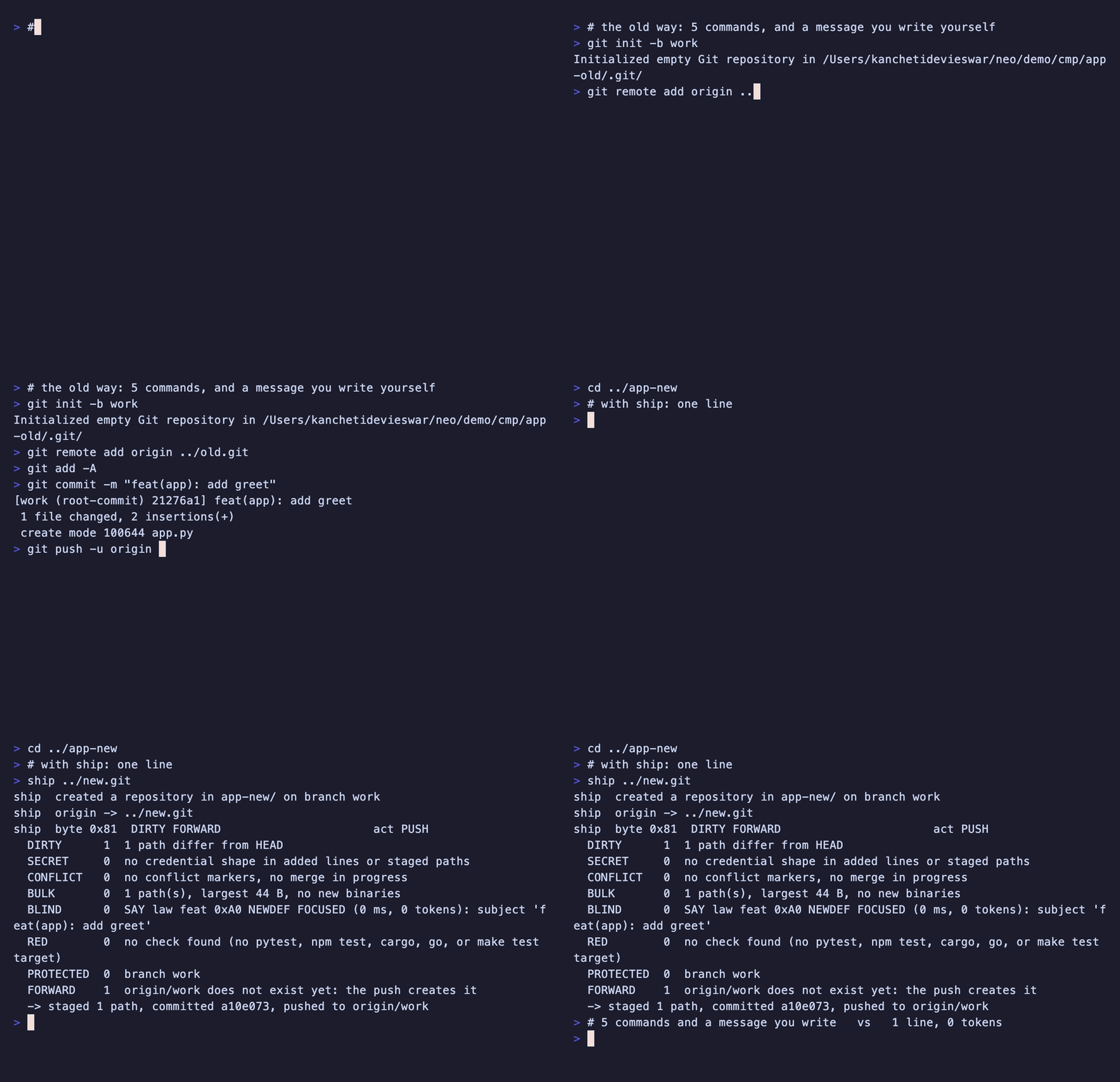
One word, one safely pushed commit. Type ship and your change is
staged, summarised, committed and pushed, or refused with the reason. No
config, no model, no API key, nothing leaves your machine but the push. Two
machine-authored, exhaustively proved kernels decide how far the change may
travel and what its subject line may claim.
pip install commitship-cli
The package on PyPI is commitship-cli; the command it installs is ship. If that command
is then "not recognized" (Windows, when pip's Scripts folder is not on
PATH), run it as python -m ship instead of ship — every command below
works both ways. Git must be installed too, since everything ship does is
git. To install the latest main rather than a release:
python -m pip install https://github.com/devkancheti4-design/ship/archive/refs/heads/main.zip
ship                         # stage, summarise, commit, push, as far as the law allows
ship "why I did this"        # your words become the subject's phrase, verbatim
ship -i                      # show the ruling, then ask y/N before anything is written
ship -n                      # dry run: measure and rule, write nothing
ship https://github.com/you/repo.git   # a plain folder: create the repo, set origin, ship it
ship --eyes ollama           # let a local model write the prose instead
ship selfcheck               # re-derive both laws over all 256 inputs, in Python and in C
To have the bare word ship on PATH on Windows, either install with
pipx install https://github.com/devkancheti4-design/ship/archive/refs/heads/main.zip
or add the folder that python -m pip show -f commitship-cli lists for ship.exe to PATH.
Why this exists
Every AI commit tool I looked at does three things I do not want done to my history. It sends the diff to someone else's API, so it needs a key, costs tokens, and the diff leaves the machine. It writes a fluent message that nobody can audit, so the same diff gets a different message on a different day and the message can claim a fix the diff does not contain. And it never refuses: it will stage a leaked key, write it a nice subject, and push.
ship is built the other way round. Nothing is inferred by anything that
cannot be audited: eight yes/no measurements become a byte, a 20-instruction
branchless kernel turns the byte into how far the change may go, and a
second byte through an 8-instruction kernel decides what the subject may
claim, with the nouns copied from the diff. Refusal is a first-class outcome,
not an error. And the two kernels come with exhaustive self-checks over all
256 inputs that you run yourself, offline, in under a second.
Safety first
The report prints the ruling before the first git write, so you see what
is about to happen, and ship -i stops there and asks:
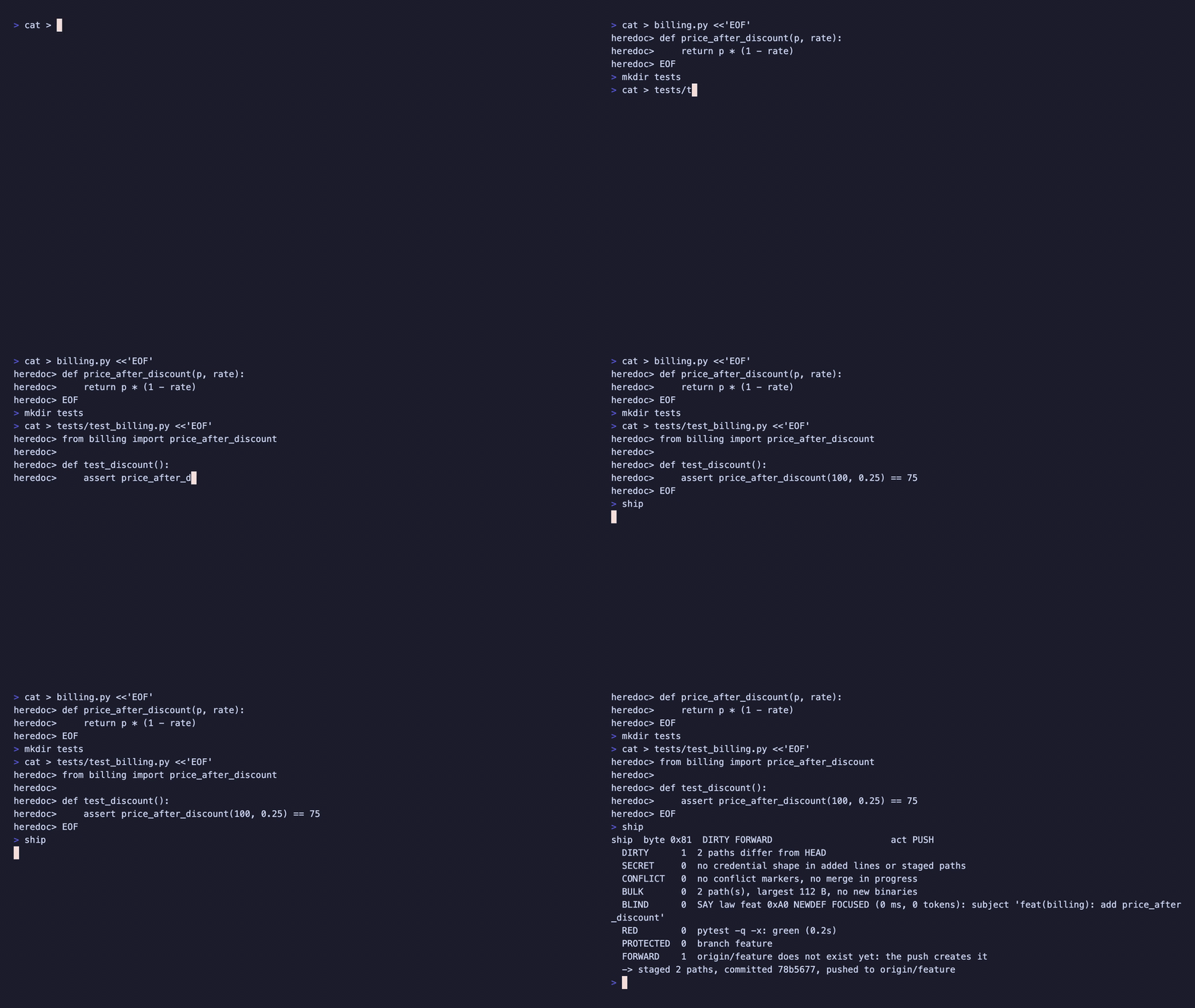
ship  byte 0x81  DIRTY FORWARD                      act PUSH
  DIRTY      1  2 paths differ from HEAD
  SECRET     0  no credential shape in added lines or staged paths
  ...
  FORWARD    1  origin/feature is an ancestor of HEAD: fast-forward
  -> will stage, commit and push. Continue? [y/N]
Without -i, ship acts on the ruling at once. Either way these hold:
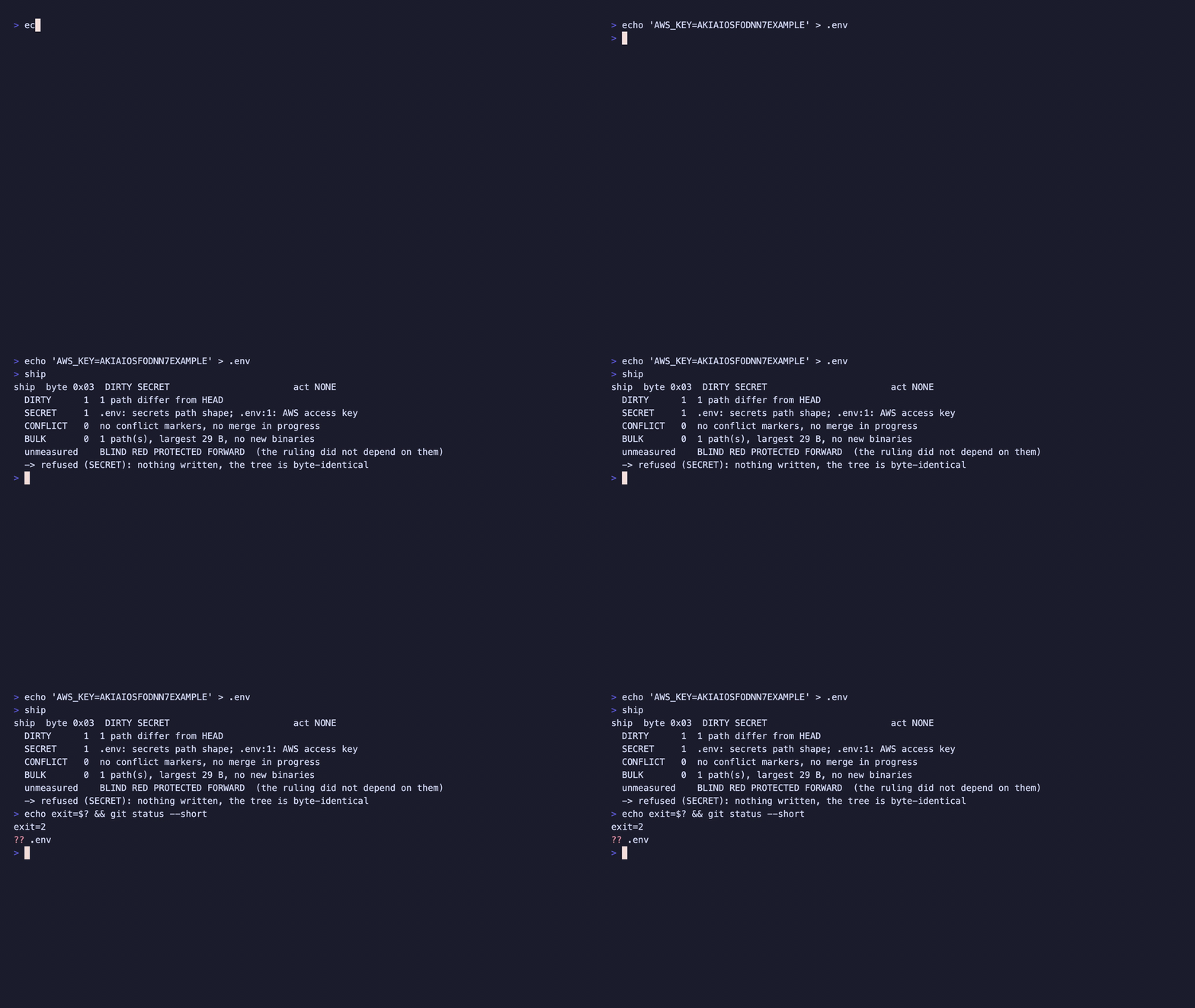
- A leaked secret, a conflict marker, or a bulk change writes nothing. Not the index, not history, not the remote. The tree is byte-identical afterwards and the report names the file and the shape, never the secret.
mainis never pushed. Neither is a red test suite, a diverged branch, or a detached HEAD. The commit is made as a local checkpoint and the push is left to you.shipnever runs--force, never rebases, never merges.- No commit under a message the eyes did not write. If the summary
cannot be produced, the change is staged and
.git/SHIP_MSGexplains. - Exactly the measured change is staged. Files that appear during the test run are not part of the change that was ruled on.
Zero tokens, zero keys, 100% private
By default there is no model at all. The summary is written by measurement:
the SAY law names the kind (feat, fix, test, docs, build, style,
revert, or plain), and the definition names, paths and scope come straight
from the diff. Zero tokens, the same message for the same change every time,
0 to 85 ms. If you want fluent prose instead, --eyes ollama asks whatever
Ollama is already running on your machine, still with nothing leaving it.
The only network ship ever touches is your own remote: one fetch to
measure whether the push would fast-forward, and the push itself.
Ultra-lightweight
| wheel | 54 kB |
| runtime dependencies | 0 (git and the Python standard library) |
| source | 1,994 lines including both kernels and their C self-checks |
| the two kernels | 20 and 8 machine instructions, no branches |
| a full run | 0.1 to 0.8 s wall on a small repo, test suite included |
How it works
working tree ──► measure 8 bits ──► ship(byte) → act    ◄ SHIP law: how far may it travel   20 instructions, 0 branches
             ──► measure 8 bits ──► say(byte)  → kind   ◄ SAY law: what may the subject claim  8 instructions, 0 branches
             ──► render  <kind>(<scope>): <nouns>       ◄ the eyes: measurement, 0 tokens
             ──► run git exactly as far as the act says, then stop and say why
The act is a ladder, and the change climbs it only as far as the SHIP law rules:
| act | what happens | who can undo it |
|---|---|---|
| 3 PUSH | stage, commit, push | nobody: it is on the remote |
| 2 COMMIT | stage, commit; stop before the network | git reset --soft HEAD~1 |
| 1 STAGE | stage, write .git/SHIP_MSG; stop before history |
git reset |
| 0 NONE | write nothing, not even the index | nothing to undo |
The SHIP byte: how far
Every bit is measured, none is an opinion, and all are measured before the first git write. What counts as a secret shape, a protected branch or a bulk change lives in the measurement (measure.py), never in the law.
| bit | name | tier | set when |
|---|---|---|---|
| 0 | DIRTY | gate | the working tree differs from HEAD (modified, deleted, or untracked non-ignored files) |
| 1 | SECRET | veto | an added line matches a credential shape (private-key header, AWS/GitHub/Slack/Google/sk- keys, bearer tokens, PASSWORD = "…"), or a staged path matches .env*, *.pem, id_rsa*, *.key, *.p12, *.pfx (.example/.sample/.template exempt) |
| 2 | CONFLICT | veto | <<<<<<</>>>>>>> markers in a changed file, unmerged paths, or MERGE_HEAD / REBASE_HEAD / CHERRY_PICK_HEAD present |
| 3 | BULK | veto | more than 50 paths, any file over 5 MB, or an untracked binary |
| 4 | BLIND | eyes | no usable summary: empty, subject over 72 characters, diff syntax in the text, or the eyes did not answer |
| 5 | RED | net | the repository's own check exists and exited non-zero (pytest, npm test, cargo test, go test, make test; auto-detected) |
| 6 | PROTECTED | net | branch is main, master, release/*, or HEAD is detached |
| 7 | FORWARD | gate | a remote exists and, after git fetch, the upstream is an ancestor of HEAD or does not exist yet |
Fail closed. Gates (DIRTY, FORWARD) are set only by a measurement that succeeded. Hazards are set by a positive finding and by any measurement that could not complete. The law never receives "unknown".
The SAY byte: what the subject may claim
The eyes are measurement too (mechanical.py). Eight facts about the change become a byte; the SAY law turns the byte into the KIND of claim the subject line may make; the body supplies the nouns.
| bit | name | tier | set when |
|---|---|---|---|
| 0 | INVERSE | shape | the change's patch, reversed, is byte-identical to one of the last 20 commits |
| 1 | BLANK | shape | the diff has hunks, none survive -w --ignore-blank-lines, no untracked file has content |
| 2 | TESTSONLY | shape | every changed path is a test (by directory or name) |
| 3 | DOCSONLY | shape | every changed path is documentation |
| 4 | DEPSONLY | shape | every changed path is a manifest, lockfile, build or CI file |
| 5 | NEWDEF | content | a code path gained a definition whose name no removed definition had |
| 6 | GUARD | content | a code path gained a guard (raise, throw, assert, null check, return err) inside a definition that existed before; moved or reindented lines do not count |
| 7 | FOCUSED | gate | the code paths number 1 to 3 and share one top-level directory |
| kind | subject | when |
|---|---|---|
| 0 revert | revert: <that commit's subject> + This reverts commit <sha>. |
INVERSE |
| 1 style | style: reformat <paths> |
BLANK |
| 2 test | test: add <test names> |
TESTSONLY |
| 3 docs | docs: <verb> <paths> |
DOCSONLY |
| 4 build | build: <verb> <files> |
DEPSONLY |
| 5 feat | feat(<scope>): add <new definitions> |
NEWDEF and FOCUSED |
| 6 fix | fix(<scope>): guard <definitions> |
GUARD and FOCUSED |
| 7 plain | <verb> <paths> or <n> files across <m> directories |
nothing above: describe, never diagnose |
The verb follows its object: add only when every named path is a new
file, remove only when every one is deleted, update otherwise. A hint
on the command line replaces the phrase, never the type:
ship "validate the discount rate" on that same change gives
feat(billing): validate the discount rate. The hint is never an input to
the law: the author's words are opinion, and the law reads only
measurements. The subject is clipped to 72 characters at a word boundary,
so the SHIP law's BLIND can only fire when git itself fails.
The laws
ship.c and say.c were authored by
search and are vendored verbatim; law.py and
say.py carry the same lane expressions character for
character, and a test fails if they drift. Both are ladders: tiers nest, so
they are bits of one mask in tier order, and ctz returns the answer with
no encoding step.
SHIP  R1  a veto is absolute            SECRET | CONFLICT | BULK  →  NONE, whatever else is set
      R2  DIRTY gates everything        clean tree  →  NONE; never an empty commit
      R3  no history without eyes       BLIND  →  STAGE at most
      R4  no network without ff/green   RED | PROTECTED | ¬FORWARD  →  COMMIT at most
      R5  monotone                      a hazard never moves a change further; a gate never moves it back

SAY   R1  shape outranks content        an undo, a reformat, tests, docs, deps: described as that
      R2  no diagnosis without focus    feat and fix need FOCUSED; a diffuse change is plain
      R3  feat outranks fix             a new definition with a guard inside is a feature
      R4  silence is the floor          no evidence → plain; the law never invents a claim
      R5  monotone                      more evidence never yields a vaguer message
Both partitions were derived in closed form before synthesis and are matched exactly: SHIP pushes on 1 input of 256 (0x81), commits on 7, stages on 8, refuses on 240; SAY splits 128/64/32/16/8/2/1/5. A kernel that always refuses, or always says plain, passes every R and is rejected by the counts. Run the proofs yourself, offline, in under a second:
ship selfcheck
SHIP law (how far the change travels), pure-Python reference over all 256 inputs:
  travelled further than allowed   0
  refused when it must not         0
  R1 veto absolute                 0
  R2 DIRTY gates everything        0
  R3 no history without eyes       0
  R4 no network without ff/green   0
  R5 monotone                      0
  partition  PUSH 1  COMMIT 7  STAGE 8  NONE 240
  counts 1/7/8/240                 exact
  the eight situations             0 violations

  TOTAL  256 inputs  0 violations

SAY law (what the subject may claim), pure-Python reference over all 256 inputs:
  said something vaguer than allowed   0
  claimed more than the evidence       0
  R1 shape outranks content           0
  R2 no diagnosis without focus       0
  R3 feat outranks fix                0
  R4 silence is the floor             0
  R5 monotone                         0
  partition 128/64/32/16/8/2/1/5
  counts 128/64/32/16/8/2/1/5         exact
  the nine situations                 0 violations

  TOTAL  256 inputs  0 violations
Each check runs twice: the pure-Python reference, and the vendored C
compiled with your cc, each against a branchy oracle that shares no
expression with the kernel. Emitted for arm64 by clang -O2: ship() is
20 instructions including ret, say() is 8; 0 branches, 0 compares, 0
selects, 0 loads in either. The authoring prompts are
SHIP_LAW_PROMPT.md and SAY_LAW_PROMPT.md.
Measure only what the ruling depends on
SHIP bits are measured in cost order, and a bit is measured only while the law's ruling still depends on it. That follows from R5: with the unmeasured hazards assumed set and the unmeasured gates clear, the law gives a floor; with the reverse, a ceiling; when they meet, nothing left to measure can change the act. So a leaked key never wakes the eyes, a protected branch never runs your test suite, and only the happy byte pays for everything. The report names what was skipped:
unmeasured BLIND RED PROTECTED FORWARD (the ruling did not depend on them)
No if-statement in the body decides where the change goes, or what it is called. The acts do.
Measured, not promised
All runs 2026-09-08 in scratch repositories with a bare local remote (fetch
and push are real git, not the public network), Apple Silicon Mac.
Wall-clock times are the whole ship invocation.
The SAY law as eyes (the default), one change after another on one branch:
| change | SAY byte | subject written | eyes | wall |
|---|---|---|---|---|
guard in an existing function, new total, two tests |
0xE0 |
feat(billing): add total |
48 ms | 0.68 s |
| one new test function | 0x04 |
test: add test_zero_rate |
59 ms | 0.69 s |
| reindent only | 0x82 |
style: reformat billing.py |
121 ms | 0.75 s |
| that reindent undone by hand | 0x83 |
revert: style: reformat billing.py |
35 ms | 0.67 s |
package-lock.json alone |
0x10 |
build: add package-lock.json |
0 ms | 0.65 s |
| a comment, with the hint "note the module purpose" | 0x80 |
note the module purpose |
111 ms | 0.75 s |
Every subject matches the REQUIRED line for its situation in the SAY
prompt, and every message passed the SHIP law's BLIND check. The same
first change, with --eyes ollama and qwen2.5-coder:7b, took 7.9 s cold
and wrote "Validate discount rate and add total helper": longer, and not
wrong, but nothing in it is auditable.
The SHIP law's situations, run with the model as eyes earlier the same day:
| situation | SHIP byte | act | wall | what happened |
|---|---|---|---|---|
| the happy path (cold model) | 0x81 |
PUSH | 7.9 s | staged 2, committed, pushed |
the leaked key (.env with an AWS key) |
0x03 |
NONE | 0.2 s | refused; eyes, check, fetch never run; tree byte-identical; exit 2 |
straight to main |
0x41 |
COMMIT | 0.6 s | committed locally; check and fetch never run; not pushed |
| the silent model | 0x91 |
STAGE | 0.3 s | index holds the change, .git/SHIP_MSG explains; no commit |
| the diverged branch (remote 1 ahead) | 0x01 |
COMMIT | 2.0 s | committed locally; never rebased, merged or forced |
The test suite (228 tests, hermetic git, a test double for the eyes) builds every one of these in a real repository and checks the tree, the index, the history, the remote and the message afterwards, plus: a hook that rejects the commit is reported (exit 3), not hidden; a file the check creates after measurement is never staged; a dry run writes nothing; eyes that raise are BLIND, not a crash; the same change gets the same message.
.venv/bin/python -m pytest -q
Configuration (all optional)
| variable | default | meaning |
|---|---|---|
SHIP_EYES |
law |
law: the SAY law and measurement, 0 tokens. ollama: a local model writes the prose |
OLLAMA_HOST |
http://localhost:11434 |
where the model lives, when asked for |
SHIP_MODEL |
first model Ollama lists | which model, when asked for |
SHIP_CONFIRM |
unset | 1: always ask y/N before the first git write, as -i does |
SHIP_CHECK |
auto-detected | the check command; none disables |
SHIP_CHECK_TIMEOUT |
600 | seconds before a check is RED for not answering |
SHIP_FETCH_TIMEOUT |
60 | seconds before a fetch clears FORWARD |
Exit codes: 0 ran as far as ruled (including "nothing to record"), 2
refused by a veto, 3 git itself failed at commit or push (a hook, an
identity, a rejected push: the report shows git's last line), 1 not a
repository.
What ship does not decide
- Which files. The change is the whole working-tree delta or nothing. Selecting a safe subset would be a deciding if-statement in the body.
- The why. A mechanical message describes what changed and never
explains motive. Your words on the command line are the phrase,
verbatim. Your
pre-commithooks still run insidegit commit, and their verdict is reported, not overridden. - Recovery. On a diverged branch
shipstops; fetching, rebasing and forcing are yours. On a red checkshipstops; repairing the tree is another law's job.
Status
Alpha. On PyPI as commitship-cli, source at
https://github.com/devkancheti4-design/ship. Python 3.10+ and any git from
the last several years (the test suite wants 2.28+ for init -b). No model,
no server, no account, no key. Ollama is used only if you ask for it.
Licensed AGPL-3.0-or-later, with a commercial option: see COMMERCIAL.md.
1 maintainer

Metadata
1 maintainer
Release files for commitship-cli 0.1.1
For a detailed explanation of source distributions (sdists) and built distributions (wheels), please see the package formats documentation.
Source distribution (sdist)
| File | Size | Uploaded | Provenance | |
|---|---|---|---|---|
| commitship_cli-0.1.1.tar.gz | 77.2 kB | With provenance | Details |
Built distribution (wheel)
| File | Interpreter | ABI | Platform | Reset |
|---|---|---|---|---|
| commitship_cli-0.1.1-py3-none-any.whl | Python 3 | none | any | Details |
Total release size: 132.3 kB
Release files / commitship_cli-0.1.1.tar.gz
| Download URL | commitship_cli-0.1.1.tar.gz |
|---|---|
| Size | 77.2 kB |
| Tags | Source |
|
SHA-256 checksum How to use checksums |
42c82bb275b091f214890c95f4644eeefe03039f9b7fe7d1b9e0823df49b1e78
|
|
BLAKE2b-256 checksum How to use checksums |
5f6788906ca1b33496e8e5262070bbb0534946d16a206dd227dde02b5aef8644
|
| Upload date | |
|
Uploaded using Trusted Publishing? What is trusted publishing? |
Yes |
| Uploaded via |
twine/7.0.0 CPython/3.13.14
|
Provenance
Provenance describes where a file came from. On PyPI, provenance is shared via attestations, which provide a verifiable record of the build or publishing details. View details, limitations and caveats.


PyPI Publish Attestation
PyPI verified that this artifact, at this checksum, originated from the publisher listed below.
Signed by GitHub Actions, verified by PyPI on Sep 14, 2026.
Transparency logRelease files / commitship_cli-0.1.1-py3-none-any.whl
| Download URL | commitship_cli-0.1.1-py3-none-any.whl |
|---|---|
| Size | 55.1 kB |
| Tags | Python 3 |
|
SHA-256 checksum How to use checksums |
5b5f022eaa5af703493b8fa969503211b6422e3a8a7020a2643c6025ee525b40
|
|
BLAKE2b-256 checksum How to use checksums |
7abcfdd4d70f66796fb382404e8e73d1085823d2f58cc75187e79b0b383aefc0
|
| Upload date | |
|
Uploaded using Trusted Publishing? What is trusted publishing? |
Yes |
| Uploaded via |
twine/7.0.0 CPython/3.13.14
|
Provenance
Provenance describes where a file came from. On PyPI, provenance is shared via attestations, which provide a verifiable record of the build or publishing details. View details, limitations and caveats.
PyPI Publish Attestation
PyPI verified that this artifact, at this checksum, originated from the publisher listed below.
Signed by GitHub Actions, verified by PyPI on Sep 14, 2026.
Transparency logSecurity for commitship-cli 0.1.1
Provenance
Provenance describes where a file came from. On PyPI, provenance is shared via attestations, which provide a verifiable record of the build or publishing details. View details, limitations and caveats.
Full provenance
All 2 files in this release have been uploaded with provenance metadata.
Attestation for commitship_cli-0.1.1.tar.gz
PyPI Publish Attestation
PyPI verified that this artifact, at this checksum, originated from the publisher listed below.
Signed by GitHub Actions, verified by PyPI on Sep 14, 2026.
Transparency logA note on package security
PyPI is a repository for distributing packages, not a service for auditing them. While third-party security researchers and our staff do their best to detect and remove malicious packages, PyPI cannot guarantee the quality, security or suitability of any given package.














