
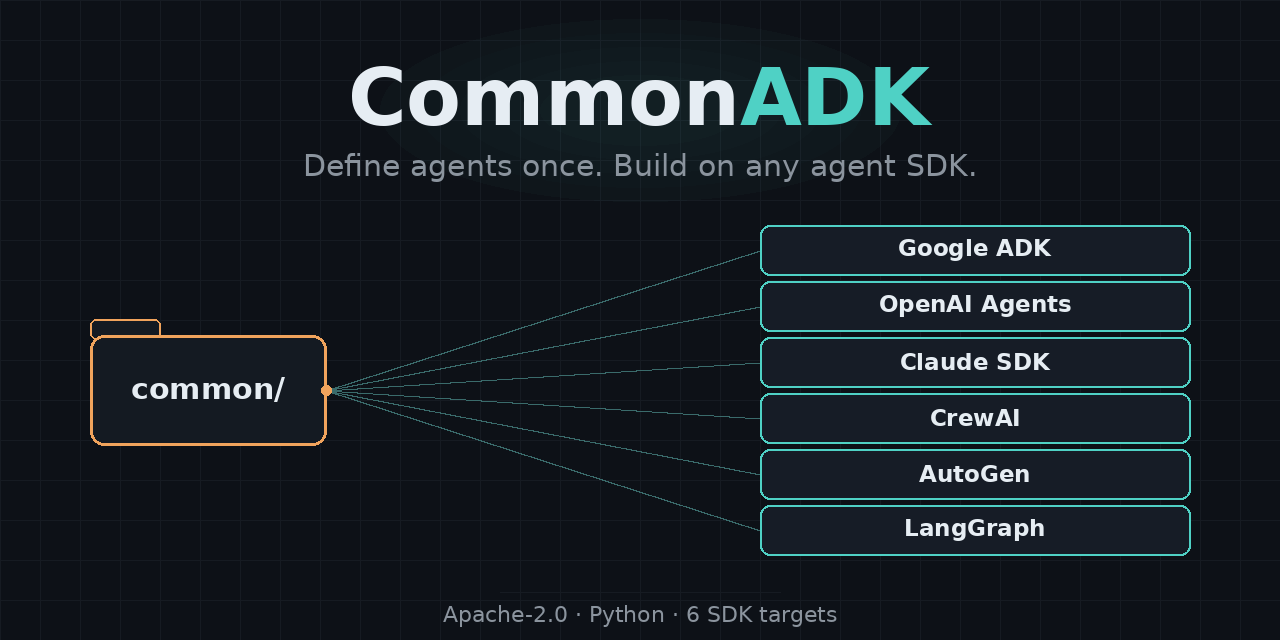
CommonADK
CommonADK is a LiteLLM-style layer for agent SDKs: define an agent system
once, in a framework-neutral common/ folder, and materialize it into any
supported agent SDK — no hand-written per-SDK agent code, no copy-pasted
prompts or tool wrappers per framework.
Hypothesis: an agent system can be defined once and built, unmodified,
on multiple SDKs. The bet CommonADK makes is that common/ can be the single
source of truth, with a thin runtime adapter per SDK doing the translation —
the same way LiteLLM lets you call any LLM provider through one interface.
The v1 success criterion (see plan.md): the same common/
folder builds and runs unmodified on both Google ADK and the OpenAI Agents
SDK. It does — examples/research-crew is proof.
Demo
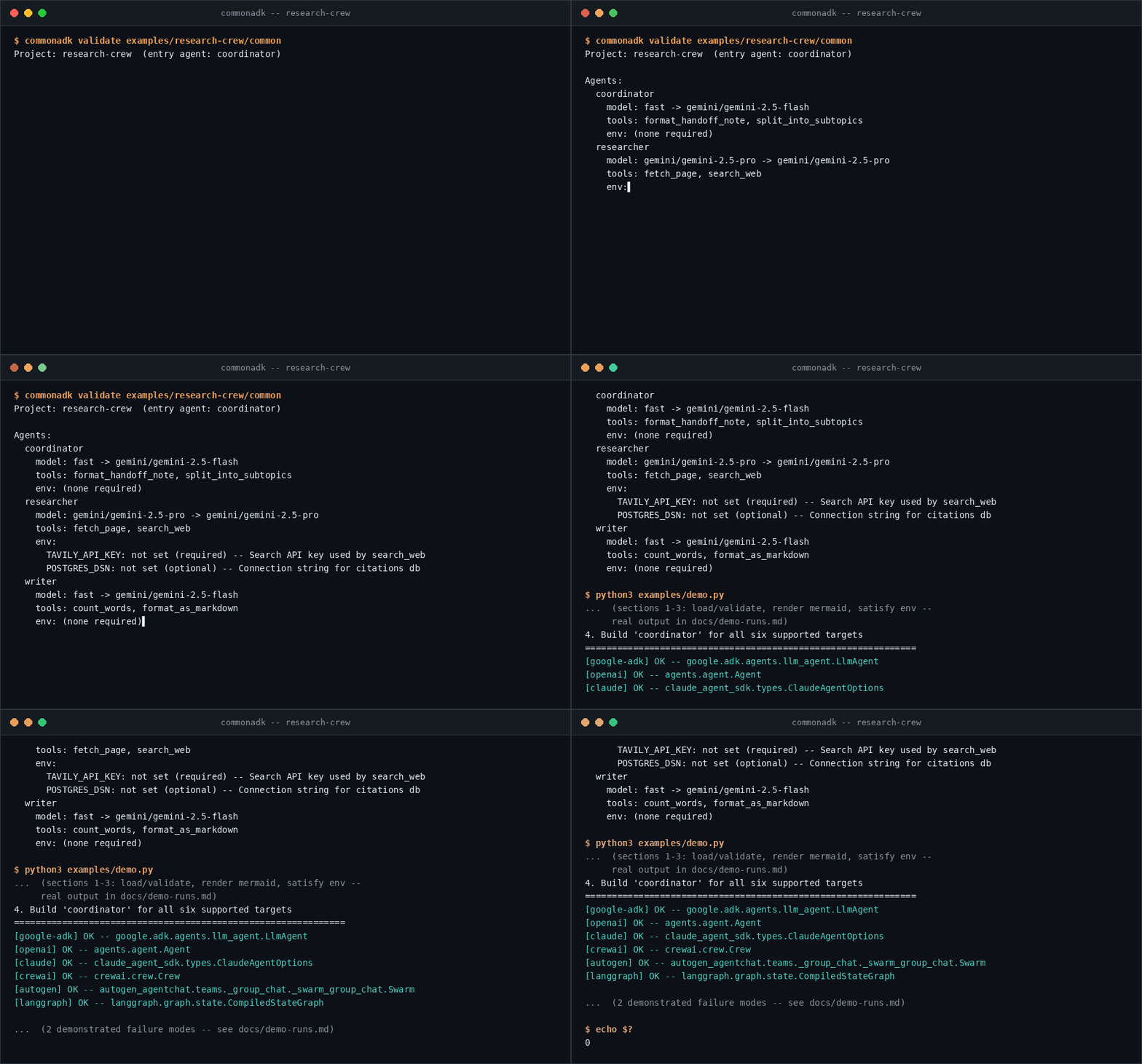
Real, captured output — commonadk validate on the shipped research-crew
example, then python3 examples/demo.py building the same coordinator
agent, unmodified, on all six SDK targets. Run it yourself with
examples/demo.py, or read the full unedited
transcripts in docs/demo-runs.md.
Quickstart
commonadk is on PyPI: pip install commonadk gets you the
core (loader, validator, mermaid renderer, CLI) with no agent SDK attached.
Install with the extra(s) for the SDK(s) you want to build against:
pip install "commonadk[google]"   # Google ADK target
pip install "commonadk[openai]"   # OpenAI Agents SDK target
pip install "commonadk[claude]"   # Claude Agent SDK target
pip install "commonadk[crewai]"   # CrewAI target
pip install "commonadk[autogen]"   # AutoGen target
pip install "commonadk[langgraph]"   # LangGraph target
pip install "commonadk[google,openai,claude,crewai,autogen,langgraph]"   # all six
Installing multiple extras together. All six extras have been verified
to resolve and install together (this repo runs its full test suite against
all six at once), but two dependency tensions are worth knowing about — both
harmless for everything commonadk itself touches: crewai pins openai<3,
so installing it alongside openai-agents (which prefers openai>=3)
resolves openai down to a 2.x release — pip then reports that as an
unsatisfied requirement (pip check will flag it), but no code path this
project exercises needs openai>=3. And autogen-core pins
protobuf~=5.29, which pulls protobuf down from the newer major version
several of google-adk's own dependencies (grpcio-status,
google-api-core, ...) would otherwise prefer — again flagged by pip check, again with no observed effect on this project's own code. Neither
tension breaks import commonadk, commonadk validate|render, or any
adapter's build().
Point it at the shipped example, a three-agent research crew
(coordinator → researcher → writer):
import commonadk

project = commonadk.load("examples/research-crew/common")   # parse + validate
agent = project.build("coordinator", target="google-adk")   # live google.adk.Agent
agent = project.build("coordinator", target="openai")       # live agents.Agent
options = project.build("coordinator", target="claude")     # claude_agent_sdk.ClaudeAgentOptions
crew = project.build("coordinator", target="crewai")         # live crewai.Crew
agent = project.build("coordinator", target="autogen")       # AssistantAgent here; Swarm if the root has handoff edges
graph = project.build("coordinator", target="langgraph")     # compiled langgraph.graph.StateGraph
(target="claude" needs each agent's agent-config.yaml to carry a
targets.claude.model override, since the example's default models are
gemini — see "Supported targets" below.)
Or from the command line:
commonadk validate examples/research-crew/common
commonadk render examples/research-crew/common
commonadk run examples/research-crew/common --target openai "Research electric vehicle adoption"
commonadk new examples/research-crew/common reviewer --from writer --type handoff
commonadk import path/to/skills examples/research-crew/common
validate loads and checks a project, printing each agent's resolved model,
tools, and required env vars (flagging which are actually set in your
shell). render regenerates interaction-layer.md from interactions.yaml
so the diagram never drifts from the spec. run builds one agent for a
target SDK and executes a single turn — this one needs real API keys. new
scaffolds a conforming agent folder (skill.md, tools.py, agent- config.yaml) inside an existing common/ — output that passes commonadk validate immediately — and refuses to overwrite an existing folder;
--from <agent> --type {delegate,handoff} additionally appends an edge to
interactions.yaml and regenerates interaction-layer.md for you. import
turns a directory of SKILL.md files into a conforming common/ project —
one agent folder per skill, skill.md copied verbatim (frontmatter
included; see "skill.md's frontmatter" below), agent-config.yaml and a
stub tools.py generated to match — and, like new, its output passes
commonadk validate immediately.
Importing existing SKILL.md libraries. If you already have a directory
of SKILL.md files — Spotify's portal-ai-plugins-style nested
skills/<name>/SKILL.md, or a flat directory of *.md files — commonadk import <skills-dir> <common-dir> turns it into a common/ project with no
edges invented between the imported agents (interactions.yaml gets an
entry: and nothing else — you wire real relationships in afterward, e.g.
with commonadk new --from). Run it again pointed at the same
<common-dir> to add more skills to an already-imported project; it
refuses to touch a directory that's neither empty nor already a valid
commonadk project.
For a runnable, offline tour of all of the above — including project.build()
against all six targets and real captured CLI output — see
examples/demo.py and docs/demo-runs.md.
The common/ folder
common/
├── config.yaml              # project-wide config
├── interactions.yaml        # typed interaction edges (source of truth)
├── interaction-layer.md     # GENERATED mermaid rendering of interactions.yaml
└── <agent-name>/
    ├── skill.md              # instructions/persona -> system instructions
    ├── tools.py               # plain typed Python functions with docstrings
    └── agent-config.yaml     # per-agent config
config.yaml — project name, entry agent, and the model-alias table
every agent's model: resolves against:
name: my-project
entry: coordinator
targets: [google-adk, openai]
default_model: fast
model_aliases:
  fast: gemini/gemini-2.5-flash
  smart: anthropic/claude-sonnet-5
<agent>/agent-config.yaml — model (an alias above, or a raw
LiteLLM-format string), tools, and required env vars. requires.env
declares names only — never values; commonadk validate and every
adapter's build-time preflight check presence, not content:
name: researcher
model: gemini/gemini-2.5-pro
tools:
  - search_web
  - fetch_page
requires:
  env:
    - name: TAVILY_API_KEY
      description: Search API key used by search_web
      required: true
<agent>/skill.md — plain Markdown instructions, passed through as the
agent's system prompt. Optional YAML frontmatter (---/YAML/--- at the
very start of the file) is stripped from the instructions text; if it sets
name or description, those are reconciled against agent-config.yaml
(which always wins on a conflict) rather than just discarded — see
docs/file-contracts.md
for the full precedence rules. This is what lets commonadk import (above)
carry a SKILL.md file's frontmatter straight through unmodified.
<agent>/tools.py — plain functions. Type hints on every parameter and a
docstring are required, checked at validate time — they're what every
adapter turns into that SDK's native tool schema:
def search_web(query: str) -> str:
    """Search the web for a query and return a short summary of top results.

    Args:
        query: The search query.
    """
    ...
interactions.yaml — the interaction graph, source of truth:
entry: coordinator
edges:
  - from: coordinator
    to: researcher
    type: delegate     # v1: delegate | handoff
  - from: researcher
    to: writer
    type: handoff
interaction-layer.md — GENERATED. commonadk render regenerates its
mermaid block from interactions.yaml, so the diagram documents the graph
instead of drifting from it:
flowchart TD
    coordinator(["coordinator (entry)"])
    researcher["researcher"]
    writer["writer"]
    coordinator -- delegate --> researcher
    researcher -. handoff .-> writer
Supported targets
| Target | target= |
Native model path | LiteLLM-wrapped otherwise |
|---|---|---|---|
| Google ADK | google-adk |
bare model id when the LiteLLM string is gemini/... |
google.adk.models.lite_llm.LiteLlm |
| OpenAI Agents SDK | openai |
bare model id when the LiteLLM string is openai/... |
agents.extensions.models.litellm_model.LitellmModel |
| Claude Agent SDK | claude |
bare model id when the LiteLLM string is anthropic/... |
no LiteLLM path — any other provider is a clear build-time error |
| CrewAI | crewai |
crewai.LLM(model=...) takes the resolved LiteLLM-format string directly, for every provider — no allowlist, no build-time error |
routes to a native provider client when it recognizes one, else falls back to litellm's completion() itself |
| AutoGen | autogen |
bare model id for openai/..., anthropic/..., and gemini/... (native autogen_ext model clients) |
no LiteLLM path — any other provider is a clear build-time error |
| LangGraph | langgraph |
"provider:model" via init_chat_model for gemini/... (→ google_genai), openai/..., and anthropic/... |
no LiteLLM path — any other provider is a clear build-time error |
Every agent's model: (an alias from config.yaml or a raw LiteLLM string
like anthropic/claude-sonnet-5) resolves the same way regardless of
target; each adapter then decides whether its SDK can speak that provider
natively or needs the SDK's own LiteLLM wrapper. A per-agent
targets.<sdk>.model override in agent-config.yaml bypasses resolution
entirely and is passed through as-is, for when you need an SDK-native model
form commonadk doesn't infer.
The Claude Agent SDK runs Anthropic models only — it has no LiteLLM wrapper
at all, so an agent whose model resolves to any provider other than
anthropic/... fails to build for target="claude" with a clear error
naming the agent, its resolved model string, and how to fix it (an
anthropic/... model, a different alias, or a targets.claude.model
override). This is why research-crew's agent-config.yaml files each carry
a targets.claude.model: claude-sonnet-5 override — the project's default
models are gemini.
AutoGen is similar in spirit: no LiteLLM path, but three native model
clients (openai/..., anthropic/..., gemini/...) instead of one, so the
shipped example builds unmodified with no targets.autogen.model overrides
needed at all. Any other provider still fails to build with the same style
of clear, actionable error.
Delegate and handoff, per SDK
interactions.yaml has one edge vocabulary — delegate and handoff — but
each of the six SDKs expresses "one agent routes work to another" through a
genuinely different data shape, and each adapter honors that shape rather
than flattening it away. Starting with the two SDKs v1 targeted: Google
ADK's sub_agents form a strict tree: an
agent instance can have exactly one parent, so a common/ graph reachable
from the build root must itself be a tree, or the adapter raises before
constructing anything (a cycle, or an agent reachable from two parents, is
rejected up front). The OpenAI Agents SDK's handoffs are a plain list of
references: the same Agent instance can sit in more than one parent's
handoffs list, and cycles are just references wired up after construction.
So the identical interactions.yaml — including graphs with a shared
sub-agent or even a cycle — builds happily as an OpenAI Agents handoff graph
while the same shape can be legitimately rejected for Google ADK. Since
v0.0.2 both adapters also distinguish delegate from handoff within
themselves: Google ADK maps delegate to an AgentTool invocation that
returns and handoff to a sub_agents transfer that does not, and the
OpenAI Agents SDK maps delegate to as_tool() and handoff to its
handoffs list. A delegate edge is exempt from the one-parent tree
constraint on Google ADK, because AgentTool never sets a parent.
The Claude Agent SDK is session/query-based, not agent-object-based: instead
of a live agent, project.build(..., target="claude") returns a
claude_agent_sdk.ClaudeAgentOptions — the config object you pass to that
SDK's query(). Its subagents (options.agents) are declared once, in a
single flat dict[str, AgentDefinition], not a nested tree — and per
the SDK's own docs, any agent whose tools include the Agent tool can invoke
any name in that flat registry, not just a parent-declared child. So this
adapter registers every agent reachable from the build root (the whole
transitive closure, however deep) into that one flat dict, and grants Agent
tool access only to the reachable agents that actually have an outgoing
edge in interactions.yaml — a deep edge (e.g. researcher -> writer when
building coordinator) is fully representable this way, and — like OpenAI
Agents' reference-based handoffs — a shared sub-agent or a cycle needs no
special rejection either: the flat dict just holds one entry per logical
agent name. See adapters/claude_agent.py's module docstring for the full
investigation and the tool-isolation mechanics (each agent's own
tools.py functions become an in-process MCP server it alone can see).
CrewAI is the one target where interactions.yaml's edge targets are
coarsened, not fully honored: project.build(..., target="crewai")
builds the requested agent as a hierarchical crew's manager_agent (or, if
it has no reachable agents at all, as the sole member of a solo sequential
crew) with every other reachable agent as a flat crew member — but CrewAI's
one delegation mechanism (allow_delegation=True) is crew-wide: an
agent that can delegate can reach any other crew member, not just the
agents interactions.yaml actually points it at. Both delegate and
handoff edges map to this one mechanism. What the graph still controls:
whether an agent can delegate at all (only agents with an outgoing edge
get allow_delegation=True) and scope (only agents reachable from the
build root join the crew). See adapters/crewai_adapter.py's module
docstring for the full investigation, including why the manager role can't
carry its own tools.
LangGraph is the one target where interactions.yaml's edge targets are
honored precisely, not coarsened — the opposite end of the spectrum from
CrewAI above: project.build(..., target="langgraph") gives each reachable
agent a prebuilt react-agent node (langchain.agents.create_agent) in one
compiled langgraph.graph.StateGraph, and for every outgoing
interactions.yaml edge it adds exactly one clearly-named tool to the
source agent — an agent can reach only the destinations the graph
actually names, nothing more. Since v0.0.2 the two edge types get genuinely
different tools: a handoff edge adds transfer_to_<destination>, which
returns LangGraph's own Command(goto=<destination>, graph=Command.PARENT)
so control transfers and does not come back, while a delegate edge adds
delegate_to_<destination>, which invokes an independently built graph for
the destination and returns its result to the caller. Neither needs a
langgraph-supervisor/langgraph-swarm dependency.
One consequence worth knowing: a build root whose only outgoing edges are
delegates is no longer wrapped in a multi-node graph at all — it comes back
as a bare, directly runnable agent, since the wrapper only ever encoded
handoff. The same is true of AutoGen and its Swarm.
Multi-parent graphs and cycles need no special handling: every reachable
agent is built once into a flat, name-keyed node registry, so a shared
destination or a cycle back to the build root is just another named handoff
tool pointing at a node that already exists. See
adapters/langgraph_adapter.py's module docstring for the full
investigation, including why langchain.agents.create_agent is used
instead of the now-deprecated langgraph.prebuilt.create_react_agent.
Mixed-target spawning
Every example above builds one common/ project under one SDK at a time.
project.build_mixed(agent_name, default_target=...) relaxes that: any
agent can pin itself to its own SDK with runtime: in its
agent-config.yaml, and agents that leave it unset fall back to
default_target — a project with no runtime: set anywhere behaves
exactly as before. Agents sharing a runtime and connected by
interactions.yaml edges are still built as one true native sub-graph by
their own adapter (an ADK sub_agents tree stays a tree); only the edges
that cross runtimes are bridged, as a plain callable "transfer to
<agent>" tool on the crossing edge's source agent — the same "every SDK
wraps a plain typed function into a tool" mechanism this whole project is
built on. google-adk, openai, crewai, and claude can source a
cross-runtime edge in v1; autogen and langgraph cannot yet (see
docs/mixed-target-design.md for exactly
why, verified against each installed SDK) — every target can be the
destination of one either way. See
examples/mixed-crew for a small two-runtime
project, and the design doc for the full three-layer model, the island
algorithm, and the failure modes. This is in-process only — no network
protocol between SDKs yet; that's future work (issue #9).
Running and observing
commonadk run executes one turn and, by default, still just prints the
final text — unchanged for anyone already using it. For google-adk and
openai (src/commonadk/runners/, the execution/telemetry layer built for
#22), two more
flags turn that one line into a full, normalized step trace:
commonadk run examples/research-crew/common --target openai --stream \
  "Research electric vehicle adoption"

commonadk run examples/research-crew/common --target google-adk \
  --trace trace.json "Research electric vehicle adoption"
--stream prints one line per normalized runtime event
(run_started/agent_started/llm_call/tool_call/transfer/
agent_finished/run_finished-or-run_error) as it happens; --trace PATH writes the full ordered event log plus roll-up totals (tokens, cost,
wall time, a breakdown per agent) to PATH as JSON. Both work
programmatically too, against the same Project any adapter builds from:
from commonadk import load
from commonadk.runners import get_runner

project = load("examples/research-crew/common")
runner = get_runner("openai")               # or "google-adk"
trace = runner.run_sync(project, "coordinator", "Research EV adoption")

print(trace.rollup())                         # totals, honest about gaps
trace.write("trace.json")
Every token/cost field is Optional, and None means "this SDK did not
report it" — never 0, never a guess. A trace's roll-up marks itself
usage_complete: false (with an explanation, not a silently wrong number)
whenever any LLM call in the run didn't report usage; cost is derived only
from tokens an SDK actually reported, against a small static pricing table
that's labeled as a snapshot, not a live feed. Multi-turn conversations use
a RunSession:
from commonadk.runners import RunSession

session = RunSession()
runner.run_sync(project, "coordinator", "What's the latest on EV adoption?", session=session)
runner.run_sync(project, "coordinator", "Now compare that to 2020.", session=session)  # same conversation
Hooks observe every event live (v1 is observe-only — a hook can't block or rewrite anything, only watch):
from commonadk.runners import HookRegistry

hooks = HookRegistry()
hooks.register(lambda event: print(event.kind, event.seq))
runner.run_sync(project, "coordinator", "hi", hooks=hooks)
All six targets have a runner as of v0.0.2, so --stream and --trace
work everywhere. Should an adapter ever land before its runner does, those
two flags give a clear error naming which targets do support them, rather
than a silent no-op. See docs/runner-design.md
for the full design: the normalized event model, the per-SDK mapping
(including exactly where token/cost data is and isn't available), the
session model, and the hook contract.
What each SDK reports differs, and the traces say so rather than papering
over it. The Claude Agent SDK computes its own cost, so that runner uses
the SDK's figure instead of the static price table. CrewAI reports genuine
per-call usage from its event bus. Where an SDK reports nothing, the trace
carries null with usage_complete: false — never a 0, which would read
as a call that was free.
Verified live runs
Five of the six targets have now executed a real turn from the same
unmodified agent definition — see the captured run in
docs/demo-runs.md for the verbatim results,
including real token counts and cost. examples/live-smoke
and scripts/live_smoke.py (issue #8) are what
produce them: a minimal project whose default_model is anthropic/claude-haiku-4-5
routes all six targets through the same Anthropic model with no per-target
override, and the script runs one real turn per target, recording outcome,
wall time, and — for google-adk/openai — a full token/cost trace via
commonadk.runners (the four other targets have no runner yet, so their
report entries say "usage": "unavailable" explicitly, never 0). It's
wired up as a workflow_dispatch-only GitHub Actions workflow
(.github/workflows/live-runs.yml) so it
only runs — and only spends money — when a maintainer explicitly triggers
it. See docs/demo-runs.md for how to
trigger it and what the report looks like.
Roadmap
The full feature map — shipped, next up, and planned — lives in
ROADMAP.md, with a GitHub issue per open item where
discussion happens. Headliners: mixed-target spawning (pinning individual
agents to different SDKs within one project,
#9) and richer
edge semantics (pipelines, loops, shared state,
#10). Design
history and settled decisions stay in plan.md.
1 maintainer

Metadata
1 maintainer
Release files for commonadk 0.0.2
For a detailed explanation of source distributions (sdists) and built distributions (wheels), please see the package formats documentation.
Source distribution (sdist)
| File | Size | Uploaded | Provenance | Actions |
|---|---|---|---|---|
| commonadk-0.0.2.tar.gz | 658.1 kB | Without provenance | Details for commonadk-0.0.2.tar.gz |
Built distribution (wheel)
| File | Interpreter | ABI | Platform | Actions Reset |
|---|---|---|---|---|
| commonadk-0.0.2-py3-none-any.whl | Python 3 | none | any | Details for commonadk-0.0.2-py3-none-any.whl |
Total release size: 797.0 kB
Release files / commonadk-0.0.2.tar.gz
| Download URL | commonadk-0.0.2.tar.gz |
|---|---|
| Size | 658.1 kB |
| Tags | Source |
|
SHA-256 checksum How to use checksums |
4b47819e0d9edcc926d26322e9dfabf7ab8b529bfe82dea26915f52b639fc858
|
|
BLAKE2b-256 checksum How to use checksums |
76b2a620768c1ed24ffa313470e4fd3905c522e80f7265e637967218cefe6c24
|
| Upload date | |
|
Uploaded using Trusted Publishing? What is trusted publishing? |
No |
| Uploaded via |
twine/7.0.0 CPython/3.13.14
|
Release files / commonadk-0.0.2-py3-none-any.whl
| Download URL | commonadk-0.0.2-py3-none-any.whl |
|---|---|
| Size | 138.9 kB |
| Tags | Python 3 |
|
SHA-256 checksum How to use checksums |
8c6a2e3db8307c6629649240d83f0c9a4bbb77a71becc1e27eee0e9175adbf35
|
|
BLAKE2b-256 checksum How to use checksums |
554096198ad48db0a8ab28f2b214a584ae950610449af2f5de4dfa0db17536cc
|
| Upload date | |
|
Uploaded using Trusted Publishing? What is trusted publishing? |
No |
| Uploaded via |
twine/7.0.0 CPython/3.13.14
|
Security for commonadk 0.0.2
Provenance
Provenance describes where a file came from. On PyPI, provenance is shared via attestations, which provide a verifiable record of the build or publishing details. View details, limitations and caveats.
No provenance found
None of the files in this release were uploaded with provenance metadata.
A note on package security
PyPI is a repository for distributing packages, not a service for auditing them. While third-party security researchers and our staff do their best to detect and remove malicious packages, PyPI cannot guarantee the quality, security or suitability of any given package.
To learn more about protecting yourself from malicious actors, visit our package security documentation.














