
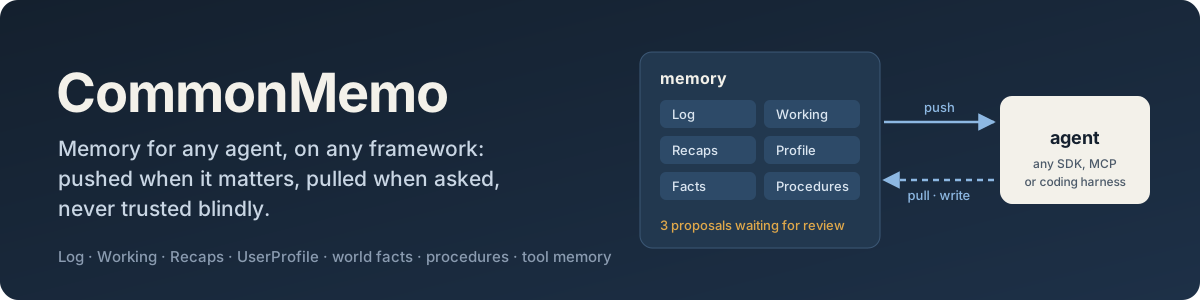
Memory for agents that works the same on every framework, and that you can audit, correct and roll back.
Agents forget everything between sessions, and the memory bolted onto them
is usually a vector store that anything can write to and nobody can
inspect. CommonMemo is one Memory handle in front of an append-only Log.
It decides what goes into each turn and records why. Agent and
model-learned writes wait for an operator's approval before they reach
anyone else. Every change can be traced back to the events behind it, and
undone. It runs the same under Google ADK, OpenAI Agents, Claude Agent SDK,
CrewAI, AutoGen and LangGraph (through CommonADK),
over MCP, and inside Claude Code, Codex and OpenCode through their hooks.


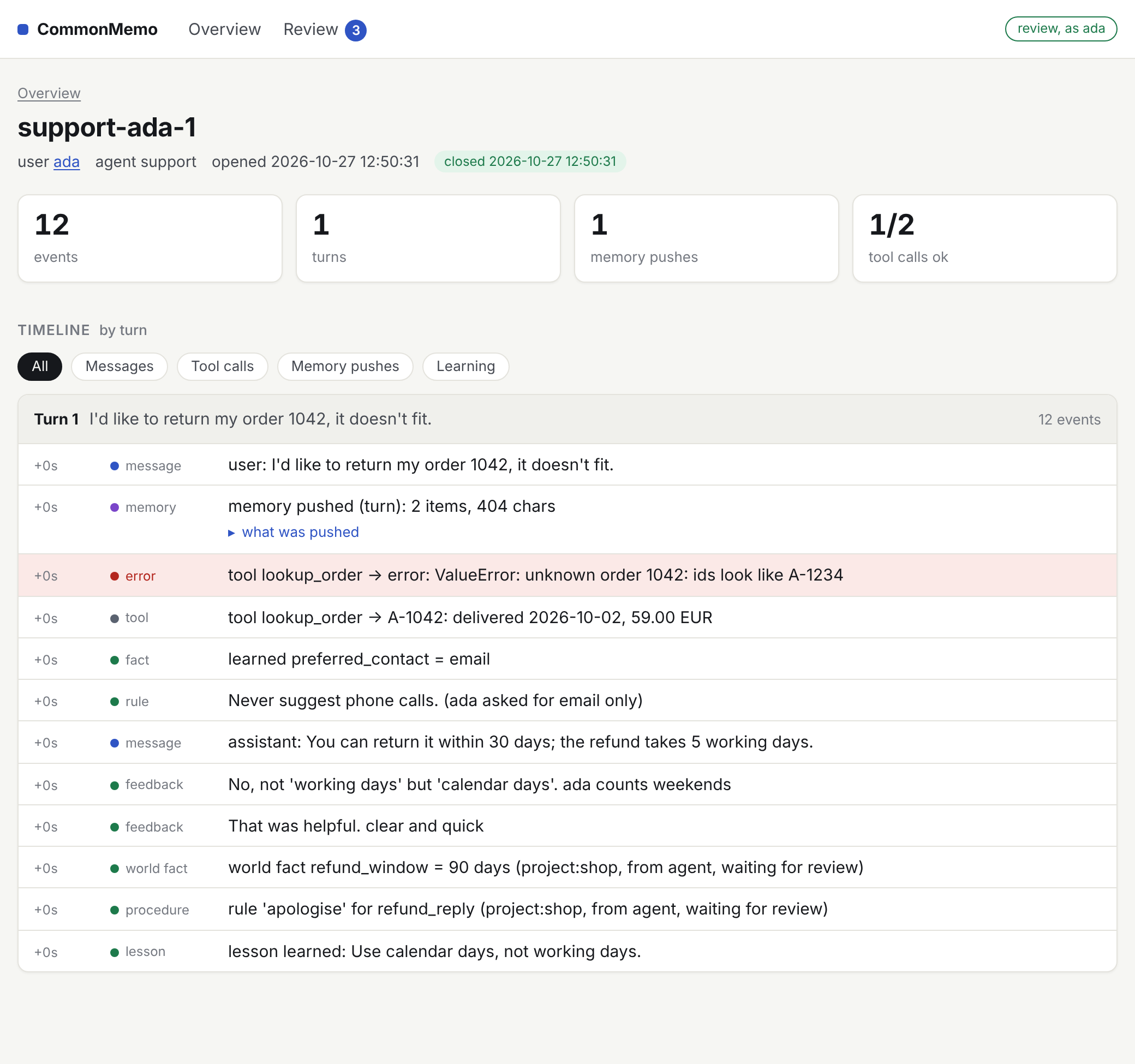
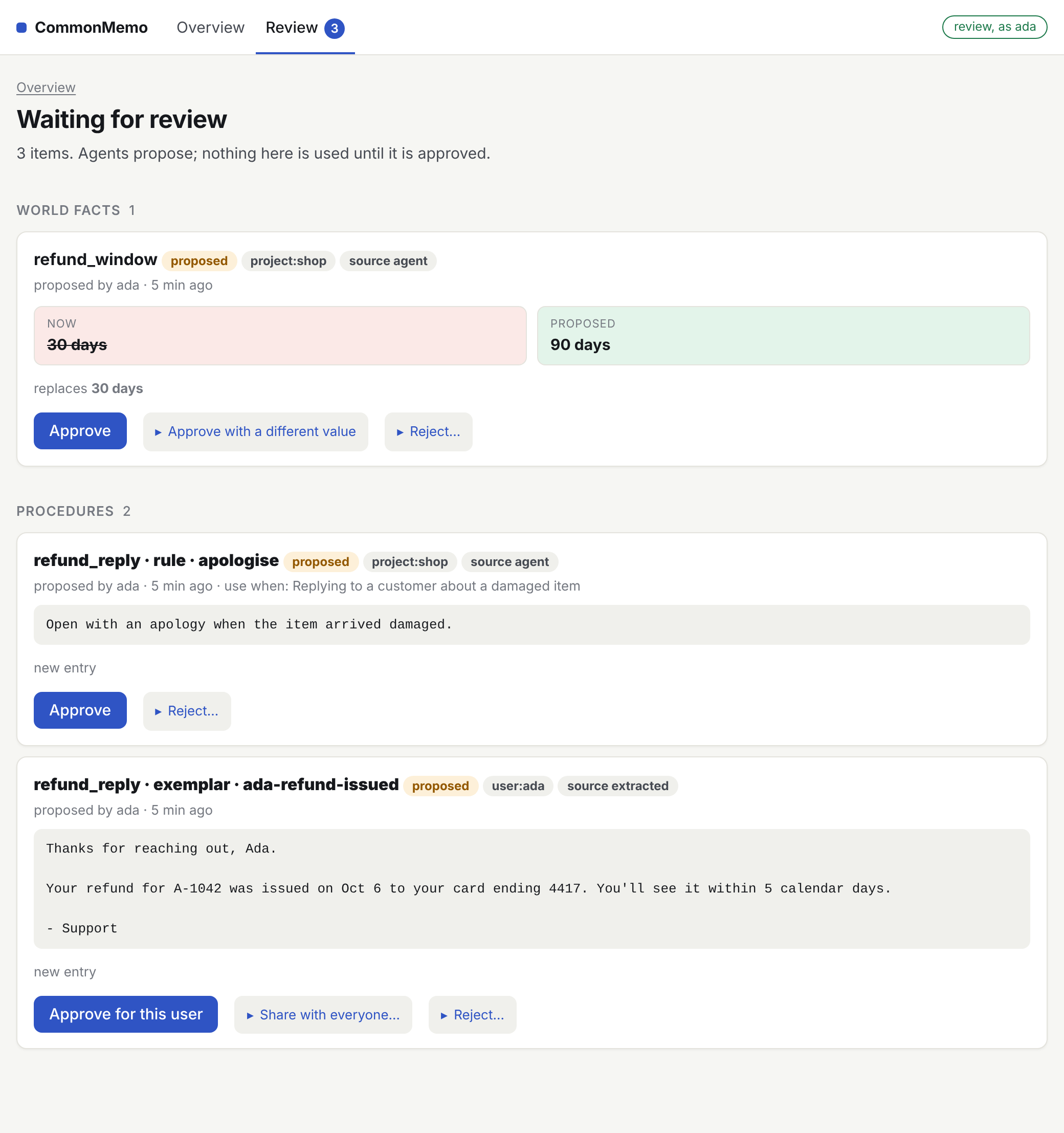
Real pages, from scripts/demo_memory.py (offline, no keys). Left: one turn's
push, item by item: a user's constraint, their profile, the project's facts,
a lesson learned from an earlier correction, the matched procedure, an
earlier session's recap, each with a why link to the events it came from.
Right: what waits for review, beside what it would replace.
Quickstart
git clone https://github.com/Mehul-Gupta-SMH/CommonMemO.git && cd CommonMemO
pip install -e .                      # core: stdlib only, offline local engine

# Build a small memory to look at: sessions, facts, procedures, a learned lesson.
python scripts/demo_memory.py demo.db

# Open it in the browser: turn traces, users, and the review queue.
commonmemo inspect --store sqlite:///demo.db --project shop --review --open

# The same from a terminal: what one turn was given, and why.
commonmemo trace support-ada-2 --store sqlite:///demo.db
commonmemo trace support-ada-2 --why refund_reply/rule/timeline --store sqlite:///demo.db

# Does memory change what an agent does? 19 scenarios, with and without it.
python -m evals

# Give Claude Code memory: print the hooks config to merge into .claude/settings.json.
commonmemo setup claude-code --user ada
Nothing above needs an API key or spends money. CommonMemo isn't on PyPI yet (#12); once it is:
pip install commonmemo                 # core: stdlib only, local engine
pip install "commonmemo[commonadk]"    # + CommonADK integration
pip install "commonmemo[graphiti]"     # + Graphiti engine (temporal knowledge graph)
pip install "commonmemo[mem0]"         # + Mem0 engine (LLM-extracted user memories)
pip install "commonmemo[postgres]"     # + Postgres for everything CommonMemo stores
pip install "commonmemo[mcp]"          # + the official MCP client, for testing the server
pip install "commonmemo[otel]"         # + turn traces as OpenTelemetry spans
How it works
flowchart LR
    app["your app, an agent SDK,<br/>MCP, or a coding harness"] -- "events: @mem.track, hooks,<br/>CommonADK runs" --> log[("Log<br/>append-only")]
    log --> kinds["Working state · world facts ·<br/>procedures · tool memory ·<br/>feedback · negatives"]
    log -- "session close" --> engine["engine: local · Graphiti · Mem0<br/>Recaps · UserProfile"]
    log -. "optional learner,<br/>any model" .-> learned["lessons · decisions ·<br/>proposals"]
    kinds --> push["push: stable half +<br/>turn half, traced"]
    engine --> push
    learned --> push
    push --> agent["agent"]
    agent -- "memory_* tools:<br/>pull and write" --> log
Everything starts as an event in the Log, which is never edited. The rest is derived from it and can be rebuilt from it:
| Tier | Holds | Owned by |
|---|---|---|
| Log | everything that happened, in order: messages, tool calls, your domain events | CommonMemo (SQLite or Postgres) |
| Working | what the current conversation or workflow run has in hand: live state and resume points, resumable by id | CommonMemo (SQLite or Postgres) |
| Recaps | short summaries of finished sessions, retrieved by relevance | a wrapped engine |
| UserProfile | durable facts about one user; a newer value supersedes, history is kept | a wrapped engine |
Beside the tiers, CommonMemo keeps structured kinds itself:
- tool memory: which tools fail, how, and what fixed it; never the users' data;
- world facts: with lifetimes; an agent's are proposals until approved;
- procedures: templates, rules, steps and accepted examples, per task type;
- feedback: ratings and corrections;
- negatives: "never do X", plus tombstones for "forget this";
- resume points: checkpoints and replayable steps.
Agents use memory in hybrid mode. A bounded part is pushed each turn:
- a stable half for the agent's instructions, which rarely changes, so prompt caching keeps working;
- a turn half with the request;
- tool notes, in the tools' own descriptions.
Agents pull the rest, and write, through the memory_* tools. Everything
pushed is framed as reference data, not instructions, and every push is
recorded as a turn trace.
CommonMemo wraps memory engines rather than building one. Extraction and
retrieval belong to engines that specialize in them (Graphiti and Mem0). The
built-in local engine is offline and deterministic, so everything works out
of the box and in tests.
Trust is decided by source, not recency (ADR 0002). What an operator or your code writes takes effect at once. What an agent or a learner writes for everyone waits in the review queue. A less trusted write never silently replaces a more trusted one; it is kept as disputed.
Use
from commonmemo import Memory, MemoryEvent

mem = Memory("sqlite:///mem.db", project="shop")   # one path is the whole setup

# 1. Decorator: every call becomes an event (arguments, result/error, duration)
@mem.track
def lookup_order(order_id: str) -> str: ...

# 2. Subclass: your own domain events -- no @dataclass needed
class TicketOpened(MemoryEvent):
    ticket: str

# 3. Session: everything else is automatic
async with mem.session(user_id="u1", agent="support") as s:
    ctx = await s.context("where is my refund?")   # what memory pushes this turn
    s.message("user", "where is my refund?")
    lookup_order("42")                              # recorded into this session; feeds tool memory
    s.record(TicketOpened(ticket="T-9"))
    s.state["ticket"] = "T-9"                       # working memory, persisted
    s.remember("preferred_contact", "email")        # explicit user fact
    s.learn("refund_window", "30 days")             # world fact (ttl= for ones that go stale)
    s.feedback(-1, "too long")                      # rating / comment
    s.correct("Pune", "Bangalore")                  # correction
    s.never("suggest phone calls")                  # standing constraint
    s.forget("old_address")                         # tombstone: stays forgotten
    tools = mem.agent_tools(s)                      # memory_recall, memory_remember, ... for an agent
# on exit: the session's events are consolidated into a recap and UserProfile facts
ctx.stable_text() is meant for an agent's instructions and
ctx.turn_text() for the turn's request (ctx.render() gives both).
mem.tool_notes(agent) gives tool memory's advice per tool, and
mem.tool_profile(tool) the numbers behind it.
On Postgres
SQLite is the default: one file, nothing to run. For memory that several processes or machines share, give it a Postgres URL instead (ADR 0001, #11):
mem = Memory("postgresql://app@db.internal:5432/agents?schema=shop", project="shop")
export COMMONMEMO_STORE=postgresql://app@db.internal:5432/agents?schema=shop # for the CLI, MCP server and hooks
The URL holds everything CommonMemo keeps itself: the Log, sessions, the
projections and the local engine's recaps. ?schema= keeps one memory in
its own schema, so a database can hold several. Writes to the Log go one
at a time, under a transaction-scoped advisory lock, so log positions
commit in order. That way a process catching up never skips an event
another process committed. The whole test suite runs on Postgres in CI,
including writers in four processes against one reader.
Ranking by meaning
One ranker decides which of a user's 50 facts go in the push, which world
facts a request is about, and what memory_recall returns
(#21). By default
it matches words, stemmed and without stop words. Give it an embedder and it
matches meaning, so "How do I reach them?" finds preferred_contact: email:
from commonmemo import EmbeddingRanker

mem = Memory(ranker=EmbeddingRanker(my_embed))   # any texts -> vectors function, sync or async
The Graphiti and Mem0 engines bring their own embedder, which ranks facts too, with no setup. Embeddings are cached, and a profile small enough to push whole is never ranked.
World facts as configuration
from commonmemo import FactKey

mem = Memory(project="shop", fact_keys=[
    FactKey("refund_window", "How long customers have to return an order", lifetime="90d", pinned=True),
    FactKey("plan_tier", "The customer's plan", allowed=("free", "pro")),
])
mem.load_facts("facts.yaml")     # keys and values, versioned with the app; loading again writes nothing new
The registry is optional (#24). With one:
- agents are shown the keys to reuse;
- an agent's write to an unregistered or near-duplicate key (
refund_period) stays a proposal for review; - registered lifetimes make facts go stale by default;
- pinned facts are always pushed; the rest only when the request is about them, so hundreds of facts don't crowd the prompt.
The environment, detected (#57). Agents guess the Python version and
library versions when nobody says. mem.detect_environment(".") records
them as env.* world facts, and the harness hooks do it at every session
start:
- env.python: 3.12.4 (requires >=3.11) (as of 2026-10-23, tool result, time-sensitive)
- env.os: Linux 6.8.0 (x86_64) (as of 2026-10-23, tool result, time-sensitive)
- env.python_packages: httpx 0.27.2, pydantic 1.10.13 (installed 1.10.9) (as of 2026-10-23, tool result, time-sensitive)
Versions come from pyproject.toml / requirements*.txt, at the version
locked in uv.lock or poetry.lock, plus the installed one where it
differs, and the same for package.json. They are direct dependencies only,
pinned in the stable half, and trusted as tool results, so an agent's guess
doesn't replace them. They refresh when they change or go stale. Environment
variables are never read.
How a task is done: procedural memory
Templates, rules, step-by-step procedures and accepted examples, per task type (#26, ADR 0003). Write them as files next to your code:
<!-- procedures/weekly_report/default.md -->
---
kind: template
use_when: Writing the weekly status report for the team
---
## Highlights
## Risks
## Next week
mem.load_procedures("procedures/")        # current at once; a changed file is a new version
async with mem.session(user_id="ada", task="weekly_report") as s:   # or leave task out: matched by use_when
    ctx = await s.push_turn(prompt)       # rules, templates and step names, in the turn half
mem.procedure_outcomes("weekly_report")   # runs, feedback and skipped steps, per version
When the app doesn't name the task, the request is matched against the
use_when lines with the same ranker as facts. Agents get two tools:
memory_get_procedurereturns the full steps and examples;memory_save_proceduresaves an entry. For the agent's own user it applies at once; for everyone, it is a proposal an operator approves.
Accepted examples (s.save_exemplar(...)) are the user's data. No one else
sees one until an operator shares it with confirm_procedure(id, scrubbed=True),
and forget_user removes them.
Learning from runs
Off by default. Give memory any model, as a function from a prompt to text. Each finished session is then distilled into:
- decision records;
- lessons, merged when they repeat and pushed to the same user;
- proposed procedures, rules and example candidates, which wait for review.
from commonmemo import ModelLearner

mem = Memory(learner=ModelLearner(lambda prompt: my_model(prompt)))   # sync or async
await mem.distill(session_id)              # or run it later, in a batch
mem.revert(run_id=f"learn:{session_id}")   # undo what one session taught
The learner sees messages, tool calls, feedback and step results, with forgotten text redacted. It never sees raw reasoning.
Facts from what was said
The local engine keeps a one-line digest of each session, and recall doesn't search the Log's messages, so what a user said once is out of reach unless someone wrote it down. Give memory a model and it extracts the durable facts as each session closes (#60; off by default, any prompt-to-text function):
from commonmemo import ModelExtractor

mem = Memory(extractor=ModelExtractor(lambda prompt: my_model(prompt)))
with mem.session("s1", user_id="ada") as s:
    s.message("user", "My sister Lena arrives on Friday 14 November.")
# next session: "sister_arrival: Lena arrives on Friday 14 November" is in ada's pushed facts
await mem.extract(session_id)              # or run it later, in a batch
They are UserFacts with source="extracted" in that user's profile, so
they are ranked by the request, found by memory_recall, and removed by
forget_user. Text the user asked to forget is redacted before the model
sees it, and a fact quoting it is dropped. Extraction runs once per session,
and a failing model never fails the close. On a LoCoMo conversation it is the
difference between 23 and 38 correct answers out of 48
(docs/live-runs.md).
One person, several ids
user_id is whatever string your app supplies. CommonMemo never decides two ids are the same person, and never from a name: two people given the same id share one memory, so make ids unique. When you know one person has two ids (a harness login and an app account), say so:
link = mem.link_users("ada-login", "ada-app", reason="same person")
mem.linked_users("ada-app")        # ["ada-app", "ada-login"]
mem.unlink_users(link.id)          # undone exactly
A link is a logged, revertible event; nothing is copied or merged. Links are transitive. While linked, a search for either id also sees the other's past messages, the profile shows the other's facts for keys the first has not stated itself, redaction covers both, and forget_user forgets both ids and the links. Recaps, lessons, procedures and rules stay per id. See #86.
What was said
Recaps and facts are what memory made of earlier sessions. Memory can also search the messages themselves (#62; on by default since #70: it took memory from 18% to 61% correct on LoCoMo, below). It puts the user's own earlier words, not a summary, into the prompt, so it is the one default you may want to turn off:
mem = Memory()  # messages=8, recall_messages=8
# the turn's push gets the 8 windows of past messages the request is about, and
# memory_recall returns 8 more: "[said] [session s1, 2026-10-24]  user: The guest room key is under the blue pot..."
mem = Memory(policy=MemoryPolicy(messages=0, recall_messages=0))  # neither pushed nor recalled
Windows are 6 consecutive messages of one of the user's other sessions, ranked
by the same ranker as everything else (shared words, or meaning with an
embedder), and carry the ids of their events, so traces, why and the
inspector show where they came from. Only that user's messages, never the
current session's, never another user's; a session without a user has none;
forgotten text is redacted and forget_user removes the messages. The hook
and MCP commands take --messages N and --recall-messages N
(COMMONMEMO_MESSAGES, COMMONMEMO_RECALL_MESSAGES; default 8, 0 turns it off).
A window says the day of its first message. MemoryPolicy(message_dates="stamp")
(#71) gives it the weekday and time, and any message recorded at another time its
own stamp; "resolve" also follows each relative date with what it means at the time
it was said (Lena arrives Friday [= Fri 2033-05-13]), computed from the calendar
with no model. It is derived when a window is read, never stored, and the ranker
scores the messages as said. Off by default: it made no difference on LoCoMo (below).
Session.message(role, content, ts=...) records a message at the time it was said.
Windows are indexed as messages are logged (#65): a projection keeps each
window's event ids and an inverted index of its stemmed terms, not its text, so
the text stays in the Log where prune, forget_user and redaction reach it. A
search asks the index for the windows sharing the most terms with the request
and reads only those: about half a millisecond at 10,000, 100,000 and 500,000
messages, where scanning took 69 to 93 ms and only reached the latest 4,000. The
index costs about 0.2 KB a message in the database (0.57 KB before #76 made its rows
small integers) and under a tenth of a millisecond to write. An
embedding ranker, which scores meaning rather than shared words, scores those
windows and the user's 2,000 newest by cosine over stored vectors (#77): a window is embedded once, from
its redacted text, and a later search, in any process, embeds only the request. About 1.5 KB a window at 384
dimensions, only when an embedding ranker is used; a search takes about 50 ms with numpy installed and
120 to 150 ms without (scripts/bench_vectors.py, synthetic vectors: the quality against keyword ranking
is not measured, since the model hosts are unreachable from the build environment). Searching every
window by brute force would take about half a second to a second at 100,000 messages; beyond that a real
vector index (pgvector, sqlite-vec) is a dependency decision.
Resume a stopped process
@mem.step                                  # finished calls replay on a rerun
def fetch(order_id: str) -> dict: ...

@mem.step(side_effects=True)               # never silently run twice
def refund(order_id: str) -> str: ...

with mem.session("job-42") as s:           # same id in a new process = resume
    order = fetch("A1")
    s.checkpoint("fetched", {"order": "A1"})
    refund("A1")
Rerunning the same code after a crash skips what finished and continues at
the first step that didn't. A side-effecting step interrupted mid-way raises
StepInDoubt instead of repeating itself. Side-effecting steps are claimed
before they run, so even several workers resuming one session at once run
each of them at most once; the others get StepInProgress while the
winner's lease is live.
See how memory changes, and undo it
with mem.run("deploy-42"):                  # tags everything written inside
    mem.learn("refund_window", "30 days")

mem.snapshot("before v3")
h = mem.history()
h.velocity(bucket=3600)                     # writes per hour, by kind/source/scope
h.churn(); h.review_flow(); h.by_run("deploy-42")
mem.as_of("before v3").world_facts()        # memory as it was then
mem.diff("before v3")                       # what changed since

mem.revert(to="before v3")                  # world facts, negatives and procedures back to a snapshot
mem.revert(run_id="commonadk:r-8812")       # undo one run; later edits by others survive
mem.freeze(source="agent")                  # agent world-fact writes become proposals
mem.alerts()                                # velocity spikes, churn, review backlog
Reverts append compensating events and never delete, so they can be undone
too. Alerts are on by default and logged to commonmemo.alerts (#27, ADR 0004).
See what memory did
Every push into an agent's context is recorded as a turn trace. It
records what was pushed (by reference), where each item came from, and what
was left out. The pushed text itself is kept only with
MemoryPolicy(trace_text=True), and forget_user removes a user's traces.
commonmemo trace s2 --why refund_window   # why the agent got it: the events it came from
commonmemo show user ada                  # profile, constraints, what was forgotten, past sessions
commonmemo inspect --open                 # the same, in a local read-only web page
commonmemo inspect --review               # also approve and reject what waits for review
mem.traces(session_id="s2"); mem.why("refund_window", session_id="s2")
from commonmemo.otel import instrument; instrument(mem)   # pushes as OpenTelemetry spans
The inspector binds to 127.0.0.1 and runs no scripts. With --review, each
approval is a form post carrying a token from that server start, checked
against its own Host and Origin, and tagged run_id="review:<reviewer>",
so a review session can be reverted (#45).
More in docs/seeing-what-memory-did.md (#25).
With Graphiti
from graphiti_core import Graphiti
from commonmemo.engines.graphiti import GraphitiEngine

mem = Memory("sqlite:///mem.db", engine=GraphitiEngine(graphiti=Graphiti(uri, user, password)))
# or Memory("sqlite:///mem.db", engine="graphiti") with NEO4J_URI / NEO4J_USER / NEO4J_PASSWORD set
Each closed session becomes one Graphiti episode in the user's graph partition. Retrieval ranks past sessions by the graph facts that match, and extracted facts join the user's explicit ones.
With Mem0
from commonmemo.engines.mem0 import Mem0Engine

mem = Memory("sqlite:///mem.db", engine=Mem0Engine(config={...}))  # Mem0's own config dict
# or Memory("sqlite:///mem.db", engine="mem0") for Mem0's defaults (OpenAI)
Each closed session is handed to Mem0, which extracts and updates the user's memories. They join the user's explicit facts, and retrieval ranks past sessions by the memories that match.
With CommonADK
CommonADK normalizes all six of its targets (Google ADK, OpenAI Agents, Claude Agent SDK, CrewAI, AutoGen, LangGraph) into one event stream, so one hook gives every target the same memory:
from commonmemo.integrations.commonadk import run_with_memory

async with mem.session(user_id="u1", agent="coordinator") as s:
    trace = await run_with_memory(s, runner, project, "coordinator", prompt)
Each turn, on a copy of the project (CommonADK itself is never changed):
- capture: every CommonADK event is recorded, and tool calls feed tool memory;
- pull: the memory tools are added to the agent, and tool memory's notes are written into the agent's own tools' descriptions;
- push: memory goes in front of the prompt, the only place released
CommonADK can take it. Putting stable memory in the agent's instructions
instead is requested in CommonADK #30;
run_with_memoryuses it automatically if a runner supports it (#7).
Runnable, offline examples for plain Python, Google ADK (through CommonADK) and harness hooks are in examples/.
As an MCP server (Claude Code, Codex, any MCP client)
commonmemo mcp serves the memory tools to MCP clients over stdio, bound to
one session. It needs nothing beyond the core. For Claude Code, add it to
the project's .mcp.json:
{
  "mcpServers": {
    "memory": {
      "command": "commonmemo",
      "args": ["mcp", "--user", "ada", "--agent", "claude-code"],
      "env": { "COMMONMEMO_STORE": "sqlite:///.commonmemo/memory.db" }
    }
  }
}
- Tools:
memory_recall,memory_get_procedure(when procedures exist),memory_remember,memory_note_fact,memory_avoid,memory_save_progressandmemory_save_procedure. With--read-only, only the first two. Writes are recorded withsource="agent", and an agent's world facts are proposals until approved, as in Python. - Push: the server's instructions carry the stable memory (negatives,
profile, world facts, lessons); the resource
memory://contexthas all of it. - Config:
--store,--engine,--project,--user,--agent,--session,--read-only, or the same asCOMMONMEMO_*environment variables. The same--sessionfrom another harness continues the session; another user's session is refused. Closing the client closes and consolidates the session.
The model decides when to call a tool, so MCP alone doesn't capture every event; the hooks below do. Tested over real stdio, and against the official MCP client (#4).
Hooks: automatic capture and push in coding harnesses
With hooks, the harness itself hands memory every prompt, tool call and
reply, and puts memory in front of the session and of each prompt. Nothing
depends on the model calling a tool. commonmemo setup <harness> prints
the config; every event runs commonmemo hook, which reads the event's JSON
on stdin.
Claude Code: merge the output into .claude/settings.json:
commonmemo setup claude-code --user ada
{
  "hooks": {
    "SessionStart": [{ "hooks": [{ "type": "command", "command": "commonmemo hook --harness claude-code --user ada" }] }],
    // the same entry for UserPromptSubmit, PostToolUse, PostToolUseFailure, Stop, PreCompact and SessionEnd
  }
}
Codex: merge commonmemo setup codex --user ada into .codex/hooks.json
(or ~/.codex/hooks.json). Codex asks you to review new hooks at startup;
trust them, or they won't run.
OpenCode: save the plugin and give it the config through the environment:
mkdir -p .opencode/plugin && commonmemo setup opencode > .opencode/plugin/commonmemo.js
export COMMONMEMO_USER=ada
| Event | Recorded | Pushed |
|---|---|---|
| session start | opens or resumes the session; the project's environment facts, when they changed (--no-environment turns it off) |
stable memory, and where a resumed session stands |
| prompt | the prompt | memory for this turn (relevant recaps, the matched procedure, state) |
| tool call | the call, its result or error (feeds tool memory) | recaps the result brings up that the turn missed |
| reply | the reply (Claude Code, Codex) | |
| compaction | a checkpoint, so work survives it | |
| session end | closes and consolidates the session |
What else the hooks do:
- Mid-run refresh: when a tool result brings up an earlier session the
prompt's push missed, its recap is pushed before the next model call. At
most 3 times per turn;
MemoryPolicy(refresh=False)turns it off (#22). - Never blocking: on any error a hook writes to stderr and exits 0.
- Resident (opt-in, Unix): a hook is a new Python process that imports the library,
about 250 ms on SQLite and 450 ms on Postgres, and Claude Code runs one per tool call.
commonmemo setup claude-code --resident(orCOMMONMEMO_RESIDENT=1) makes each hook a thin client of a server that stays loaded: 48 ms on SQLite, 61 ms on Postgres, the same output. The server starts itself on the first hook (which is answered the usual way), listens on a socket in a private per-user directory, serves only you, handles one event at a time, quits after 10 idle minutes (COMMONMEMO_HOOK_IDLE, in seconds) and is replaced when the code changes. If anything about it fails, the hook runs the usual way (#92). - One session across harnesses: each harness session is its own memory
session by default. Give them the same
--session(orCOMMONMEMO_SESSION) to continue one: start in Claude Code, resume in Codex, and Codex is told where the work stood. Each event records which harness wrote it. - Shared recaps: recaps of a user's past sessions are shared across
harnesses either way, labelled with where each happened, so Claude Code
sees what the user did in Codex yesterday.
MemoryPolicy(recaps_across_agents=False)keeps them per agent (#34). - With the MCP server too: add
--recall-toolto the hook command (or setCOMMONMEMO_RECALL_TOOL=1). The push then says when it left things out ("More in memory than shown here: 5 facts about the user. Call memory_recall with what you need."), so the model knows to look (#23).
Hooks and the MCP server work best together: hooks capture and push, and the tools let the agent recall and save on purpose. The hook payloads are tested against recorded payloads from Claude Code 2.1.302, and against the schemas built into Codex 0.163.0 (#5).
Does it help? The evaluation suite
evals/ runs each scenario twice, with memory and without it, against a
scripted agent. The agent decides only from the text it is shown: the
prompt and the tools' descriptions. Its rules are the obvious ones a capable
model would follow. What it can't do is know anything it wasn't shown, and
that's what the suite measures.
python -m evals # prints the report; docs/evals.md is the committed baseline
All 19 of 19 pass with memory. In the 13 scenarios where a run without memory makes sense, memory turns a failure into a success in all 13. The other 6 are safety checks with nothing to compare against:
- a tool failure with a known fix is not repeated;
- a user's "never" is respected, and the latest preference wins;
- a crashed pipeline resumes without charging twice;
- a forgotten fact never returns, in the push or through recall;
- stored text never becomes an instruction;
- one user's claim doesn't change what another is told;
- a burst of bad writes is detected, frozen and reverted;
- a tool result that brings up an older session gets its recap mid-run;
- when the push leaves things out, the agent is told and recalls them;
- a fact past its lifetime isn't quoted, and an agent's write doesn't override an operator's;
- a fact asked about in other words is recalled (4/4 by meaning, 1/4 by shared words);
- a request for a known task gets the house template without naming it;
- a correction in one session becomes a lesson for that user's next one, and no one else's;
- the agent uses the API of the library version the project pins (pydantic 1's
.dict()); - a fact stated once in a session is recalled in the next one, once extracted;
- a detail a recap drops (the middle of a session) is found in the user's past messages.
It runs in CI on every PR (#18).
On long conversations, with a real model (#59, #62, #74, scripts/locomo_benchmark.py,
docs/live-runs.md): all ten LoCoMo
conversations, 450 sampled questions (the first five were used while building; the other five
were run afterwards with nothing changed), the smallest model (claude-haiku-5-5) for
everything, about $10.5 in all.
| First five | Held-out five | All ten | $ / question | |
|---|---|---|---|---|
| no memory (guessing alone) | 13/222 | 12/228 | 25/450 (6%) | 0.0008 |
memory with recaps and facts only (messages=0, how it shipped before #70) |
39/222 | 32/228 | 71/450 (16%) | 0.0015 |
| naive retrieval over the raw transcript (8 excerpts by shared words) | 118/222 | 109/228 | 227/450 (50%) | 0.0018 |
memory with ModelExtractor (facts extracted as sessions close) |
116/222 | 149/228 | 265/450 (59%) | 0.0029 |
memory that searches what was said (messages=8, recall_messages=8, now the default) |
136/222 | 140/228 | 276/450 (61%) | 0.0020 |
| both of those | 143/222 | 151/228 | 294/450 (65%) | 0.0031 |
| the whole conversation in the prompt | 113/222 | 115/228 | 228/450 (51%) | 0.0103 |
The honest reading: memory with only recaps and facts sits far below simple retrieval, because its digest is one line per session and recall didn't search what was said. Searching past messages through memory (windows of the user's own earlier words, pushed and recalled) beats retrieval over the same text in both halves (94 questions against 45 over all ten, p < 0.001) and is the cheap part: no model call. Extraction only tied retrieval on the first five, where its prompt was adjusted once after looking at misses, and beat it on the five that were not (149 against 109), so over all ten it is ahead of retrieval (105 against 67, p = 0.005), at about 1.5 times the cost of windows and a model call per session. Adding it to windows is 18 questions better over ten (64 against 46, p = 0.1): a gain, but one this sample cannot separate from noise. The whole conversation in the prompt is no better than retrieval at about six times the cost. Having a model write search metadata for each window (keywords, questions it answers, absolute dates) found the evidence for 4 points more questions but changed no answers, so it isn't built (#66); embeddings weren't tried. Stamping each window with when it was said and resolving its relative dates ("Friday" to a date), and having a model resolve pronouns and places, changed no answers either (#71). A normalised topic tree searched coarse to fine did worse than plain search, not better (#67). Haiku only, keyword ranking, a model judge, and a disguise against the model having seen the public data: a baseline, not a rate.
Status
v0.0.1, not on PyPI yet (#12). In:
- the four tiers and three engines (local, Graphiti, Mem0);
- the structured kinds: tool memory, world facts, procedures, feedback, negatives, resume points;
- hybrid agent memory, ranking by meaning, and learning from runs;
- history, revert, freeze, budgets and alerts;
- turn traces, the inspector with its review screen, and OpenTelemetry;
- the CommonADK integration, the MCP server, and hooks for Claude Code, Codex and OpenCode.
CI runs the test suite on Python 3.10 and 3.13: 285 tests in the fullest environment. It also runs with no extras, with each extra on its own, and once more with everything on Postgres 16. It checks that the core imports none of the extras.
Every decision has a record: ADR 0002 (who may change a world
fact), ADR 0003 (procedural memory) and
ADR 0004 (history and revert) are accepted, and so is ADR 0001
(storage: SQLite by default, Postgres shared; its DynamoDB backend is still to come). The design is in docs/design.md,
and what's next is in the roadmap issue (#14).
Honest caveats
-
Message windows are on by default (#70): a user's own earlier words, not a summary, can appear in a later prompt, and the database grows about 0.2 KB a message for the index. Only that user's other sessions;
MemoryPolicy(messages=0, recall_messages=0)turns it off. Extraction (a model call per closing session) is off. -
One live run so far, with Claude Code as the model. It covered the hooks, the MCP tools, procedures, learning and injection, all through real
claude -psessions: 5 of 6 checks passed for $0.08, and it found two bugs (#49, #50). See docs/live-runs.md, and rerun it withscripts/live_claude_code.py. It was one run with one model, so it shows the wiring works, not a rate. The Graphiti and Mem0 engines haven't had a live run (#3: they need an OpenAI-compatible LLM and embedder). -
The evals show the mechanism, not the benefit to a real model. A scripted agent that only reads what it's shown proves memory put the right thing in front of it. It doesn't prove a real model uses it well; the one live run above is a first, small check of that. The meaning-based recall result uses a small offline concept embedder, not a real one. The LoCoMo run above is the first public-benchmark check; more conversations and the other engines are still to come (#18, #3).
-
Framing isn't a guarantee. Pushed memory is labelled reference data, and stored text never lands where instructions go (an eval checks this). But it is text a model reads, and some of it came from users and tools. An agent's world facts and procedures for everyone need approval, which limits the reach of a poisoned write. Lessons and an agent's notes for its own user don't.
-
Without an embedder, ranking matches words. The keyword ranker is stemmed and drops stop words, but "How do I reach them?" won't find
preferred_contactwithout an embedding ranker or an engine that has one. -
One Postgres log, written one event at a time. On Postgres, appends take one lock so positions commit in order. That's simple and correct, but it caps write throughput at one log: measured, about 400 events a second on Postgres and 270 on SQLite on a 4-CPU machine, about 3 million turns a day if the load were flat ([#17](https://github.com/Mehul-Gupta-SMH/CommonMemO/issues/17, docs/benchmarks.md). A turn currently issues about 1,060 SQL statements, mostly tool notes read one tool at a time, and a hook process costs 270 to 550 ms; both are fixable in the code and come before partitioning or a scale-out backend. Graphiti and Mem0 keep their own stores either way.
-
The review screen is a local tool, not an admin console. It has no accounts: the reviewer's name is whatever
--reviewersays, and it relies on a loopback bind plus a per-start token. Fine on your own machine; don't expose it. -
Learning adds a model call when a session closes. In the coding-harness hooks, that call runs in the session-end hook.
Development
pip install -e ".[dev,commonadk,graphiti,mem0,mcp,otel,postgres]"
pytest
COMMONMEMO_TEST_POSTGRES=postgresql://postgres@localhost:5432/postgres pytest   # the whole suite on Postgres
python -m evals --md docs/evals.md   # regenerate the eval baseline
scripts/live_engines.py runs a short scenario on the Graphiti and Mem0
engines against real backends and an LLM. It's not part of the test suite,
because it spends model tokens:
pip install -e ".[graphiti,mem0]" kuzu
OPENAI_API_KEY=... python scripts/live_engines.py      # Neo4j if NEO4J_* is set, else embedded Kuzu
Planned work is tracked in issues, indexed by the roadmap (#14).
Nothing gets coded without an issue. The inspector's real pages over sample data
are at https://mehul-gupta-smh.github.io/CommonMemO/ (python scripts/build_pages.py renders them
from the product's own page code, so they cannot drift from it).
Related
- CommonADK — define an agent system once, build it on any agent SDK. CommonMemo plugs into its event stream to give all six targets the same memory.
- agent-gauntlet — search agent configurations under deliberate tool failure, and ship the one that survives.
License
Apache-2.0. See LICENSE.
Repo metadata
This is kept here to be copied into GitHub's About box (the ⚙ next to "About" on the repo page). The agent proxy blocks writes to repository settings, so this is the source of truth until it is pasted across.
Description:
Framework-neutral memory for agents: pushed when it matters, pulled when asked, never trusted blindly. Traced, reviewable and revertible; works with CommonADK, MCP, Claude Code, Codex and OpenCode.
Topics:
llm-agents agent-memory memory mcp claude-code ai-agents llm python sqlite postgres observability
1 maintainer

Metadata
1 maintainer
Release files for commonmemo 0.0.1
For a detailed explanation of source distributions (sdists) and built distributions (wheels), please see the package formats documentation.
Source distribution (sdist)
| File | Size | Uploaded | Provenance | Actions |
|---|---|---|---|---|
| commonmemo-0.0.1.tar.gz | 924.4 kB | With provenance | Details for commonmemo-0.0.1.tar.gz |
Built distribution (wheel)
| File | Interpreter | ABI | Platform | Actions Reset |
|---|---|---|---|---|
| commonmemo-0.0.1-py3-none-any.whl | Python 3 | none | any | Details for commonmemo-0.0.1-py3-none-any.whl |
Total release size: 1.1 MB
Release files / commonmemo-0.0.1.tar.gz
| Download URL | commonmemo-0.0.1.tar.gz |
|---|---|
| Size | 924.4 kB |
| Tags | Source |
|
SHA-256 checksum How to use checksums |
19a63e6fcbf04bcde484c26aa9dd172e7b3a4c3d388d7f053d6e4fc11866545e
|
|
BLAKE2b-256 checksum How to use checksums |
615e315277a1417399486ddf40132b24d55a8cecd6f5c8637e1bff5fc26c8c89
|
| Upload date | |
|
Uploaded using Trusted Publishing? What is trusted publishing? |
Yes |
| Uploaded via |
twine/7.0.0 CPython/3.13.16
|
Provenance
Provenance describes where a file came from. On PyPI, provenance is shared via attestations, which provide a verifiable record of the build or publishing details. View details, limitations and caveats.


PyPI Publish Attestation
PyPI verified that this artifact, at this checksum, originated from the publisher listed below.
Signed by GitHub Actions, verified by PyPI on Oct 30, 2026.
Transparency logRelease files / commonmemo-0.0.1-py3-none-any.whl
| Download URL | commonmemo-0.0.1-py3-none-any.whl |
|---|---|
| Size | 208.4 kB |
| Tags | Python 3 |
|
SHA-256 checksum How to use checksums |
be9670d6ff4643cf56c2aa2b953bd43673bfd52b68d156c8cec6a9873d765c6a
|
|
BLAKE2b-256 checksum How to use checksums |
b2a29670126beea24baa68ba24bc8dcbf0d3c4b6e76fccbbb954728ef7cf22df
|
| Upload date | |
|
Uploaded using Trusted Publishing? What is trusted publishing? |
Yes |
| Uploaded via |
twine/7.0.0 CPython/3.13.16
|
Provenance
Provenance describes where a file came from. On PyPI, provenance is shared via attestations, which provide a verifiable record of the build or publishing details. View details, limitations and caveats.
PyPI Publish Attestation
PyPI verified that this artifact, at this checksum, originated from the publisher listed below.
Signed by GitHub Actions, verified by PyPI on Oct 30, 2026.
Transparency logSecurity for commonmemo 0.0.1
Provenance
Provenance describes where a file came from. On PyPI, provenance is shared via attestations, which provide a verifiable record of the build or publishing details. View details, limitations and caveats.
Full provenance
All 2 files in this release have been uploaded with provenance metadata.
Attestation for commonmemo-0.0.1.tar.gz
PyPI Publish Attestation
PyPI verified that this artifact, at this checksum, originated from the publisher listed below.
Signed by GitHub Actions, verified by PyPI on Oct 30, 2026.
Transparency logA note on package security
PyPI is a repository for distributing packages, not a service for auditing them. While third-party security researchers and our staff do their best to detect and remove malicious packages, PyPI cannot guarantee the quality, security or suitability of any given package.
To learn more about protecting yourself from malicious actors, visit our package security documentation.














