

COmpositional Nonlinear-debiased Inference, Fay–Herriot with Ellipsoidal conformal Regions
Robust. Compositional. Confident.





Design-aware small-area estimation of forest structure as distributions, not just totals. CONIFER estimates the diameter distribution — stem density split across DBH classes — for small forest areas where the field sample is too thin for a reliable direct estimate, and it attaches an honest, checked statement of uncertainty.
Under the hood it is a compositional area-level Fay–Herriot estimator with a cross-fitted, one-step-debiased machine-learned mean and design-aware conformal prediction sets on the simplex. It reduces exactly to classical Fay–Herriot when the mean is linear.
pip install conifer-sae
Start from your cruise data
You have a tree list and, ideally, stand-level remote-sensing metrics. That is all CONIFER needs.
import conifer

inv = conifer.from_treelist(
    trees,                       # one row per tallied tree
    stand_col="STAND", plot_col="PLOT", dbh_col="DBH_IN",
    baf=20,                      # prism cruise; use plot_area=0.1 for fixed-area plots
    aux=stand_metrics,           # LiDAR / spectral / terrain, one row per stand
    aux_stand_col="STAND",
)
print(inv.describe())            # what CONIFER sees
print(inv.issue_table())         # problems, in language you can act on

est = inv.fit()
conifer.conformalize_holdout(est)                 # calibrate — no known truth needed
cov = conifer.coverage_check(est)                 # and check that it actually holds up
print(cov.summary)
# "Across 10 independent splits, the 90% interval for a given diameter class contained
#  the held-out field value 91% of the time. That meets the stated level."

conifer.report.to_html(est, "stand_report.html", coverage=cov)
conifer.report.to_excel(est, "results.xlsx")
from_treelist bins DBH, derives effective area, and wires the correct sampling covariance for
your plot design — a prism cruise gets a design-based covariance built from the plot replicates,
because the multinomial assumption behind the analytic one does not hold when each tree carries a
DBH-dependent expansion factor. Stand identifiers are carried through every table, figure and
export, so a mis-sorted input can no longer silently corrupt the estimate.
Metric units, FIA 1″/2″ class breaks, stand polygons in and out (read_stands,
attach_estimates), and a min_dbh merchantability threshold are all supported.
No code at all
pip install "conifer-sae[app]"
conifer-studio
If your shell reports conifer-studio: command not found (common on Windows, where pip's
scripts folder is often not on PATH), this does the same thing and never depends on PATH:
python -m conifer.studio
Upload a tree list — or press Load the demo cruise — and get stand tables, maps, an Excel
workbook and a printable stand report. Everything runs on the machine you start it on, so
proprietary inventory never leaves your network. See apps/forester/.
About the uncertainty
Two things here are worth stating plainly, because both are easy to get wrong.
Calibration without a known truth. Conformal prediction needs a calibration set where the truth
is known. A real inventory never has one. Calibrating against the design-direct estimate of the
same plots looks reasonable and is invalid: CONIFER's estimate is a shrinkage of that
estimate, so the residual is mechanically smaller than the true error — measured against a known
truth it under-covers at 68% for a nominal 90% set. conformalize_holdout() instead splits each
stand's plots in two, fits on one half and calibrates against the other. Independent by
construction, and it errs wide rather than narrow.
Per-class by default. For any one diameter class you name, the reported interval contains the
truth at the stated rate. That is the question a forester actually asks, and it is several times
narrower than a set guaranteed to contain all classes simultaneously (~3.4× the estimate against
~29×, at 0.953 measured per-class coverage). Pass joint=True for the simultaneous claim. Every
table and figure states which of the two it is reporting.
Both claims are checked, not asserted: coverage_check() measures realised coverage on held-out
plots and reports it in a sentence you can put in front of a client.
Or start from matrices
The v0.1 interface is unchanged, for when the data is already aligned:
import conifer
est = conifer.DiameterDistribution(seed=0).fit(counts, area_eff, X)
est.conformalize(s_truth_cal, cal_idx, joint=True, alpha=0.10)
lo, hi = est.predict_interval(joint=True)
est.benchmark(totals, var_totals=var_totals)      # coherence with FIA class totals
Run the minimal worked example:
python examples/quickstart.py
Watch it run — a worked example
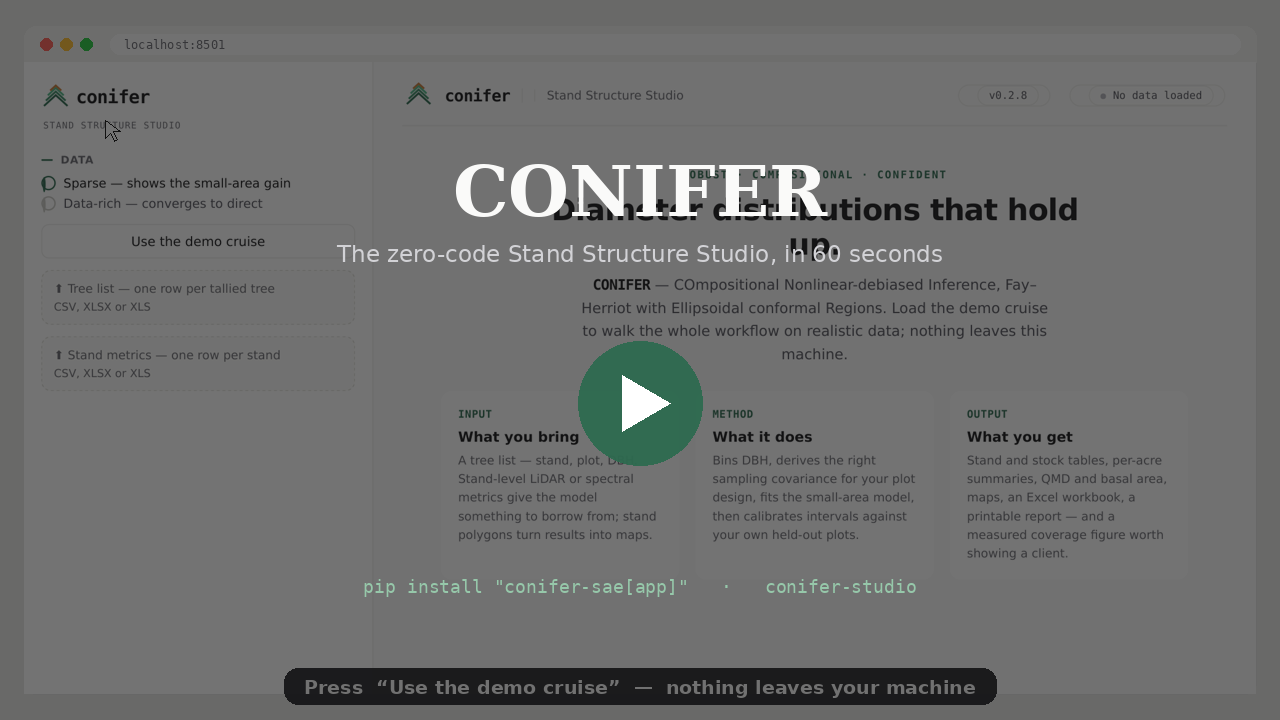
A ~36-second screencast of the real workflow — every panel is actually executed, showing the live output and figures. Click the poster to play, or download the MP4.
Step-by-step vignette
A full, sae-style walkthrough — fit, point estimates, a QMD functional, parametric intervals,
design-aware conformal sets (per-class, joint $L_\infty$, and a min-volume simplex ellipsoid), an
honest coverage check, benchmarking, plotting, and the command line — on small, fully
reproducible synthetic data. Every number and figure is produced by the code above it.
- Notebook (renders on GitHub):
docs/vignettes/conifer-getting-started.ipynb - Rendered HTML: open the executed vignette
pip install conifer-sae
jupyter notebook docs/vignettes/conifer-getting-started.ipynb
The names
CONIFER is a package; you build estimators on a shared engine.
| Name | What it is |
|---|---|
conifer.DiameterDistribution |
the estimator you fit (formerly StemDensityClassSAE) |
conifer.CompositionalFH |
the reusable engine underneath it — debiased-ML mean + FH + conformal simplex sets |
conifer.SpeciesComposition |
planned v0.3 sibling: species shares on the same engine |
conifer.io |
tree lists, stand polygons, validation — everything upstream of the fit |
conifer.calibration |
conformal calibration when the truth is unknown |
conifer.report |
stand tables, plain-language narrative, Excel and HTML deliverables |
A new region is a run, not a name — DiameterDistribution(spatial=True, regen_aware=True)
toggles capabilities; you don't fork the package per state.
Why it exists (what nothing else does)
Small-area estimation and conformal prediction are both mature — but not together, and not on the simplex, and not for forestry:
- emdi / sae (R) give area-level FH with parametric MSE, but no compositional target and no distribution-free prediction sets.
- MAPIE / crepes (Python) give conformal prediction, but no small-area borrowing and no simplex geometry.
- rFIA / FIESTA give design-based forest estimates, but do not model or borrow strength.
CONIFER sits in that gap: compositional SAE + design-aware conformal sets on the simplex, forestry-native — and it consumes design-based FIA estimates as its benchmark rather than competing with them.
Reading the output on a prism cruise
On a variable-radius (prism/BAF) cruise, expect CONIFER's estimate in the smallest diameter
class to sit well below the field-only estimate. That is the method working, not a miss: a prism
selects trees with probability proportional to basal area, so a single tallied small tree carries a
very large trees-per-acre expansion, and only a minority of stands catch one at all. The field-only
small-tree estimate is therefore high-variance and inflated in exactly those stands, and CONIFER
shrinks it toward what comparable stands and the covariates support. The % from this stand's own plots column tells you how far that shrinkage went for each stand.
Command line
Point it at three aligned CSV matrices:
conifer fit --counts counts.csv --area area.csv --aux aux.csv --out s_hat.csv
Validation
The estimator was developed and stress-tested in the St. Joe (Idaho) study: on the merchantable diameter distribution it significantly beats the direct estimator and a broad competitor slate (kNN, Weibull, MERF, SAEforest, BART-FH, Dirichlet-multinomial, KBAABB, a multivariate FH), is coherent with FIA (design-consistent), and its conformal set is the only
1 maintainer

Metadata
1 maintainer
Release files for conifer-sae 0.2.3
For a detailed explanation of source distributions (sdists) and built distributions (wheels), please see the package formats documentation.
Source distribution (sdist)
| File | Size | Uploaded | Provenance | Actions |
|---|---|---|---|---|
| conifer_sae-0.2.3.tar.gz | 854.9 kB | With provenance | Details for conifer_sae-0.2.3.tar.gz |
Built distribution (wheel)
| File | Interpreter | ABI | Platform | Actions Reset |
|---|---|---|---|---|
| conifer_sae-0.2.3-py3-none-any.whl | Python 3 | none | any | Details for conifer_sae-0.2.3-py3-none-any.whl |
Total release size: 962.1 kB
Release files / conifer_sae-0.2.3.tar.gz
| Download URL | conifer_sae-0.2.3.tar.gz |
|---|---|
| Size | 854.9 kB |
| Tags | Source |
|
SHA-256 checksum How to use checksums |
f2266934eaf39dc0875314892dbd86957831b1bc64279200bba574c24b1003de
|
|
BLAKE2b-256 checksum How to use checksums |
c63f07a18e05567e398a050225d47cbf1891247a47dbbb386e173deb54539a85
|
| Upload date | |
|
Uploaded using Trusted Publishing? What is trusted publishing? |
Yes |
| Uploaded via |
twine/6.1.0 CPython/3.13.14
|
Provenance
Provenance describes where a file came from. On PyPI, provenance is shared via attestations, which provide a verifiable record of the build or publishing details. View details, limitations and caveats.


PyPI Publish Attestation
PyPI verified that this artifact, at this checksum, originated from the publisher listed below.
Signed by GitHub Actions, verified by PyPI on Jul 27, 2026.
Transparency logRelease files / conifer_sae-0.2.3-py3-none-any.whl
| Download URL | conifer_sae-0.2.3-py3-none-any.whl |
|---|---|
| Size | 107.2 kB |
| Tags | Python 3 |
|
SHA-256 checksum How to use checksums |
ef52063479783568c46ca7bdfe229ab3d095fb469de9396b5fb0e89bf79c5adf
|
|
BLAKE2b-256 checksum How to use checksums |
1151c381d8eaa1559ecd1ab958c8b7d2ca3ddd7f6ba166bbd4d72192b26b04d6
|
| Upload date | |
|
Uploaded using Trusted Publishing? What is trusted publishing? |
Yes |
| Uploaded via |
twine/6.1.0 CPython/3.13.14
|
Provenance
Provenance describes where a file came from. On PyPI, provenance is shared via attestations, which provide a verifiable record of the build or publishing details. View details, limitations and caveats.
PyPI Publish Attestation
PyPI verified that this artifact, at this checksum, originated from the publisher listed below.
Signed by GitHub Actions, verified by PyPI on Jul 27, 2026.
Transparency logSecurity for conifer-sae 0.2.3
Provenance
Provenance describes where a file came from. On PyPI, provenance is shared via attestations, which provide a verifiable record of the build or publishing details. View details, limitations and caveats.
Full provenance
Both files in this release have been uploaded with provenance metadata.
Attestation for conifer_sae-0.2.3.tar.gz
PyPI Publish Attestation
PyPI verified that this artifact, at this checksum, originated from the publisher listed below.
Signed by GitHub Actions, verified by PyPI on Jul 27, 2026.
Transparency logA note on package security
PyPI is a repository for distributing packages, not a service for auditing them. While third-party security researchers and our staff do their best to detect and remove malicious packages, PyPI cannot guarantee the quality, security or suitability of any given package.
To learn more about protecting yourself from malicious actors, visit our package security documentation.














