
Extract what matters from any media source. Available as Python Library, macOS Service, CLI and MCP Server

Project description
Content Core






Extract, process, and summarize content from URLs, files, and text through a unified async Python API, CLI, or MCP server.
Supported Formats
| Category | Formats |
|---|---|
| Web | URLs, HTML pages, YouTube videos, Reddit posts |
| Documents | PDF, DOCX, PPTX, XLSX, EPUB, Markdown, plain text |
| Media | MP3, WAV, M4A, FLAC, OGG (audio); MP4, AVI, MOV, MKV (video) |
Quick Start
pip install content-core
import content_core

result = await content_core.extract_content(url="https://example.com")
print(result.content)
Or with zero install:
uvx content-core extract "https://example.com"
CLI Usage
Content Core provides a unified content-core command with subcommands for extraction, summarization, and MCP server.
Extract
# From a URL
content-core extract "https://example.com"

# From a file
content-core extract document.pdf

# With JSON output
content-core extract document.pdf --format json

# With a specific engine
content-core extract "https://example.com" --engine firecrawl

# From stdin
echo "some text" | content-core extract
Summarize
# Summarize text
content-core summarize "Long article text here..."

# With context
content-core summarize "Long text" --context "bullet points"

# From stdin
cat article.txt | content-core summarize --context "explain to a child"
MCP Server
content-core mcp
Configuration
# Set persistent config
content-core config set llm_provider anthropic
content-core config set llm_model claude-sonnet-4-20250514

# List current config
content-core config list

# Delete a config value
content-core config delete llm_provider
Config is stored in ~/.content-core/config.toml. Priority: command flags > env vars > config file > defaults.
Zero-Install with uvx
All commands work without installation using uvx:
uvx content-core extract "https://example.com"
uvx content-core summarize "text" --context "one sentence"
uvx content-core mcp
Python API
Extraction
import content_core

# From a URL
result = await content_core.extract_content(url="https://example.com")

# From a file
result = await content_core.extract_content(file_path="document.pdf")

# From text
result = await content_core.extract_content(content="some text")

# With engine override
from content_core import ContentCoreConfig
config = ContentCoreConfig(url_engine="firecrawl")
result = await content_core.extract_content(url="https://example.com", config=config)
Summarization
import content_core

summary = await content_core.summarize("long article text", context="bullet points")
Configuration
from content_core import ContentCoreConfig

config = ContentCoreConfig(
    url_engine="firecrawl",
    document_engine="docling",
    audio_concurrency=5,
)
result = await content_core.extract_content(url="https://example.com", config=config)
MCP Integration
Content Core includes a Model Context Protocol (MCP) server for use with Claude Desktop and other MCP-compatible applications.
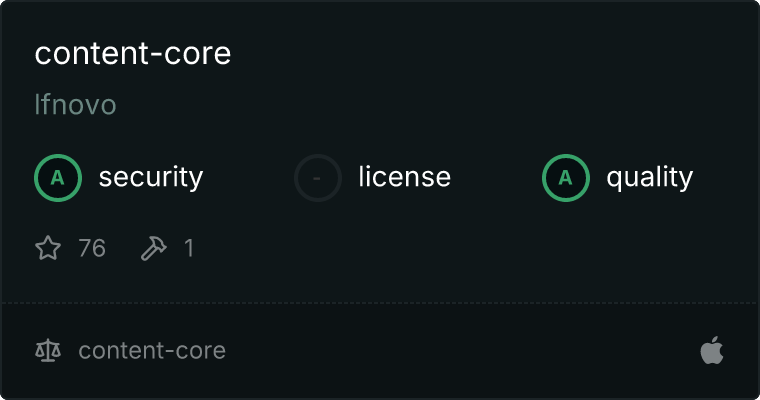
Add to your claude_desktop_config.json:
{
  "mcpServers": {
    "content-core": {
      "command": "uvx",
      "args": ["content-core", "mcp"],
      "env": {
        "OPENAI_API_KEY": "sk-..."
      }
    }
  }
}
The MCP server exposes two tools: extract_content and summarize_content. Both return plain text.
For detailed setup, see the MCP documentation.
Claude Code Skill
Content Core includes a SKILL.md that teaches AI agents how to use it for extracting content from external sources. To make it available in your Claude Code project, copy it to your skills directory:
# Download the skill
curl -o .claude/skills/content-core/SKILL.md --create-dirs \
  https://raw.githubusercontent.com/lfnovo/content-core/main/SKILL.md
Once installed, Claude Code can use content-core to extract content from URLs, documents, and media files — either via CLI (uvx content-core) or MCP if configured.
AI Providers
Content Core uses Esperanto to support multiple LLM and STT providers. Switch providers by changing the config — no code changes needed:
# Use Anthropic for summarization
content-core config set llm_provider anthropic
content-core config set llm_model claude-sonnet-4-20250514

# Use Groq for transcription
content-core config set stt_provider groq
content-core config set stt_model whisper-large-v3
Supported providers include OpenAI, Anthropic, Google, Groq, DeepSeek, Ollama, and more. See the Esperanto documentation for the full list.
Configuration
Content Core uses ContentCoreConfig powered by pydantic-settings. Settings are resolved in priority order: constructor args > env vars (CCORE_*) > config file (~/.content-core/config.toml) > defaults.
Environment Variables
| Variable | Description | Default |
|---|---|---|
CCORE_URL_ENGINE |
URL extraction engine (auto, simple, firecrawl, jina, crawl4ai) |
auto |
CCORE_DOCUMENT_ENGINE |
Document extraction engine (auto, simple, docling) |
auto |
CCORE_AUDIO_CONCURRENCY |
Concurrent audio transcriptions (1-10) | 3 |
CRAWL4AI_API_URL |
Crawl4AI Docker API URL (omit for local browser mode) | - |
FIRECRAWL_API_URL |
Custom Firecrawl API URL for self-hosted instances | - |
CCORE_FIRECRAWL_PROXY |
Firecrawl proxy mode (auto, basic, stealth) |
auto |
CCORE_FIRECRAWL_WAIT_FOR |
Wait time in ms before extraction | 3000 |
CCORE_LLM_PROVIDER |
LLM provider for summarization | - |
CCORE_LLM_MODEL |
LLM model for summarization | - |
CCORE_STT_PROVIDER |
Speech-to-text provider | - |
CCORE_STT_MODEL |
Speech-to-text model | - |
CCORE_STT_TIMEOUT |
Speech-to-text timeout in seconds | - |
CCORE_YOUTUBE_LANGUAGES |
Preferred YouTube transcript languages | - |
API keys for external services are set via their standard environment variables (e.g., OPENAI_API_KEY, FIRECRAWL_API_KEY, JINA_API_KEY).
Proxy Configuration
Content Core reads standard HTTP_PROXY / HTTPS_PROXY / NO_PROXY environment variables automatically. No additional configuration is needed.
Optional Dependencies
# Docling for advanced document parsing (PDF, DOCX, PPTX, XLSX)
pip install content-core[docling]

# Crawl4AI for local browser-based URL extraction
pip install content-core[crawl4ai]
python -m playwright install --with-deps

# LangChain tool wrappers
pip install content-core[langchain]

# All optional features
pip install content-core[docling,crawl4ai,langchain]
Using with LangChain
When installed with the langchain extra, Content Core provides LangChain-compatible tool wrappers:
from content_core.tools import extract_content_tool, summarize_content_tool

tools = [extract_content_tool, summarize_content_tool]
Documentation
- Usage Guide -- Python API details, configuration, and examples
- Processors -- How content extraction works for each format
- MCP Server -- Claude Desktop and MCP integration
Development
git clone https://github.com/lfnovo/content-core
cd content-core

uv sync --group dev

# Run tests
make test

# Lint
make ruff
License
This project is licensed under the MIT License.
Contributing
Contributions are welcome! Please see our Contributing Guide for details.
Release history Release notifications | RSS feed


Download files
Download the file for your platform. If you're not sure which to choose, learn more about installing packages.
Source Distribution
Built Distribution
Filter files by name, interpreter, ABI, and platform.
If you're not sure about the file name format, learn more about wheel file names.
Copy a direct link to the current filters
File details
Details for the file content_core-2.0.3.tar.gz.
File metadata
- Download URL: content_core-2.0.3.tar.gz
- Upload date:
- Size: 20.5 MB
- Tags: Source
- Uploaded using Trusted Publishing? No
- Uploaded via: uv/0.11.6 {"installer":{"name":"uv","version":"0.11.6","subcommand":["publish"]},"python":null,"implementation":{"name":null,"version":null},"distro":{"name":"Ubuntu","version":"24.04","id":"noble","libc":null},"system":{"name":null,"release":null},"cpu":null,"openssl_version":null,"setuptools_version":null,"rustc_version":null,"ci":true}
File hashes
| Algorithm | Hash digest | |
|---|---|---|
| SHA256 |
e4252da6ff407da0554682ea11b50ab9b849d470cd5ec71e6379d6e62502a0ec
|
|
| MD5 |
a647c0c32ea91a9be2310e54173ca047
|
|
| BLAKE2b-256 |
e2eaedaa640474314e67fb0bef721af878eb53e8a47334d884b884d15d9cc54e
|
File details
Details for the file content_core-2.0.3-py3-none-any.whl.
File metadata
- Download URL: content_core-2.0.3-py3-none-any.whl
- Upload date:
- Size: 57.0 kB
- Tags: Python 3
- Uploaded using Trusted Publishing? No
- Uploaded via: uv/0.11.6 {"installer":{"name":"uv","version":"0.11.6","subcommand":["publish"]},"python":null,"implementation":{"name":null,"version":null},"distro":{"name":"Ubuntu","version":"24.04","id":"noble","libc":null},"system":{"name":null,"release":null},"cpu":null,"openssl_version":null,"setuptools_version":null,"rustc_version":null,"ci":true}
File hashes
| Algorithm | Hash digest | |
|---|---|---|
| SHA256 |
c740aac5efd54ce712b7278f89ac6d354a232c0f5163193d63c671af2c714da6
|
|
| MD5 |
5b1ee2c3b5ee2407ec22f61690e6dfa1
|
|
| BLAKE2b-256 |
08c47f807277718304b93ada06d0fedde8e318addd1db21c45d71fe80c19ae42
|






