
contextcost




What does it cost an AI agent to read your repository — and how much of that is waste it can prove?
uvx contextcost .           # measure the repo you're standing in — nothing installed
uvx contextcost plotly.js   # or any repo by name or URL
In 3 seconds, on repos you already know:
| you point it at | it costs to read | waste it can prove (measured) |
|---|---|---|
plotly/plotly.js |
63.8M tokens | 26.8M — 42% |
dask/dask |
4.3M tokens | 2.0M — 46.5% |
uvx contextcost plotly.js reports that 26.8M of its 63.8M tokens (42%) are build output, minified bundles and recorded test fixtures an agent never reads usefully. The 42% isn't a guess — the tool re-walks the repository with its proposal applied and reports the difference between the two measurements. (All 17 measured repos →)
The differentiator in one line: a packer just bundles your repo — contextcost proves what's waste by re-measuring the repo with the cuts applied, so the percentage is something it observed, not a guess. That is why every number above is reproducible with bash docs/case-studies/reproduce.sh.
17 real repositories, measured
One command per repository (uvx contextcost <repo>), full public checkouts.
"Measured saving" is what disappears when the proposed exclusions are applied
— re-measured by walking the tree a second time, never added up from
guesses:
| repository | tokens to read it | measured saving | share |
|---|---|---|---|
| moby/buildkit | 14,600,569 | 13,070,932 | 89.5% |
| jesseduffield/lazygit | 5,766,190 | 4,487,197 | 77.8% |
| sharkdp/bat | 53,715,389 | 29,977,946 | 55.8% |
| astral-sh/uv | 8,855,618 | 4,523,776 | 51.1% |
| astral-sh/ruff | 20,666,629 | 10,384,853 | 50.2% |
| dask/dask | 4,315,000 | 2,006,637 | 46.5% |
| plotly/plotly.js | 63,831,059 | 26,822,142 | 42.0% |
| gitleaks/gitleaks | 301,132 | 101,742 | 33.8% |
| trufflesecurity/trufflehog | 4,456,181 | 1,444,421 | 32.4% |
| rclone/rclone | 7,889,210 | 1,719,408 | 21.8% |
| pandas-dev/pandas | 10,105,577 | 2,176,295 | 21.5% |
| keycloak/keycloak | 18,687,556 | 1,397,219 | 7.5% |
| contextcost (this repo) | 113,369 | 8,566 | 7.6% |
| pydata/xarray | 2,133,276 | 126,159 | 5.9% |
| restic/restic | 1,054,989 | 49,807 | 4.7% |
| astropy/astropy | 7,881,727 | 212,121 | 2.7% |
| mikefarah/yq | 420,446 | 2,989 | 0.7% |
Numbers captured with v0.5.0, whose estimate carried a ±14% measured bound; v0.5.2 measures that same bound at ±23% after recalibration showed how far the earlier ratios were off on lockfiles and numeric data. The savings column is unaffected either way — it is the difference of two full walks of each repository, independent of the token estimator's accuracy.
The spread is the finding: there is no universal waste percentage, only your
repository's number — and a disciplined repository like yq correctly comes
back clean instead of being handed invented findings. Per-file breakdowns:
the first seven repositories,
ten more, and the
head-to-head against a packing tool
here. Re-run the whole table
yourself: bash docs/case-studies/reproduce.sh.
The 3-second version
Real output on plotly.js (full public
checkout at 71a2ff7, 2026-08-24, contextcost v0.5.0):
$ contextcost plotly.js/

  63,831,059 tokens to read this repository   ±23% estimated, no tokenizer
  2717 text files · 1346 binaries not counted · 6 paths ignored

WHERE IT GOES
  test                   35,583,286  ████████████████████████████  56%
  dist                   24,598,872  ███████████████████·········  39%
  src                     1,596,194  █···························   3%

LARGEST FILES
  4,578,500  test/image/mocks/gl3d_snowden_altered.json  sampled
  4,578,201  test/image/mocks/gl3d_snowden.json  sampled
  2,593,972  dist/plotly-strict.js  sampled

SAVING
  63,831,059 → 37,008,917 tokens   42% saved
  Measured by walking the repository again with the proposal applied,
  not by subtracting what was dropped.
26.8 million tokens of that repository's reading cost is compiled bundles, recorded test fixtures, and generated files — enough to fill a frontier model's 200K-token context window about 134 times, spent mostly on JSON number matrices and minified output. An agent asked to fix a chart bug reads none of it usefully.
And the estimate is trustworthy: re-run with --accurate, the real tokenizer
(cl100k_base) counts 63,363,404 tokens — the estimate above landed 0.7%
off, well inside even the recalibrated ±23% band. On data-heavy repositories
that gap is exactly the thing naive character-counting gets wrong by 30–70%.
The "42%" is not a sum of opinions. The tool proposes cuts, then walks the repository a second time with the proposal applied, so the saving is the difference between two measurements — and if a pattern had caught anything it wasn't supposed to, you'd see the narrowing in the report. This scales down too: seven real repos measured ran from 46.5% waste (dask) to 2.7% (astropy), and ten more stretched that to 89.5% (moby/buildkit) down to 0.7% (yq) — clean repos correctly get told they're clean.
How this relates to the packing tools (repomix, gitingest, code2prompt): we ran repomix and contextcost on the same plotly.js checkout — the comparison. Short version: 73% of what the packer packed was provable dead weight, and the packer has no opinion about that. Packing is step two; auditing is step one.
Point it at any repository. It measures what reading that repository costs in tokens, works out which files are spending that budget without earning it, and then re-measures the result — so every number it reports is one it observed.
Install
# try it on any repo right now, nothing installed:
uvx contextcost .

# or install it:
pip install contextcost
No dependencies. Python 3.9+. Also works with pipx run contextcost ..
Why this exists
Every coding agent (Claude Code, Cursor, Codex, Copilot) spends 20–45% of its context window on files that add no signal — measured on full public checkouts with uvx contextcost <repo>: plotly.js wastes 42% (26.8M tokens, mostly dist/ bundles + numeric mock data), dask wastes 46.5% (2.0M tokens, led by a single pixi.lock at 22% of the whole repo), while disciplined repos like astropy come back at 2.7%. The spread is the finding: there is no universal waste percentage, only your repository's number — and unlike packers (repomix, gitingest) that bundle blindly, contextcost proves the waste by re-measuring the repo with cuts applied, so every saving is observed, not guessed. Try it: uvx contextcost .
What it will not do
Stated up front, because a tool that measures something is only useful if you know where its numbers stop.
It does not use a real tokenizer. An exact count needs tiktoken — a
compiled dependency with a wheel per platform. A tool whose pitch is "find out
what your repo costs in ten seconds" cannot open with a build toolchain. So it
approximates by character class and prints its error bound next to every
total.
That bound is measured, not asserted. docs/calibrate.py encodes a corpus with
cl100k_base and rewrites ERROR_BOUND from the result, so the printed band is
the one that was actually observed — run it after any estimator change, and CI
fails if the estimator drifts past it. The current bound is ±23%,
measured over this repository's own source plus real lockfiles and synthetic
dense/CJK samples.
Two caveats that belong here rather than in a footnote. It is one
tokenizer — Anthropic and most others do not publish theirs, so this is a
proxy, and "byte-pair encoders land close to each other" is doing real work in
that sentence. And the bound covers source, configuration and lockfiles, not
packed or minified output: a repository whose cost is dominated by
dist/*.min.js or a bundled artifact can sit well outside it, because those
files tokenize nothing like the corpus. For any number you intend to quote —
especially on a JavaScript project — run --accurate and the real tokenizer
settles it. The estimate is the triage; the re-measurement is the answer.
CJK is counted per script, not as one thing
Charging Chinese at the Latin rate under-counts it roughly threefold, so CJK has always been counted separately. What was wrong until recently is that it was counted as one category, and the scripts are not close to each other:
| script | tokens per character |
|---|---|
| Japanese kana | 0.85 |
| Korean hangul | 1.10 |
| Chinese, simplified | 1.08 |
| Chinese, traditional | 1.55 |
Traditional Chinese costs 44% more per character than simplified for the same sentence, because the tokenizer has far fewer merges for it. A single constant under-counted it by 30% — and traditional is what this project's author writes documentation in, so the first real user would have been the one mis-billed.
Simplified and traditional share a Unicode block, so they are told apart by looking for characters that exist only in the traditional set. Measured on prose: 27% of traditional Han characters trip that detector, and 0% of simplified ones.
Numeric data dumps are their own class
Running --accurate against plotly.js
exposed the estimator's next blind spot: it read 45 M tokens where the
tokenizer said 64 M. The gap was not source code — it was recorded test
fixtures and JSON number matrices, files whose bodies are thousands of small
integers (gl2d_parcoords_blocks.json was under-counted by 71%). A byte-pair
encoder merges digits poorly, so the more of a file is digits, the more
tokens per character it costs — the opposite of what the code ratio assumed.
Files that are mostly digits now form a numeric class with its own ratio,
derived from the measured digit share. On plotly.js this took the whole-tree
error from 29.4% to 1.2%; on astropy from 20.8% to 12.6%; h5py and pandas,
which have almost no such files, were unchanged. The class is conservative on
purpose — a file qualifies only if it already looked like code, at least 10%
of it is digits, letters are under 25%, and the digits outnumber the letters —
so ordinary number-heavy source stays on the code path.
For most of this project's life that bound read ±12%, and it had been chosen
rather than measured — the comment beside it cited a calibration script that
did not exist. When the script was finally written, the true figure was more
than four times worse, and fixing the ratios it exposed (source code is 4.14
characters per token, not the 3.15 that had been reasoned out; dense content is
bimodal and no single ratio fits it) is what produced the table above. That is
recorded in estimate.py rather than quietly corrected, because a tool that
argues against unverified numbers should say when it shipped one.
It will not decide the ambiguous cases for you. Findings carry a
confidence: certain (the file says what it is, or its name is reserved by
the tool that wrote it), likely (a strong path convention), and possible.
Confidence describes the evidence for the file's category, not universal
irrelevance: a lockfile is machine-written with certainty and can still be
essential during a dependency upgrade. Read the proposal in the context of
the work you use the agent for.
That last tier — mostly large data files — is never excluded automatically,
because a large CSV is waste in a web app and is the entire subject in an
analysis repository, and nothing visible from the file system tells those
apart. Those are listed separately, with the rule's reasoning, for you to
judge. --include-possible moves them in.
It never edits your repository unless you ask. The default output is a
proposal. --write-ignore targets the selected consumer's native ignore file;
--write-gitignore remains available as an explicit compatibility option.
Write mode refuses a symbolic-link destination instead of following it beyond
the repository boundary.
.contextcostignore — exclusions that belong to the measurement alone.
The right exclusion for an AI context budget is often wrong everywhere else: a
recorded test fixture should reach an agent and stay tracked by Git.
contextcost --emit-ignore writes the verified proposal into this
project-local file, which contextcost reads for every consumer (even with
--no-gitignore) and applies last, so its patterns win — including !
re-inclusions, if you want to rescue files from a broader rule. Accepting a
saving is one command and changes nothing outside this tool's own measurement.
It does not reproduce a live product's prompt or bill. Consumer profiles model documented ignore-file inputs: the set of text files eligible for context. They do not reproduce semantic retrieval, repo maps, compression, tool calls, product default exclusions, a proprietary tokenizer, or how much one particular request actually sends.
It has no users yet. This is a new tool. The estimator's error bound is measured against a reference tokenizer, and the reduction is measured rather than estimated, but neither of those is the same as having been run against a thousand repositories by people who did not write it.
How the saving is verified
This is the part worth being suspicious of in any tool that claims one, so here is the mechanism in full.
- Walk the repository, respecting the selected consumer's ignore inputs. Attribute a cost to every eligible file.
- Classify what looks wasteful, with quoted evidence per file.
- Turn the findings into ignore patterns.
- Walk the repository again with those patterns applied.
- Compare the files that disappeared against the files that were proposed.
Those two sets must be equal. If a pattern took anything extra — a
docs/rule that also caughtdocs/guide/writing.md, or a PNG sitting beside a minified bundle — the patterns are narrowed to exact paths, the repository is walked a third time, and the report says the narrowing happened.
Step 5 is the one that matters. A saving computed by adding up what a tool decided to drop cannot tell the difference between a pattern that worked and a pattern that matched too much: the number goes up either way.
On an ordinary small project
The example below is generated by docs/build_docs.py: a small web project
with some source, a lockfile, a bundle, a vendored widget and a snapshot file.
Nobody would call it bloated.
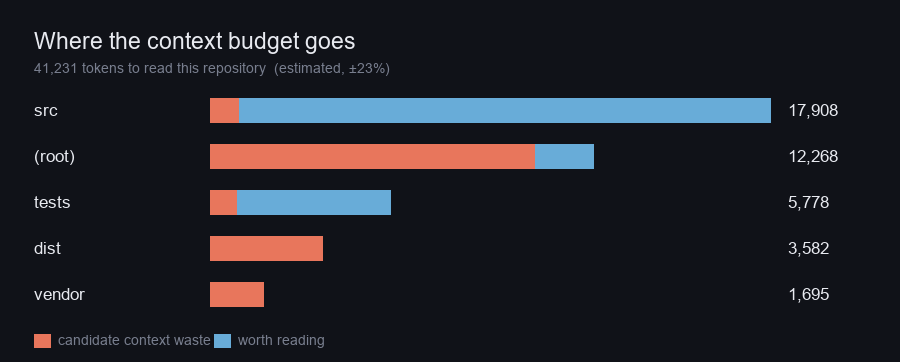
41,231 tokens to read 16 text files (estimated, ±23% — see below for why there is no tokenizer).
| file | tokens | rule | confidence |
|---|---|---|---|
package-lock.json |
10,392 | lockfile | certain |
dist/bundle.min.js |
3,582 | minified | certain |
vendor/legacy/widget.js |
1,043 | vendored | likely |
src/generated/schema.js |
924 | generated | certain |
tests/__snapshots__/app.test.js.snap |
850 | snapshot | likely |
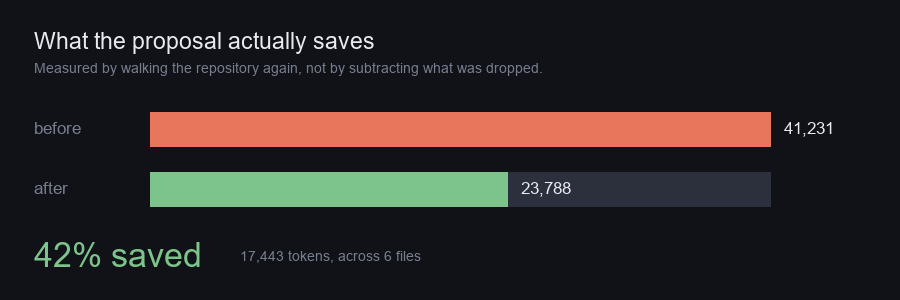
Excluding those leaves 23,788 tokens — a 42% reduction, and that number is the difference between two walks of the repository, not a sum of what was dropped.
Usage
contextcost                       # measure the current directory
contextcost path/to/repo          # measure somewhere else
contextcost --json                # machine-readable, schema v1, for scripts and CI
contextcost --json-schema         # print the --json key contract
contextcost --markdown            # GitHub-flavoured Markdown, for PR comments
contextcost --markdown --badge    # ...with a shields.io badge line for a README
contextcost --accurate            # exact counts via tiktoken (see below)
contextcost --include-possible    # also act on large data files
contextcost --consumer cursor     # include .cursorignore in the measurement
contextcost --consumer aider      # include .aiderignore in the measurement
contextcost --consumer repomix    # include Repomix's documented ignore files
contextcost --consumer cursor --write-ignore  # append to .cursorignore
contextcost --emit-ignore         # append to .contextcostignore (this tool only)
contextcost --write-gitignore     # explicit legacy .gitignore destination
contextcost --no-gitignore        # count files git would hide
contextcost --top 20              # more rows per section
python -m contextcost --version   # module entry point also works
Exact counts: --accurate
The default numbers are estimates with a measured ±23% error bound (run
python docs/calibrate.py to see the current figure against a real tokenizer),
and for most decisions — "is this repo worth reading", "which files are the
problem" — that resolution is enough. The bound covers source, configuration and
lockfiles; repositories dominated by packed or minified output sit outside it,
so when a number will be quoted, --accurate counts with the real tokenizer:
pip install 'contextcost[accurate]'
contextcost --accurate
Three things stay true when it is on:
- Both numbers are shown. The estimate keeps its band beside the exact figure, and the report says whether the estimate landed inside it. A tool that prints only exact numbers is asking you to forget it was ever wrong.
- Sampling stays sampling. Files above 2 MB are still extrapolated from a
prefix and marked
sampled, rather than spending seconds being precise about one big file. - Zero dependencies stays the default. tiktoken is never imported unless
you pass the flag; without it installed,
--accurateexits with code 3 and the install hint.
Measured on this repository itself, estimate and exact agree within 1 %. On
repositories full of numeric data dumps they can diverge far more — which is
exactly the kind of thing running --accurate once will tell you.
See the exact-counts case study for a head-to-head comparison of estimated vs. tokenizer-accurate counts on 17 repositories, and why the estimate bound was recalibrated from ±14% to ±23%.
Consumer-native ignore files
The same repository has a different eligible file set in different tools. ContextCost therefore measures the selected consumer and writes a verified proposal to the file that consumer actually documents:
--consumer |
additional inputs | --write-ignore destination |
|---|---|---|
generic |
nested .gitignore files |
.gitignore |
cursor |
.cursorignore |
.cursorignore |
aider |
.aiderignore |
.aiderignore |
repomix |
.ignore, .repomixignore, .git/info/exclude |
.repomixignore |
All non-generic profiles also use nested .gitignore files unless
--no-gitignore is supplied. Cursor documents .cursorignore as the stronger
boundary for keeping files out of AI requests; Aider documents .aiderignore
for large repositories; Repomix documents .repomixignore in the same syntax
as .gitignore. The exact scope and the limitations of each model are recorded
in consumer profiles.
This distinction matters for tracked files. Git itself says that
.gitignore applies to intentionally untracked files and does not stop
tracking a file already in the index. A consumer may still use that pattern as
its own context filter, but writing .cursorignore, .aiderignore, or
.repomixignore expresses the intended AI-tool boundary directly.
The exit code is 1 when an actionable context-waste candidate was found and
0 when it was not, so this works as a CI check:
- name: Keep the context budget honest
  run: pipx run contextcost --quiet
That exit code will bite you under set -e. "Found something" is not an
error, but bash -e cannot tell the difference and will abort your script on
it. This tool's own CI failed on exactly that the first time it ran. When you
want the output rather than the verdict, say so:
contextcost --json > cost.json || true
To gate on total size rather than on removable waste, --fail-over BUDGET
exits 4 when the measured total exceeds BUDGET tokens — with --accurate
that is the exact count, otherwise the estimate. Exit code 4 is distinct
from 1 on purpose: waste (1) is a cleanup task, over-budget (4) is a
scoping decision.
- name: The whole repo must fit an agent's window
  run: pipx run contextcost --fail-over 200000 --quiet
In a pull request
--delta measures what a change does to the context budget: it walks a base
checkout and the head tree per file, compares them by path, and classifies the
head tree so "+32k of this is a lockfile" is a measurement, not a guess from
filenames. The bundled Action posts (and keeps updated) that report as a PR
comment:
# .github/workflows/contextcost.yml in any repository
name: contextcost
on: pull_request
jobs:
  delta:
    runs-on: ubuntu-latest
    permissions:
      pull-requests: write
    steps:
      - uses: CAOShurong/contextcost/action@main
        with:
          # optional: fail the check if the PR adds more than this many tokens
          # to what an agent reads (e.g. 1000000)
          max-added: 1000000
Or run it by hand. The base can be a second checkout of the same repository — for example the PR's merge base next to the working tree:
contextcost . --delta ../repo-at-merge-base --markdown
— or simply a git revision of the repository being measured, which is exported automatically (no second clone, no worktree):
contextcost . --delta main            # uncommitted changes vs the branch
contextcost . --delta HEAD~1          # what the last commit did to the budget
contextcost repo/ --delta v4.0.0      # a tagged release vs its checkout
## contextcost — context delta

**53,834 → 95,631 tokens** (+41,797, estimated ±23%).

| rule | tokens | share of repo |
| --- | --- | --- |
| **lockfile** | +32,232 | 34% |
| unclassified *(real work?)* | +9,565 | 10% |
As a library
from contextcost.reduce import reduce_repository

result = reduce_repository("path/to/repo", consumer="aider")
print(result.before, "->", result.after)   # both measured
print(result.patterns)                     # what to add to .aiderignore
print(result.deferred)                     # what it refused to decide
walk_repository, classify and reduce_repository are all usable
separately, and every dataclass has as_dict().
As an MCP server
Coding agents that speak MCP can call this tool instead of shelling out — same measurement, same schema, one tool call:
contextcost mcp # line-delimited JSON-RPC on stdio
Two tools are served. estimate(repo) returns the full --json payload;
propose(repo) returns the measured exclusion proposal plus a ready-to-paste
ignore block. Stdio transport, stdlib-only JSON-RPC 2.0 — no SDK dependency:
{"jsonrpc": "2.0", "id": 1, "method": "tools/call",
 "params": {"name": "estimate", "arguments": {"repo": "/path/to/repo"}}}
Claude Code, Cursor and Codex CLI each take a two-line config — copy-paste blocks live in docs/coding-agents.md. Any MCP client then gets "what does this repo cost and what is wasting it" as a tool call beside the model.
Development
python -m pytest -q                      # 198 tests, no configuration needed
python -m ruff check src tests docs
python docs/build_docs.py                # regenerate the figures and README
python docs/build_docs.py --check        # CI fails if they are stale
The figures above are generated from a real run against a generated example repository, and CI fails if the README's numbers drift from what the code actually produces.
Verify a release
Starting with v0.2.0, every GitHub release includes a SHA256SUMS manifest and
GitHub build-provenance attestations for the wheel and source distribution:
sha256sum --check SHA256SUMS
gh attestation verify contextcost-0.2.0-py3-none-any.whl \
  --repo CAOShurong/contextcost
The GitHub and PyPI files are built once in the same release workflow. Verify the downloaded bytes rather than treating a tag or a green job as proof of the artifact you installed.
Share it
If the number surprised you, it will probably surprise whoever maintains the next repository you point this at. The landing page renders a proper preview card when pasted into Slack, Discord, X, or a chat window — no extra work needed, just paste the link.
Questions, methodology debates, and "this number looks wrong" reports are
welcome in Discussions —
if a saving looks off, paste --accurate --json output and it becomes a
concrete, checkable claim.
Licence
MIT.
1 maintainer

Release files for contextcost 0.5.4
For a detailed explanation of source distributions (sdists) and built distributions (wheels), please see the package formats documentation.
Source distribution (sdist)
| File | Size | Uploaded | |
|---|---|---|---|
| contextcost-0.5.4.tar.gz | 238.4 kB | Details |
Built distribution (wheel)
| File | Interpreter | ABI | Platform | Reset |
|---|---|---|---|---|
| contextcost-0.5.4-py3-none-any.whl | Python 3 | none | any | Details |
Total release size:307.2 kB
Release files / contextcost-0.5.4.tar.gz
| Download URL | contextcost-0.5.4.tar.gz |
|---|---|
| Size | 238.4 kB |
| Tags | Source |
|
SHA-256 checksum How to use checksums |
1cdfd8c3ef53607d91fc6af700146ae14b19a1c86498813b4cbe6500a7cf9f21
|
|
BLAKE2b-256 checksum How to use checksums |
25f82058c7a7b6e94b5805e06d6f8d656b639256ae90860f186d3f3cebb73034
|
| Upload date | |
|
Uploaded using Trusted Publishing? What is trusted publishing? |
Yes |
| Uploaded via |
twine/7.0.0 CPython/3.13.14
|
Provenance
Provenance describes where a file came from. On PyPI, provenance is shared via attestations, which provide a verifiable record of the build or publishing details. View details, limitations and caveats.


PyPI Publish Attestation
PyPI verified that this artifact, at this checksum, originated from the publisher listed below.
Signed by GitHub Actions, verified by PyPI on Aug 28, 2026.
Transparency logRelease files / contextcost-0.5.4-py3-none-any.whl
| Download URL | contextcost-0.5.4-py3-none-any.whl |
|---|---|
| Size | 68.8 kB |
| Tags | Python 3 |
|
SHA-256 checksum How to use checksums |
2006e4c14445309f39e148791af40ac59d786e4397cf10deeaa47e724aee85de
|
|
BLAKE2b-256 checksum How to use checksums |
d3914572a6c0c3bb23c8582e488e08d356922b039bae84b74b29a7ea00de2067
|
| Upload date | |
|
Uploaded using Trusted Publishing? What is trusted publishing? |
Yes |
| Uploaded via |
twine/7.0.0 CPython/3.13.14
|
Provenance
Provenance describes where a file came from. On PyPI, provenance is shared via attestations, which provide a verifiable record of the build or publishing details. View details, limitations and caveats.
PyPI Publish Attestation
PyPI verified that this artifact, at this checksum, originated from the publisher listed below.
Signed by GitHub Actions, verified by PyPI on Aug 28, 2026.
Transparency log













