
ContextSmith
Give your coding agent the right code, not more code.
A local context engine for Claude Code, Cursor, Codex and any MCP agent. It indexes your repository into a code graph, hybrid search and git history, and answers every task with the code that matters, packed into a token budget you choose.


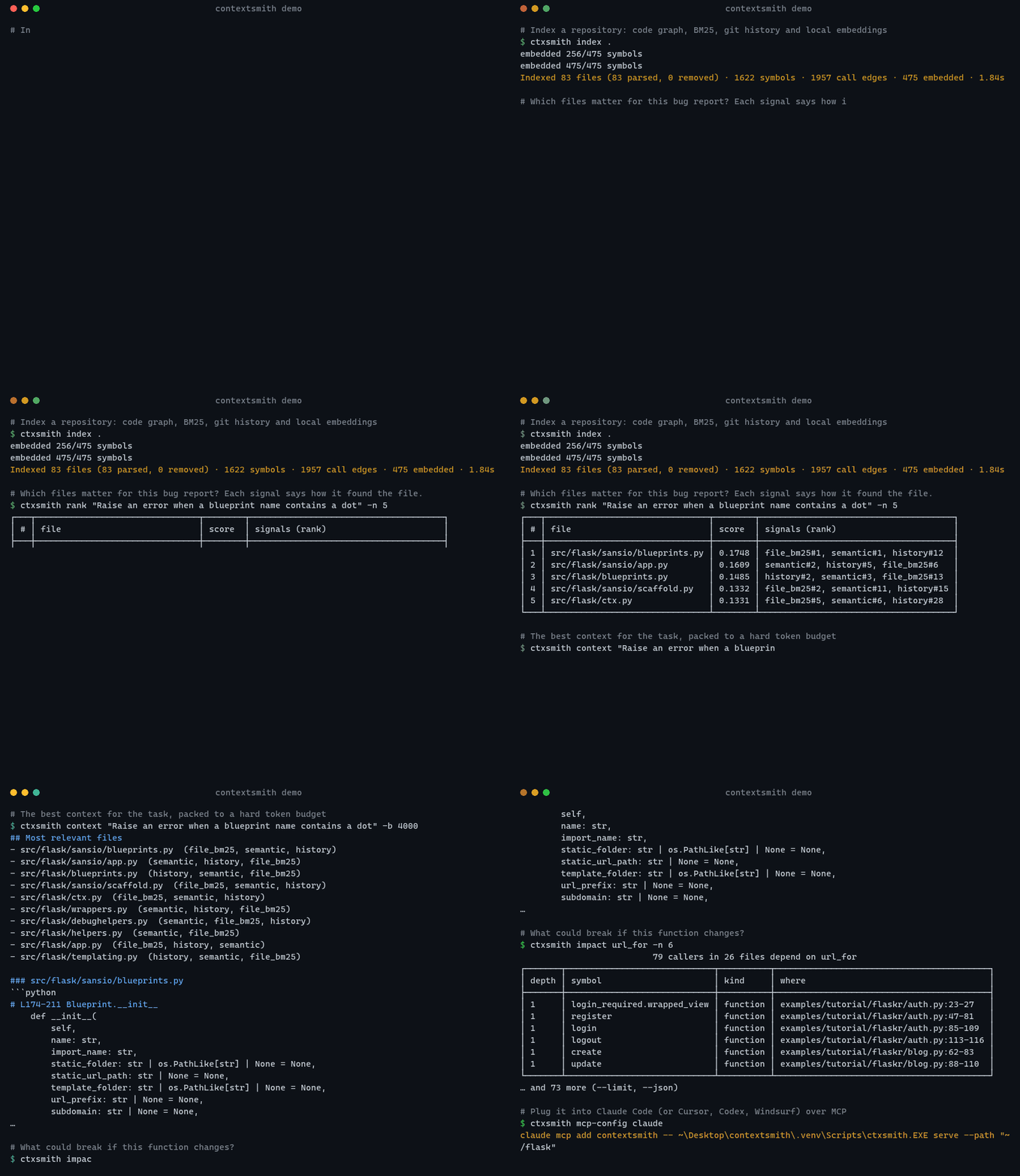
Coding agents spend their context window on the wrong code. They grep, open whole files, and run out of room before they reach the function that needs the fix, and you pay for every token they read. ContextSmith answers one question as well as possible: given this task and N tokens, what code should the agent read?
| 92% of real bug fixes had the right file inside a 4,000-token context vs 29% for search + whole files |
1.7x more often the exact lines to change are shown 48% vs 29%, same budget |
100% local no API keys, no cloud, code never leaves the machine |
Measured on 114 Django issues from SWE-bench Lite that no tuning step ever saw. Method and full results.
Quickstart (60 seconds)
pipx install "contextsmith[semantic]"      # or: pip install "contextsmith[semantic]"
cd your-repo
ctxsmith index                              # once; afterwards only changed files are re-read
ctxsmith context "Coupons are applied twice at checkout" --budget 4000
Connect it to your agent (the command prints the exact line for your machine):
ctxsmith mcp-config claude    # or: cursor, windsurf, codex
claude mcp add contextsmith -- ctxsmith serve --path /path/to/your-repo
From then on the agent calls get_context itself and gets ranked, budgeted code instead of
grepping. Without the [semantic] extra everything still works, using keyword search only.
Who it's for
Developers
- Faster, better agent sessions on big repos. The agent starts from the right functions instead of exploring; fewer wrong edits and "I couldn't find it" loops.
- Understand unfamiliar code.
ctxsmith context "where are payment retries handled?"returns the relevant functions with their file and line numbers. - Change safely.
ctxsmith impact charge_cardlists everything that calls it, transitively: what a change could break, before you make it. - Remember the gotchas.
ctxsmith note add "never call without the account lock" --symbol charge_cardpins a note to the code; it shows up in every future context for that code, for you and for the agent.
Teams and companies
| Need | How ContextSmith covers it |
|---|---|
| Code that must not leave the building (finance, health, government, enterprise IP) | Runs entirely on the developer's machine. Parsing, search and embeddings are local; the only network use is a one-time download of two small open models, which you can mirror internally for air-gapped machines |
| Predictable AI spend | Every answer has a hard token budget you set, so context cost per task is fixed instead of "whatever the agent opened" |
| Works with the agents you already pay for | Standard MCP server: Claude Code, Cursor, Windsurf, Codex, Copilot agents and in-house agents use the same index |
| Onboarding | New engineers and their agents ask questions in plain language and land on the right code |
| Code review and CI | ctxsmith context "$PR_TITLE" -b 6000 gives a review bot the code a PR touches and depends on; ctxsmith impact NAME shows the blast radius |
| Team knowledge | Decisions and invariants live next to the code as notes, not in someone's head |
| No lock-in, no procurement | MIT licence (commercial use is fine), a single SQLite file per repository, no server to run, no account |
Typical rollout: each developer installs it with pipx, runs ctxsmith index in the
repositories they work on, and adds one MCP line to their agent. There is nothing to host.
See Using it at a company for CI and offline setups.
Builders of AI tools
ContextSmith is also a Python library. Use it as the retrieval layer of your own agent, review bot or internal assistant:
from contextsmith import Engine

eng = Engine("path/to/repo")
eng.index()
pack = eng.context("Fix the race when two users book the last seat", budget=6000)
prompt = f"{pack.text}\n\nTask: fix the race when two users book the last seat."
Results
The test: take a real GitHub issue from SWE-bench Lite, check the repository out at the issue's own commit (so no future code or history leaks in), give the issue text to the tool, and check whether the code the real fix changed comes back.
Final test on Django: 114 issues that no tuning step ever saw.
| BM25, whole files | ContextSmith | |
|---|---|---|
| The fix's file is ranked 1st / in the top 3 / top 5 | 50.9% / 70.2% / 77.2% | 51.8% / 79.8% / 85.1% |
| The fix's file is inside a 4,000-token context | 28.9% | 92.1% (3.2x) |
| The exact lines the fix changes are shown in 4,000 tokens | 28.9% | 48.1% (1.7x) |
| Query time (median, laptop CPU, 2,800-file repository) | 145 ms | 238 ms |
The baseline pastes BM25-ranked files whole until the budget runs out, which is what "search the repo and open files" agents do. ContextSmith spends the same tokens on the functions that matter and outlines of the rest, so the right file almost always makes it in.
All strategies and ablations
| strategy | R@1 | R@3 | R@5 | R@10 | file in 4k | file in 8k | lines in 4k | lines in 8k | ms |
|---|---|---|---|---|---|---|---|---|---|
| BM25, whole files | 50.9 | 70.2 | 77.2 | 84.2 | 28.9 | 49.1 | 28.9 | 49.1 | 145 |
| lexical (no embeddings) | 48.2 | 74.6 | 78.9 | 86.0 | 86.0 | 89.5 | 42.3 | 46.2 | 145 |
| embeddings only | 48.2 | 69.3 | 78.9 | 86.8 | – | – | – | – | 249 |
| ContextSmith (default) | 51.8 | 79.8 | 85.1 | 88.6 | 92.1 | 96.5 | 48.1 | 50.7 | 238 |
| + cross-encoder re-rank | 34.2 | 73.7 | 81.6 | 91.2 | – | – | – | – | 1824 |
| without git history | 56.1 | 78.9 | 84.2 | 90.4 | – | – | – | – | 249 |
Full numbers: bench/results-django/summary.md.
What the ablations say, including what didn't work:
- Embeddings earn their place: adding them to the lexical ranker lifts top-5 from 79% to 85% and exact-line coverage from 42% to 48%.
- The cross-encoder re-rank hurts the top result (52% → 34%) at 8x the latency, so it is off by default and marked experimental. A general web-search re-ranker doesn't understand issue-to-code relevance; a code-trained one is on the roadmap.
- Git commit history is mixed: it helped on the tuning repositories, but on Django removing it raises recall@1 by 4 points. It stays on because the default was fixed before the Django run; changing it now would be tuning on the test set.
- At 8,000 tokens whole files catch up on exact lines (49% vs 51%): every Django fix here touches one file, and at that budget it often fits whole.
Method. Weights were chosen by grid search on 89 issues from 8 other repositories
(pytest, requests, flask, sphinx, pylint, xarray, astropy, seaborn) with
bench/tune.py and
bench/tune_pack.py,
then frozen before Django was run once. Reproduce it with
ctxsmith bench --repos django/django (first run: about two hours on a laptop).
How it works
flowchart LR
    subgraph Index["ctxsmith index (incremental)"]
        TS["tree-sitter<br/>7 languages"] --> SYM["symbols · calls · imports"]
        SYM --> G["call graph<br/>PageRank"]
        SYM --> FTS["FTS5 BM25<br/>files · symbols · bodies"]
        SYM --> EMB["ONNX embeddings<br/>symbol summaries"]
        EMB --> VEC["sqlite-vec<br/>cosine index"]
        GIT["git log"] --> H["commit-message index<br/>co-change pairs"]
    end
    subgraph Query["get_context(task, budget)"]
        Q["task text"] --> S1["file BM25"] & S2["semantic kNN"] & S3["paths in task"] & S4["history BM25"]
        S1 & S2 & S3 & S4 --> RRF["reciprocal-rank<br/>fusion"]
        RRF --> KS["knapsack packer<br/>value per token"]
        KS --> OUT["≤ N tokens of code"]
    end
    Index -. one SQLite file .-> Query
One SQLite file per repository holds everything: files, symbols, call and import edges,
three FTS5 indexes, git statistics, team notes, and the vector index (a vec0 virtual table
from sqlite-vec; a numpy fallback runs where SQLite
can't load extensions).
Retrieval (RAG). Each signal produces its own ranked list of files; reciprocal-rank fusion combines them, so no single noisy signal dominates:
| Signal | What it catches |
|---|---|
BM25 over whole files (camelCase/snake_case split, paths weighted up) |
exact vocabulary |
Semantic kNN over symbol summaries (BAAI/bge-small-en-v1.5, ONNX, CPU) |
the same idea in different words |
Paths named in the task (tracebacks, "in foo/bar.py") |
explicit pointers |
| BM25 over each file's commit messages | "this was touched for a similar bug before" |
| Co-change, call-graph neighbours, PageRank, exact-name mentions | available as weights; off by default because the benchmark showed they hurt file ranking |
The weights come from a grid search (bench/tune.py) on 89 SWE-bench Lite issues from 8
repositories and were then checked on Django, which tuning never saw.
What gets embedded, and why. Not whole files and not raw chunks: one short summary per function or class — path, qualified name, signature, first docstring sentence. On a laptop CPU this is ~30x cheaper than embedding bodies, and it is what identifies "which function is this about". Vectors are cached by content hash, so a function that didn't change is never embedded twice — across re-indexes and across git checkouts. Test files are skipped.
Experimental re-rank. ctxsmith context --rerank re-scores the top 20 files with a
cross-encoder (ms-marco-MiniLM-L-6-v2). It is off by default because the benchmark shows it
hurts (see Results).
Packing. Candidates are function bodies (matched by name, docstring and body text), class outlines and file outlines. A greedy knapsack takes the best value per token, discounts repeats from one file, and enforces the budget on the final rendered text, so the answer is never over budget.
Always fresh. Re-indexing compares file size and mtime before reading anything and only re-parses and re-embeds what changed; checking an unchanged 2,800-file repository takes about half a second. The MCP server does this before answering (at most every 2 seconds), so the agent never reads code it has just edited from a stale index.
Use it from your agent (MCP)
ctxsmith mcp-config <client> prints the exact snippet for your machine.
Claude Code
claude mcp add contextsmith -- ctxsmith serve --path /path/to/repo
Cursor, Windsurf and other clients (mcp.json):
{
  "mcpServers": {
    "contextsmith": { "command": "ctxsmith", "args": ["serve", "--path", "/path/to/repo"] }
  }
}
Codex (~/.codex/config.toml):
[mcp_servers.contextsmith]
command = "ctxsmith"
args = ["serve", "--path", "/path/to/repo"]
| Tool | Returns |
|---|---|
get_context(task, budget_tokens) |
the best code for the task, packed to the budget |
search(query) |
ranked functions and classes |
find_symbol(name) |
where something is defined |
callers(name) / callees(name) |
one hop of the call graph |
impact(name) |
everything that transitively calls it: what a change could break |
related_files(path) |
files linked by code, and files that change together in git |
add_note(text, path, symbol) |
a decision or gotcha that later sessions should know |
overview() |
languages, size, central and most-changed files |
reindex() |
force an incremental re-index |
CLI
| Command | What it does |
|---|---|
ctxsmith index [PATH] [--no-semantic] |
Index; incremental, embeddings on when the extra is installed |
ctxsmith context "task" -b 4000 |
Best context within a token budget |
ctxsmith rank "task" |
Ranked files, with the signals that found each |
ctxsmith search "query" |
Ranked functions and classes |
ctxsmith symbol / callers / callees NAME |
Navigate the call graph (--json for scripts) |
ctxsmith impact NAME |
What could break if NAME changes |
ctxsmith related FILE |
Files linked by code, and files that change together |
ctxsmith note add "text" --file F |
Remember a decision or gotcha |
ctxsmith overview |
Languages, size, central and most-changed files, semantic status |
ctxsmith serve |
MCP server over stdio |
ctxsmith mcp-config [claude|cursor|codex] |
Setup snippet for your agent |
ctxsmith bench --repos django/django |
Run the SWE-bench Lite benchmark yourself |
Python API
from contextsmith import Engine

eng = Engine("path/to/repo")       # index stored in path/to/repo/.contextsmith/
eng.index()                        # incremental; returns counts and timings
pack = eng.context("Fix the race when two users book the last seat", budget=6000)
pack.text, pack.tokens, pack.files, pack.spans   # markdown, size, files, line ranges shown

eng.rank("seat double-booked").files  # ranked files, with the signals that found each
eng.search("seat reservation")     # ranked functions and classes
eng.impact("reserve_seat")         # transitive callers
eng.related_files("booking/models.py")
eng.add_note("Seats are locked per show, not per seat", path="booking/models.py")
Configuration
| Variable | Default |
|---|---|
CTXSMITH_EMBED_MODEL |
BAAI/bge-small-en-v1.5 (any fastembed text model, e.g. jinaai/jina-embeddings-v2-base-code) |
CTXSMITH_RERANK_MODEL |
Xenova/ms-marco-MiniLM-L-6-v2 |
FASTEMBED_CACHE_PATH |
~/.cache/contextsmith/models |
The index lives in <repo>/.contextsmith/ (git-ignored automatically). Without the
semantic extra everything still works, lexically.
Using it at a company
Per developer (the usual rollout). pipx install "contextsmith[semantic]", then
ctxsmith index in each repository and one ctxsmith mcp-config line per agent. Nothing to
host, no accounts, no shared service to secure.
In CI: give a review bot the code a pull request is about.
# .github/workflows/pr-context.yml
name: PR context
on: pull_request
jobs:
  context:
    runs-on: ubuntu-latest
    steps:
      - uses: actions/checkout@v4
        with: { fetch-depth: 0 }            # full history powers the git signals
      - uses: actions/setup-python@v5
        with: { python-version: "3.12" }
      - uses: actions/cache@v4               # reuse the index and the model between runs
        with:
          path: |
            .contextsmith
            ~/.cache/contextsmith/models
          key: contextsmith-${{ github.base_ref }}
      - run: pip install "contextsmith[semantic]" && ctxsmith index
      - run: ctxsmith context "$TITLE" --budget 6000 > pr-context.md
        env:
          TITLE: ${{ github.event.pull_request.title }}   # via env, never inline: no injection
      - uses: actions/upload-artifact@v4
        with: { name: pr-context, path: pr-context.md }
Feed pr-context.md to whichever review model you use, or post ctxsmith impact <function>
output as a comment so reviewers see the blast radius.
Offline and air-gapped machines.
# on a machine with internet access (same OS and Python version as the target)
pip download "contextsmith[semantic]" -d wheels
ctxsmith index                     # downloads the embedding model (65 MB) once
# copy wheels/ and ~/.cache/contextsmith/models/ across, then on the offline machine:
pip install --no-index --find-links wheels "contextsmith[semantic]"
export HF_HUB_OFFLINE=1            # never try the network again
What is stored, and where. One SQLite file per repository in <repo>/.contextsmith/:
symbols, search indexes, call graph, git statistics and commit messages, notes, and
embedding vectors. It is git-ignored automatically and never uploaded anywhere. ContextSmith
has no telemetry; the only downloads are the open embedding model from Hugging Face on first
use (none without the semantic extra) and, if you run ctxsmith bench, the public benchmark.
FAQ
Does my code leave my machine? No. Parsing, search, embeddings and the MCP server all run locally. Your agent still sends the context it receives to its own model provider, as it would with any file it reads; ContextSmith just makes that context smaller and more relevant.
How big a repository can it handle? Measured on Django (2,800 files, 38,000 functions and classes) on a laptop CPU: 16 s to build the code graph, search and git index from scratch, about 3.5 minutes to embed everything the first time, 0.2 s per query, 0.5 s to check for changes, 136 MB on disk. After the first run only changed files are re-parsed and re-embedded.
Does it replace my agent's own search? No, it gives it a better starting point. The agent can still open any file; it just starts from the right functions instead of grepping.
Which models does it use? BAAI/bge-small-en-v1.5 for embeddings (ONNX, CPU, 65 MB),
changeable with CTXSMITH_EMBED_MODEL. No large language model is involved: ContextSmith
retrieves, your agent reasons.
What does it cost? Nothing. MIT licence, including commercial use.
Is it production-ready? It is v0.1: tested on Windows, macOS and Linux with Python 3.11–3.13, benchmarked in public, and honest about what doesn't work yet (see Results). Issues and pull requests are welcome.
Languages
Python, JavaScript, TypeScript/TSX, Java, Go and Rust, parsed with tree-sitter.
How it compares
Graphify, codebase-memory-mcp, GitNexus, Serena and Claude Context are good tools; this is where ContextSmith differs:
| ContextSmith | |
|---|---|
| Answers "the best context for this task in N tokens" | ✅ budgeted packer, never over budget |
| Published, reproducible benchmark with baselines and ablations | ✅ ctxsmith bench, held-out repositories |
| Lexical + semantic + git history, fused | ✅ |
| Fully local, no API keys, one SQLite file | ✅ |
| Team notes pinned to code, surfaced in context | ✅ |
| Commercial-friendly licence | ✅ MIT |
Roadmap
Multi-repo indexes, note staleness tracking, a file watcher, a graph view, a PR impact report, and more languages. Ideas and benchmark-backed pull requests are welcome: see CONTRIBUTING.md.
Licence
MIT
1 maintainer

Metadata
1 maintainer
Release files for contextsmith 0.1.0
For a detailed explanation of source distributions (sdists) and built distributions (wheels), please see the package formats documentation.
Source distribution (sdist)
| File | Size | Uploaded | Provenance | |
|---|---|---|---|---|
| contextsmith-0.1.0.tar.gz | 55.5 kB | With provenance | Details |
Built distribution (wheel)
| File | Interpreter | ABI | Platform | Reset |
|---|---|---|---|---|
| contextsmith-0.1.0-py3-none-any.whl | Python 3 | none | any | Details |
Total release size: 104.3 kB
Release files / contextsmith-0.1.0.tar.gz
| Download URL | contextsmith-0.1.0.tar.gz |
|---|---|
| Size | 55.5 kB |
| Tags | Source |
|
SHA-256 checksum How to use checksums |
fccb6aa70521e3ecc16ea13b53fbc7d43274529b8003d1550bf961eb12e11cea
|
|
BLAKE2b-256 checksum How to use checksums |
2dc23e0e420ec970f7ea1ccc5b7ff8eab6291462798c2fd51ee2b1f666c65d81
|
| Upload date | |
|
Uploaded using Trusted Publishing? What is trusted publishing? |
Yes |
| Uploaded via |
twine/7.0.0 CPython/3.13.16
|
Provenance
Provenance describes where a file came from. On PyPI, provenance is shared via attestations, which provide a verifiable record of the build or publishing details. View details, limitations and caveats.


PyPI Publish Attestation
PyPI verified that this artifact, at this checksum, originated from the publisher listed below.
Signed by GitHub Actions, verified by PyPI on Oct 25, 2026.
Transparency logRelease files / contextsmith-0.1.0-py3-none-any.whl
| Download URL | contextsmith-0.1.0-py3-none-any.whl |
|---|---|
| Size | 48.8 kB |
| Tags | Python 3 |
|
SHA-256 checksum How to use checksums |
d8ffe56d6d61b90f4a27c4c6d8ea775be58f31d35cf2213b157e487fa87e297f
|
|
BLAKE2b-256 checksum How to use checksums |
4c8d78617139d3bfa6552aeb5c20c35a81665d6838bfc910fb9833f8a48ff115
|
| Upload date | |
|
Uploaded using Trusted Publishing? What is trusted publishing? |
Yes |
| Uploaded via |
twine/7.0.0 CPython/3.13.16
|
Provenance
Provenance describes where a file came from. On PyPI, provenance is shared via attestations, which provide a verifiable record of the build or publishing details. View details, limitations and caveats.
PyPI Publish Attestation
PyPI verified that this artifact, at this checksum, originated from the publisher listed below.
Signed by GitHub Actions, verified by PyPI on Oct 25, 2026.
Transparency logSecurity for contextsmith 0.1.0
Provenance
Provenance describes where a file came from. On PyPI, provenance is shared via attestations, which provide a verifiable record of the build or publishing details. View details, limitations and caveats.
Full provenance
All 2 files in this release have been uploaded with provenance metadata.
Attestation for contextsmith-0.1.0.tar.gz
PyPI Publish Attestation
PyPI verified that this artifact, at this checksum, originated from the publisher listed below.
Signed by GitHub Actions, verified by PyPI on Oct 25, 2026.
Transparency logA note on package security
PyPI is a repository for distributing packages, not a service for auditing them. While third-party security researchers and our staff do their best to detect and remove malicious packages, PyPI cannot guarantee the quality, security or suitability of any given package.
To learn more about protecting yourself from malicious actors, visit our package security documentation.














