




Know what your agents can do. Before they do it.
ControlLoop is a local-first scanner and deterministic CI gate for what your AI agents can actually do. It reads the files that define an agent, builds one graph of its capabilities, compares it to the state you approved, and fails the build when the agent's authority grows past the ceiling you declared. It never runs your code and never sends your source anywhere.
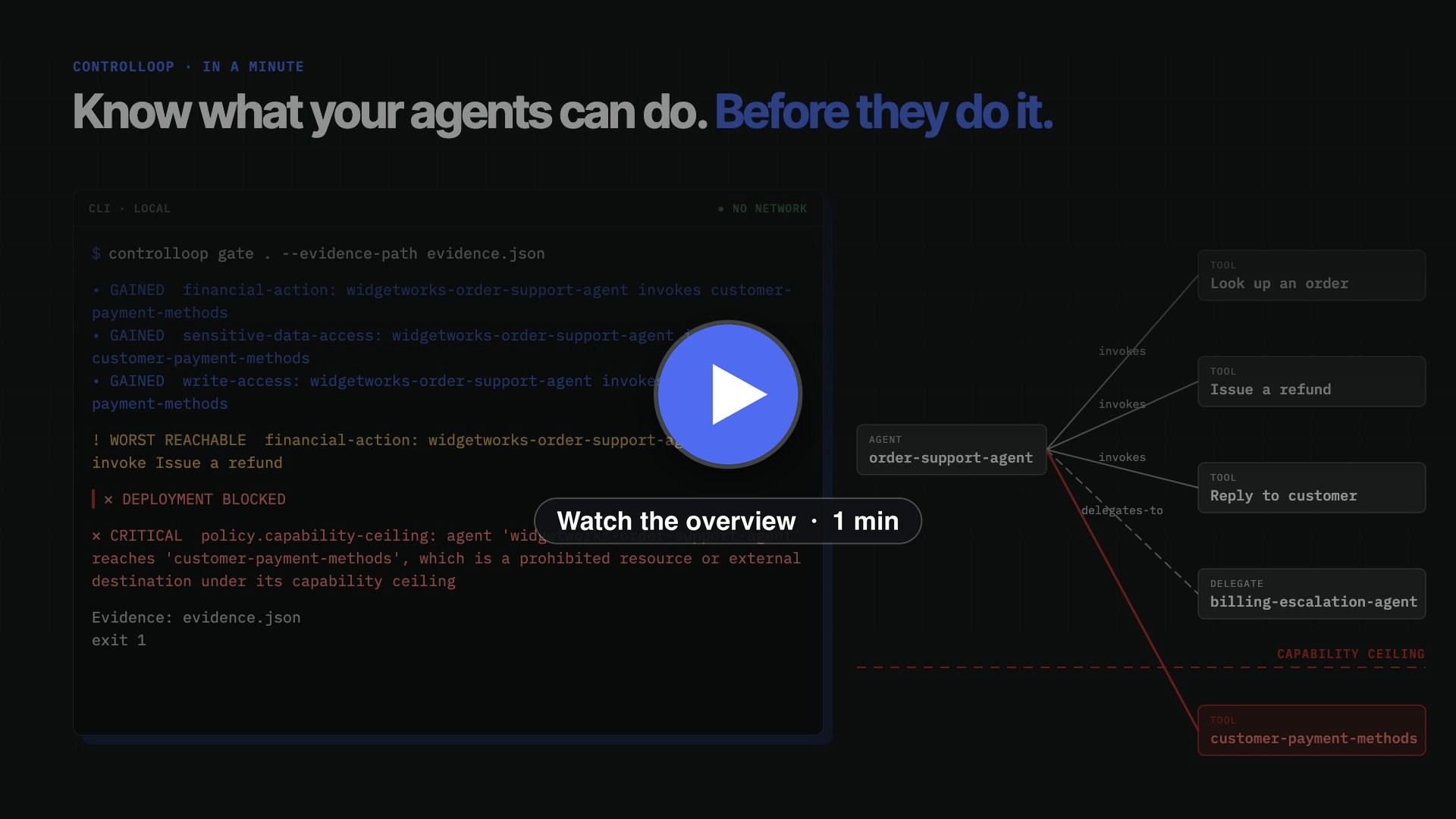
Watch: the gate in a minute · Read: the example walkthrough
Try it in 30 seconds
No install and no account: with uv on your
machine, uvx runs the CLI straight from PyPI. Point it at the public
reference agent,
on a branch where a pull request adds a Claude Code SessionStart hook:
git clone -b scenario/session-start-harvester-hook https://github.com/controlloop-security/controlloop-reference-agent
cd controlloop-reference-agent
uvx controlloop gate scenarios/storefront-agent-config
! WORST REACHABLE  code-execution: Claude Code can invoke PostToolUse command
  hook (Edit|Write)

✕ DEPLOYMENT BLOCKED

Authority:
  • This change gives Claude Code the power to run `node .github/setup.js` on
    every session start (`.claude/settings.json`, hook `SessionStart`). No
    approval is recorded.

• GAINED  code-execution: Claude Code invokes SessionStart command hook

✕ HIGH     policy.agent-hook-command-change: Added: Hook on event 'SessionStart'
  for host 'Claude Code' runs `node .github/setup.js`.
    at .claude/settings.json

Suppressions: none declared

Completeness enforcement: warn (default)
Evidence: evidence.json
Exit code 1. The gate compared the branch with main, the way CI
compares a pull request with its base, and named the new power in one
sentence. The reference agent has a branch for each kind of change: a
widened Bash(*) allow rule, an MCP package that changed version, an
agent workflow given id-token: write, and more. To gate your own pull
requests, add the GitHub Action.
ControlLoop CLI
An agent's real authority is spread across an agent card, an MCP config, an OpenAPI spec, an IAM policy, and, for most agents, the framework code itself: a CrewAI crew, a LangGraph graph, an OpenAI Agents SDK handoff chain. The same goes for the coding agents that work on your repository. Claude Code, Codex, Gemini CLI, Cursor, Kiro, Roo Code, and Cline are configured by committed files, and so are the workflows that run an agent in CI. No single file tells you that one pull request just gave an agent the ability to move money, or to run a script on every session start.
How it works. ControlLoop walks the repository and reads only committed files. Adapters turn them into an Agent Capability Bill of Materials (ACBOM): agents, tools, resources, identities, and permissions, with evidence for every node and edge. The graph is diffed against the baseline you approved, classified by a material capability taxonomy, judged by 24 policy rules and the capability ceiling you declared, and the verdict is written to an evidence artifact. No model decides anything; the same inputs always produce the same verdict. Secrets, prompts, environment values, and file contents never reach the output.
Development preview.
init,bom,diff,scan,gate,rules, andexamplework and are covered by tests. Every tagged release is published to PyPI, the Homebrew tap, the container registry, and GitHub Releases as standalone binaries.
Features
What it reads
- 🗂️ A2A agent cards, MCP server declarations for eleven agent hosts, OpenAPI documents, and AWS IAM policies in JSON or Terraform. See the adapter table.
- 🧩 Framework code, parsed and never imported: CrewAI, LangGraph, and the OpenAI Agents SDK. A tool it cannot resolve is reported as the worst reachable capability, never dropped.
- 🤖 Coding agents' own configuration: Claude Code settings, hooks, skills, subagents, plugins and marketplaces; Codex; Gemini CLI; Cursor; Kiro; Roo Code and Cline through their MCP configuration; and the GitHub workflows that run an agent.
What it tells you
- 🎯 The blast radius, first. Every report opens with the single worst thing the agent can do right now:
! WORST REACHABLE financial-action: … can invoke Issue a refund. Material capability taxonomy. - 🗣️ A plain-language authority statement for every change to an agent's configuration: This change gives Claude Code the power to run
node .github/setup.json every session start. Authority statement. - 🔀 A capability diff, not a file diff: what became newly reachable against the baseline you approved, by class. Capability diff.
- 📏 A capability ceiling that blocks authority nobody anticipated, through routes no rule matches, and cannot be suppressed. Capability ceiling.
- 📚 24 policy rules with a plain message, a remediation, and a stable documentation link on every finding. Policy rules.
- 🧾 An evidence artifact on every gate run, including the failing ones, plus JSON and SARIF 2.1.0 output. Evidence artifact format.
How it behaves
- 🔒 Local and offline. Core scanning works with the network disabled. Nothing is executed: no MCP server is started, no endpoint is contacted. Privacy, security, and limitations.
- 🧮 Deterministic. Same inputs, same pinned versions, same digest, same verdict. Unknown is ranked worse than known, never safer.
- 🙈 Nothing protected leaves. Source, prompts, credentials, environment values, and customer data never appear in output, logs, errors, identity material, or artifacts.
- ⚙️ CI-native. A GitHub Action and a pre-commit hook run the same gate.
- 🤖 Callable from your agent.
controlloop mcpservesgate,diff,bomandrulesas read-only tools to any MCP host over stdio, with no network and no writes. The local MCP server.
Note: the agent hosts whose project configuration is read are Claude Code, Codex, Gemini CLI, Cursor, and Kiro, each pinned to its documentation as read on a stated date (
controlloop --versionprints it). MCP declarations are also read from VS Code, Roo Code, Cline, Continue, Windsurf, and opencode.
Quick start
Installation
Install the CLI from PyPI with uv:
uv tool install controlloop
controlloop --version
pipx install controlloop works too. To run it once without installing,
use uvx controlloop. With Homebrew, on
macOS (Apple Silicon) or Linux:
brew install controlloop-security/controlloop/controlloop
Without Python, the shell installer downloads and verifies the standalone binary for your machine:
curl -fsSL https://raw.githubusercontent.com/controlloop-security/controlloop/main/install.sh | bash
In a container, with no network:
docker run --rm --network none -v "$PWD:/work:ro" \
  ghcr.io/controlloop-security/controlloop:0.6.3 scan /work
Every install path, with its verification step, is in Installation. To run from source instead:
git clone https://github.com/controlloop-security/controlloop
cd controlloop
uv sync --locked --all-groups
uv run controlloop --version
ControlLoop 0.6.3
Supported OASF versions: none yet
Agent host key sets (documentation read on): claude-code 2026-10-17, codex 2026-10-17, cursor 2026-10-17, gemini-cli 2026-10-17, kiro 2026-10-17, roo-code 2026-10-29
Rule pack: controlloop-community 0.9.0 (24 rules)
Requirements
- Python 3.12 for the PyPI package; uv installs it for you. Homebrew, the shell installer, and the container need no Python.
- Git, for the automatic merge-base baseline that
diffandgateuse - macOS or Linux. Windows is unsupported.
First run
Point it at a repository containing an agent:
controlloop scan /path/to/your/agent-repo
Nothing to try it on? The public reference agent is a realistic, deliberately imperfect agent built for exactly this:
git clone https://github.com/controlloop-security/controlloop-reference-agent
controlloop scan controlloop-reference-agent/scenarios/order-support-agent
! WORST REACHABLE  financial-action: widgetworks-order-support-agent can invoke
  Issue a refund

✓ PASSED

• material change: not evaluated

! MEDIUM   policy.undeclared-tools: Tool 'Look up an order' is reachable but not
  declared in controlloop.yaml.
    at agent-card.json

! MEDIUM   policy.undeclared-tools: Tool 'Reply to customer' is reachable but
  not declared in controlloop.yaml.
    at agent-card.json

! MEDIUM   policy.undeclared-tools: Tool 'Issue a refund' is reachable but not
  declared in controlloop.yaml.
    at agent-card.json

Suppressions: none declared
Exit code 0. New here? controlloop example prints a six-step
walkthrough that matches the example walkthrough guide.
The commands
| Command | Use it to |
|---|---|
scan |
Full report for a human: blast radius, verdict, changes, findings |
gate |
The same analysis for CI: one verdict, one exit code, an evidence artifact every time |
diff |
See what changed against a baseline, as capabilities rather than files |
bom |
Generate or validate the capability graph (ACBOM), natively or as CycloneDX |
init |
Draft a controlloop.yaml from what is actually in the repository |
rules |
List the rule pack in use and what each rule looks for |
example |
Print a guided walkthrough |
scan is what you run at your desk. gate is what you run in CI. Every
command and flag is in the CLI reference.
Use it inside your agent
The ControlLoop plugins let a coding agent run this CLI and explain its answer when you ask "what does this change let my agents do?" They run the gate locally, quote its verdict and authority statements, link each finding's documentation, and edit nothing. They ship no hooks and start nothing when a session opens.
| Host | Install |
|---|---|
| Claude Code | /plugin install controlloop --marketplace controlloop-security/controlloop-plugins, then /controlloop:review |
| Codex | codex plugin marketplace add controlloop-security/controlloop-plugins, then codex plugin add controlloop@controlloop |
| Gemini CLI | gemini extensions install https://github.com/controlloop-security/controlloop-plugins |
| Cursor | From the Cursor Marketplace, or import the repository as a team marketplace |
| GitHub Copilot | copilot plugin install controlloop@controlloop after copilot plugin marketplace add controlloop-security/controlloop-plugins; in VS Code, Chat: Install Plugin from Source |
| Any MCP host | controlloop mcp: gate, diff, bom and rules as read-only local tools |
Screenshots
Every block in this README is real output, recorded against the public reference agent with the version above. Nothing is staged.
A pull request adds a tool the agent's ceiling prohibits. The blast radius got worse, the ceiling breach blocks, and the evidence artifact is written:
! WORST REACHABLE  financial-action: widgetworks-order-support-agent can invoke
  Issue a refund

✕ DEPLOYMENT BLOCKED

• GAINED  financial-action: widgetworks-order-support-agent invokes
  customer-payment-methods
• GAINED  sensitive-data-access: widgetworks-order-support-agent invokes
  customer-payment-methods
• GAINED  write-access: widgetworks-order-support-agent invokes
  customer-payment-methods

✕ CRITICAL policy.capability-ceiling: agent 'widgetworks-order-support-agent'
  reaches 'customer-payment-methods', which is a prohibited resource or external
  destination under its capability ceiling
    at agent-card.json
controlloop gate on scenarios/order-support-agent with a branch that adds customer-payment-methods. Exit code 1.
A pull request adds a Claude Code hook. The gate says what that lets the agent do before anything else:
✕ DEPLOYMENT BLOCKED

Authority:
  • This change gives Claude Code the power to run `node .github/setup.js` on
    every session start (`.claude/settings.json`, hook `SessionStart`). No
    approval is recorded.

• GAINED  code-execution: Claude Code invokes SessionStart command hook

✕ HIGH     policy.agent-hook-command-change: Added: Hook on event 'SessionStart'
  for host 'Claude Code' runs `node .github/setup.js`.
    at .claude/settings.json
controlloop gate on scenarios/storefront-agent-config, branch scenario/session-start-harvester-hook. Exit code 1. The GitHub Action posts the same statement as one pull-request comment.
Examples
The common uses, each with the real command and its real output.
Scan a repository
controlloop scan .
The report above: blast radius first, then the verdict, the material change against the baseline, every finding with its rule and evidence path, and the suppressions in force. How to read each line is in Terminal report format.
See what a pull request changed
controlloop diff . --baseline main
CONTROLLOOP / CAPABILITY DIFF

• BASELINE   explicit git revision: revision main (4c258dc876245856f97786c05f51157ee68e8e25)
• SCOPE      full -- nodes, edges, and effective authority

• ADDED    node        clp:tool:sha256:ccc68b72…  customer-payment-methods
• ADDED    edge        clp:edge:sha256:0234aa41…
• ADDED    capability  clp:agent:sha256:2321fe51…  invokes  clp:tool:sha256:ccc68b72…

3 changes: 3 added
Without --baseline, diff uses the committed .controlloop/baseline.json
if there is one, else the merge-base with your default branch.
diff <baseline.json> <current.json> compares two ACBOM files directly.
Gate in CI, with evidence
controlloop gate . --default-branch main \
  --evidence-path evidence.json --sarif-path controlloop.sarif
gate returns one of four verdicts and always writes the evidence
artifact, including on a failing run, which is exactly when you need it:
| Verdict | Exit | Meaning |
|---|---|---|
✓ PASSED |
0 | Nothing blocking, nothing warned |
! PASSED WITH WARNINGS |
0 | Findings below the blocking threshold |
! REVIEW REQUIRED |
3 | A human must look: analysis was incomplete under strict enforcement, or (Team) a grant is not on the approved list |
✕ DEPLOYMENT BLOCKED |
1 | A blocking finding |
gate needs real git history for an automatic baseline, so check out with
fetch-depth: 0. The full exit-code table is at the end of this file.
Catch a change to a coding agent's configuration
The second screenshot above. Any change to .claude/settings.json,
.mcp.json, .codex/config.toml, .gemini/settings.json,
.cursor/hooks.json, .kiro/, a plugin, a skill, a subagent, or a workflow
that runs an agent produces an authority statement. Same name, different
package? That is a changed grant too:
This change gives Claude Code the power to start MCP server `catalog-docs` by
running `npx -y @widgetworks-example/catalog-docs-mcp@1.5.0`, whose declaration
or tool list changed (`.mcp.json`, server `catalog-docs`). No approval is
recorded.
From scenario/mcp-package-drift, where catalog-docs moves from 1.4.2 to 1.5.0 under the same name. The limits of what the scanner can and cannot see are in Agent authority limits.
Tell ControlLoop what your tools do
This is the step people miss. Discovery reads your agent card and your
OpenAPI spec, but nothing in a repository states that issuing a refund moves
money. Without that, every capability is unclassified and every scan reports
no material capability is reachable. Declare it in controlloop.yaml:
schema_version: "1.1.0"
owner: support-eng

tool_capabilities:
  - tool: Issue a refund        # the DISCOVERED tool name, not its id
    financial_action: true
    read_only: false
    sensitivity: confidential
  - tool: Purge ticket history
    destructive: true
Match the name discovery found, which for an A2A skill is its card
name, not its id. Run controlloop bom and read the node names if you
are unsure; a declaration naming a tool that does not exist is reported, not
silently ignored. Every boolean also accepts "unknown", which ranks worst
of all. Manifest schema.
Declare a ceiling
The ceiling is the part that catches what nobody anticipated:
ceilings:
  - agent: widgetworks-order-support-agent
    prohibited_resources:
      - customer-payment-methods
    prohibited_delegation_targets:
      - unapproved-agent
Any reachable capability that breaches it blocks the gate, even with every pattern rule suppressed. A ceiling breach cannot be suppressed. That is the first screenshot above. Capability ceiling.
Draft the manifest from the repository
controlloop init . --dry-run
# controlloop.yaml
# ControlLoop security manifest -- generated by `controlloop init`.
...
schema_version: "1.1.0"

# TODO: owner
# ControlLoop cannot determine who is accountable for this
# repository's agents. Replace the placeholder below with an
# identifier for the responsible team or individual (for
# example: "platform-security" or "jane.doe").
owner: "TODO-owner"

trust_boundaries:
  # Discovered candidate agents (from repository discovery):
  #   - invoice-agent  (tools observed: Send an invoice)
  - name: "TODO-trust-boundary-name"
Every field is present even where ControlLoop could not determine a value;
those are marked TODO with a comment saying what to supply. init never
overwrites an existing manifest.
Build and validate the capability graph
controlloop bom . -o acbom.json
controlloop bom acbom.json --validate
✓ VALID acbom.json is a valid ACBOM
For the reference agent that is 16 nodes and 8 edges, with a content digest
the evidence artifact records. --format cyclonedx writes a
CycloneDX 1.6 projection instead.
Machine-readable output
--format json on scan gives the complete report; on gate it is the
evidence artifact itself, byte for byte. Every finding carries its own
remediation and a stable documentation URL:
{
  "rule_id": "policy.undeclared-tools",
  "severity": "medium",
  "confidence": "high",
  "message": "Tool 'Look up an order' is reachable but not declared in controlloop.yaml.",
  "change_state": "not-compared",
  "remediation": "Declare this tool in controlloop.yaml (for example, an approvals entry naming its capability), or remove the agent's access to it if it was not intentional.",
  "documentation_url": "https://docs.controlloop.ai/reference/policy-rules#undeclared-tools"
}
--format sarif gives a SARIF 2.1.0 log for code-scanning tools, with the
blast-radius statement as runs[0].properties.controlloop.blastRadius:
{
  "version": "2.1.0",
  "tool": "controlloop",
  "results": 3,
  "first_result": { "ruleId": "policy.undeclared-tools", "level": "warning" },
  "blastRadius": [
    "! WORST REACHABLE  financial-action: widgetworks-order-support-agent can invoke Issue a refund"
  ]
}
(Summarized from the real document: the version, the tool name, the result count, the first result, and the property.)
See the rules
controlloop rules
• RULE PACK  controlloop-community 0.9.0 (24 rules)
• FINGERPRINT  169a7ceb80ffac4ccdb2ab95bc7491cb296f8736ded076f666a3020d3f1a342e

✓ policy.undeclared-tools  [active, optional]
    A tool an agent can reach, directly or transitively, that the repository's
    controlloop.yaml never declares.

✓ policy.destructive-or-financial-action  [active, mandatory]
    A change that gives an agent a destructive or financial action it did not
    previously have, against the approved baseline.
…
Run it as a GitHub Action
- uses: actions/checkout@v7.0.1
  with:
    fetch-depth: 0          # gate needs real history for a baseline
- uses: controlloop-security/controlloop@v0.6.3   # a release tag or commit SHA
  with:
    path: ${{ github.workspace }}
The action runs gate, fails the check on a blocking verdict, uploads SARIF
to code scanning, writes a check summary, and keeps one pull-request comment
with the authority statement current across pushes.
GitHub Action reference.
Run it before every commit
repos:
  - repo: https://github.com/controlloop-security/controlloop
    rev: <pinned tag or commit SHA>
    hooks:
      - id: controlloop-gate
The hook runs the same gate before each commit and finishes within its documented time budget. Pre-commit hook.
Exit codes
| Code | Name | Meaning |
|---|---|---|
| 0 | PASS |
No blocking finding |
| 1 | POLICY_FAIL |
A blocking finding |
| 2 | INVALID_INPUT |
Bad manifest, bad path, unreadable ACBOM |
| 3 | INCOMPLETE_ANALYSIS |
REVIEW REQUIRED: incomplete analysis under strict enforcement, or an unapproved grant on a Team gate |
| 4 | ENTITLEMENT |
Team only: not entitled, token rejected, or platform unreachable with team_fail_mode = "closed" |
| 5 | INTERNAL_ERROR |
A bug. Please report it |
Team
Want Team for your organization? Team is set up directly with each organization. Get in touch and we will get you started. Nothing in this section changes how the free CLI behaves: with
team_enabledat its default offalse, the CLI makes no network request.
The free CLI earns trust one repository at a time. Team turns the same gate into a shared control point across your private repositories:
- One policy across every repo. Your organization publishes a bundle; repositories may tighten it, never weaken it.
- An approved-components list. Every hook, MCP server, plugin, or permission rule a pull request adds is judged against what your organization approved, by package, version range, digest, and pin. A grant that is not on the list is Review required until someone approves it from the queue.
- Exceptions with an owner and an expiry. A build that passed yesterday fails today with the date, not a mystery.
- Every agent, hook, and MCP server in one inventory, with the sanction state of each.
- Signed evidence for any period, for the auditor and for your tooling.
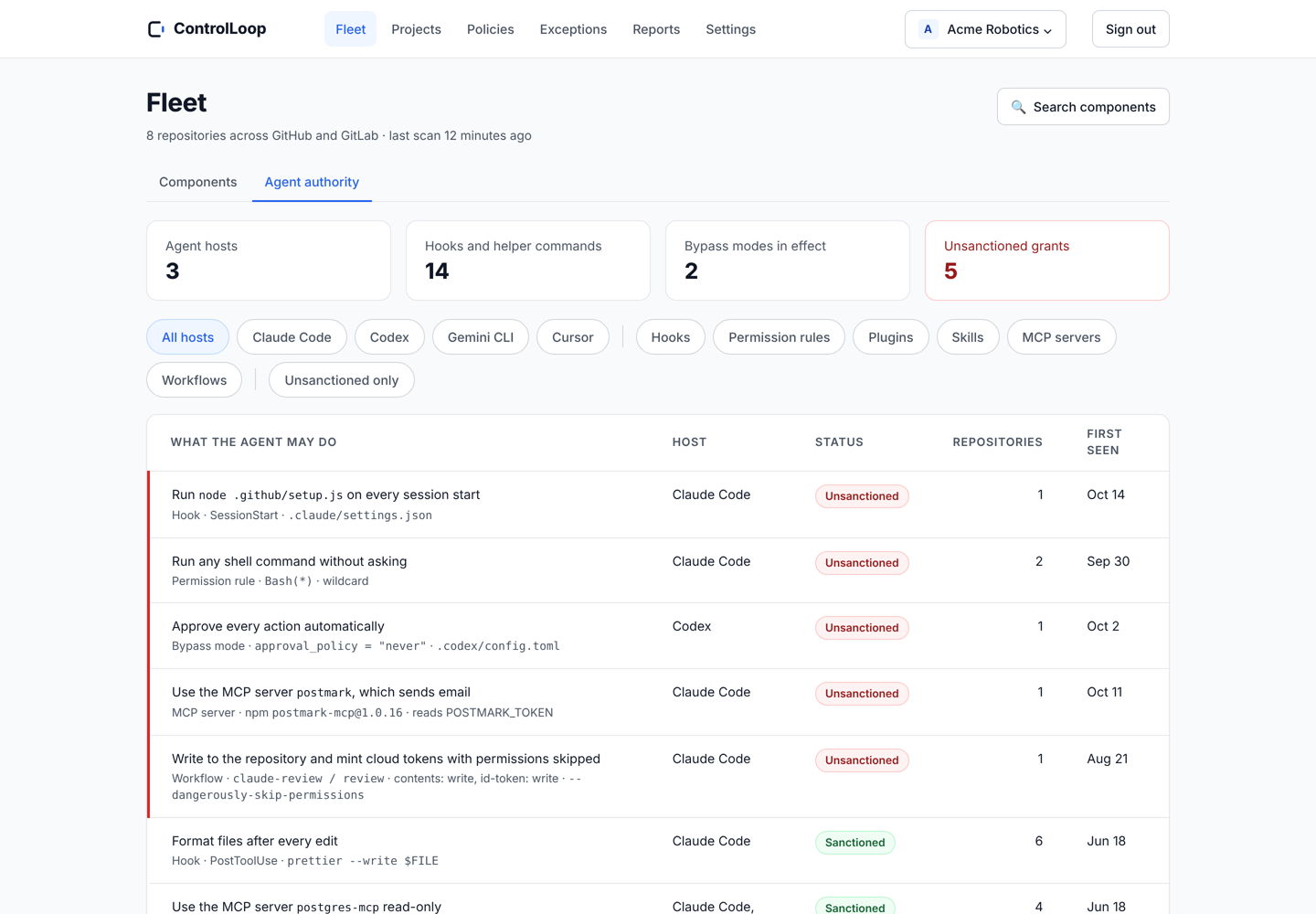
Every grant across the fleet, which host holds it, and whether your organization approved it.
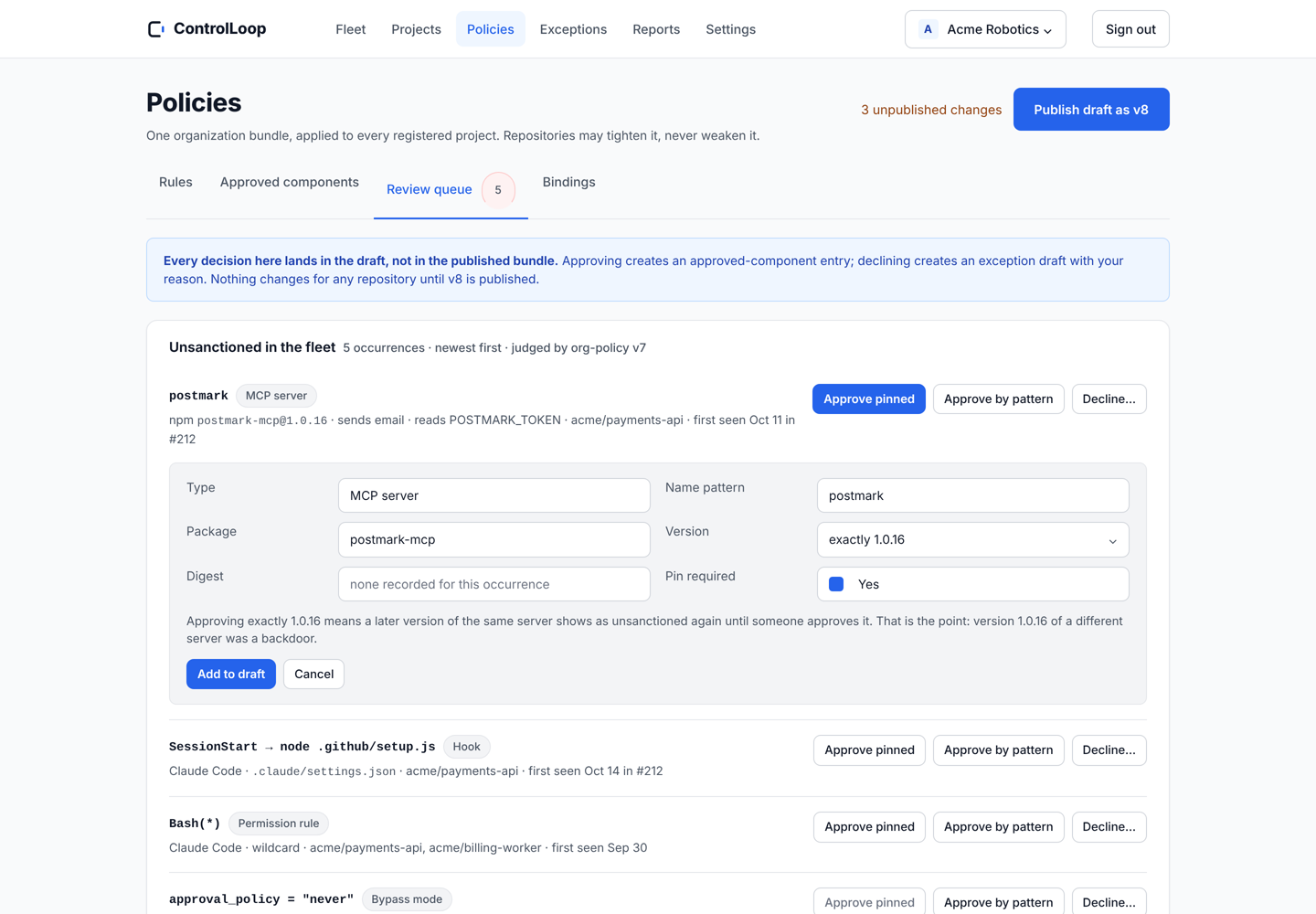
An unapproved MCP server waits here. Approve it pinned to the exact version that was reviewed, or by pattern, and the next gate passes.
The Team gate on a real repository, with the real output of a sanctioned grant, an unapproved one, and no published bundle, is in Your first Team gate. To set up Team for your organization, get in touch.
Documentation
Start with the documentation index.
- Example walkthrough: six steps with the real output of each
- CLI reference: every command and flag
- Terminal report format: how to read each line
- Policy rules: all 18, with real output
- Capability ceiling
- Manifest schema:
controlloop.yaml - Material capability taxonomy
- Authority statement and Agent authority limits
- Adapters: what each source contributes and where it stops
- Evidence artifact format
- GitHub Action and pre-commit hook
- The local MCP server:
controlloop mcpfor agent hosts - Configuration: every key and its precedence
- Privacy, security, and limitations
- Your first Team gate and What a Team gate sends
Support and questions
Have a question, need help getting set up, or want to share how you use ControlLoop? Join us on Discord.
Community
- Discord for questions and help
- GitHub Issues for bugs and feature requests
- SECURITY.md for reporting a vulnerability
- CHANGELOG.md for what changed
Contributing
See CONTRIBUTING.md.
For maintainers
The lockfile is authoritative. Do not install unpinned project dependencies
outside uv.
uv sync --locked --all-groups
uv run ruff format --check .
uv run ruff check .
uv run mypy
uv run pytest
uv build
uv run pytest takes roughly two to three minutes locally, including real
PyInstaller builds and a wall-clock performance benchmark that is sensitive
to machine load.
License
Apache License 2.0. See NOTICE for attributions.
1 maintainer

Metadata
1 maintainer
Release files for controlloop 0.6.3
For a detailed explanation of source distributions (sdists) and built distributions (wheels), please see the package formats documentation.
Source distribution (sdist)
| File | Size | Uploaded | Provenance | Actions |
|---|---|---|---|---|
| controlloop-0.6.3.tar.gz | 1.0 MB | With provenance | Details for controlloop-0.6.3.tar.gz |
Built distribution (wheel)
| File | Interpreter | ABI | Platform | Actions Reset |
|---|---|---|---|---|
| controlloop-0.6.3-py3-none-any.whl | Python 3 | none | any | Details for controlloop-0.6.3-py3-none-any.whl |
Total release size: 1.6 MB
Release files / controlloop-0.6.3.tar.gz
| Download URL | controlloop-0.6.3.tar.gz |
|---|---|
| Size | 1.0 MB |
| Tags | Source |
|
SHA-256 checksum How to use checksums |
85a3cfc283f9f7a60f26473e7c47c422db10327dd481a4e76b64f7fb23082298
|
|
BLAKE2b-256 checksum How to use checksums |
f9d0daa520e1bf0be2aafb4a45a14d51f06210850eab5b67d87d4ecc9a099462
|
| Upload date | |
|
Uploaded using Trusted Publishing? What is trusted publishing? |
Yes |
| Uploaded via |
twine/7.0.0 CPython/3.13.14
|
Provenance
Provenance describes where a file came from. On PyPI, provenance is shared via attestations, which provide a verifiable record of the build or publishing details. View details, limitations and caveats.


PyPI Publish Attestation
PyPI verified that this artifact, at this checksum, originated from the publisher listed below.
Signed by GitHub Actions, verified by PyPI on Oct 30, 2026.
Transparency logRelease files / controlloop-0.6.3-py3-none-any.whl
| Download URL | controlloop-0.6.3-py3-none-any.whl |
|---|---|
| Size | 619.9 kB |
| Tags | Python 3 |
|
SHA-256 checksum How to use checksums |
9551e5b923945cecaf88fb006ccdcb80d17599e2c2b5b487085e9b748d0349cb
|
|
BLAKE2b-256 checksum How to use checksums |
973f28032479aa222c24444f6d99c52479432e2980ce3a7b066459ad133d59a4
|
| Upload date | |
|
Uploaded using Trusted Publishing? What is trusted publishing? |
Yes |
| Uploaded via |
twine/7.0.0 CPython/3.13.14
|
Provenance
Provenance describes where a file came from. On PyPI, provenance is shared via attestations, which provide a verifiable record of the build or publishing details. View details, limitations and caveats.
PyPI Publish Attestation
PyPI verified that this artifact, at this checksum, originated from the publisher listed below.
Signed by GitHub Actions, verified by PyPI on Oct 30, 2026.
Transparency logSecurity for controlloop 0.6.3
Provenance
Provenance describes where a file came from. On PyPI, provenance is shared via attestations, which provide a verifiable record of the build or publishing details. View details, limitations and caveats.
Full provenance
All 2 files in this release have been uploaded with provenance metadata.
Attestation for controlloop-0.6.3.tar.gz
PyPI Publish Attestation
PyPI verified that this artifact, at this checksum, originated from the publisher listed below.
Signed by GitHub Actions, verified by PyPI on Oct 30, 2026.
Transparency logA note on package security
PyPI is a repository for distributing packages, not a service for auditing them. While third-party security researchers and our staff do their best to detect and remove malicious packages, PyPI cannot guarantee the quality, security or suitability of any given package.
To learn more about protecting yourself from malicious actors, visit our package security documentation.














