
ConvMemory
A lightweight reranker for long-term agent memory. Better memory retrieval, at a fraction of the cost of running a large cross-encoder over the pool.


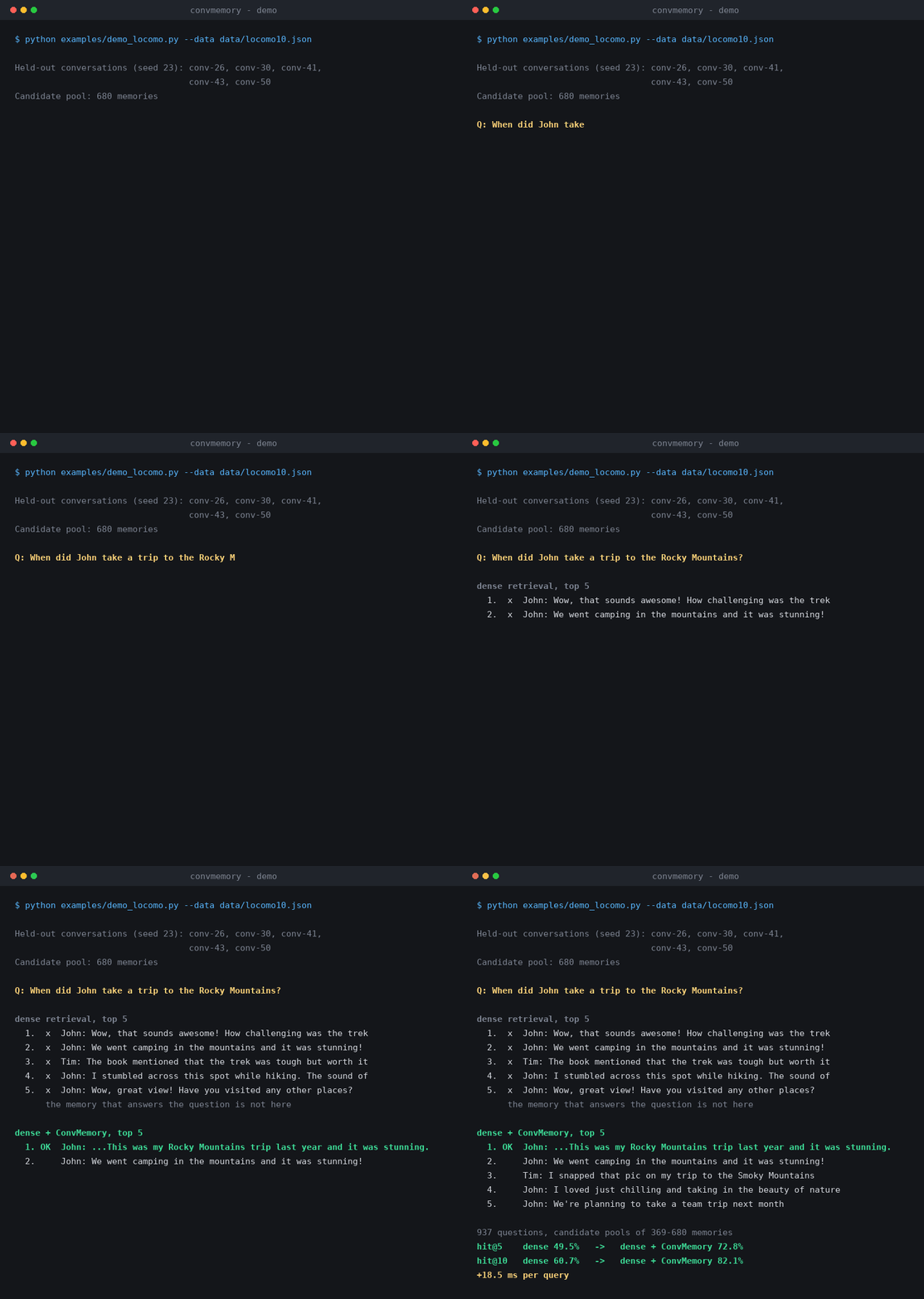
Real output from examples/demo_locomo.py on held-out conversations. Reproduce it in one command.
You already have a memory store and a vector search. ConvMemory is one layer after it:
        user query
            |
   vector / hybrid search        mem0 · LangChain · LlamaIndex · your own store
            |          top-k candidates
       ConvMemory                14 MB reranker, no cross-encoder over the pool
            |          reordered memory context
          agent
Keep your existing memory store. Add ConvMemory as the reranking layer. Drop-in adapters for mem0, LangChain, LlamaIndex and plain vector stores are about ten lines each.
Every mechanism claim here is backed by a five-seed retrained attribution study with paired-bootstrap intervals. The write-up of how that study was designed, and what it changed: I thought ConvMemory worked because of temporal reasoning. Five seeds proved me wrong.
Install
The reranker is a small torch model, and the encoder stack is optional — a store that already holds embeddings runs on the core install alone:
pip install "convmemory[encode]"   # text in, text out
pip install convmemory             # reranker only: numpy + torch
Three lines
from convmemory import ConvMemory

model = ConvMemory.from_pretrained("Purdy0228/ConvMemory-LoCoMo-MPNet")
results = model.rerank(query=query, memories=candidates, top_k=10)
memories is a list of {"id": ..., "text": ...} in the order your store keeps
them. Each result carries rank, memory_id, score, and text.
Already have embeddings? Then you never need the encoder — this is the path the core install is built for, and it is roughly 50x faster because nothing is re-encoded:
results = model.rerank_embeddings(
    query_embedding=query_embedding,
    memory_embeddings=memory_embeddings,   # what your store already has
    memory_ids=memory_ids,
    memory_texts=memory_texts,
    query=query,
    top_k=10,
)
Why ConvMemory?
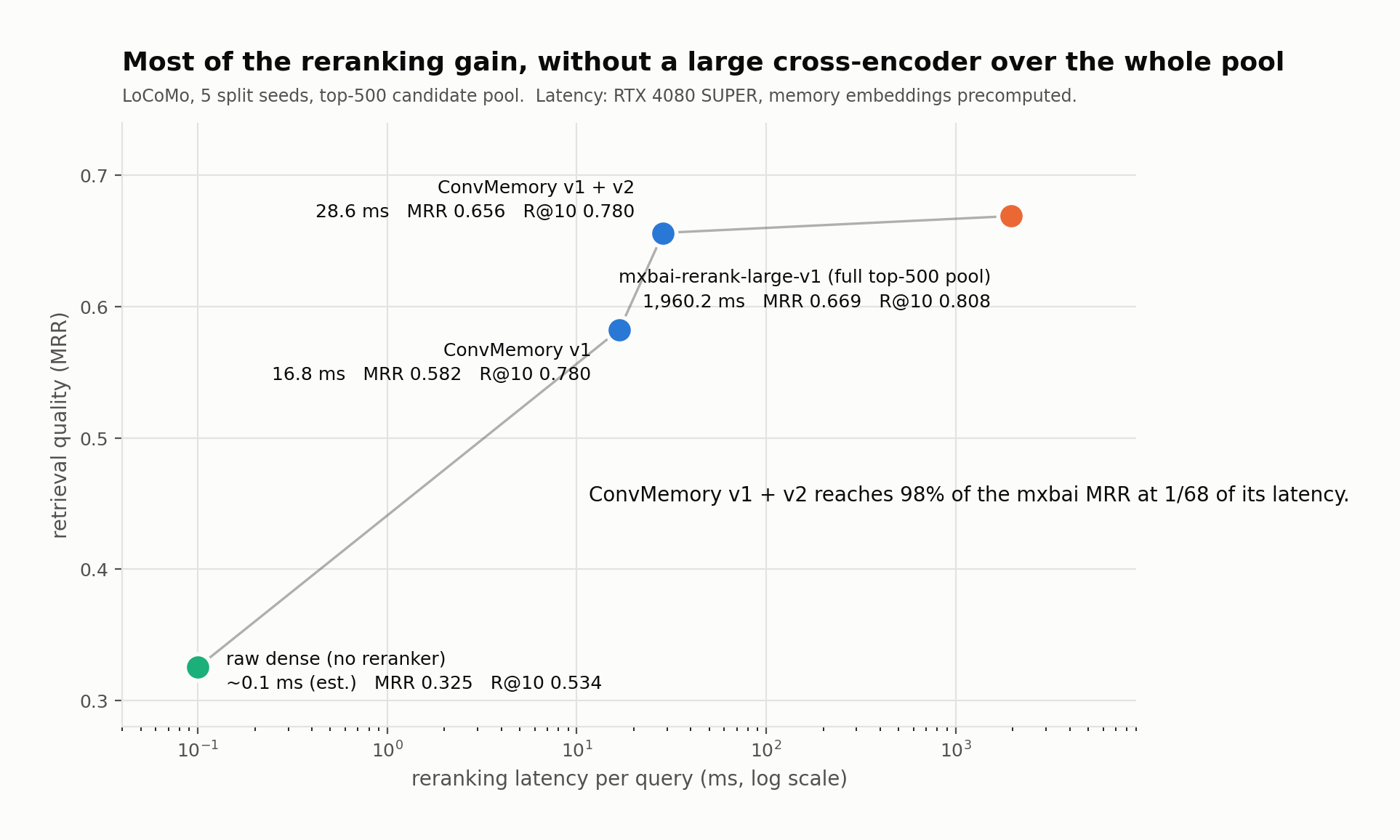
Reranking a 500-candidate pool with a large cross-encoder means 500 transformer forward passes per query. ConvMemory scores the pool with a small learned model over embeddings you already have, and lands on the cost/quality frontier:
| Method | R@10 | MRR | ms/query |
|---|---|---|---|
| raw dense (no reranker) | 0.5345 | 0.3254 | <1 |
| BGE-reranker-base, full pool | 0.6967 | 0.5469 | — |
| BGE-reranker-large, full pool | 0.7621 | 0.6120 | — |
| ConvMemory v1 | 0.7798 | 0.5824 | 16.8 |
| ConvMemory v1 + v2 | 0.7798 | 0.6560 | 28.6 |
| mxbai-rerank-large-v1, full pool | 0.8080 | 0.6688 | 1960.2 |
ConvMemory v1 + v2 beats both BGE rerankers on Recall@10 and MRR, at 28.6 ms — against models that run a full cross-encoder pass over all 500 candidates. It reaches 98% of the mxbai MRR for 1/68th of the latency.
On a CPU box, or anywhere a query budget is measured in milliseconds, this is the reranking layer you can deploy today.
LoCoMo, 5 split seeds, top-500 pool, RTX 4080 SUPER, memory embeddings precomputed. BGE latency comes from this repo's LongMemEval harness (BGE-large, 556 ms/query) rather than the timed LoCoMo run. Complete results across six datasets: docs/BENCHMARKS.md.
See it on real data
examples/demo_locomo.py runs dense retrieval and dense + ConvMemory side by
side on the held-out conversations of the released checkpoint's split:
python examples/demo_locomo.py --data data/locomo10.json --device cuda
Output on the five held-out conversations (937 questions, candidate pools of 369-680 memories):
metric          dense only    dense + ConvMemory
hit@5           464 (49.5%)          682 (72.8%)
hit@10          569 (60.7%)          769 (82.1%)

per-query time (memory embeddings precomputed, lexical signatures prewarmed):
  query encoding (shared by both paths): 8.05 ms
  dense scoring:                         0.26 ms
  ConvMemory reranking:                 18.53 ms
A single question from that run, pool of 680 memories:
Q: When did John take a trip to the Rocky Mountains?
dense only
  1.    John: Wow, that sounds awesome! How challenging was the trek through the Himalayas?
  2.    John: We went camping in the mountains and it was stunning! The air was so refreshing.
  3.    Tim: The book mentioned that the trek was tough but worth it, with challenging terrain...
  4.    John: I stumbled across this spot while hiking. The sound of that river was so soothing...
  5.    John: Wow, great view! Have you visited any other places?

dense + ConvMemory
  1. OK John: ... This was my Rocky Mountains trip last year and it was stunning. Seeing those
        mountains, fresh air - it makes you realize how incredible the world is.
  2.    John: We went camping in the mountains and it was stunning! The air was so refreshing.
  3.    Tim: I snapped that pic on my trip to the Smoky Mountains last year...
ConvMemory promotes the evidence turn to rank 1. Dense similarity alone fills the top of the list with memories that are about mountains.
Held-out conversations of the released checkpoint's split; LoCoMo is in-domain for this checkpoint. Get locomo10.json from snap-research/locomo.
Where it fits
ConvMemory is built for candidate pools of hundreds to thousands — the regime where dense recall slides from 0.90 to 0.55 on the LongMemEval stress setting, and where a cross-encoder over the whole pool prices itself out.
It is tuned for conversational and agent memory: conversations, user histories, agent traces, task logs, session notes. Results across six datasets, with the scope of each, are in docs/BENCHMARKS.md.
How it works
A lightweight learned reranker over fused dense + lexical features, with a small neighborhood window. Every feature is cheap once your embeddings exist, and there is no per-candidate transformer forward pass in the v1 path — that is where the 68x comes from.
That description is the one the evidence supports, and earning it took a five-seed retrained attribution study with paired-bootstrap intervals across question slices. The design of that study is the most useful thing this project can hand another ML engineer:
→ I thought ConvMemory worked because of temporal reasoning. Five seeds proved me wrong.
Slice tables, intervals, and protocol: docs/NEGATIVE_RESULTS.md.
Integrations
Keep your store, add the layer. Examples in examples/integrations/:
| Example | What it shows |
|---|---|
basic_vector_store.py |
numpy vector store, no framework |
langchain_retriever.py |
a LangChain-compatible retriever wrapper |
llamaindex_postprocessor.py |
a LlamaIndex node postprocessor |
mem0_rerank.py |
reranking mem0 search results |
custom_agent.py |
a plain agent memory loop |
Benchmark it on your own data
convmemory benchmark --queries queries.jsonl --memories memories.jsonl
Reports Recall@k, MRR and latency before and after ConvMemory on your memories,
and writes a --json summary that is easy to paste into an issue.
See docs/BENCHMARK_CLI.md for the file format.
Bring queries with labelled gold_ids. The "before" row is dense retrieval in
the checkpoint's own embedding space — how to read the delta.
Whatever you measure, an issue with your numbers is welcome — reports from real memory stores are what shape the next checkpoint.
More layers
The v1 reranker above is the core. These are opt-in and off by default:
| Layer | What it adds | Docs |
|---|---|---|
| v2 evidence reranker | token-level rescoring of the protected v1 top-10; +0.073 MRR, recall-preserving | EVIDENCE_RERANKER.md |
| v3 validity context | surfaces the later update evidence alongside a memory | VALIDITY_CONTEXT.md |
| Chinese models | dual-space GTE retriever, BGE student, OPC-v3 validity | CHINESE.md |
| CCGE-LA (alpha) | conflict-aware editing of stale/current memory pairs | CCGE_LA.md |
| Memory-MLA (experimental) | prefix-protected recall expander | MEMORY_MLA.md |
Ask "where does Alice work now" and relevance alone will rank the superseded memory alongside the current one, because both are on topic. The v3 validity layer handles that case: it attaches the update evidence to a memory so the agent can reason about it.
Checkpoints
| Checkpoint | Hub |
|---|---|
| ConvMemory v1 (LoCoMo/MPNet) | Purdy0228/ConvMemory-LoCoMo-MPNet |
| v2 evidence reranker | Purdy0228/ConvMemory-v2-Evidence-Reranker |
| v3 validity context | Purdy0228/ConvMemory-v3-Validity-Context |
| CCGE-LA alpha editor | Purdy0228/ConvMemory-CCGE-LA |
| Chinese dual-space GTE | Purdy0228/ConvMemory-ZH-DualSpace-GTE |
| Chinese OPC student (BGE) | Purdy0228/ConvMemory-OPC-Student-BGE |
The v1 checkpoint is also a GitHub release asset; offline setup instructions are in docs/MODEL_CARD.md. Checkpoints and embeddings must share an embedding model family and dimension.
API surface
Stable:
ConvMemory.from_pretrained, .rerank, .retrieve, .expand_context,
.rerank_embeddings, .encode, .prewarm_lexical.
Public alpha: .load_ccge_editor, .attach_ccge_editor,
CCGELowAmplitudeEditor, build_ccge_features.
Research preview: context-expansion policies, cascade fusion with cross-encoder scoring, JSONL adapters for external datasets. See docs/MODULES.md.
Technical report
Reproducibility: EVALUATION_PROTOCOL.md, MODEL_CARD.md, TRAINING.md. Raw datasets, checkpoints, embedding caches, and per-question CSVs live outside Git history to keep the repository light.
License
MIT
1 maintainer

Metadata
1 maintainer
Release files for convmemory 0.7.0
For a detailed explanation of source distributions (sdists) and built distributions (wheels), please see the package formats documentation.
Source distribution (sdist)
| File | Size | Uploaded | |
|---|---|---|---|
| convmemory-0.7.0.tar.gz | 66.6 kB | Details |
Built distribution (wheel)
| File | Interpreter | ABI | Platform | Reset |
|---|---|---|---|---|
| convmemory-0.7.0-py3-none-any.whl | Python 3 | none | any | Details |
Total release size: 122.7 kB
Release files / convmemory-0.7.0.tar.gz
| Download URL | convmemory-0.7.0.tar.gz |
|---|---|
| Size | 66.6 kB |
| Tags | Source |
|
SHA-256 checksum How to use checksums |
142aea0b0863e0141ff8930efaa2f9d8f50d8025883fecdff9dbcae7a972475c
|
|
BLAKE2b-256 checksum How to use checksums |
e7ccd965e324aadb10e46a546b90c35ab9d1cbebf701bc6cf67fca703e5bed77
|
| Upload date | |
|
Uploaded using Trusted Publishing? What is trusted publishing? |
No |
| Uploaded via |
twine/6.2.0 CPython/3.12.3
|
Release files / convmemory-0.7.0-py3-none-any.whl
| Download URL | convmemory-0.7.0-py3-none-any.whl |
|---|---|
| Size | 56.1 kB |
| Tags | Python 3 |
|
SHA-256 checksum How to use checksums |
f537db0e71f11b1f4d88d85a5e0ce03d605b591f6716eeed16de1ee06e6d1e29
|
|
BLAKE2b-256 checksum How to use checksums |
174df132e1218c357114b0988aae7217afddfcee15896982f18837b9b585b708
|
| Upload date | |
|
Uploaded using Trusted Publishing? What is trusted publishing? |
No |
| Uploaded via |
twine/6.2.0 CPython/3.12.3
|














