
The open-source topological-relational memory database. Reference implementation of the NoVectDB paradigm.
Verified details
These details have been verified by PyPIProject links
GitHub Statistics
Maintainers

Project description

CookiX
The open-source topological-relational memory database
Stop measuring distances. Start understanding adjacency.
Installation • Quickstart • How it works • Honest status • Benchmarks • Roadmap • Contributing




What is CookiX?
CookiX is the reference implementation of the NoVectDB (Not Only Vector Database) paradigm: the idea that knowledge has shape, direction, and composition, and our databases should too.
Vector databases embed everything into flat ℝⁿ and retrieve by cosine distance. That works for fuzzy lookups but breaks down when you need:
- Relational reasoning — "What prevents rain from reaching the coat?" (a typed, directed edge — not proximity)
- Multi-hop queries — "Is pipe A compatible with fitting B via adapter C?" (path traversal)
- Contradiction detection — "Do specs X and Y conflict?" (directed semantics)
- Interpretable retrieval — "Why was this result returned?" (a reasoning path, not a float)
CookiX stores knowledge as Knowledge Objects in a typed, directed graph and retrieves by traversing relations — returning the path that justifies each answer.
MongoDB is to NoSQL what CookiX is to NoVectDB.
Installation
pip install cookix                 # core (graph traversal, zero heavy deps)
pip install "cookix[topology]"     # + persistent-homology re-ranking
pip install "cookix[kuzu]"         # + durable embedded graph storage
pip install "cookix[llm]"          # + LLM relation extraction
pip install "cookix[server]"       # + HTTP server & reasoning-path explorer UI
pip install "cookix[all]"          # everything
Requires Python 3.10+.
Quickstart
import cookix

db = cookix.connect("demo")

db.insert({"_id": "umbrella", "content": "blocks rain", "edges": [("prevents", "rain")]})
db.insert({"_id": "rain",     "content": "falling water", "edges": [("causes", "wet_coat")]})
db.insert({"_id": "wet_coat", "content": "a soaked coat"})

# Multi-hop reasoning — returns the path, not a distance
for r in db.query(anchor="umbrella", target="wet_coat", mode="reasoning"):
    print(r.explain())
# umbrella --[prevents]--> rain --[causes]--> wet_coat  (score=..., hops=2)
Try the built-in demos:
cookix demo umbrella
cookix demo pipe
cookix info          # shows which optional layers are active
The reasoning-path explorer
A vector database can only show you a blob and a distance. CookiX can show you why — the typed path that justifies each answer, as an interactive graph.
![CookiX reasoning-path explorer — the query 'what prevents rain?' lights up the umbrella —[prevents]→ rain path](https://pypi-camo.freetls.fastly.net/d2f9fa7f3a6698cae740d3d18700d10d048ff3b7/68747470733a2f2f7261772e67697468756275736572636f6e74656e742e636f6d2f436f6f6b695844422f436f6f6b69582f6d61737465722f6173736574732f64656d6f2d726561736f6e696e672e706e67)
pip install "cookix[server]"
cookix serve                 # opens an HTTP API + UI at http://127.0.0.1:8000
cookix serve --demo pipe     # start from the pipe-compatibility demo
Open the browser UI, type a natural-language query (e.g. "what prevents rain?"), and the matching reasoning path lights up on the graph. Switch the ablation mode in the UI to see exactly what the topology and sheaf layers add on top of pure graph traversal.
3D sheaf explorer
The UI also includes a 3D sheaf explorer (linked from the top bar, or /sheaf). At dim=3, every object's sheaf stalk is a unit vector on the sphere and every relation is a rotation of it. Pick an anchor and a target, and watch the anchor's "meaning" get carried through each relation on the reasoning path — the gap between where it lands and the target's stalk is the composition residual. A coherent chain lands near the target; an incoherent one drifts away.
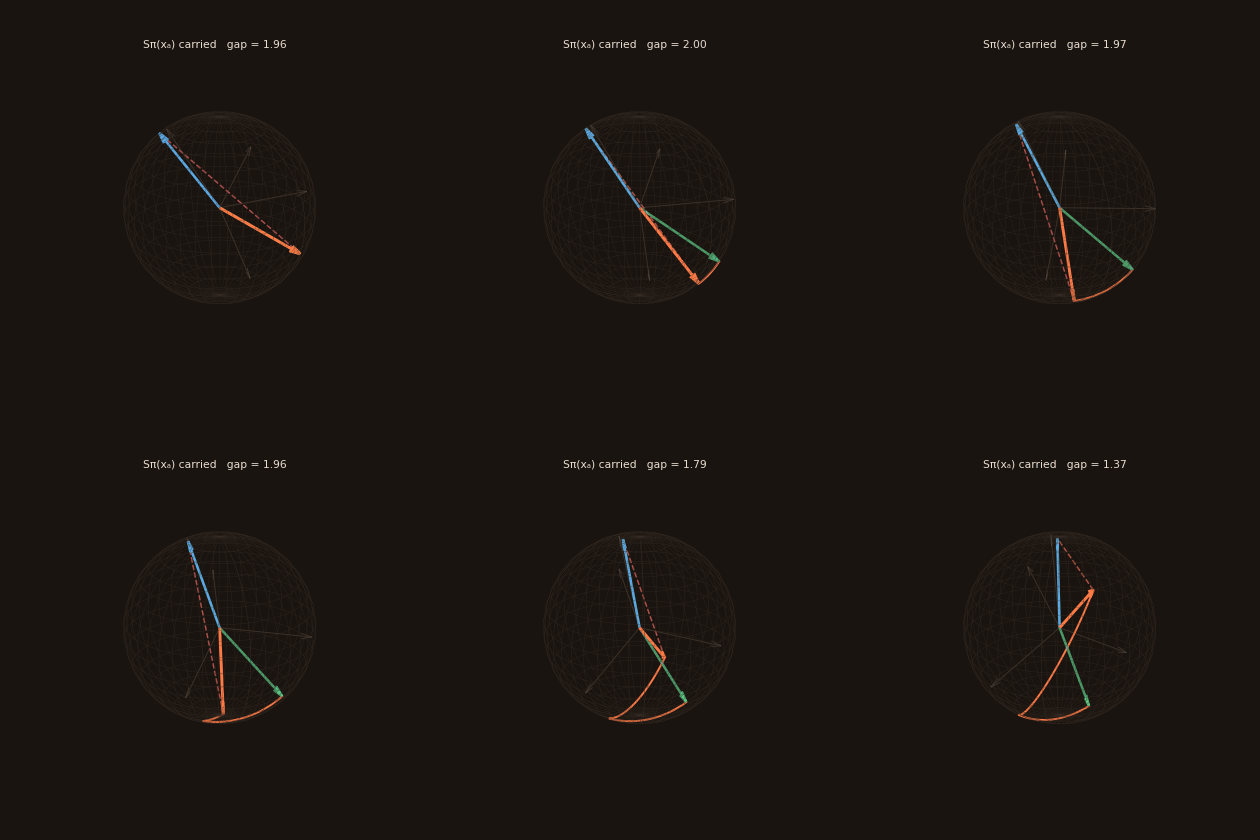
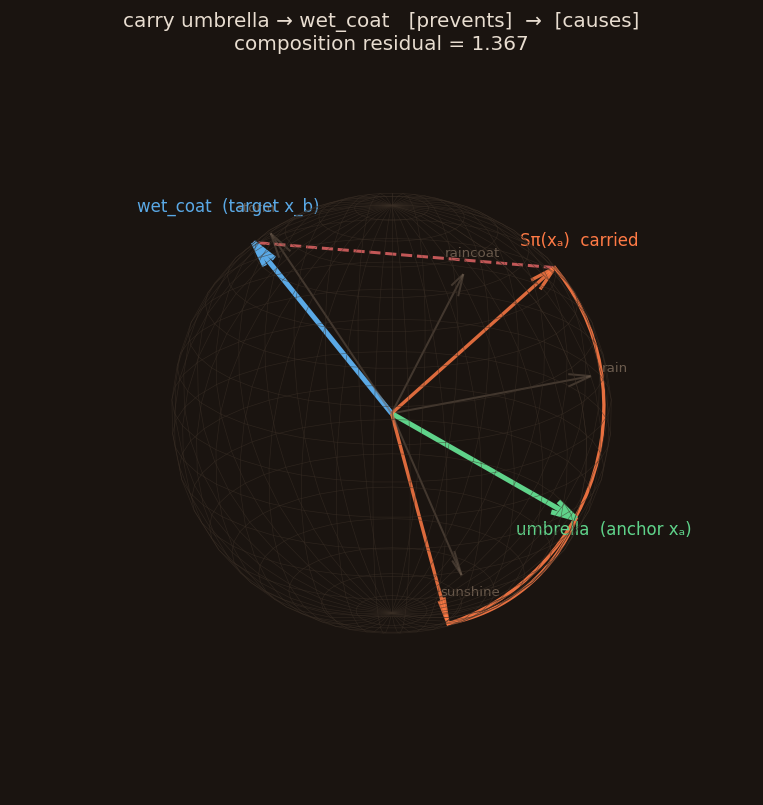
Honest note: the restriction maps are currently random placeholders, so residuals are large by design (the trace above lands far from the target). The explorer is built to make that visible — when learned maps arrive, you'll see meaning start to compose.
The server also exposes the database over HTTP for non-Python clients:
curl -X POST http://127.0.0.1:8000/api/query \
  -H "Content-Type: application/json" \
  -d '{"query": "what prevents rain?", "mode": "reasoning"}'
How it works
Each piece of knowledge is a Knowledge Object K = (V, E, 𝒯, 𝒮):
| Component | What it is | Status |
|---|---|---|
| V | Optional embedding vector (legacy compatibility) | stable |
| E | Typed, directed, weighted edges (causes, prevents, is_a, …) |
stable — the proven core |
| 𝒯 | Topological signature from persistent homology | experimental |
| 𝒮 | Sheaf section — how meaning transforms across a relation | experimental |
Retrieval runs a multi-stage pipeline (paper Algorithm 1):
- Deterministic lookup — exact typed-edge match (precision 1.0 for single-hop).
- Geodesic BFS — type-filtered, weighted shortest-path traversal for multi-hop.
- Topological re-ranking — by similarity of persistent-homology signatures (optional).
- Sheaf composition — by how consistently meaning composes along each path (optional).
The composite distance:
d(Kₐ, Kᵦ) = α · geodesic(a,b) + β · (1 − TVS(𝒯ₐ, 𝒯ᵦ)) + γ · ‖sheaf_residual‖
Every layer is ablatable via mode=:
db.query(anchor="a", target="b", mode="graph")     # traversal only (baseline)
db.query(anchor="a", target="b", mode="topo")      # + topology
db.query(anchor="a", target="b", mode="sheaf")     # + sheaf
db.query(anchor="a", target="b", mode="reasoning") # full pipeline
Durable storage and topological indexing
The engine depends only on a small StorageBackend contract, so the store is
swappable. Three backends ship with behavioural parity (a shared test battery
runs against them): the default in-memory NetworkX store, a crash-safe durable
store (pure Python), and a durable embedded Kùzu property-graph store.
db = cookix.connect("graph.kuzu", backend="kuzu")        # embedded property graph
db = cookix.connect("data/mydb", backend="durable")      # WAL + atomic snapshots
Durability you can rely on. The durable backend gives a production database
the guarantees a volatile store cannot:
- Write-ahead log — every mutation is
fsync'd to an append-only log before it is acknowledged, and the log is torn-write tolerant (a half-written tail from a crash is detected by a per-record CRC and dropped on replay, recovering to the last fully-durable record). - Atomic snapshots — folding the WAL into a snapshot is a temp-file +
os.replace, so a crash mid-snapshot can never corrupt the previous good one. - Atomic transactions —
with db.transaction(): …is an all-or-nothing write batch committed with a singlefsync; an error in the block rolls back and writes nothing. - Thread-safe — a re-entrant lock serialises writers (single-writer, multi-reader); concurrent writes cannot interleave into a corrupt graph or log.
- Backup / restore — point-in-time snapshot to a file and rebuild from it.
These are covered by a crash-recovery, atomic-rollback, concurrency-stress and backup/restore test battery.
For shape-based retrieval at scale, TopoIndex provides approximate
nearest-neighbour search over persistence signatures via cosine LSH — sublinear
TVS lookup, deterministic, with an exact fallback and a built-in recall measure.
Running the server in production
The embedded library is the trusted interface; the HTTP server (cookix serve)
adds opt-in operational controls for networked deployment (all off by default
so the demo just works). See SECURITY.md for the full threat model.
cookix serve --api-key "$KEY" --rate-limit 600   # auth + 600 req/min/client
# or via env: COOKIX_API_KEY, COOKIX_RATE_LIMIT_RPM, COOKIX_MAX_K,
#             COOKIX_MAX_HOPS, COOKIX_MAX_BODY_BYTES, COOKIX_READ_ONLY
- Auth + roles — API keys (
Authorization: Bearer/X-API-Key), constant-time compared, each mapped to a role:read<write<admin. Reads needread, inserts needwrite(403on insufficient role). SetCOOKIX_API_KEYS="k1:read,k2:write". - Secure by default —
serverefuses to bind a non-loopback interface without auth (override with--insecure/COOKIX_ALLOW_INSECURE=1). - Rate limiting — per-client fixed window →
429withRetry-After. - Resource limits —
k/max_hopsclamped, request body capped (413). - Read-only mode — reject mutations (
403) to serve a frozen database. - Observability —
/healthz,/readyz, Prometheus/metrics, JSON access logs.
A hardened, non-root Dockerfile (with a /healthz HEALTHCHECK)
ships in the repo: docker build -t cookix . && docker run -p 8000:8000 cookix.
Talk to a running server from another process with the dependency-free typed client over the stable wire API (see API_STABILITY.md):
from cookix import CookixClient

db = CookixClient("http://localhost:8000", api_key="…")
db.insert({"_id": "umbrella", "content": "umbrella", "edges": [("prevents", "rain")]})
for r in db.query("what prevents rain?"):
    print(r["explain"])
What 1.0 is — and is not
CookiX 1.0 is a production-ready single-node topological-relational
database. Calling it 1.0 is a scoped, honest claim — here is exactly what that
does and does not mean.
What 1.0 delivers (validated and tested — 120 tests):
- ✅ A relational engine that beats strong baselines on real data. On 2WikiMultiHopQA, typed multi-hop traversal reaches hits@10 0.58 vs Okapi BM25's 0.39 (+50% relative) under oracle entity-linking — measured on data CookiX did not design. See Benchmarks.
- ✅ Durability. A crash-safe backend: write-ahead log, atomic snapshots, atomic transactions, thread-safe concurrency, backup/restore — proven by a crash-recovery and concurrency-stress battery.
- ✅ Deployability & security. API-key auth, rate limiting, resource limits, read-only mode, metrics + health probes, a documented threat model, a hardened Dockerfile.
- ✅ Predictable performance. Query latency stays ~2 ms from 1k→50k objects (settle-once Dijkstra; pure Python, single node).
- ✅ Stable distribution. Versioned Python + wire + on-disk APIs, a typed
client, and a wheel that builds, passes
twine check, and installs cleanly.
What 1.0 deliberately does not claim (no overselling):
- 🚫 Not distributed. 1.0 is single-node — no clustering, sharding, or replication. That is post-1.0.
- 🧪 The topological (𝒯) and sheaf (𝒮) layers are still open research bets.
They remain optional and ablatable; we have not shown they improve
retrieval, and 1.0 does not depend on them. The sheaf maps are learnable
(
cookix.sheaf.set_learned_maps, ~50–60% held-out residual drop), but that is a property of the maps, not a proven retrieval win. - ⏳ The Rust hot-path core is post-1.0. It is a performance optimization, not a correctness or safety requirement; the pure-Python engine is fast enough for 1.0's single-node target. (No Rust toolchain was available to build it here.)
- ⏳ End-to-end open-domain QA is extraction-limited. The engine result above
is under oracle entity-linking; free-text triple extraction (
cookix eval --extraction) is the measured bottleneck and the honest frontier.
If the exotic layers don't earn their keep in honest ablations, we'll say so. That's the point.
Benchmarks
CookiX ships a deterministic, reproducible evaluation suite. One seed fixes the corpus, the baselines, and every reported number:
cookix eval                       # Markdown table (defaults: seed=0, 40 worlds, k=5)
cookix eval --worlds 80 --json    # machine-readable
The corpus is a steelman, not a strawman: every entity's text describes the entity itself (never its relations), and entities in a world share a topical adjective — so a content/vector retriever genuinely retrieves the right neighbourhood. The relational answer lives only in the typed edges, so recovering it requires traversal, not proximity. All retrievers see the same natural-language query and are scored identically.
Baselines: a random no-skill floor, and lexical-tfidf — TF-IDF cosine
over content, standing in for the vector-similarity family (a dense embedder
plugs into the same interface and behaves the same way with respect to
relations: it retrieves by topical proximity, not traversal).
seed=0, 40 worlds (240 documents, 160 queries spanning single-hop forward,
single-hop inverse, multi-hop, and contradiction), k=5:
| retriever | hits@1 | hits@5 | precision@5 | recall@5 | mrr | path_acc |
|---|---|---|---|---|---|---|
| random | 0.006 | 0.019 | 0.004 | 0.019 | 0.010 | 0.000 |
| lexical-tfidf | 0.250 | 0.750 | 0.150 | 0.750 | 0.375 | 0.000 |
| cookix-graph | 1.000 | 1.000 | 0.200 | 1.000 | 1.000 | 1.000 |
| cookix-topo | 1.000 | 1.000 | 0.200 | 1.000 | 1.000 | 1.000 |
| cookix-sheaf | 1.000 | 1.000 | 0.200 | 1.000 | 1.000 | 1.000 |
| cookix-reasoning | 1.000 | 1.000 | 0.200 | 1.000 | 1.000 | 1.000 |
Reading the numbers honestly:
- The lexical baseline is real, not a punching bag. It reaches
recall@5 = 0.75because the shared adjective lets it pull the correct world's neighbourhood. But itshits@1is only0.25— it cannot pick the relationally-correct entity out of that neighbourhood, and itspath_accis 0 because content similarity structurally cannot produce a reasoning path. - CookiX recovers the exact relational target and the gold path on this corpus, which is what the typed-graph core is built to do.
topo/sheaf/reasoningmatchgraphhere — on a corpus this clean the graph core already saturates, so the exotic layers have no headroom to demonstrate. Their value has to be shown on harder, noisier data; that's exactly why they remain ablatable. We are not claiming 𝒯/𝒮 help yet.
External validation: 2WikiMultiHopQA
The synthetic numbers prove the claim on a corpus CookiX designed. The harder
question — does it hold on data CookiX didn't design? — is now answered on
2WikiMultiHopQA, a standard multi-hop QA benchmark. It is uniquely suited
because each example ships gold (subject, relation, object) evidence
triples, which lets us measure the relational engine in isolation from the
known extraction bottleneck.
cookix eval --dataset 2wiki --path dev.json --k 10 # full reproducible run
We build one global knowledge graph from every example's gold triples (so
traversal faces real distractor edges from thousands of other questions), then
compare typed multi-hop traversal against Okapi BM25 — the standard strong
lexical passage retriever — over the same paragraphs. Both are scored on whether
the gold answer entity lands in the top-k. Measured on the first 2,000
dev examples (1,802 evaluable; k=10):
| retriever | hits@10 | MRR | path_match |
|---|---|---|---|
| BM25 (strong lexical) | 0.386 | 0.239 | n/a |
| cookix-graph | 0.580 | 0.282 | 0.579 |
| cookix-reasoning | 0.580 | 0.283 | 0.579 |
- +50% relative hits@10 over BM25 on real multi-hop questions: typed traversal reaches answers that are not lexically adjacent to the question, which is exactly where passage retrieval breaks down.
path_match = 0.58— CookiX recovers the gold relation chain on most answered questions. BM25 scoresn/ahere by construction: it returns passages, not reasoning paths.reasoningtiesgraphon answer recall (the re-ranking layers reorder candidates but don't change which answers are reachable) — reported honestly, not hidden.
Honest scope, stated plainly: the table above is the oracle entity-linking setting standard in KG-QA — CookiX is given the question's head entity as anchor, so it measures the reasoning engine (the paper's Algorithm 1).
Dropping the oracle — the honest open-domain result. What happens when a
real (imperfect) entity linker must pick the anchor? cookix eval --dataset 2wiki --no-oracle uses a lexical BM25 linker; on the same 2,000 examples:
| setting | CookiX hits@10 | MRR | path_match |
|---|---|---|---|
| oracle anchor | 0.580 | 0.282 | 0.579 |
| linked anchor (non-oracle) | 0.340 | 0.168 | 0.331 |
| BM25 (no linking needed) | 0.386 | 0.239 | n/a |
The lexical linker recovers the gold head entity only 50.1% of the time, and
CookiX's advantage evaporates — at hits@10 0.340 it now trails BM25's 0.386,
because half the time it starts traversing from the wrong anchor. The lesson,
stated without spin: the relational engine is strong when linked correctly, but
end-to-end open-domain accuracy is gated by entity linking (and, for free text,
extraction). Closing that — a better/LLM linker and extractor — is the live
frontier (Phase 18), not a solved claim. CookiX still returns a
reasoning path (path_match 0.33) where BM25 returns none.
Extraction quality is the multi-hop ceiling
The retrieval numbers above assume the graph is already correct. In practice the
graph is built by an extractor, and extraction error is the true ceiling on
multi-hop reasoning: if each edge is recovered with probability p, an h-hop
answer is correct with probability about pʰ — error compounds with depth. We
measure p directly against a hand-annotated gold corpus:
cookix eval --extraction           # deterministic rule-based study (offline)
cookix eval --extraction --llm     # also score the LLM extractor (needs an API key)
Rule-based extractor on 16 gold-annotated sentences (18 gold triples):
| extractor | precision | recall | f1 | relation_acc | gold | pred | exact |
|---|---|---|---|---|---|---|---|
| rule-based | 0.615 | 0.444 | 0.516 | 1.000 | 18 | 13 | 8 |
The decomposition is the interesting part: relation typing is perfectly reliable
(relation_acc = 1.0 — whenever the extractor spans the right entities it labels the
relation correctly), but free-text coverage is the bottleneck (recall = 0.44).
The misses are exactly the realistic cases: out-of-vocabulary synonyms ("leads to",
"ward off"), two-relation sentences (a keyword splitter emits only the first), and
preposition boundaries. Projecting that per-edge recall through the compounding model:
| extractor | 1-hop | 2-hop | 3-hop | 4-hop |
|---|---|---|---|---|
| rule-based | 0.444 | 0.198 | 0.088 | 0.039 |
A 4-hop chain survives only ~4% of the time. That is why extraction is a
first-class, swappable component and why the LLMExtractor exists — and it sets up
Phase 2's open question: how much of that ceiling does an LLM extractor actually buy
back? (The LLM run needs an API key, so it is kept out of the deterministic suite.)
Learned sheaf restriction maps
The sheaf layer scores a chain by its composition residual
||S_π(x_a) − x_b||: low residual = a coherent reasoning path. The maps F_r shipped
by default are random orthogonal placeholders, so that residual is uninformative. CookiX
can now learn them — the closed-form orthogonal Procrustes map per relation that best
transports source stalks onto targets, with inverses tied to transposes:
cookix eval --sheaf # residual ablation: placeholder vs learned
On approximately sheaf-consistent synthetic data (per-component noise 0.1, dim=16),
evaluated on held-out edges and 2-hop paths:
| maps | 1-hop residual | 2-hop residual |
|---|---|---|
| placeholder (random) | 1.399 | 1.416 |
| learned (Procrustes) | 0.534 | 0.731 |
| residual drop | 62% | 48% |
The placeholder sits at ~√2 ≈ 1.41 — the expected distance between two unrelated unit vectors, i.e. no information. Learning the maps cuts residual by roughly half on data the maps never saw; the remaining residual tracks the injected noise floor, not memorisation.
Honest scope: this demonstrates that when relations act near-linearly on semantic frames, the maps are recoverable — the linear, closed-form rung of "learned sheaves". Whether real LLM-derived stalks satisfy that, and whether gradient-based neural sheaf diffusion (jointly learning stalks and maps) does better, remains the open question. The layer stays ablatable so the answer is measured, not assumed.
Query performance
Correctness is necessary but not sufficient — the engine also has to be fast enough to use. The same synthetic corpus doubles as a throughput benchmark:
cookix eval --perf # time the end-to-end query path per ablation mode
End-to-end (natural language in, ranked reasoning paths out) over 240 documents, 160 queries × 3 repeats, single-threaded pure Python:
| mode | median latency | p95 | throughput |
|---|---|---|---|
| graph-only | 0.06 ms | 0.13 ms | ~13,000 q/s |
| + topology | 0.06 ms | 0.16 ms | ~13,000 q/s |
| + sheaf | 0.07 ms | 0.36 ms | ~7,000 q/s |
| full (all layers) | 0.07 ms | 0.38 ms | ~6,500 q/s |
Numbers are from one machine and move with hardware and load; only the relative
cost of each layer is portable, and the workload is fixed by seed. The graph
baseline is sub-0.1 ms median; the sheaf term roughly halves throughput, which is
the price of composition re-ranking and is itself a measured trade-off rather than
an assumption. Ranking memoises per-query object lookups so adding layers does not
re-fetch the anchor for every candidate.
Ranking memoises per-query object lookups, and the geodesic search is a settle-once Dijkstra (a node is never re-expanded once its minimum-cost path is fixed) with early-exit when a specific target is requested.
Scaling
The micro-benchmark above is on 240 objects. How does it hold as the graph grows?
A structural stress workload — a random typed graph, out-degree 4, anchor-only
4-hop traversals — measured with cookix eval --scale:
| objects | ingest | peak mem | median query | p95 | throughput |
|---|---|---|---|---|---|
| 1,000 | 0.08 s | 3 MB | 1.5 ms | 2.8 ms | ~560 q/s |
| 10,000 | 0.9 s | 30 MB | 2.0 ms | 3.1 ms | ~460 q/s |
| 50,000 | 6.4 s | 155 MB | 2.2 ms | 6.1 ms | ~340 q/s |
The result that matters: query latency stays near-flat (~1.5→2.2 ms) across a 50× increase in graph size. Traversal cost is bounded by the local reachable frontier (degree × hops), not the total object count — which is the whole point of settle-once Dijkstra over a typed graph. Memory is ~3 KB/object and ingest is roughly linear.
Honest scope: this is single-threaded pure Python on one machine. The planned Rust/PyO3 hot-path core (Phase 15 of the roadmap) targets exactly this geodesic inner loop; it is not yet built (it needs a Rust toolchain), so the algorithmic win shipped here is the settle-once/early-exit Dijkstra, in Python.
Load & soak (HTTP server under concurrent clients)
cookix loadtest stands up the real HTTP server and drives it with many
concurrent clients over real sockets — measuring what a deployment feels, and,
over a long run, whether memory leaks. A representative short run (8 clients,
10k-object graph, single uvicorn process):
| metric | value |
|---|---|
| throughput | ~130 req/s (single process) |
| errors | 0 / 2,613 |
| latency | median 59 ms · p95 84 ms · p99 102 ms |
| memory | start 106 MB → peak 130 → end 123 (non-monotonic, no leak) |
The signals that matter: zero dropped requests under sustained concurrency,
a bounded tail (p99 ~100 ms), and no runaway memory. The ~130 req/s is the
honest ceiling of a single synchronous Python process with connection-per-
request clients — production throughput comes from running multiple workers
(uvicorn --workers N, process-level parallelism past the GIL) and is the subject
of Phase 14. A multi-hour soak (cookix loadtest --duration 7200)
is how the leak claim is ultimately earned.
Use cases
- RAG pipelines — relational retrieval with reasoning paths instead of opaque chunks
- Engineering knowledge — part compatibility, spec conflicts, standards conformance
- Medical ontologies — drug interactions, contraindication chains
- Legal reasoning — precedent chains, statute conflict detection
Roadmap
-
Phase 0 — Typed-graph core: Knowledge Objects, deterministic lookup, geodesic traversal, interpretable paths
-
Phase 0 — Optional topology + sheaf layers behind ablation switches
-
Phase 0 — HTTP server (
cookix serve) + browser reasoning-path explorer UI -
Phase 1 — Reproducible benchmark harness (
cookix eval): synthetic relational corpus, fair vector-family + no-skill baselines, all ablations, deterministic from one seed. Next: port to external multi-hop datasets. -
Phase 2 — Extraction-quality study (
cookix eval --extraction): gold-triple corpus, precision/recall/F1 + relation-typing accuracy, and the measured per-edgepʰmulti-hop ceiling. Next: quantify how much an LLM extractor buys back. -
Phase 3 — Learned sheaf restriction maps (
cookix eval --sheaf): orthogonal-Procrustes maps learned per relation, ~50–60% held-out residual drop vs the random placeholder. Next: neural sheaf diffusion (jointly learn stalks + maps). -
Phase 4 — Durable Kùzu backend hardened to in-memory parity (shared test battery: dangling-target and incoming-edge semantics) +
TopoIndex(cosine-LSH ANN over persistence signatures, with exact fallback + recall measure). -
Phase 5 — Reproducible performance benchmark (
cookix eval --perf): per-mode end-to-end latency/throughput on the synthetic corpus, plus per-query lookup memoisation in the ranking pass. Next: the Rust hot-path core targeting this inner loop. The road to a productionv1.0(full plan with exit gates in ROADMAP.md): -
Phase 6 — Credibility gate. External validation on 2WikiMultiHopQA (
cookix eval --dataset 2wiki): gold-triple knowledge graph vs Okapi BM25 over the same paragraphs. hits@10 0.58 vs 0.39 (+50% rel.) andpath_match0.58 on 2,000 dev examples, under oracle entity-linking. Next: HotpotQA/MuSiQue loaders + a dense-retriever baseline. -
[~] Phase 7 — Performance gate (partial). Scaling benchmark (
cookix eval --scale) + settle-once/early-exit Dijkstra: query latency near-flat ~2 ms from 1k→50k objects, ~3 KB/object. Rust/PyO3 hot-path core still deferred (needs a Rust toolchain not present in this environment). -
Phase 8 — Data-safety gate.
durablebackend: write-ahead log (fsync-on-commit, CRC torn-write tolerance), atomic snapshots, atomic-batch transactions, thread-safe single-writer locking, backup/restore — proven by a crash-recovery, rollback, concurrency-stress and round-trip test battery. -
Phase 9 — Deployability gate. API-key auth, per-client rate limiting,
k/max_hops/body-size limits, read-only mode, JSON access logs, Prometheus/metrics,/healthz+/readyz, a documented threat model (SECURITY.md), and a hardened non-rootDockerfile. (App hardening test-proven; the container image is provided but not build-validated in this environment.) -
Phase 10 — Distribution gate. Versioned wire API (
API_VERSION, exposed at/api/info) + SemVer/deprecation policy (API_STABILITY.md), a dependency-free typedCookixClient, a versioned on-disk format with a migration guard, and a wheel+sdist that build, passtwine check, and install+run in a clean venv. (Actual PyPI publish is the maintainer's step — it needs credentials and is intentionally not automated.) -
Phase 11 / v1.0 — Released. End-to-end production smoke test (durable backend + authed server + client + crash recovery), a perf-regression guardrail, full docs (SECURITY.md, API_STABILITY.md), and the honest 1.0 scope statement above. The Rust core (Phase 7) is reclassified as a post-1.0 performance optimization rather than a 1.0 blocker.
Explicitly out of scope for v1.0: distributed clustering/sharding, a hosted service, and any claim that the 𝒯/𝒮 layers help retrieval. Post-1.0: the Rust/PyO3 hot-path core, external HotpotQA/MuSiQue loaders + a dense-retriever baseline, and the actual PyPI publish.
Road to fully production-hardened (post-1.0). v1.0 is production-ready for a controlled single-node deployment; making it safe for public-internet / multi-tenant / high-scale use is a further eight phases (12–19), each with a hard exit gate — see ROADMAP.md:
- Phase 12 —
pip install cookixworks — live on PyPI (1.1.0), published via OIDC trusted publishing on thev1.1.0tag. TheDockerworkflow builds → runs → smoke-tests/healthz→ Trivy-scans (green); theReleaseworkflow builds + clean-venv-verifies the wheel + publishes. Gate met. - [~] Phase 13 — Load/soak harness shipped (
cookix loadtest): real server + concurrent clients, throughput/tail-latency/error-rate + memory sampling for leak detection. First run: 0 errors, p99 ~100 ms, no leak. Remaining: a multi-hour soak and a 1M-object run on real hardware. - [~] Phase 14 — WAL group-commit shipped (
group_commit=toggle, correctness-tested). Honest finding: only ~3% here — the single-writer lock + GIL, not fsync, is the write bottleneck; real write-scaling needs finer-grained locking + multi-process serving. (Read replicas moved to Phase 17.) - Phase 15 — Rust/PyO3 hot-path core. Genuinely blocked here: no Rust toolchain in this environment to compile or parity-test it, and I will not commit unbuildable code claiming to be a core. The settle-once/early-exit Dijkstra (Phase 7) is the interim pure-Python win; the CI cibuildwheel matrix (Phase 12) is ready to build the extension once written on a machine with
cargo. - [~] Phase 16 — API-key roles (read/write/admin) + secure-by-default binding (refuse public bind without auth) shipped and tested. Remaining: per-tenant data isolation, distributed rate limiting (Redis), OpenTelemetry tracing, TLS reference configs.
- [~] Phase 17 — Read-only follower replicas shipped (
backend="durable", read_only=True+refresh()): a replica loads snapshot + WAL tail, refuses writes, and refreshes to follow the primary — the read-scaling building block. Remaining: live WAL streaming, automatic failover, sharding. - [~] Phase 18 — Non-oracle entity linking shipped (
--no-oracle): with a lexical linker (50% link accuracy) CookiX drops to hits@10 0.34 (below BM25's 0.39) — an honest measurement that entity linking is the open-domain bottleneck. Remaining: a better/LLM linker, a dense-retriever baseline, HotpotQA + MuSiQue. - [~] Phase 19 — Codeable parts done: an on-call RUNBOOK.md, a Grafana dashboard (
ops/grafana-dashboard.json), and model-based fuzz tests (random op sequences + crash recovery checked against a reference model). The real gate — months of uptime through real incidents — is earned, not coded.
Contributing
CookiX is open source and welcomes contributors.
git clone https://github.com/CookiXDB/CookiX.git
cd cookix
pip install -e ".[dev,all]"
pytest
Areas we need help with: evaluation/benchmarking, topological data analysis, LLM relation extraction, storage performance, and docs.
Citation
@article{hafdi2026novectdb,
  title   = {NoVectDB: A Topological-Relational Paradigm for Post-Vector Data Management},
  author  = {Hafdi, Ahmed},
  year    = {2026},
  note    = {CookiX Project}
}
License
Built in Morocco 🇲🇦 — Built for the world 🌍
Knowledge has shape, direction, and composition. Our databases should too.
Project details
Verified details
These details have been verified by PyPIProject links
GitHub Statistics
Maintainers
Release history Release notifications | RSS feed


Download files
Download the file for your platform. If you're not sure which to choose, learn more about installing packages.
Source Distribution
Built Distribution
Filter files by name, interpreter, ABI, and platform.
If you're not sure about the file name format, learn more about wheel file names.
Copy a direct link to the current filters
File details
Details for the file cookix-1.1.6.tar.gz.
File metadata
- Download URL: cookix-1.1.6.tar.gz
- Upload date:
- Size: 2.5 MB
- Tags: Source
- Uploaded using Trusted Publishing? Yes
- Uploaded via: twine/6.1.0 CPython/3.13.12
File hashes
| Algorithm | Hash digest | |
|---|---|---|
| SHA256 |
60f7471c9038239b7bd5be80e8216589eeb41b5980fb0b4528782a3938dc170b
|
|
| MD5 |
d7b87114290cfe4a557781922bb488e4
|
|
| BLAKE2b-256 |
5e4da6712b0094a5a20bdd20d2fcd48fc80bbc207517f610493dcd18038f454c
|
Provenance
The following attestation bundles were made for cookix-1.1.6.tar.gz:
Publisher:
release.yml on CookiXDB/CookiX
-
Statement:
-
Statement type:
https://in-toto.io/Statement/v1 -
Predicate type:
https://docs.pypi.org/attestations/publish/v1 -
Subject name:
cookix-1.1.6.tar.gz -
Subject digest:
60f7471c9038239b7bd5be80e8216589eeb41b5980fb0b4528782a3938dc170b - Sigstore transparency entry: 1672324527
- Sigstore integration time:
-
Permalink:
CookiXDB/CookiX@96a2a8930d5b308a5e2b2bb0eb6b03f20fd2caec -
Branch / Tag:
refs/tags/v1.1.6 - Owner: https://github.com/CookiXDB
-
Access:
public
-
Token Issuer:
https://token.actions.githubusercontent.com -
Runner Environment:
github-hosted -
Publication workflow:
release.yml@96a2a8930d5b308a5e2b2bb0eb6b03f20fd2caec -
Trigger Event:
push
-
Statement type:
File details
Details for the file cookix-1.1.6-py3-none-any.whl.
File metadata
- Download URL: cookix-1.1.6-py3-none-any.whl
- Upload date:
- Size: 486.1 kB
- Tags: Python 3
- Uploaded using Trusted Publishing? Yes
- Uploaded via: twine/6.1.0 CPython/3.13.12
File hashes
| Algorithm | Hash digest | |
|---|---|---|
| SHA256 |
d4fe047a33d3c85b52d57d15b0c44d1301a93c461c7bc02221fdba6e6b64cd69
|
|
| MD5 |
2e70f74f86d1612eed9d2ad5f70974b7
|
|
| BLAKE2b-256 |
c3dc36d59b19ac39ba2db6e463500df7dbdcc6944597999c82046aa0239b7bdc
|
Provenance
The following attestation bundles were made for cookix-1.1.6-py3-none-any.whl:
Publisher:
release.yml on CookiXDB/CookiX
-
Statement:
-
Statement type:
https://in-toto.io/Statement/v1 -
Predicate type:
https://docs.pypi.org/attestations/publish/v1 -
Subject name:
cookix-1.1.6-py3-none-any.whl -
Subject digest:
d4fe047a33d3c85b52d57d15b0c44d1301a93c461c7bc02221fdba6e6b64cd69 - Sigstore transparency entry: 1672324559
- Sigstore integration time:
-
Permalink:
CookiXDB/CookiX@96a2a8930d5b308a5e2b2bb0eb6b03f20fd2caec -
Branch / Tag:
refs/tags/v1.1.6 - Owner: https://github.com/CookiXDB
-
Access:
public
-
Token Issuer:
https://token.actions.githubusercontent.com -
Runner Environment:
github-hosted -
Publication workflow:
release.yml@96a2a8930d5b308a5e2b2bb0eb6b03f20fd2caec -
Trigger Event:
push
-
Statement type:






