
CoordSystems
CoordSystems is a Python package to help working with different coordinate reference systems at the same time. The intention is to support annotated types for Cartesian, Polar and Spherical coordinates.
Installation
Just install it with pip:
pip install coordsystems
Usage
The Coordinate types carries out the conversion when needed. For example, when summing a Cartesian and a Spherical, the Spherical will be first converted to Cartesian, and then summed up.
from coordsystems import Cartesian, Spherical

c = Cartesian([1, 2, 3]) # x = 1, y = 2, z = 3
s = Spherical([1, 0, 0]) # r = 1, θ = 0, φ = 0
Cartesian(s) # Cartesian([0, 0, 1])
c + s # Cartesian([1, 2, 4])
c.x # 1
s.phi # 0
Cartesian system
In a Cartesian System (here assuming 3D), each coordinate is written as a multiple of a unit basis vector ($\vec i$, $\vec j$ and $\vec k$). Those unit vectors are in the direction usually known as $x$ (for $\vec i$), $y$ (for $\vec j$) and $z$ (for $\vec k$).
To mark a point as a Cartesian point, just use the Cartesian constructor, passing a list or numpy.ndarray with each coordinate, or another Coordinate object.
In a Cartesian system, the vector sum is just the element-wise sum. So $(1,2,3) + (1,0,0) = (2,2,3)$.
Spherical system
In a Spherical System (necessarily 3D), each point is described also by three coordinates (because they are the same $\mathbb{R}^3$ space), but now with $r$ (radius), $\theta$ (polar angle) and $\phi$ (azimuthal angle).
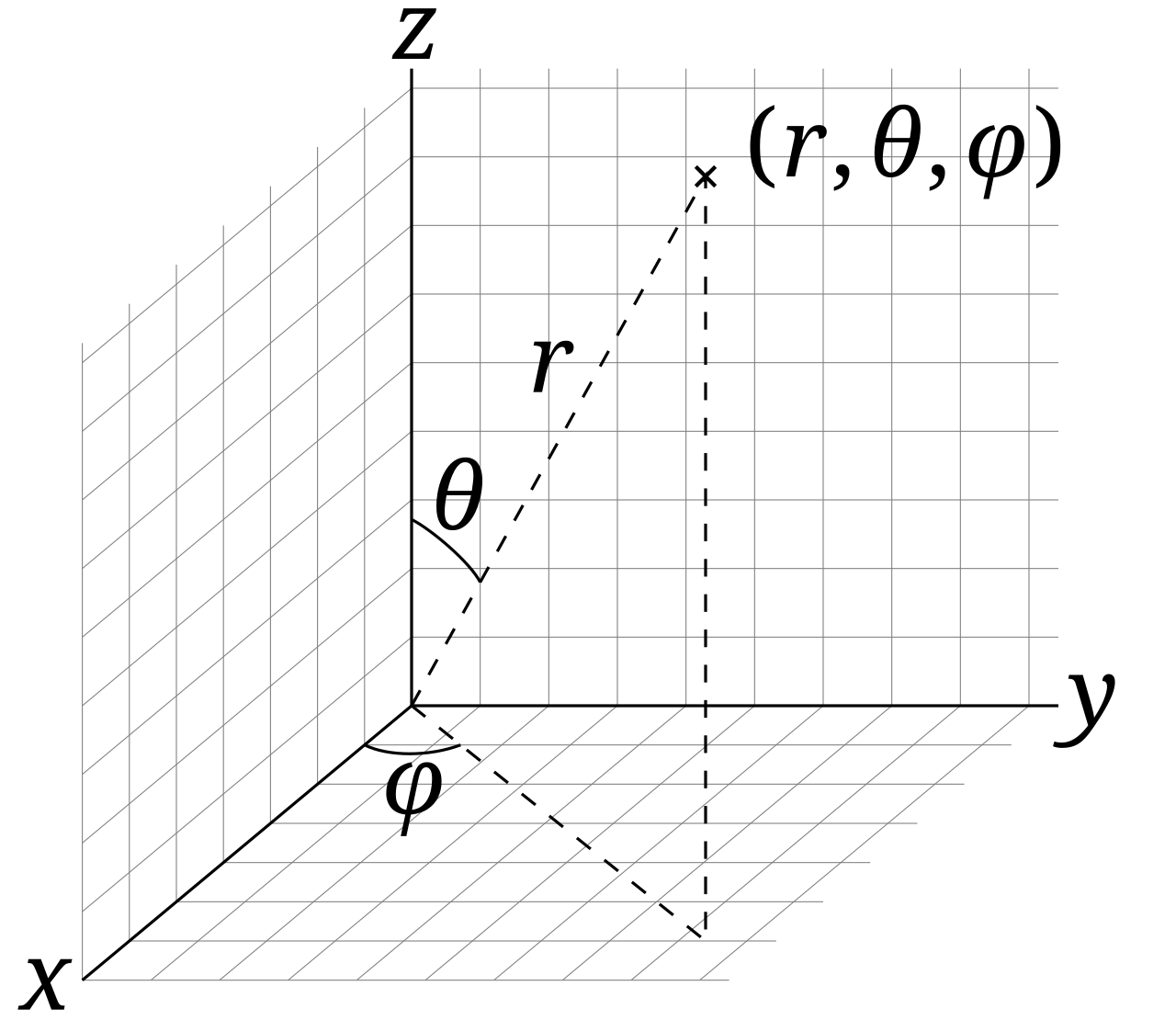
Different from Cartesian systems, here the vector sum isn't trivial. For example, $(2, \frac{\pi}{2}, \pi) + (\frac{1}{2}, \frac{\pi}{6}, 0) = (1.7321, \frac{\pi}{3}, \pi)$. Actually, it's easier to convert them to Cartesian, perform the sum, and convert it back again. Luckily, a Spherical object do it for you:
>>> import numpy as np
>>> from coordsystems import Spherical
>>> Spherical([2, np.pi/2, np.pi]) + Spherical([1, np.pi/6, 0])
Spherical([1.7320508075688772, 1.0471975511965976, 3.141592653589793])
Accessing coordinates
In a p = Cartesian(...), you can access directly each coordinate (p.x, p.y, p.z) or use indexing (p[0] == p['x'] == p.x).
In a q = Spherical(...), you can also access each coordinate independently (q.r, q.theta and q.phi). Indexing notation isn't implemented yet.
In any case, the implemented operations takes care of the system and try to do any operation in a Cartesian base, converting stuff when appropriate.
Development
To help in the development of this project, just clone the repository and install the uv tool as a global dependency (you don't need a global Python executable or a environment manager like conda or pipenv).
After cloning, you can run the GUI with:
$ uv run gui
It'll create an environment in .venv/, install dependencies and run the project inside the correct environment.
TODO
We still need to implement many things in this package before it gets ready for production.
-
Number * Coordinatemultiplication -
Sphericalindexing access - Option to choose the symbol for polar and azimuthal angles (if θ = polar and φ = azimuthal or the opposite).
- Cartesian custom basis (allow not only the canonical basis).
1 maintainer

Metadata
1 maintainer
Release files for coordsystems 0.0.3
For a detailed explanation of source distributions (sdists) and built distributions (wheels), please see the package formats documentation.
Source distribution (sdist)
| File | Size | Uploaded | |
|---|---|---|---|
| coordsystems-0.0.3.tar.gz | 18.2 kB | Details |
Built distribution (wheel)
| File | Interpreter | ABI | Platform | Reset |
|---|---|---|---|---|
| coordsystems-0.0.3-py3-none-any.whl | Python 3 | none | any | Details |
Total release size: 35.4 kB
Release files / coordsystems-0.0.3.tar.gz
| Download URL | coordsystems-0.0.3.tar.gz |
|---|---|
| Size | 18.2 kB |
| Tags | Source |
|
SHA-256 checksum How to use checksums |
feb7494da7ece53f7b060615d65920457688e5d4603154128f7d5a294b36ea70
|
|
BLAKE2b-256 checksum How to use checksums |
ff3d8e28d6145a9ce545b871de7ab97115d5028b162cd1c3e8bc97c0d7887735
|
| Upload date | |
|
Uploaded using Trusted Publishing? What is trusted publishing? |
No |
| Uploaded via |
uv/0.6.2
|
Release files / coordsystems-0.0.3-py3-none-any.whl
| Download URL | coordsystems-0.0.3-py3-none-any.whl |
|---|---|
| Size | 17.2 kB |
| Tags | Python 3 |
|
SHA-256 checksum How to use checksums |
79436cc977810d7d3465c6cd257a07fde195452627a3748e35cc0f9a7ec928f6
|
|
BLAKE2b-256 checksum How to use checksums |
25393580340797863ef468e1d774dad020c4e3516835c86634a3b32ff990a456
|
| Upload date | |
|
Uploaded using Trusted Publishing? What is trusted publishing? |
No |
| Uploaded via |
uv/0.6.2
|














